Imagine a painter obsessed with a mountain. For twenty-five years, Paul Cézanne tirelessly returns to the Mont Sainte-Victoire. More than eighty canvases, watercolors, drawings. But it's not a simple landscape artist's fascination. It’s a quest: to transform this rocky mass into pure geometric architecture.
The Geometricization of Mont Sainte-Victoire by Cézanne
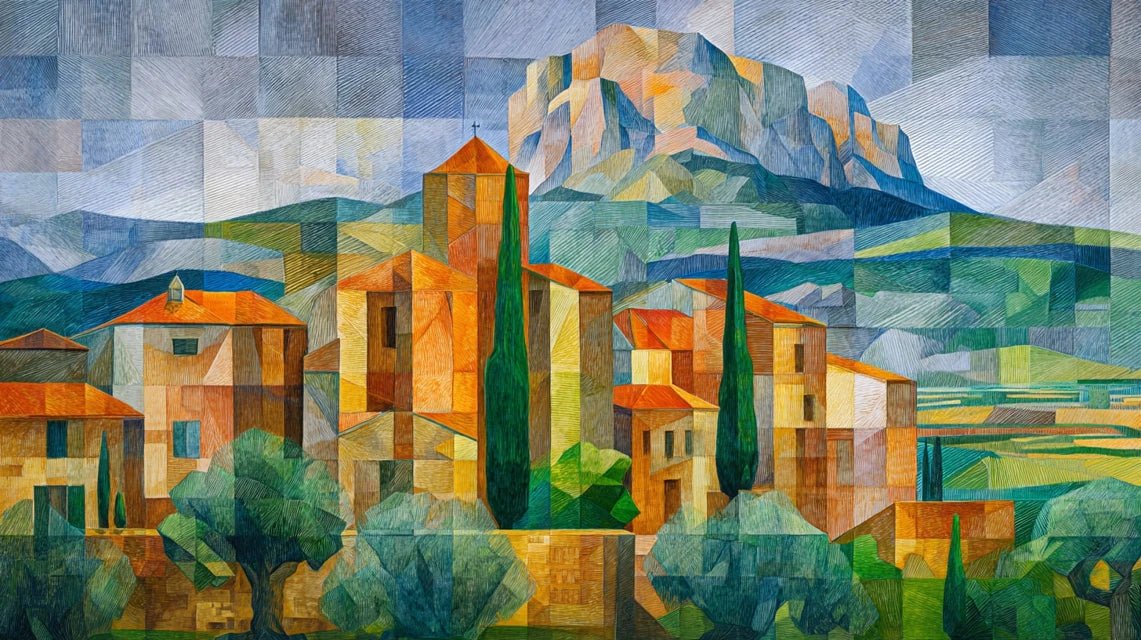
Cézanne didn't want to copy what he saw. He was searching for something deeper: the hidden structure of things. Facing his Provençal mountain, he simplifies, slightly twists perspectives, and reorganizes. The result? crystalline and balanced forms.
His method could be summed up in a famous sentence: “Treat nature with cylinders, spheres, and cones.” Specifically, it meant deconstructing the landscape into elementary volumes. The mountain becomes a massive cone, houses become perfect cubes, trees become cylinders. This formal reduction creates a disturbing effect: you recognize Mont Sainte-Victoire, but transformed into a kind of abstract cathedral.
The Technique of Colored Modulation on Mont Sainte-Victoire
How to construct these geometric forms without drawing outlines? Cézanne invented a revolutionary technique: colored modulation. Forget classic black shadows. Here, color alone sculpts the volume.
Observe his canvases: luminous areas range from orange to pink, then half-tones slide towards green and lilac, finally shadows are tinged with light blues. This succession of touches naturally creates depth. Each small spot of color is a plane in space.
A testimony by Émile Bernard sheds light on his method: “He would start with the shadows using a first touch. He would add a second, larger one, then a third. All these superimposed tones ended up modeling the object solely through their coloration.” (Source: Centre Pompidou)
For Cézanne, changing a color meant changing the form itself. In his late views of Mont Sainte-Victoire, the blues of the sky and the mountain sometimes blend together. This fusion creates a geometric pictorial space where everything becomes colored pictorial architecture.
The Geometric Forms of Mont Sainte-Victoire by Cézanne
Let's take one of his canvases. The mountain? A truncated cone with sharp edges. The railway viaduct in the valley? A series of impeccable rectangles evoking a Roman aqueduct. The houses? White cubes with triangular roofs. The parasol pines? Vertical cylinders crowned with green spheres.
What fascinates is the balance found. Cézanne never falls into total abstraction. You always identify the Provençal landscape, but stripped down to the essentials. This approach of geometric synthesis also creates a strange timelessness: it's impossible to guess the season, the hour, the weather. The painting exists outside of time.
In 1908, the critic Louis Vauxcelles discovered Georges Braque’s landscapes applying this method. His reaction? “It's made of little cubes!” (Source: Larousse Art). Cubism had just received its name.
The evolution of the geometrization of Mont Sainte-Victoire
Cézanne’s approach radicalized over time. In his early versions from the 1880s-1895, he used regular parallel strokes. The forms remained legible, the ochre and green colors clearly evoked Provence.
Everything changes after 1902. Cézanne had a studio built on the Lauves hill, with a direct view of the mountain. It is there that he painted his most daring versions in an affirmed post-impressionist approach. Fragmented planes multiply, contours burst. The touches become more free, creating multiple facets like a crystal.
In these late works, some areas remain deliberately unfinished. The white canvas appears between the touches of color. It's not laziness: it’s an aesthetic decision. For Cézanne, the painting was complete as soon as the structural balance worked.
From the geometrised Mont Sainte-Victoire to cubism
“Cézanne is the father of us all,” said Picasso. This sentence takes on its full meaning in front of views of Mont Sainte-Victoire. The 1907 retrospective has a bombshell effect on young Parisian artists.
Georges Braque immediately went to L'Estaque, a site painted by Cézanne. He brought back landscapes decomposed into faceted volumes, cubic houses stacked up. This is the birth of “Cézannian cubism” (Source: Centre Pompidou). This phase from 1907-1909 directly takes over the ochre-green colors and the master’s geometrization.
Picasso and Braque then go further with analytical cubism. They totally fragment objects, multiplying points of view until abstraction. But the founding principle remains that of Cézanne: no longer imitate nature, but build an autonomous structural painting.
Today, when we look at a Mondrian canvas or a Bauhaus building, we can see the legacy of Mont Sainte-Victoire. This Provençal mountain, geometrised by Cézanne for twenty-five years, has become the matrix of modern art.
FAQ: Understanding the geometrization of Mont Sainte-Victoire
Q: Why did Cézanne paint Mont Sainte-Victoire more than 80 times?
R: It wasn't a simple repetition. Each canvas was a new attempt to “realize” the deep structure of the mountain. Cézanne sought to reveal the hidden geometric architecture beneath natural appearances. By multiplying versions, he refined his method of decomposition into elementary forms and perfected his technique of colored modulation.
Q: What is colored modulation in Cézanne?
R: It’s a revolutionary technique where color alone creates volume, without resorting to traditional shadows. The touches gradually pass from one shade to another according to the order of the spectrum (orange → pink → green → lilac → blue), thus creating depth. Each touch of color functions as a geometric plane in pictorial space.
Q: How did Cézanne’s Mont Sainte-Victoire influence Cubism?
A: The geometric views of the mountain served as a direct model for the Cubists. Braque and Picasso applied the same decomposition into simple geometric shapes and the same multiplication of planes. “Cézannian Cubism” (1907-1909) explicitly borrows the master’s methods: simplified volumes, ochre-green palette, and construction by color rather than drawing.