Imagine a man standing on the heights of Hampstead, his paint box open on his knees, his gaze fixed on the sky. It is September 1821. John Constable is not daydreaming. He is observing, stopwatch in hand, notebook open. At his feet, a scribbled note: "Silver grey clouds, light southwest wind, rain this night." Constable does not just paint landscapes. He studies them as a scientist studies a specimen.
This unprecedented fusion between art and meteorology will revolutionize landscape painting.
Constable's Landscapes: A Naturalistic Revolution in British Art
John Constable grew up in the heart of the English countryside of Suffolk. Son of a miller, he spent his childhood observing clouds – not for their beauty, but out of necessity. Orienting the sails of a mill requires reading the wind before it arrives. This practical education shapes his gaze.
When he turns to painting, Constable rejects conventions. His contemporaries idealize nature, add romantic ruins, dramatize skies. Not him. He wants to capture what he sees exactly as he sees it. No frills, no exaggerated sentimentality.
The result? Canvases of a disturbing realism. In 1823, the critic Henry Fuseli uttered this famous sentence: Constable's landscapes "make me call for my coat and umbrella." You can almost feel the humidity, the fresh wind, the impending rain. It is no longer painting – it is a window open onto the world.
Meteorological Observations and Constable's Techniques: Science at the Service of Landscapes
1821 marks a turning point. Constable begins to document his observations as a meteorologist would. On the back of each study, he notes:
- The precise time of realization
- The direction of the wind
- The type of clouds (in scientific Latin)
- The forecast for the following hours
"Hampstead, September 11, 1821, 10am-11am. Sunny morning. Silver grey clouds. Ground humid and warm. Light southwest wind. Fine all day – but rain at night."
These annotations transform his canvases into pictorial weather reports. Constable no longer simply represents a moment – he contextualizes it scientifically.
He devours the meteorology books that are flourishing at the time. His copy of Thomas Forster's "Researches About Atmospheric Phaenomena" is covered in annotations. This scientific immersion directly nourishes his art. Discover how these influences materialize visually in our collection of wall landscapes.
His technique also evolves. He paints quickly, very quickly. Wet on wet, without letting the layers dry. Why? Because clouds don't wait for him. In ten minutes, a cumulus formation can change completely. Constable must be as fast as the weather.
Hampstead Cloud Studies: Laboratory of Meteorological Landscapes by Constable
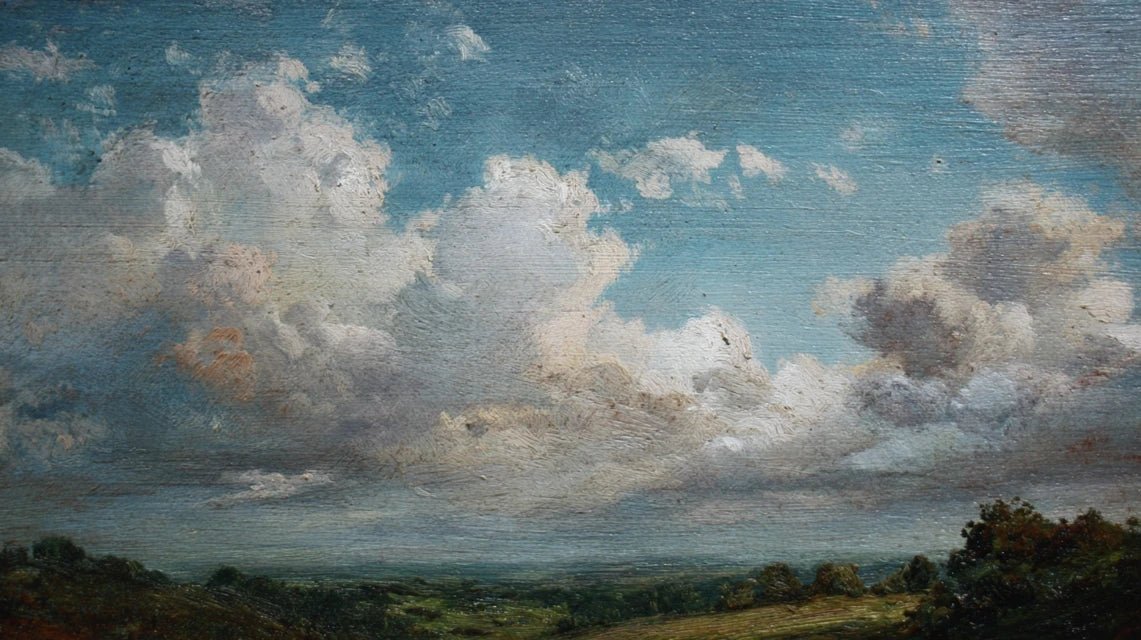
Hampstead becomes his laboratory. This promontory north of London offers a clear view of the immensity of the sky. Between 1821 and 1822, Constable produced around fifty studies there. Some show only clouds, others include the top of a tree to anchor the composition.
He calls these exercises "skying" – an untranslatable word that evokes the action of "doing the sky". Each canvas is a technical challenge: how to capture these shapes that dissolve before your eyes? How to render the density of a cumulus, the lightness of a cirrus?
In a letter to his friend John Fisher, Constable writes: "The sky is the central point, the measure of scale, the main organ of feeling." For him, neglecting the sky is missing the essential of a landscape. It is the sky that gives character to a scene – its luminosity, its mood, its truth.
The Hampstead studies reveal an astonishing mastery. Thin cirrus clouds announcing fine weather. Layered gray stratocumulus before rain. Stormy cumulus under a thunderstorm. Constable now knows the language of clouds.
Luke Howard's nomenclature: scientific foundation for Constable's naturalist landscapes
This understanding deepens when Constable discovers the work of Luke Howard. This London pharmacist accomplished something extraordinary in 1802: giving names to clouds.
Before Howard, no one knew how to talk about clouds. They would say "big white clouds" or "flat gray clouds". Howard proposes a scientific classification inspired by Linnaeus: cirrus (hair), cumulus (masses), stratus (layers). Simple, universal, revolutionary.
Constable discovers this nomenclature around 1821. The impact is immediate. Suddenly, he has a precise vocabulary for what he has always observed. Art historians note a qualitative change in his skies after this date. More consistency, more scientific accuracy, more conviction.
Howard does not just name; he explains that clouds obey natural laws. They are not random – they follow predictable patterns. For Constable who asserts that "painting should be practiced as an inquiry into the laws of nature", it is a powerful intellectual validation.
The application of meteorological observations in Constable's definitive landscapes
All this research irrigates his major works. Take "The Hay Wain" (1821). This famous painting shows a cart crossing a ford. But look at the sky: cumulus and stratocumulus coexist there in perfect meteorological coherence. The lighting of the scene comes directly from these clouds. No trickery, no artificial pictorial arrangements.
"Salisbury Cathedral from the Meadows" (1831) goes even further. A rainbow crosses the cathedral after the storm. Dark clouds disperse, letting light filter through. Everything responds to a rigorous atmospheric logic – yet the emotion is intense. Science and art merge completely.
In "Seascape Study with Rain Cloud" (circa 1824), Constable captures a maritime shower. Black, violent brushstrokes render the burst of a cumulus over the sea. You can almost feel the spray, the rising wind, the rain striking.
This approach crosses the Channel. In 1824, "The Hay Wain" is exhibited at the Paris Salon. Delacroix is overwhelmed. The Barbizon painters – Corot, Rousseau, Millet – discover that nature can be painted as it is, without idealization. This direct influence will lead to the Impressionists and their quest for fleeting light.
Constable has proven that scientific observation and artistic sensitivity do not oppose each other. They reinforce each other. His weather landscapes remain today among the most convincing ever painted.
FAQ: Constable's Weather Landscapes
Why did Constable annotate his sky studies?
Constable added precise meteorological annotations (date, time, wind, cloud type) to scientifically document atmospheric conditions. This methodical approach allowed him to understand the natural laws governing celestial phenomena and improve the scientific accuracy of his landscapes. These notes transformed his canvases into veritable pictorial weather reports.
What influence did Luke Howard have on Constable's landscapes?
Luke Howard, a London pharmacist, created in 1802 the first scientific classification of clouds (cirrus, cumulus, stratus). Constable discovered these works around 1821 and immediately adopted this nomenclature. The impact was major: his skies gained scientific consistency and naturalist conviction. Howard provided Constable with the technical vocabulary that was lacking in his empirical observation.
How did Constable's meteorological observations influence Impressionism?
Constable's landscapes, exhibited at the Paris Salon in 1824, revealed to French artists that nature could be painted without idealization. His rigor of observation and his ability to capture fleeting atmospheric phenomena directly inspired the Barbizon School (Corot, Rousseau), which in turn influenced the Impressionists. The lineage is direct: from Constable's meteorological naturalism to Monet's capture of fleeting light.