In a Tokyo gallery in 1970, a visitor stops before a simple steel plate placed on raw cotton. Nothing more. Yet, this gray and white installation captures the essence of emptiness and presence with a power that no academic painting had ever achieved. This was Mono-ha, the radical movement that would transform our perception of art and space.
Here's what Japanese Mono-ha brings to your understanding of black and white: a philosophy of non-intervention where color fades to reveal the truth of materials, an aesthetic of sobriety that amplifies the presence of each element, and an invitation to contemplate the space between things rather than the things themselves.
You may admire the simplicity of black and white in your interiors, but you feel something is missing: that depth, that almost spiritual presence possessed by certain artistic installations. How did these Japanese artists manage to create so much intensity with so little? The answer lies in their revolutionary approach to material and color.
Good news: understanding the use of black and white in Mono-ha doesn't require a degree in art history. This movement speaks directly to our senses, to our experience of space and silence. I will guide you through this fascinating exploration that will transform your view of minimalist art and its application in our living spaces.
The emergence of Mono-ha: when matter speaks louder than color
The Mono-ha movement was born in the late 1960s, in a Japan experiencing rapid economic growth. Its name literally means “school of things” – a designation that says it all about its philosophy. Artists like Lee Ufan, Nobuo Sekine and Kishio Suhara rejected traditional painting to present raw materials: stone, wood, steel, earth, glass.
What immediately strikes you about these Mono-ha installations is their reduced color palette. Artists favor natural tones: the gray of steel, the beige of cotton, the black of charcoal, the white of washi paper. This restriction is not an arbitrary aesthetic choice, but a profound philosophical decision.
By eliminating bright colors, Mono-ha refuses emotional manipulation. The artists want you to meet the material in its naked truth, without the seductive filter of polychromy. Black and white then becomes a way to reveal rather than represent.
The philosophy of Ma: the space between things
At the heart of Mono-ha lies the Japanese concept of Ma – interval, emptiness, space. In black and white installations, this space takes on an almost tangible dimension. Imagine a black steel plate placed on white sand: it is not the steel alone nor the sand alone that creates the work, but the tension between the two.
This approach profoundly influences the use of black and white. Rather than creating dramatic contrasts as in Western art, Mono-ha cultivates nuances: silvery grays, off-whites, deep but not absolute blacks. It is a chromatic range that breathes, which leaves room for visual silence.
Materials as carriers of light and shadow
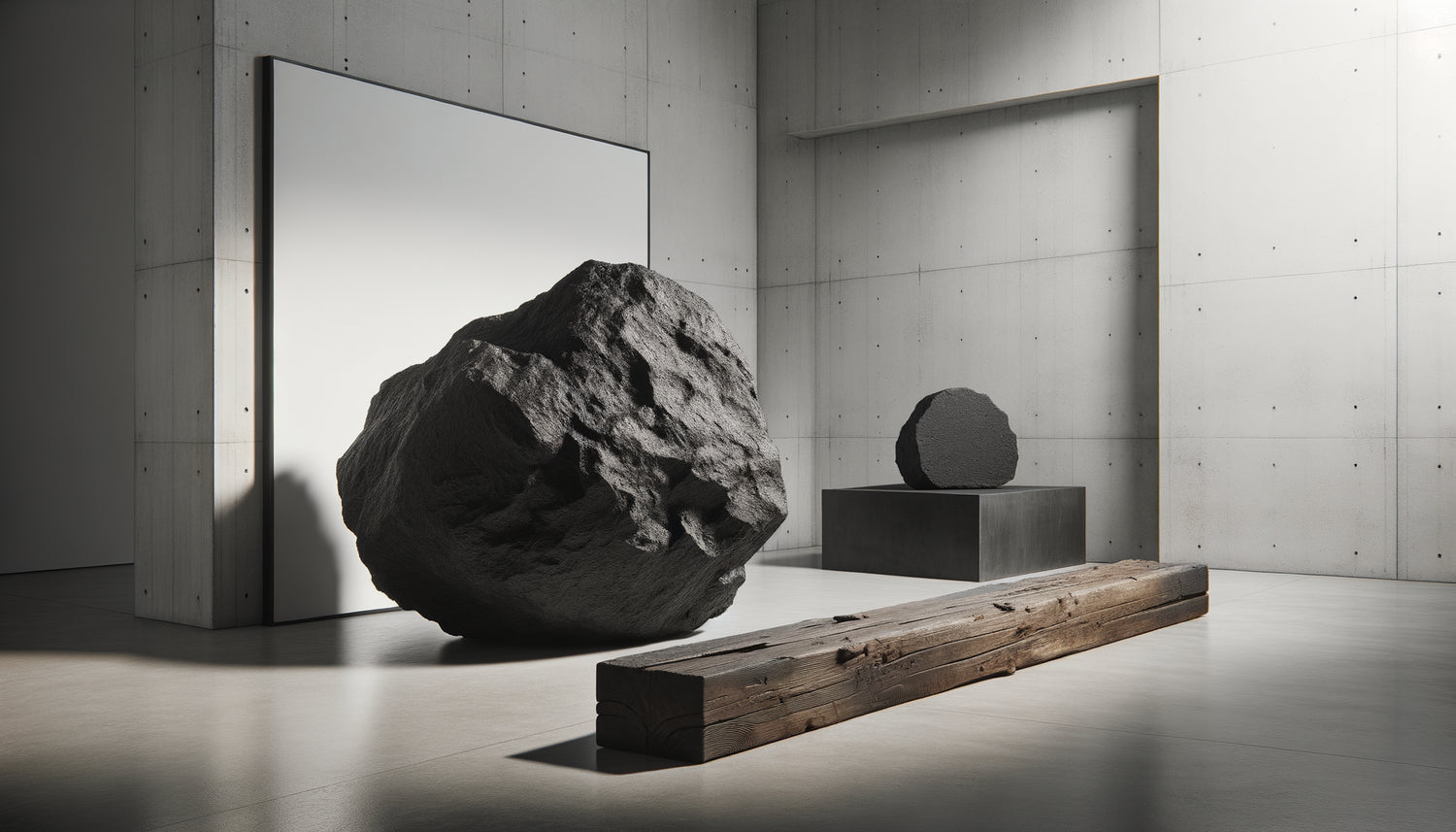
In an iconic installation by Lee Ufan, raw stones and steel plates converse in an immaculate white space. Here, black and white is not applied – it emanates naturally from the chosen materials. The stone brings its variations of gray, the steel reflects light creating games of shadows, the white floor amplifies each presence.
This method radically transforms our understanding of black and white. It is no longer a palette imposed by the artist, but an intrinsic quality that reveals the deep nature of things. Mono-ha teaches us that the black of a volcanic stone differs fundamentally from the black of fabric or ink.
The artists of the movement exploit these differences with remarkable sensitivity. They arrange materials to create visual conversations: the matte against the shiny, the porous against the smooth, the opaque against the translucent. Each texture captures and diffuses light differently, generating an infinite palette of grays.
Steel and paper: an iconic duo
Among all the material combinations of Mono-ha, that of steel and washi paper perfectly embodies the black and white aesthetics of the movement. Steel – cold, industrial, metallic gray – contrasts with the organic softness of traditional Japanese paper, a milky white.
In the installations of Katsuro Yoshida, these two materials meet without dominating each other. The paper is not simply a passive support: its fibrous texture, its translucency captures light in a way that dialogues with the metallic reflections of steel. The result? A space where black and white becomes a complete sensory experience.

Non-intervention: letting be rather than creating
A fundamental principle distinguishes Mono-ha from all previous artistic movements: non-intervention. Artists do not sculpt, paint, or radically transform materials. They arrange them, juxtapose them, present them.
This philosophy directly influences the black and white approach. Rather than applying black paint to a white support – a classic artistic intervention gesture – Mono-ha artists choose materials that are already black or white in their natural state. A dark stone remains a stone. White cotton remains cotton.
This approach may seem simple, even simplistic. In reality, it requires extraordinary sensitivity. Choosing which steel, which stone, which paper, and then deciding on their arrangement in space – this is the art of Mono-ha. It's a minimalism of means that generates a maximization of presence.
Time as an invisible collaborator
In Mono-ha installations, black and white evolves with time. Steel rusts, paper yellows slightly, stone patinates. This transformation is not a defect but an additional dimension of the work. The artists of the movement accept and even celebrate this impermanence.
Imagine an installation where charcoal rests on cotton. Over the days, particles of charcoal migrate imperceptibly, creating an intermediate zone of gray. Mono-ha teaches us that black and white is never static – it's a living dialogue between materials, light and duration.
The influence of Mono-ha on contemporary aesthetics
The legacy of Mono-ha extends far beyond art galleries. Its approach to black and white has profoundly influenced architecture, interior design, and even contemporary photography. This aesthetic of restraint, of unmanipulated material presence, resonates particularly in our era saturated with images and stimulation.
In our interiors, we find this Mono-ha spirit in the love of raw concrete, unpainted steel, untreated wood. This trend towards honest material – which shows its true color rather than an applied tint – descends directly from the philosophy of the Japanese movement.
Contemporary designers apply the lessons of Mono-ha: create intensity through sobriety, generate emotion through restraint, cultivate presence through emptiness. In a black and white composition inspired by the movement, each element breathes, every space counts, every texture dialogues.
Translating the Mono-ha spirit into your space
You don't need to transform your living room into a conceptual art gallery to integrate the wisdom of Mono-ha. It’s about adopting a philosophy of less: prioritize material quality over quantity of objects, let the space between elements breathe, accept natural textures rather than overly perfect finishes.
In an interior inspired by Mono-ha, a black and white artwork doesn't shout to attract attention. It simply exists, with presence and dignity. Black is not an aggressive black but a deep, almost contemplative one. White is not clinical but soft, welcoming the gaze without dazzling it.
Transform your space with the Mono-ha philosophy
Discover our exclusive collection of black and white artworks that embody this aesthetic of pure presence and contemplative space.

Towards a new relationship with black and white
The Mono-ha movement offers us much more than just an art history lesson. It proposes a silent revolution in our relationship to space, objects, colors – or rather their absence. By integrating black and white not as a decorative palette but as a material truth, these Japanese artists have opened the way to an aesthetic of authenticity.
Imagine your space transformed by this approach: less cluttered but more present, less colorful but more intense, less decorated but more lived-in. This is the promise of Mono-ha – a promise of visual silence that paradoxically speaks louder than a thousand screaming colors.
The next time you contemplate a black and white composition, think about Mono-ha. Ask yourself: is it an applied color or a revealed truth? Is it an artificial contrast or an authentic dialogue between materials? This simple question will transform your gaze and enrich your aesthetic experience.
Start small: choose a corner of your interior. Remove the excess, keep the essentials, let the space breathe. Observe how natural light creates its own variations of gray. It is there, in this visual silence, that the spirit of Mono-ha begins to live. And you will discover that black and white is not an absence of color, but the presence of everything that really matters.
Frequently asked questions about Mono-ha and black and white
Is Mono-ha solely a Japanese movement?
Although born in Japan, Mono-ha quickly attracted artists from various backgrounds, including the Korean Lee Ufan, one of its major figures. The movement is part of an international conversation with American minimalism and Italian Arte Povera, but it distinguishes itself through its grounding in Eastern philosophy of emptiness and non-intervention. Its approach to black and white reflects this cultural specificity: where Western art often uses black and white contrast dramatically, Mono-ha cultivates nuances and subtle transitions. You can therefore appreciate this movement without being an expert in Japanese culture – it speaks a universal language of matter and space that transcends borders.
Can we really draw inspiration from Mono-ha to decorate our interior?
Absolutely, and it's even one of the most natural applications of this aesthetic! Mono-ha is not just a contemporary art movement reserved for galleries – it’s a philosophy of space applicable to your daily life. To incorporate its spirit, prioritize authentic materials in their natural tones: raw concrete, untreated steel, naturally bleached wood, stone. The key is to create purified compositions where each element breathes, where black and white is not artificially applied but emanates from the materials themselves. Start by decluttering, eliminating purely decorative objects, and keeping only what has a strong material presence. You will discover that an interior inspired by Mono-ha is not cold but soothing, not empty but contemplative.
What is the difference between Mono-ha and Western minimalism?
This is an essential question to understand the uniqueness of Mono-ha. Western minimalism, embodied by artists such as Donald Judd or Dan Flavin, creates precise geometric forms, often manufactured industrially, with formal perfection. Mono-ha, on the other hand, favors raw, unprocessed materials in their natural irregularity. In their approach to black and white, this difference is striking: Western minimalism often paints surfaces in uniform matte black or white, creating perfect blocks of color. Mono-ha prefers naturally grayed stone, steel bearing traces of its manufacture, paper with variations in texture. It’s the difference between imposing a form and revealing a presence. Both approaches are valid, but Mono-ha offers a more organic, sensual relationship with matter – particularly suited to our living spaces.