I spent three months in a Zen temple in Kyoto, watching each morning an old master trace landscapes that seemed to emerge from nothingness. No precise outlines, no classic perspective – just a few brushstrokes loaded with ink that exploded onto the paper in a mysterious haze. The mist swallowed the mountains, trees floated in the void, and yet... everything was there. This ancestral technique is called haboku, literally "splattered ink," and it overturns everything we think we know about landscape art.
Here's what the haboku technique brings to your visual world: an aesthetic of suggestion rather than description, immediate emotional power, and a timeless modernity that transcends eras. These shattered landscapes, born in Zen monasteries in the 15th century, speak a universal language: that of the essential.
You may admire these Japanese works where everything seems dissolved in mist, where a few lines suffice to evoke an entire mountain. But how on earth do you achieve this particular effect? How do these Zen masters manage to create so much depth with so little material? Frustration often comes from the idea that it takes a lifetime of study to understand these codes.
Rest assured: the haboku technique is based on perfectly understandable philosophical and gestural principles. Behind the apparent spontaneity lies a millennial discipline, but also a creative freedom accessible to those who accept letting go. I take you into the intimacy of this fascinating practice, where ink becomes mist and emptiness creates fullness.
The Zen origin of haboku: when emptiness becomes landscape
Haboku is born in the heart of Japanese Zen Buddhism, during the Muromachi period (1336-1573). Monk painters like Sesshū Tōyō sought to capture not the appearance of the world, but its essence. For them, a splattered landscape was not a destruction of form, but its liberation.
Unlike more descriptive Chinese techniques from which it draws inspiration, haboku radicalizes the approach. Ink is literally "splattered" (haku means "to project" or "to splash"), projected and diluted to create hazy gray areas where forms barely emerge. Zen masters used this technique during their moments of deep meditation, when the brush became a simple extension of breath.
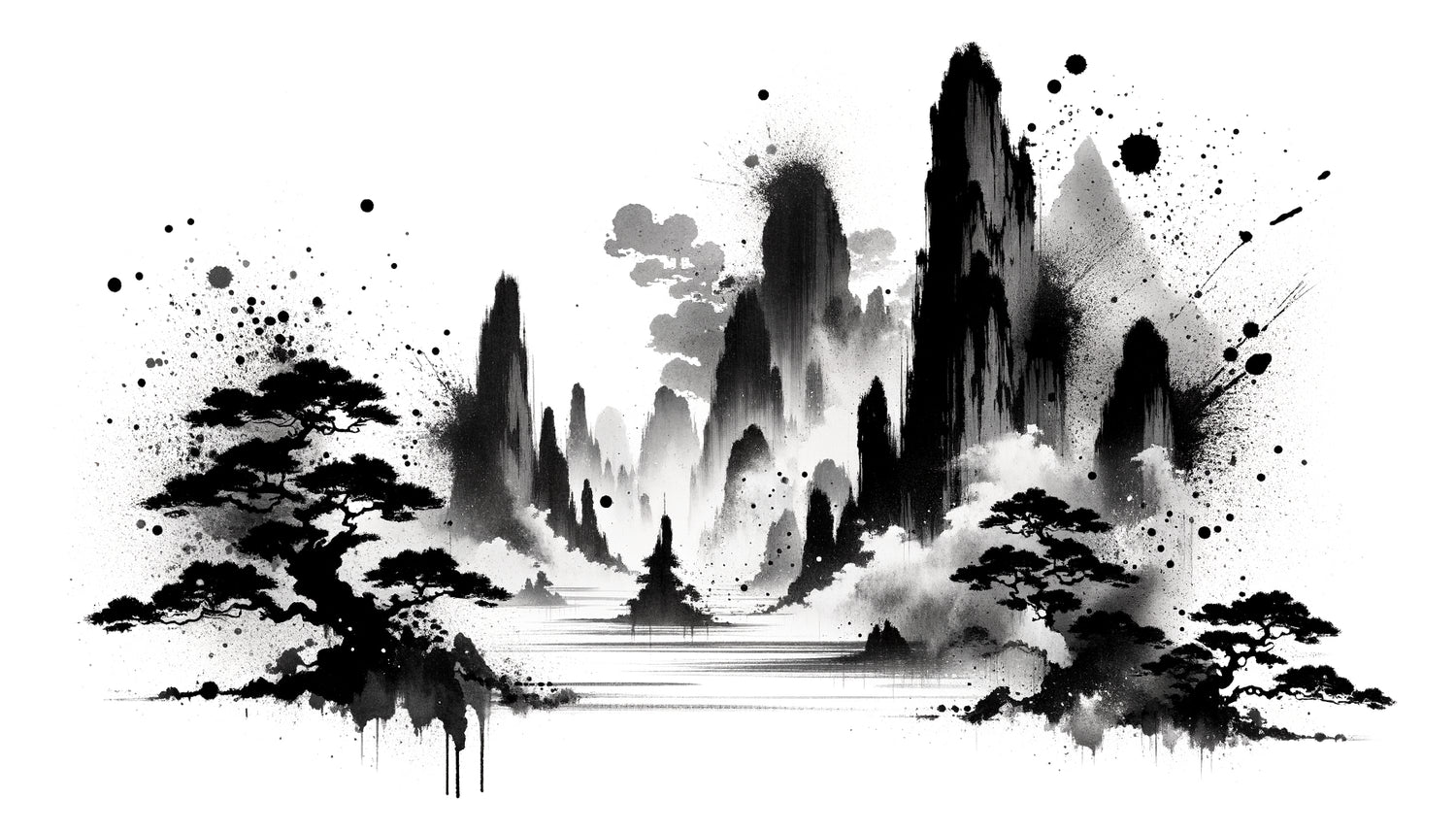
What strikes you about haboku landscapes is their ability to evoke the totality of a scene with three or four shades of gray. A mountain? A vigorous vertical line immersed in blurred washes. A tree? A few branches emerging from the mist like vegetable ghosts. The viewer mentally completes what the artist suggests – this is all the power of ma, that Japanese concept of emptiness signifying.
The three fundamental gestures of haboku
Splattered wash: creating the primordial mist
The foundation of the haboku technique begins with the tarashikomi – applying wet ink to wet paper. Zen masters would first moisten their support with a wide brush, creating controlled areas of humidity. Then, with a brush loaded with diluted ink, they would deposit touches that instantly spread, creating these famous splattered landscapes where the contours seem to explode.
Water plays here the role of conductor. Too dry, the surface rejects diffusion. Too wet, the ink becomes uncontrollable. Monks practiced for years to master this precise moment when the paper accepts transformation without suffering it.
The structure line : anchoring the essential
At the heart of the vaporous chaos of haboku, a few dry and decisive lines come to structure the composition. These lines, traced with concentrated ink with an almost dry brush (kasure), create anchor points: the crest of a mountain, the trunk of a pine tree, the edge of a rock.
Zen masters waited for the wet washes to be almost dry before adding these accents. The contrast between the blurred areas and these sharp lines creates a visual tension that gives all its drama to the splattered landscape. It's like a cry in silence, a certainty in doubt.
Controlled splatter : the desired accident
The signature technique of haboku: the broad and spontaneous gesture where ink is projected onto the paper. Not with violence, but with that controlled energy called ki in Japanese. The loaded brush strikes almost the support, leaving the ink to explode into unpredictable formations evoking rocks, clouds, or distant vegetation.
This apparent spontaneity actually hides an intimate knowledge of materials. Masters knew exactly what dilution, what angle of brush, what speed of gesture would produce one effect or another. The paradox of haboku: it takes years of discipline to achieve this freedom that seems so natural.

Why haboku fascinates contemporary aesthetics
You have surely come across these splattered landscapes in minimalist interiors, these black and white compositions where the mist seems to invade the space. Haboku is experiencing a spectacular revival in contemporary design, and for good reason: it perfectly meets our current desire for meaningful sobriety.
Unlike overloaded artworks, a haboku landscape breathes. It creates visual calm while maintaining strong aesthetic interest. Areas of emptiness are not "nothing" – they are considered space, offered contemplation. This is exactly what conscious decor enthusiasts seek: works that soothe without boring.
The monochrome aspect of haboku also makes it a valuable ally for chromatic harmony. These black ink artworks integrate into any colorful universe, creating visual pauses that structure the space. I have seen vibrant landscapes radically transform the atmosphere of overly cluttered living rooms, simply by introducing this zen breath.
How to recognize an authentic haboku
Not all Japanese washes are haboku. This specific technique has identifiable characteristics that zen masters have codified:
Dissolution of contours: forms are never completely outlined. They emerge and dissolve into the ink mist, creating this sensation of a fragmented landscape where the eye struggles to fix boundaries.
Hierarchy of values: from deep black to almost transparent grays, haboku plays on an extended tonal range. Masters prepared several ink dilutions before starting, knowing exactly what intensity they would use for each element.
Economy of means: a true haboku landscape never uses more gestures than necessary. Every stroke counts, every splash has a role. This radicality distinguishes haboku from other more descriptive ink painting styles.
The presence of emptiness: often, more than half the surface remains unpainted. This void is not a lack – it is an active presence that allows the composition to breathe and the mind of the viewer to travel.

Integrating the spirit of haboku into your daily life
You don't need to become a zen monk to benefit from the philosophy of haboku. This aesthetic approach can transform your relationship with decoration and visual environment.
Start by observing vibrant landscapes with a new eye. Look at how blurry areas and sharp accents dialogue, how emptiness creates rhythm. This education of the gaze naturally refines your decorative choices: you develop a sensitivity to the balance between presence and absence.
In your spaces, gradually introduce elements that embody the spirit of haboku: monochrome works where suggestion takes precedence over description, asymmetrical compositions that allow walls to breathe, objects whose beauty lies in their essential simplicity.
Zen masters taught that true mastery of haboku began when one stopped trying to control everything. Accepting the unexpected, welcoming happy accidents, letting the material express itself – these principles wonderfully apply to the art of living. An overly controlled interior becomes rigid; a space that accepts imperfection remains alive.
Let the poetry of emptiness transform your interior
Discover our exclusive collection of black and white artworks that capture the essence of broken landscapes and bring this zen breath to your walls.
The living heritage of haboku
The haboku technique is not a museum relic. Contemporary artists from around the world reinterpret these broken landscapes, proving that the visual language of Zen masters transcends cultural and temporal boundaries.
What makes haboku eternally modern is its rejection of exhaustiveness. In an age of information overload, these works that suggest without showing everything offer a saving counterpoint. They remind us that we can communicate deeply with economy of means.
By integrating a haboku landscape into your daily life – whether through a hanging artwork or simply by adopting its aesthetic principles – you invite a form of millennial wisdom. The one who knows that emptiness is not absence, that blur is not imprecision, and that suggestion sometimes hits truer than description.
Zen masters understood something essential: we do not see with our eyes, but with our minds. The broken landscapes of haboku do not show the world – they create a space where our imagination can finally unfold. Perhaps this is their most beautiful gift: to make us active in front of the work, co-creators of its meaning.
Close your eyes and imagine that morning in your living room, when the grazing light touches this haboku landscape hanging opposite the window. The grays come alive, the shapes float, and suddenly your ordinary space becomes a place of contemplation. No need for grand speeches or excessive decoration – just this silent presence that transforms the atmosphere. The haboku technique offers you this: the possibility of introducing poetic depth into your daily life, one stroke of ink at a time.
Start simply: observe the works that use this approach, educate your eye to the nuances of black and white, then let yourself be guided by your intuition. Zen masters would tell you that the journey counts more than the destination – and that every moment spent in the presence of these fragmented landscapes is already a form of meditation.