In the silent workshop of a Zen monastery from the 15th century, an artist monk observes the morning mist clinging to the mountains. Instead of dipping his brush in water like his contemporaries, Sesshu Toyo barely touches it, leaving the hairs almost dry. This seemingly contradictory gesture revolutionized Japanese landscape art and continues to inspire designers and creators around the world. Why did this undisputed master of ink painting choose this austere technique when tradition favored fluid and generous washes?
Here's what Sesshu Toyo’s dry brush technique reveals to us: an aesthetic of restraint that paradoxically creates more intensity, a mastery of emptiness that transforms absence into presence, and a Zen philosophy translated into minimalist pictorial gestures. This radical approach resonates today in our contemporary interiors, where simplicity and essentials reclaim their place against decorative abundance.
You may have already admired these black and white Japanese landscapes, these mountains that seem to emerge from nothingness, these trees sketched in a few furious strokes. You may have wondered how these minimalist works manage to create such emotional depth, why they breathe when they use so little material. This frustration with the invisible is precisely what Sesshu was seeking.
Rest assured: understanding this technique requires no specialized knowledge of Asian art history. It simply takes grasping the logic that unites technical gesture and philosophical vision, understanding how an almost empty brush can paradoxically say everything. By discovering the reasons behind this bold artistic choice, you will transform your view of minimalist art and enrich your sensitivity to purified spaces.
The paradox of the thirsty brush: when less becomes infinitely more
Sesshu Toyo developed his dry brush technique after an initiatory journey to China between 1467 and 1469. There, he studied the masters of the Ming dynasty, but it was by observing real landscapes that he forged his conviction: nature is not captured by accumulation, but by subtraction. The almost-dry brush becomes his tool of revelation, not description.
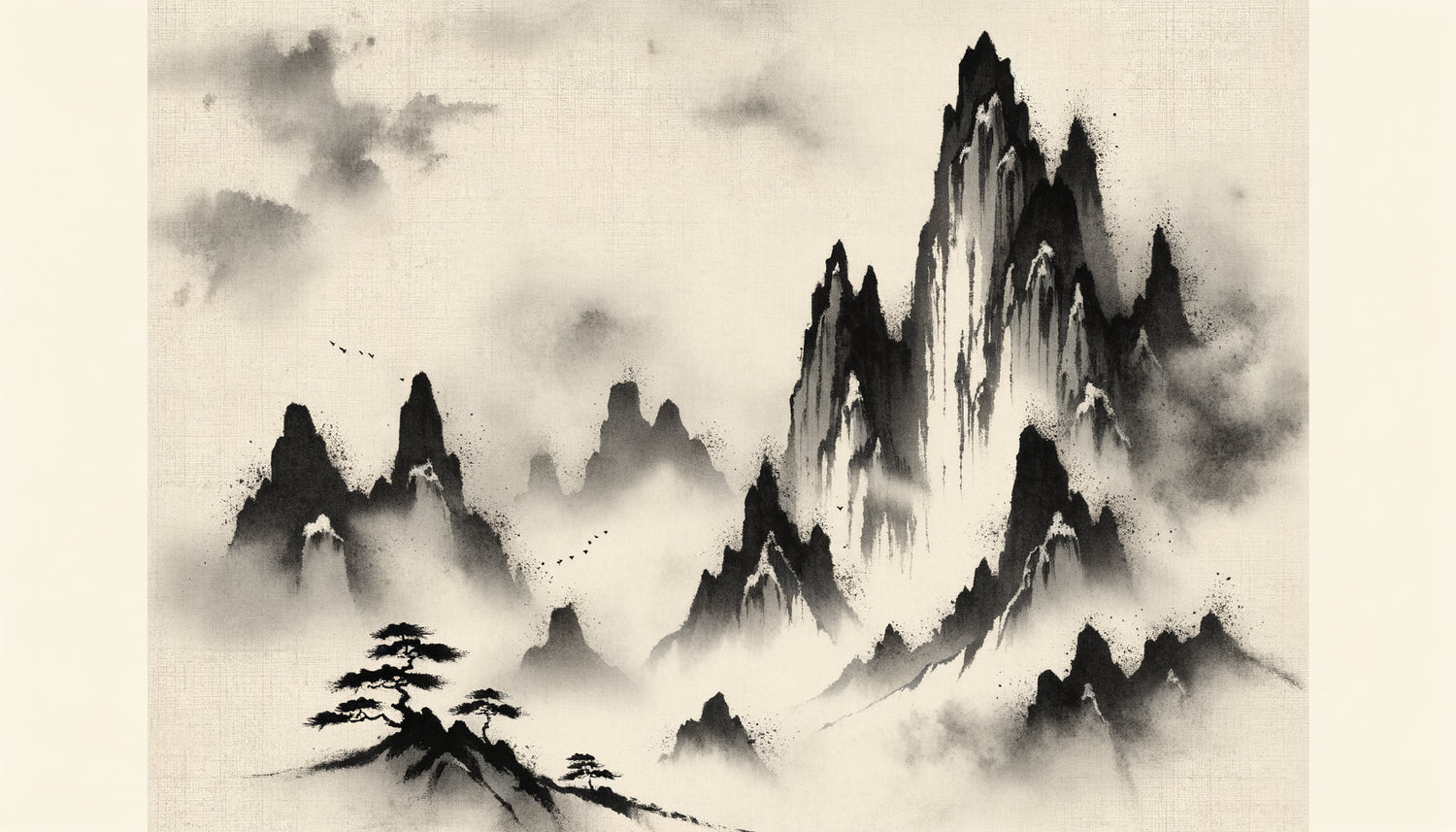
Technically, this approach is called haboku (splashed brush) or hatsuboku (projected brush). Sesshu loads his brush with ink, then wrings it out almost entirely before applying it to the paper. The result? Rough, fragmented strokes that catch on the texture of rice paper. The mountains are not painted; they are scratched into existence. The trees do not grow in the image; they are summoned by dry and rapid gestures.
This technique creates a unique, almost tactile texture. Unlike fluid washes that glide and blend, the dry brush leaves irregular traces, breathing whites, pulsating blacks. Each brushstroke retains its own identity while participating in the whole. It is exactly what interior architects are looking for today in raw materials: this authentic presence, this signature of the gesture.
The essence of Zen philosophy: painting the breath rather than the form
To understand why Sesshu painted with a quasi-dry brush, one must delve into the Zen thought that permeated every aspect of his monastic life. In Zen Buddhism, ultimate reality does not reside in material forms but in the primordial void from which they emerge. The dry brush does not describe the mountains: it reveals the energy that flows through them.
This approach is rooted in the concept of ma, this Japanese interval where the essential resides. Between two strokes of a dry brush, the white of the paper is not an emptiness to be filled but a space charged with potential. The unpainted areas become as important as those covered in ink. Sesshu did not paint landscapes; he orchestrated dialogues between presence and absence.
A brush loaded with water allows for smooth transitions, poetic blends. But it also erases the vitality of the gesture, softens the decisive moment when the brush meets the paper. The dry brush, on the other hand, captures raw spontaneity, the Zen moment when mind and hand become one. Each stroke becomes an irreversible event, a total commitment that tolerates neither regret nor hesitation.

Economy of means as supreme refinement
Sesshu Toyo had perfectly mastered the conventional techniques of ink painting before adopting the quasi-dry brush. His choice was therefore not a simplification but a conscious asceticism. In Japanese culture, supreme refinement lies in the ability to suggest rather than exhibit, to evoke rather than exhaustively describe.
With a loaded brush, one can multiply nuances, create subtle gradations, deploy an impressive technical virtuosity. But this abundance risks overwhelming the gaze, dispersing attention. The dry brush forces you to focus on the essentials: only the absolutely necessary strokes survive. Each mark must justify its existence. This discipline recalls the principle of wabi-sabi, that beauty found in imperfection and incompleteness.
Sesshu's landscapes do not show everything: they show just enough for the viewer's imagination to complete the work. A mountain sketched in a few jagged strokes becomes all the mountains you have contemplated. A tree suggested by three dry brushstrokes contains the essence of all trees. This economy of means does not impoverish the aesthetic experience; it multiplies it by soliciting the active participation of the viewer.
Texture and energy: what the dry brush reveals on paper
Visually speaking, the almost-dry brush produces effects impossible to achieve otherwise. When barely damp bristles rub against rice paper, they create fractured textures that evoke the roughness of bark, the erosion of rock, the density of foliage. These controlled accidents bring a tactile dimension to Sesshu's landscapes.
Contemporary artists who work with loaded brushes obtain smooth, homogeneous, almost photographic surfaces. Sesshu, with his thirsty brush, created vibrant, almost rough surfaces that capture the kinesthetic quality of nature. His mountains are not gentle hills: they spring from the paper with a telluric force. His trees do not bend gracefully: they resist the winds with vegetal vigor.
This particular texture also creates surprising effects of depth. The areas where the dry brush has left irregular whites seem to recede into space, creating a hazy atmosphere without resorting to conventional gradations. Dense and black lines advance towards the viewer, sculpting space by contrast rather than tonal modulation. It is an architecture of voids and solids rather than a gradation of grays.

The legacy of Sesshu in our contemporary interiors
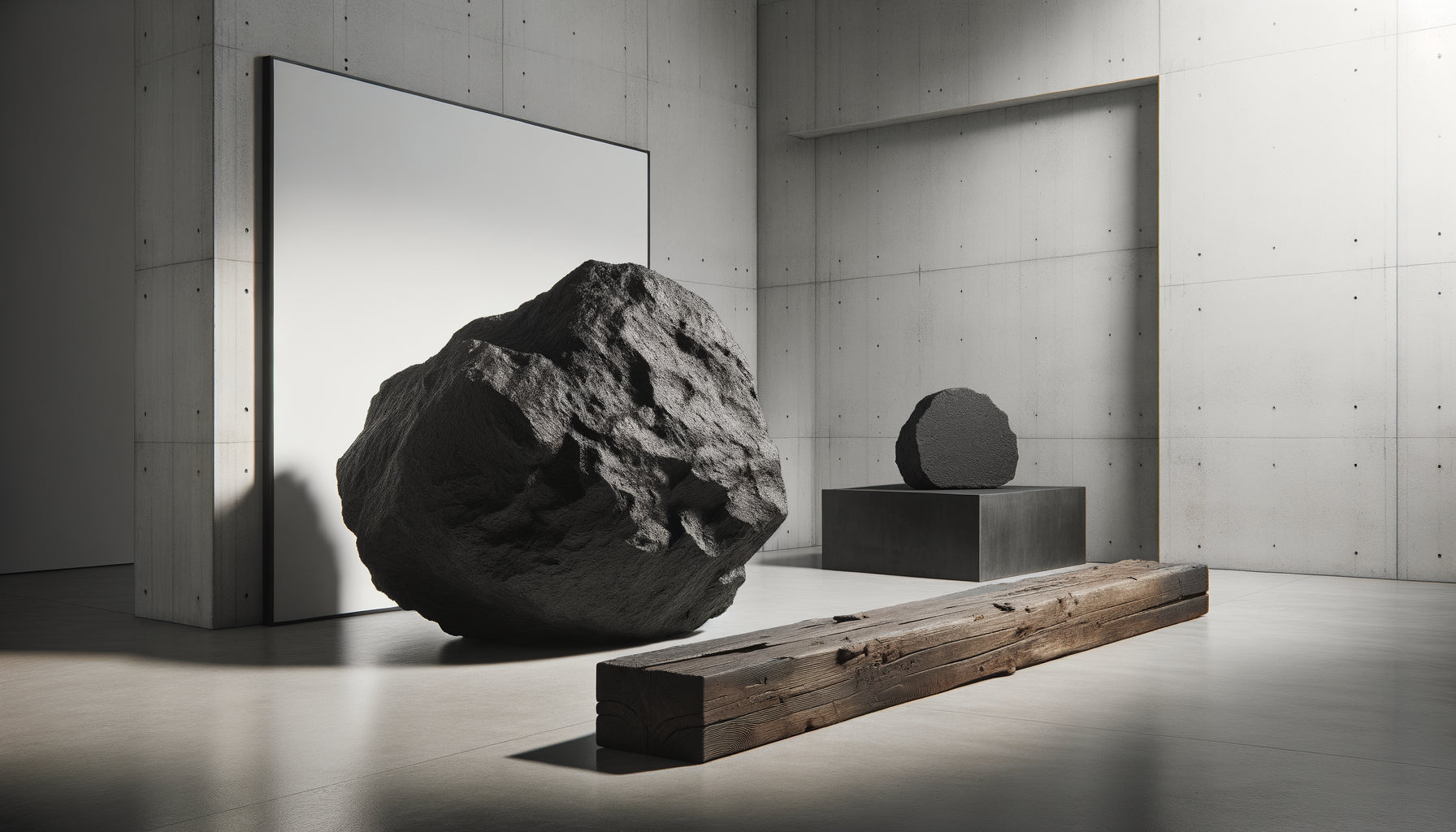
Five centuries after Sesshu Toyo, his technique of the almost-dry brush continues to influence contemporary aesthetics. The movement towards minimalist interiors draws on the same sources: the eloquence of austerity, the power of the unspoken, the beauty of the unfinished. Designers who choose raw materials with visible textures rather than smooth and perfect surfaces apply, consciously or unconsciously, the principles of Sesshu.
In current decoration, there is a return to purified artworks that breathe rather than saturate the space. Paintings inspired by Japanese aesthetics, with their minimalist black and white compositions, recreate this fertile tension between presence and absence. They function as visual breaths in our interiors often overloaded with information and stimuli.
Sesshu's choice of dry brush anticipated our contemporary desire for authenticity. At a time when everything is smoothed, filtered, digitally perfected, these rough and imperfect traces reconnect us to the presence of the human gesture. They remind us that a mastered imperfection is better than mechanical perfection, that a strong suggestion surpasses an exhaustive description.
Mastery and spontaneity: the paradox of released control
The technique of the quasi-dry brush requires a paradox that only masters can embody: absolute control in service of total spontaneity. Sesshu Toyo practiced for decades before achieving this freedom within constraint. The dry brush forgives no hesitation: once placed on the paper, the line is definitive.
This irreversibility forces the artist to a total presence at the moment. No repentance possible, no correction, no retouching. It is the pictorial equivalent of Zen meditation: an absolute attention to the present moment. The brush becomes the extension of the unreflective mind, this mushin where action precedes conscious thought.
For our contemporary existences fragmented by multitasking and permanent distraction, this lesson remains burning. Sesshu's landscapes teach us the value of total commitment in a single action, the beauty that is born when we accept the impermanence and irreversibility of each gesture. They invite us to rediscover this intense presence in our own creations, whether it is arranging an interior or choosing a work of art.
Let Sesshu's Zen spirit inspire your decor
Discover our exclusive collection of black and white paintings that captures this minimalist aesthetic where every line counts and every silence breathes.
Transform your gaze on the essential
Sesshu Toyo painted his landscapes with a quasi-dry brush because he had understood that the truth of a place does not reside in its exhaustive description but in capturing its invisible essence. This austere technique allowed him to visually translate Zen principles of economy, presence and fertile void. Each rough stroke became an affirmation of life, each white an invitation to contemplation.
Today, as you arrange your interior or choose a work of art, think about this lesson of the dry brush: sometimes taking away says more than adding. Spaces that breathe, purified compositions, authentic textures create atmospheres more habitable than decorative accumulation. Let the whites exist, embrace mastered imperfection, choose the eloquence of minimalism.
Start small: identify in your interior a space that you could purify rather than embellish. Observe how the created void changes the quality of your attention. Then, perhaps, welcome a work that practices this art of suggestion rather than description. You will discover that the most vast landscapes sometimes hold within a few essential strokes, and that your interior breathes better when it dares visual silences.
Frequently asked questions
What really differentiates a dry brush from a normally loaded one in Japanese painting?
The fundamental difference lies in the amount of water and the texture of the line produced. A normally loaded brush glides across the paper releasing a continuous flow of ink, creating smooth lines, blended washes, and soft transitions between tones. The quasi-dry brush used by Sesshu Toyo, on the other hand, contains very little water: the artist loads his brush with ink then almost completely wrings it out before applying it. Result: the bristles rub against the paper rather than glide, creating rough, fragmented lines with irregular whites that allow the surface to breathe. This technique produces an almost tactile texture, evoking natural erosion, the roughness of bark or the mineral density of rocks. It is also a much more irreversible gesture: where the loaded brush allows for retouching and progressive blends, the dry brush imposes each stroke as a definitive event, demanding absolute mastery and total presence at the moment.
Can I appreciate Sesshu's works without knowing Zen philosophy?
Absolutely! Sesshu Toyo’s landscapes speak directly to our senses before engaging our intellect. Their aesthetic power functions independently of any philosophical knowledge. What you feel in front of these minimalist compositions – this sense of space, this visual breathing, this contained force – is perfectly valid without conceptual decryption. However, understanding the Zen context considerably enriches the experience. Knowing that the whites are not accidental voids but spaces charged with potential, that the jagged strokes capture vital energy rather than external form, that each brushstroke translates a moment of total presence: all this adds layers of meaning to what you already intuitively see. It’s like tasting an exceptional wine: you can appreciate it without knowing the terroir, grape varieties or winemaking methods, but this knowledge multiplies the pleasure. Sesshu's art works at both levels: immediately accessible by its refined beauty, infinitely richer when one understands its philosophical intention.
How to integrate Sesshu's dry brush aesthetic into a modern interior?
The spirit of the almost-dry brush translates into contemporary decoration through several immediately applicable principles. First, prioritize materials with visible textures rather than smooth and uniform surfaces: raw wood with its visible grains, polished concrete with its irregularities, crinkled linen rather than ironed cotton. These materials embody the same rough authenticity as Sesshu's brushstrokes. Next, practice decorative economy: instead of multiplying objects, select a few strong pieces separated by breathing spaces. A white wall between two artworks functions like unpainted paper between two brushstrokes. Choose minimalist works of art, particularly black and white compositions inspired by Japanese aesthetics, which create this fertile tension between presence and absence. Finally, embrace controlled imperfection: a slightly asymmetrical pottery piece, a painting with visible strokes rather than a perfect reproduction, a natural floral arrangement rather than symmetrical. The spirit of Sesshu lies in the ability to find beauty in stripped-down essentials, in an authentic gesture rather than standardized perfection.