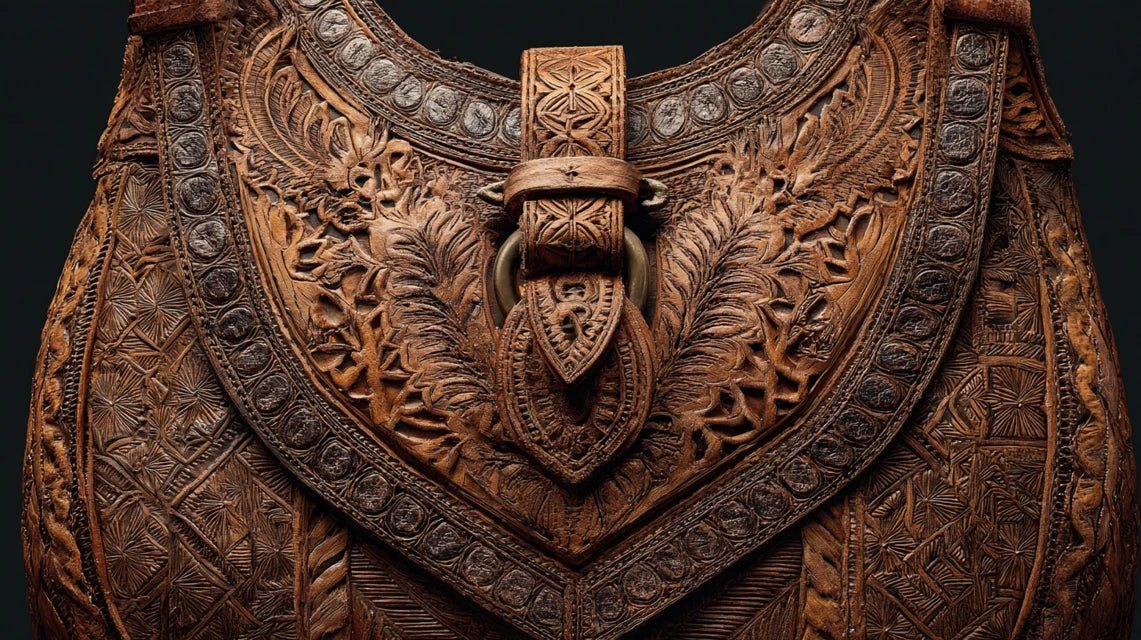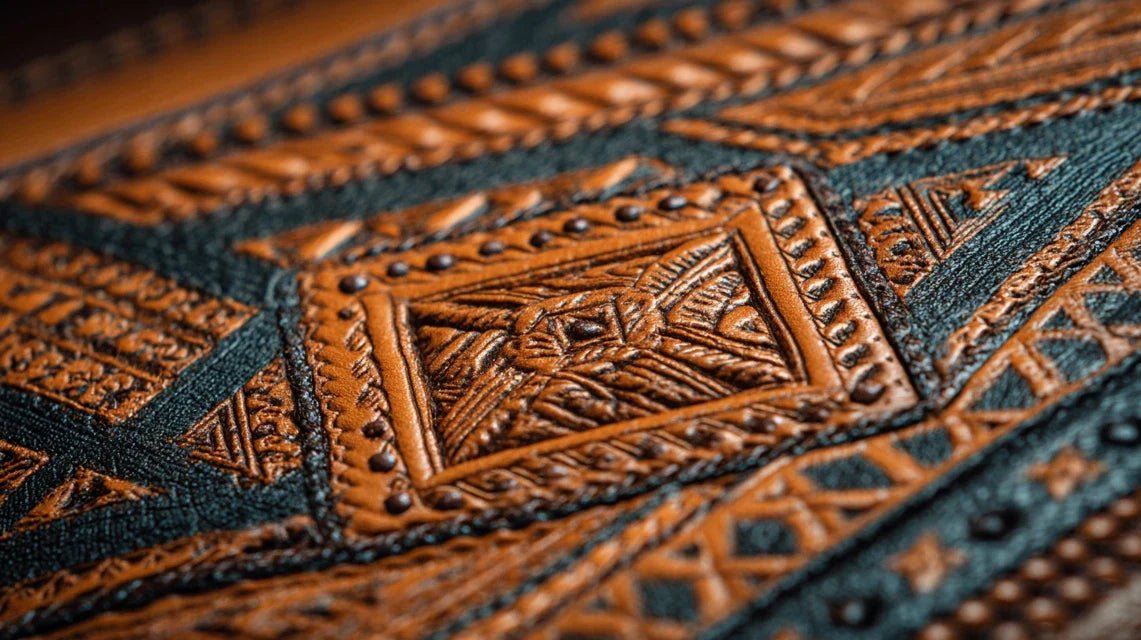
The first time I held a leather cushion adorned with Tuareg motifs in my hands, I felt something inexplicable. These geometric lines, both simple and hypnotic, seemed to tell a story spanning millennia. Each cross, each triangle, each diamond carried within it the echo of the desert, the breath of the Sahara, the memory of a nomadic people. That day, I understood that these patterns were not mere decorations, but fragments of an ancestral culture engraved in leather.
Here's what the origin of Tuareg motifs on leather reveals: a centuries-old artisanal tradition, a symbolic language passed down from generation to generation, and a refined aesthetic that transcends eras to perfectly integrate into our contemporary interiors.
Many admire these creations without knowing their depth. They are seen on cushions, poufs, bags, but their true meaning, their creation context, their intimate connection with Tuareg identity are often ignored. This lack of knowledge deprives us of an authentic connection with these objects.
Rest assured: understanding the origin of Tuareg motifs on leather requires no particular expertise. It is enough to let yourself be guided by their history, explore their symbolism, discover the ancestral gestures that give birth to them. In this article, I take you to the heart of the Sahara, where these patterns were born, so that each piece in your interior becomes a carrier of meaning and emotion.
The Tuareg people: guardians of the desert and masters of leather
To understand the origin of Tuareg motifs on leather, you must first know those who create them. The Tuaregs, nicknamed the blue men of the desert, are a nomadic Berber people who have roamed the Sahara for centuries. Spread between Mali, Niger, Algeria, Libya and Burkina Faso, they have developed a unique craftsmanship, intimately linked to their way of life.
Leather occupies a central place in their daily lives. The Tuaregs use goat, sheep or camel skin to make essential objects: saddlebags, cushions, bags, sandals, dagger sheaths. Each piece is designed to withstand the extreme conditions of the desert while reflecting the cultural identity of its creator.
Leatherwork is traditionally reserved for specialized artisans, often organized into castes. Tanning is done using ancestral methods, using acacia bark to give the leather its characteristic color and suppleness. Once tanned, the leather becomes a support for profound artistic expression: the incrustation of geometric motifs.
Symbols engraved in collective memory
The origin of Tuareg motifs on leather draws from an extremely rich symbolic system. Each geometric shape has a precise meaning, passed down orally from master to apprentice. These patterns are not chosen at random: they tell the story of the people, their beliefs, their relationship with the cosmos.
The Agadez cross, also known as the Southern Cross, is undoubtedly the most iconic motif. Its four branches pointing to the cardinal directions symbolize the four directions of the desert, the immensity of space, the freedom of the nomad. It can be found engraved on leather with remarkable precision, each line being hand-crafted.
The triangles evoke dunes, tents, sometimes the mountains of the Ahaggar or the Aïr. The diamonds represent eyes, the vigilance necessary for survival in the desert. The broken lines symbolize the path traveled, the stages of a nomadic life. Together, these motifs compose a visual language of great complexity.
A writing without an alphabet
The Tuaregs have their own writing system, the tifinagh, used since antiquity. But the leather motifs constitute a form of parallel expression, a symbolic writing accessible to all, even those who do not master alphabetic writing. Each artisan composes his or her own variation, bringing his or her personal touch while respecting ancestral codes.

Discover this inspiring artwork
The ancestral technique of leather engraving
Understanding the origin of Tuareg motifs on leather is also about understanding the know-how that makes them possible. The technique used is that of engraving and inlaying, a meticulous process that requires patience and precision.
The artisan begins by tracing the motifs with pencil or directly with a punch. He then engraves the leather using tapered metal tools, creating grooves of varying depths. These grooves are sometimes filled with colored paste, usually green, red or yellow, obtained from natural pigments. The contrast between the natural leather and these bright colors makes the motifs stand out.
Some pieces feature relief patterns, achieved by embossing the leather. Others play on the superposition of layers of leather in different shades. This technical diversity testifies to the richness of the Tuareg artisanal heritage and its ability to renew itself while preserving its authenticity.
A completely manual process
No machines are involved in the creation of Touareg patterns on authentic leather. Each piece is unique, bearing the marks of the hand that shaped it. Imperfections, far from being defects, constitute the artisan's signature and proof of the object's authenticity. This human dimension gives Touareg creations a soul that industrial productions cannot reproduce.
The influence of trade and cultural exchanges
The origin of Touareg patterns on leather cannot be understood without mentioning the historical role of the Tuaregs in trans-Saharan trade. For centuries, they controlled the caravan routes linking North Africa to sub-Saharan Africa, transporting salt, gold, ivory, slaves, and precious fabrics.
These commercial exchanges favored cultural influences. Touareg patterns have integrated elements from the Maghreb, Egypt, and even the Middle East, while retaining their distinctive identity. This ability to absorb and reinterpret external influences explains the richness and diversity of current Touareg patterns.
Leather objects adorned with patterns also served as currency and diplomatic gifts. Offering a finely decorated bag was a sign of respect and alliance. These pieces traveled through the desert, carrying with them Tuareg culture far beyond their territory of origin.

Discover this inspiring artwork
From utilitarian object to contemporary decorative piece
While the origin of Touareg patterns on leather is deeply rooted in nomadic life, their destiny has evolved. Today, these patterns adorn objects that are no longer solely utilitarian but also decorative, sought after by lovers of ethnic design and authentic craftsmanship.
Touareg leather cushions bring a touch of raw elegance to a contemporary sofa. Poufs become focal points in a bohemian living room. Bags and totes appeal to those seeking unique and durable accessories. This transition from nomadic use to sedentary use has done nothing to diminish the evocative power of these patterns.
Interior designers around the world have embraced this heritage. Touareg patterns on leather fit perfectly into minimalist interiors, bringing texture, warmth, and depth. Their clean geometry dialogues with Scandinavian design, industrial style, or wabi-sabi aesthetics. They create a bridge between tradition and modernity, between desert and city.
Accessible luxury and responsibility
Unlike fleeting trends, investing in pieces adorned with Touareg motifs on leather means choosing durability. Genuine leather develops a patina over time, gains character, tells its story. It also supports artisanal communities that perpetuate a know-how threatened by globalization and mass production.
Let the soul of the Sahara enter your interior
Discover our exclusive collection of African art that celebrates the richness of traditional motifs and brings a touch of authenticity to your decor.
Preserving a heritage in the face of contemporary challenges
Understanding the origin of Touareg motifs on leather also means being aware of the threats facing this craftsmanship. Young Touareg generations, confronted with forced sedentarization, rural exodus and climate change, are turning less to traditional trades.
Mass-produced imitations from Asian factories flood the market, offering denatured versions of Touareg motifs at low prices. These copies, often made on synthetic leather with printing techniques, have nothing in common with the authenticity of artisanal pieces. They impoverish meaning while unfairly competing with artisans.
Faced with these challenges, several initiatives are emerging. Artisanal cooperatives are organizing to guarantee fair prices and transmit techniques to young people. Labels of authenticity are emerging to protect consumers and value the work of genuine Touareg artisans. As a buyer, choosing an authentic piece becomes an activist act, a gesture of cultural preservation.
Imagine your living room transformed by the presence of a Touareg leather cushion, its geometric motifs capturing the light, silently telling the story of the desert. You now know that these lines are not just decorations, but the language of a people, the echo of a nomadic freedom, the fruit of ancestral craftsmanship. Each time your gaze rests on this object, you connect to something greater than yourself: a collective memory, a cultural resistance, a timeless beauty.
The origin of Tuareg patterns on leather reminds us that decoration is never trivial. Every object we choose to inhabit our space carries a story, an ethic, a soul. By integrating these authentic pieces into your interior, you are not only beautifying your home: you are participating in the preservation of a heritage, honoring human creativity, creating a bridge between cultures. So, the next time you're looking to add character to your interior, remember the Tuareg artisans, their patient hands tracing millennial symbols on leather, and choose authenticity.
Frequently Asked Questions
How to recognize authentic Tuareg patterns on leather?
Authentic Tuareg patterns have several distinctive characteristics. First, the leather must be genuine, with a natural patina and slightly uneven texture. The patterns are hand-carved, which implies small variations and imperfections that prove artisanal authenticity. Lines are never perfectly symmetrical, unlike industrial productions. The colors used to fill the patterns come from natural pigments: green, red earth, yellow ochre. Finally, each authentic piece bears a unique signature, a personal composition by the artisan in respect of traditional codes. Beware of pieces that are too perfect, with colors that are too bright or uniform, often produced mechanically. Authenticity can also be felt in the weight and suppleness of the leather, which must have been tanned using traditional methods. Do not hesitate to ask for the exact provenance and history of the piece before buying.
What is the meaning of the different Tuareg patterns?
Tuareg patterns on leather constitute a true symbolic language. The Agadez cross, an emblematic motif, represents the four cardinal directions and symbolizes the freedom of movement of the nomad in the immensity of the desert. Triangles evoke sand dunes, tents or mountains, central elements of the Saharan landscape. Diamonds are associated with eyes and vigilance, an essential quality for survival in a hostile environment. Broken or zigzag lines symbolize the path traveled, the incessant movements of the Tuareg people. Concentric circles represent wells, sources of life in the desert, or the sun. Some patterns evoke spiritual protection, others celebrate femininity, fertility or warrior courage. It should be known that these meanings are not fixed: each artisan can bring his own interpretation, thus enriching the tradition. This symbolic richness makes each piece adorned with Tuareg motifs a true visual narrative.
How to care for a leather object with Tuareg patterns?
Maintaining a leather item adorned with Tuareg motifs requires simple precautions to preserve its beauty and longevity. Avoid direct exposure to sunlight, which could discolor the leather and pigments of the motifs. Dust regularly with a soft, dry cloth. To nourish the leather, use a natural product suitable (beeswax, argan oil), applying it sparingly and avoiding the colored areas of the motifs, as some products may alter the pigments. Never use harsh chemicals or industrial cleaners. If the leather becomes stained, gently clean with a slightly damp cloth, then dry immediately. Accept that the leather will patina over time: this evolution is part of its charm and testifies to its authenticity. If your piece is a cushion or pouf, turn it regularly for even wear. Finally, store your leather items in a dry, well-ventilated place, away from humidity which could encourage mold.