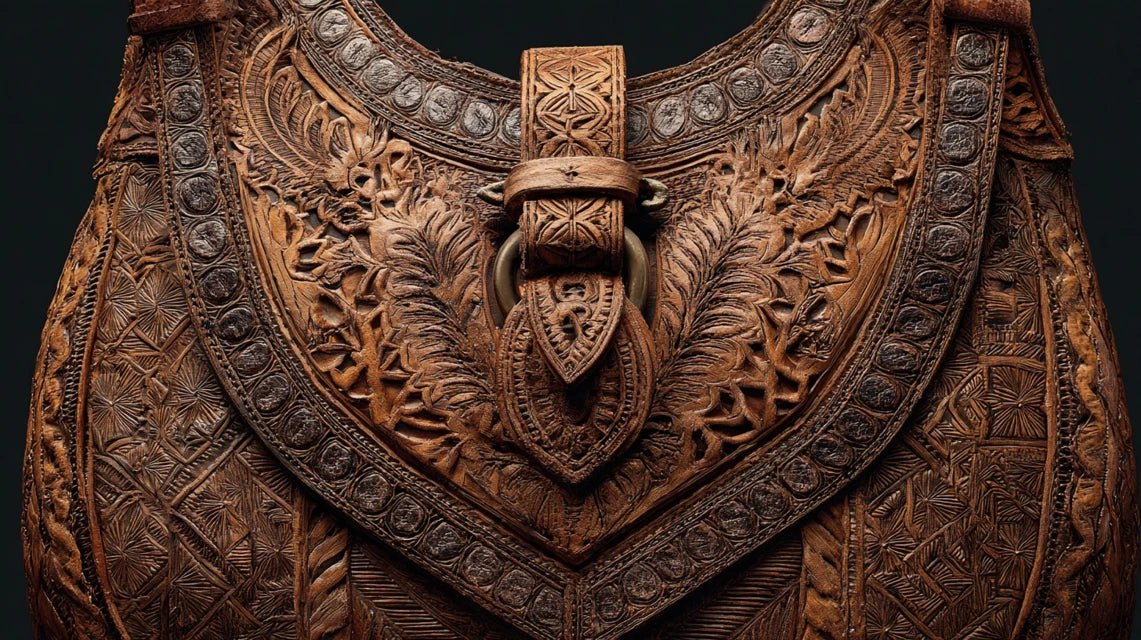
I discovered Fulani motifs during a sourcing trip in northern Nigeria, in the dusty workshop of a master artisan. His calloused hands pressed the leather with millimeter precision, revealing hypnotic geometries that seemed to tell ancient stories. That day, I realized that these creations were not mere decorations, but visual archives of a nomadic civilization over a thousand years old.
Here's what Fulani embossed leather motifs bring to your interior: an authentic connection with one of the most refined artisanal traditions of West Africa, a cultural depth that transforms each room into a conversation, and that timeless elegance that only objects steeped in history can offer.
You may admire these magnificent pieces in galleries or on social media, fascinated by their tactile beauty and enigmatic patterns. But behind each creation lies a symbolic universe that few truly know. Who are these Fulani? Why do they engrave leather with such devotion? And how do these ancestral techniques survive in the digital age?
Let me take you to the nomadic camps of the Sahel, at the heart of a tradition that has crossed centuries without losing its soul. You will discover how these patterns were born from dunes, herds and beliefs, and why they deserve a place in the most demanding contemporary interiors.
The Fulani: nomadic guardians of millennial knowledge
The Fulani, also known as Peuls or Foulbé, constitute one of the most widespread pastoral peoples in Africa, present from Senegal to Sudan. Their nomadic lifestyle, dictated by the transhumance of their zebu herds, has shaped a unique material culture where each object had to be both functional, transportable and bearer of identity.
Leather represented for them the raw material par excellence. Abundant thanks to their herds, resistant to extreme Sahelian conditions, this material became their preferred canvas of expression. Women tanned the skins according to ancestral methods passed down from mother to daughter, while men mastered the delicate art of embossing.
Contrary to popular belief, Fulani motifs are not merely decorative. Each line, each circle, each triangle embedded in the leather constituted a codified visual language. These symbols communicated clan affiliation, social status, sometimes even significant family events. Wearing a bag adorned with certain patterns meant announcing one's lineage before even speaking a word.
The embossed leather technique: when patience becomes art
Fulani embossed leather requires extraordinary technical mastery developed over several generations. The artisan begins by selecting a vegetable-tanned cow or goat skin, a process that can take several weeks with acacia bark and other local plants.
Once the leather is prepared, the artisan lightly moistens the surface and uses forged metal tools – punches, spatulas, stamps – to gradually press the material. This pressure creates reliefs and hollows that capture light differently, generating a fascinating visual depth. Some patterns require up to fifteen passes with different tools to achieve the desired complexity.
Fulani artisans also incorporate natural dyeing techniques to enhance their creations. Indigo for deep blues, ochre for earthy tones, henna for subtle reds – each color comes from local plants or minerals. These pigments penetrate the fibers of the leather during the repoussé process, creating lasting contrasts that improve with time.
Traditional tools : extensions of the artisan's hands
Each master has their own collection of tools, often forged by blacksmiths belonging to the Mabo caste, traditionally allied with the Fulani. These instruments sometimes bear the marks of three generations of use. Fine-tipped punches create delicate lines, circular stamps produce recurring solar motifs, while wide spatulas allow surfaces to be smoothed to create contrast.

Discover this inspiring work
Decoding the symbolism : what the motifs really tell
Fulani repoussé leather patterns form a sophisticated visual alphabet where nothing is left to chance. The parallel lines that run through many pieces evoke the transhumance routes, those invisible but essential roads that herders travel each year with their herds.
Concentric circles, omnipresent in Fulani craftsmanship, represent several concepts simultaneously. They symbolize the Sahel sun, source of life but also trials for these nomads. They also evoke the community gatherings around the fire, crucial moments of oral transmission and social cohesion.
Interlocking triangles, often arranged in rhythmic friezes, refer to the zebu horns, sacred animals that embody wealth and prestige. More subtly, these triangular shapes also recall the traditional conical dwellings and spiritual protections against negative forces.
Some more complex patterns incorporate stylized depictions of the gourd, a universal container in Fulani culture, or the traditional comb, a highly symbolic object linked to femininity and rites of passage. These elements transform each embossed leather creation into a true three-dimensional narrative.
From nomadic camp to contemporary interiors
The evolution of Fulani patterns is testament to a remarkable ability to adapt. As nomadic practices become rarer in the face of progressive settlement, artisans have managed to preserve the essence of their know-how while adapting it to new economic realities.
Artisan cooperatives, particularly in Mali, Niger and Burkina Faso, now allow creators to market their works beyond local markets. These structures preserve ancestral techniques while introducing subtle innovations: formats adapted to modern interiors, color combinations that respond to current trends, while maintaining the symbolic integrity of the patterns.
In contemporary interiors, a Fulani embossed leather piece brings this rare authenticity that manufactured objects cannot reproduce. The tactile texture, the subtle irregularities testifying to handwork, the patina that develops over time – each element contributes to creating an emotional connection between the object and its owner.
Integrating these treasures into your decor
Cushions adorned with Fulani embossed leather instantly transform a minimalist sofa into a narrative focal point. Wall panels create plays of light and shadow that evolve throughout the day. Decorative trays and boxes bring an elegant functionality while serving as conversation starters during receptions.
The key is to respect the object: these creations deserve to be highlighted, not drowned in a decorative accumulation. Side lighting beautifully emphasizes the reliefs of the embossed leather, revealing all the technical complexity of the craftsmanship.

Discover this inspiring work
Contemporary challenges of an ancestral craft
The transmission of Fulani embossed leather techniques is currently experiencing a critical period. Younger generations, drawn to urbanization and the economic opportunities of cities, sometimes turn away from this demanding heritage. Mastering the art of embossing requires years of learning, a rare patience in an age of instant gratification.
The raw materials themselves are also problematic. Traditional vegetable tanning, ecological but time-consuming, is competing with faster but less noble industrial chemical processes. Some artisans face the difficult choice of compromises to survive economically, sometimes diluting the authenticity of their production.
Yet encouraging initiatives are emerging. Programs for intangible heritage enhancement document techniques before they disappear. International designers collaborate with master craftsmen to create collections that fairly compensate know-how while exposing these creations to new audiences.
Each conscious purchase of an authentic Fulani embossed leather piece becomes a vote for the preservation of this tradition. It is recognizing that behind the object lies a human chain: the herder, the tanner, the artisan, each contributing to keeping alive a millennial heritage.
Ready to welcome the soul of the Sahel into your interior?
Discover our exclusive collection of African paintings that celebrate the authenticity of African artisanal traditions and transform your walls into galleries of living history.
Conclusion: owning a fragment of nomadic history
Fulani embossed leather motifs embody much more than a seductive aesthetic. They represent the creative resilience of a people who have managed to transform the constraints of nomadism into artistic opportunity, the harshness of the Sahel into tactile beauty, and daily gestures into sacred rituals.
Imagine your hand stroking the reliefs of a Fulani cushion as you read, your guests intrigued by the depth of the motifs adorning your wall, this silent connection that is established between your space and the distant camps where these traditions are still born every day.
Integrating these creations into your decor means choosing substance over trend, history over the ephemeral. It affirms that your interior deserves objects that carry within them centuries of know-how, hands that have patiently pressed the leather until it reveals its secret language.
Start with one piece, just one. Let it dialogue with your space. Observe how the light plays with its reliefs, how your perception evolves as you gradually discover the richness of its motifs. You have just invited an authentic fragment of nomadic Africa into your home.
FAQ: Everything you need to know about Fulani embossed leather patterns
How to recognize an authentic Fulani embossed leather?
Authenticity can be detected by several revealing clues. First, the subtle irregularities: a true handmade work presents minimal variations in the depth of reliefs, unlike perfectly uniform industrial reproductions. Then, the feel of the leather itself – vegetable tanning produces a unique texture, slightly grainy, which becomes more supple over time. Authentic patterns also follow a coherent symbolic logic: they tell a story, are organized according to geometric principles specific to Fulani tradition. Beware of pieces that are too perfect or fanciful motifs with no connection to the traditional repertoire. The smell of the leather is also an indicator: vegetable tanning releases a characteristic earthy scent, very different from chemicals. Finally, the back of the piece should show the marks of embossing work – the patterns appear in negative on the reverse side, testifying to the pressure exerted. A serious seller will be able to document the origin of the piece and explain the meaning of the patterns present.
How to care for a Fulani embossed leather piece?
Embossed leather requires delicate but non-restrictive maintenance. Absolutely avoid prolonged direct exposure to sunlight which dries out the material and fades natural dyes. Regular dusting with a soft, dry cloth is usually sufficient – reliefs can accumulate dust in their recesses. To nourish the leather every six to twelve months, use natural beeswax or a specific cream for old leathers, in small quantity. Apply in gentle circular motions, respecting the reliefs without seeking to flatten them. Let it penetrate for a few hours then polish gently. If your piece has colored parts, always test the product on a discreet area before general application. Avoid excessive humidity which could deform the leather or alter the vegetable dyes. In case of stain, intervene quickly with a slightly damp cloth, without rubbing vigorously. Embossed leather naturally develops a patina over time – it is a desirable characteristic that adds character, not a defect to be corrected. This living material rewards patient care with beauty that deepens with the years.
Where to find authentic Fulani embossed leather creations?
Several circuits provide access to authentic pieces, each with its advantages. Specialized galleries in African crafts generally offer authenticity guarantees and can document the provenance of their pieces – a guarantee of quality but with a price reflecting this curation. Fair trade cooperatives establish direct links with craft communities, ensuring fair compensation for creators while offering reasonable prices. Some organizations such as UNESCO or cultural NGOs maintain online stores supporting the preservation of traditional skills. Travelers can obviously acquire directly in the Fulani regions – Mali, Niger, Burkina Faso, northern Nigeria – by visiting craft markets or workshops. However, this approach requires an experienced eye to distinguish authentic pieces from simplified tourist productions. Craft fairs and temporary exhibitions in ethnographic museums are also excellent opportunities to meet artisans in residence. Whatever your source, prioritize sellers who can explain the meaning of motifs, the manufacturing technique and the precise geographical origin. An abnormally low price should alert you – authentic work requires dozens of hours and deserves fair valuation.