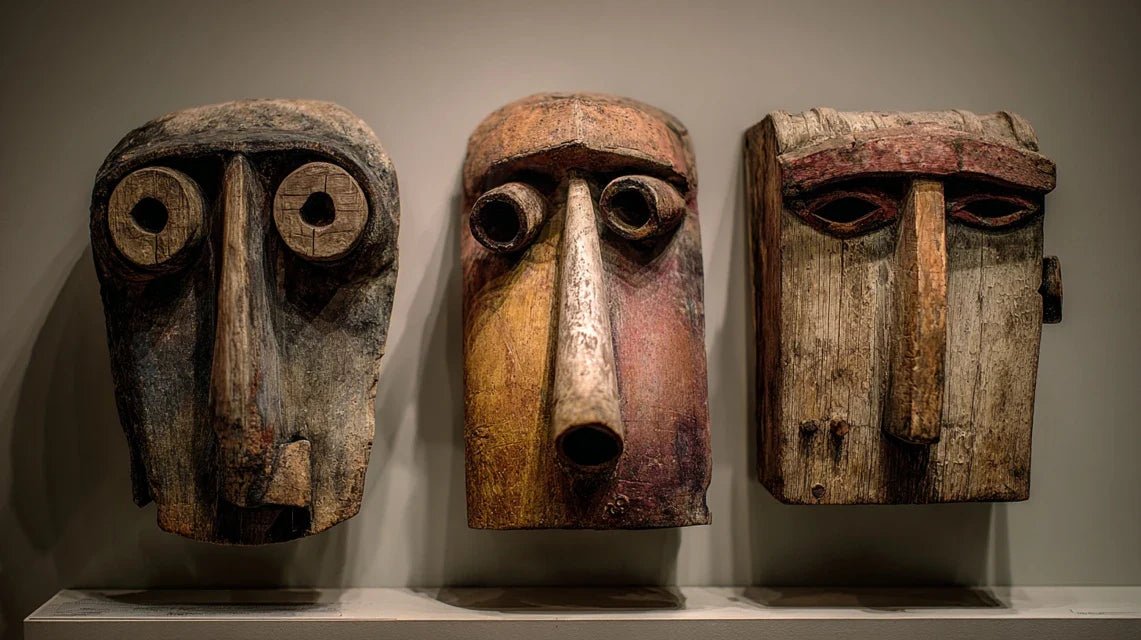
The first time I came across a Dan mask with tubular eyes in a Brussels gallery, I felt an immediate fascination. These cylinders projected forward, this almost hypnotic gaze, this presence that transcends the simple object of art. How could such a streamlined form emanate such spiritual intensity?
Here's what tubular-eyed masks reveal in Dan art: a sacred function of mediation with the invisible world, a codified symbolic language transmitted for centuries, and a sculpted aesthetic that still influences contemporary design. These masks are not mere wall decorations, but portals to a profound understanding of African cosmology.
Many admire tribal art without grasping its true meanings. One buys a mask for its exotic appearance, without realizing that one is inviting into their home an object charged with a millennial history. This lack of knowledge deprives us of an authentic connection with these extraordinary works.
Rest assured: understanding the symbolism of Dan masks does not require being an anthropologist. It suffices to accept that an object can carry multiple dimensions – artistic, spiritual, social – and to let oneself be guided by the visual codes inscribed in it by the sculptors. Each formal element tells a story.
In this article, I'll take you to the heart of Dan culture, this ethnic group established between Côte d’Ivoire and Liberia, to decode together the deep meaning of these fascinating tubular eyes and discover how to consciously integrate this cultural richness into your interior.
The eyes that pierce the veil between two worlds
In Dan cosmology, tubular eyes do not represent a simple aesthetic stylization. They embody the mask's ability to see simultaneously in the world of the living and that of spirits. These sculpted cylinders, sometimes several centimeters long, act as spiritual telescopes allowing the wearer to access an expanded view of reality.
Dan masks belong to two main categories: female masks (deangle) with smooth and peaceful features, and male masks with more angular characteristics. Tubular eyes appear mainly on some running and war masks, as well as on the judge masks that arbitrate village conflicts.
Each Dan mask embodies a forest spirit – a gle – who chooses a man to manifest in the visible world. The tubular eyes symbolize this double nature: the spirit looks through the human, and the human sees with the perception of the spirit. It is a visual fusion that materializes a spiritual fusion.
The amplified vision of the guardian
In Dan ceremonies, the mask wearer with tubular eyes is no longer quite himself. He becomes the vehicle of a superior force tasked with maintaining social balance. These prominent eyes signal his ability to detect lies, to identify sources of disorder, and to perceive what escapes ordinary sight.
I have always been struck by the modernity of this design: long before our theories on the unconscious, the Dan had formalized the idea that there are levels of perception beyond our daily vision. Tubular eyes are the sculptural translation of this philosophy.
Decoding the Sculptural Language of Dan Masks
Beyond the tubular eyes, each element of a Dan mask constitutes a system of signs perfectly codified. The mouth, the forehead, scarifications, the headdress: nothing is left to chance. Understanding this language is accessing a form of three-dimensional writing.
Short tubular eyes generally indicate an entertainment or teaching mask, whose social function remains relatively gentle. Conversely, long tubular eyes, sometimes exaggerated, signal a mask of intense power: judge, warrior, or guardian of prohibitions. The longer the cylinders, the more the mask's function touches on the sacred and authority.
The surface of the mask also plays a crucial role. A Dan mask patinated by time and ritual use possesses a spiritual charge different from a recent creation. Discerning collectors seek this patina of use, these traces of sacrifices and libations that testify to the spiritual activation of the object.
Symmetry as an Expression of Harmony
Carefully observe an authentic Dan mask: despite their organic appearance, these sculptures respect a remarkable symmetry. This formal regularity is not only aesthetic, it expresses the quest for balance that animates Dan society. The mask embodies order in the face of chaos, harmony in the face of conflict.
The tubular eyes, always perfectly aligned and symmetrical, reinforce this impression of balance. They create a powerful vertical axis that anchors the mask in a symbolic verticality, connecting the underground world of ancestors to the celestial world of cosmic forces.

Discover this inspiring work
When Tribal Art Meets Contemporary Design
The influence of Dan masks on Western modern art is considerable, although often overlooked. Picasso, Modigliani, Giacometti: all were fascinated by this ability to stylize the human face while maintaining maximum expressive power.
The tubular eyes of Dan masks have directly inspired some Cubist explorations on the fragmentation of gaze and the multiplication of viewpoints. This idea that a face could carry multiple perspectives simultaneously originates in the Dan spiritual vision long before the Parisian avant-gardes.
Today, in contemporary interiors, a Dan mask with tubular eyes creates an architectural focal point of rare intensity. Its sculptural verticality naturally dialogues with the clean lines of modern furniture, while its symbolic charge brings a narrative depth often absent from minimalist spaces.
Integrating a Dan mask with awareness
Hanging a Dan mask in your home is not an insignificant gesture. It's inviting a presence, a story, a worldview. I always advise reserving a prominent location for it, where it can breathe without being drowned in an accumulation of objects.
The ideal? A plain wall, preferably in a neutral shade that enhances the patina of the wood. Side lighting beautifully highlights the reliefs of the tubular eyes and creates shadows that accentuate the sculptural dimension of the work. Avoid direct sunlight which could damage the ancient wood.
Also consider the height: a Dan mask should be positioned slightly above eye level, as it would be during a ceremony where the wearer, standing on stilts, dominates the assembly. This elevation naturally reinforces its symbolic presence.
Regional variations and their meaning
Not all Dan masks are alike. Sculptors from mountainous regions produce works with more angular features, with tubular eyes often shorter and stockier. In contrast, artists from forest areas prefer more rounded shapes, more elongated eyes.
These variations are not merely stylistic: they reflect differences in social organization and ritual practices between communities. A mask from the north of the Dan area, with its massive tubular eyes, intervenes in different ceremonial contexts than its southern cousin with finely sculpted eyes.
For the collector or art enthusiast, understanding these nuances allows one to appreciate the diversity within a single artistic tradition. Dan masks are not a monolithic block, but a constellation of creative variations around shared symbolic principles.
Hybrid masks: between tradition and innovation
Some contemporary Dan masks incorporate characteristics from other traditions – Baoulé, Gouro, Yacouba. These hybridizations are a testament to the constant exchanges between communities and the creative vitality of African sculptors.
A Dan mask with tubular eyes combined with Baoulé decorative elements tells a story of migrations, marital alliances, or simply aesthetic admiration. Far from being corruptions of tradition, these creations demonstrate that tribal art is alive, evolving, in constant dialogue with its cultural environment.
Be captivated by the spiritual power of tribal art
Discover our exclusive collection of African paintings that bring narrative depth and sculptural presence to your living spaces.

Discover this inspiring artwork
Preserving and transmitting: a cultural responsibility
Owning a Dan mask with tubular eyes implies a form of cultural stewardship. These objects carry the memory of a community, the imprint of a sculptor, the energy of past ceremonies. Treating them with respect is honoring this chain of transmission.
The African art market unfortunately has its share of looted works or those acquired under questionable conditions. Favor reputable galleries that document the provenance of their pieces and work in collaboration with communities of origin. A mask accompanied by its history is infinitely more valuable than an anonymous object.
Also consider conservation: the wood of Dan masks, often light and porous, requires a stable environment. Avoid sudden variations in humidity and temperature that can cause cracks. A humidity level between 45 and 55% is perfectly suitable for these ancient works.
Passing on knowledge to future generations
Each time you share the meaning of tubular eyes with a visitor, you participate in cultural transmission. These conversations transform a decorative object into a vector of knowledge, a bridge between cultures.
Explain to your children, your friends, that this mask is not just a distorted face, but a sophisticated representation of a spiritual vision of the world. Tell them how the Dan people developed a sculptural language to express the invisible. This informal education combats stereotypes and enriches our understanding of human creativity.
Imagine your living room transformed by the silent presence of a Dan mask. Its tubular eyes capture the evening light, creating moving shadows that seem to animate the ancient wood. It's no longer just an elegant interior, it's a space that dialogues with history, that welcomes another vision of the world.
You don't need to become an expert to appreciate these works. Simply start by observing carefully: the curve of a cheek, the tilt of tubular eyes, the texture of aged wood. Let yourself be touched by this aesthetic that has crossed centuries without losing its evocative power.
Visit exhibitions, browse specialized catalogs, exchange with enthusiasts. Each encounter with Dan art enriches your perspective, refines your sensitivity. And one day, you will instantly recognize an authentic Dan mask among a hundred imitations – not through erudition, but through that intuitive understanding that only patient exposure to the works can offer.
Frequently Asked Questions about Dan Masks
How to distinguish an authentic Dan mask from a tourist reproduction?
An authentic Dan mask has several revealing characteristics. First, observe the patina of use: ritual pieces bear traces of manipulations, libations, sometimes residues of sacrifices. The wood shows natural, uneven wear, concentrated on contact areas. Tourist reproductions generally have a uniform finish, sometimes artificially aged with dyes. Then examine the sculptural quality: the tubular eyes of an authentic mask respect perfect symmetry while maintaining a subtle organic nature. The features are resolved with confidence, fruit of a technical mastery passed down through generations. Finally, the weight and density of the wood provide information on authenticity: Dan sculptors traditionally used specific local woods, light but resistant. A piece that is too heavy or made of inappropriate wood raises questions. Do not hesitate to seek the expertise of specialized galleries that can provide documented provenance.
Can a Dan mask be hung in any room of the house?
Technically yes, but some precautions are necessary. Avoid excessively humid rooms like bathrooms, where fluctuations in humidity can damage the antique wood. The kitchen, with its greasy fumes and temperature changes, is not ideal either. On the other hand, a living room, library, office or even a bedroom are perfectly suitable. Symbolically, Dan masks embody specific social functions – justice, protection, celebration – and some collectors choose the location based on these meanings. A judge's mask naturally finds its place in an office, a protective mask near the entrance. But beyond these considerations, trust your intuition: which space in your home calls for this presence? Where can the mask dialogue harmoniously with the architecture and furniture? Simply ensure that it is visible and highlighted, not relegated to a dark corner. Indirect lighting beautifully reveals the volumes of the tubular eyes and creates a contemplative atmosphere.
Do Dan masks require special maintenance?
Maintaining a Dan mask is fortunately very simple. The main enemy of antique wood is the brutal variation of environmental conditions. Maintain a stable temperature (ideally between 18 and 22°C) and a constant humidity level (45-55%). Absolutely avoid direct sunlight which dries out the wood and can alter ancient patinas. For dusting, use a soft-bristled brush or a delicate duster, never a damp cloth that could penetrate the natural cracks in the wood. If you notice the appearance of small holes or sawdust, consult a specialist restorer quickly: it may be xylophagous insects requiring treatment. Never apply products – varnish, oil, wax – without the advice of an expert, as you could irreparably damage the original patina. A well-preserved Dan mask lasts through the decades without problems: these works have already survived decades, sometimes centuries of existence, they are more resistant than we imagine. Your role is simply to offer them a stable and respectful environment.