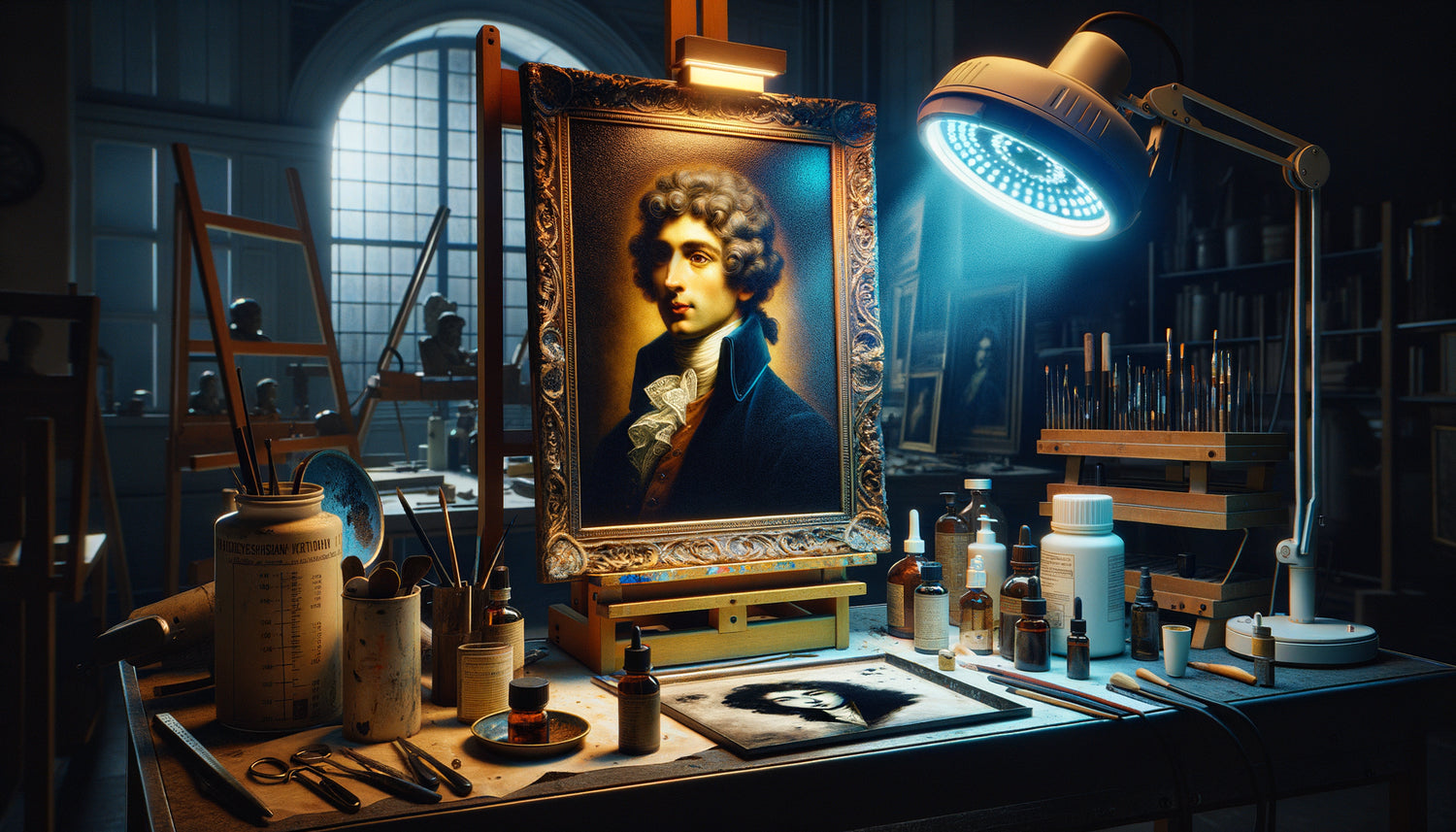
That morning, in the hushed dimness of my restoration workshop, a Parisian collector placed an 18th-century portrait on my table, purchased at auction. "It seems strange to me," she murmured. As I turned on my UV lamp, my intuition was confirmed: beneath the browned varnishes, layers of modern paint screamed their presence. The painting had been repainted, probably several times. I have witnessed this scene dozens of times in twenty years of restoring antique works.
Here's what detecting repaint on a historical painting brings: the ability to read the hidden history of a work, to protect your investment by knowing its true value, and to consciously decide whether restoration is necessary. Because a repaint is not always a malicious alteration; sometimes it's a secular protection, sometimes a forgery. Knowing how to distinguish them changes everything.
You are standing before an antique painting that fascinates you. You hesitate to acquire it, or you already have it in your living room, hanging on the wall. But this question torments you: is it really the original work? Are these vibrant colors authentic for a canvas of three centuries? This too-smooth face, these too-sharp contours, these repaints that silently alter the historical and financial value of your treasure.
Good news: detecting repaint on a historical painting is within your reach. Without being a professional restorer, you can learn to observe revealing signs, use simple techniques, and develop that critical eye that transforms an amateur into an informed connoisseur. I am going to pass on the methods I apply daily in my workshop, from the most accessible to the most technical.
The visual examination: when your eyes become detectors
Before any sophisticated instrument, your eyes are your first detection tool. A repaint on a historical painting, always leaves visible traces when you know where to look. Approach the painted surface, observe it from different angles, especially in raking light.
The cracks tell a story. An antique painting naturally develops a network of fine, regular cracks that traverse the entire surface like the skin of a face wrinkled by time. A repaint, on the other hand, presents anomalies: areas without cracks, artificially too-regular cracks, or worse, cracks that abruptly stop at the border between original and modern addition.
Also look at the color transitions. A repaint applied to mask wear or a tear often creates passages that are too abrupt, contours that are too sharp. The hand of the original painter had his nuances, his hesitations, his subtle blends. The modern restorer, even talented, works differently, with different pigments, different binders.
Areas to Watch Out For
Focus your attention on the edges of the painting, which are often repainted to even out the frame. Signatures are also sensitive points: some unscrupulous dealers add or modify signatures to increase value. Examine visible damaged areas: a repaired tear is almost always accompanied by local retouching.
Ultraviolet Light Reveals the Invisible
In my workshop, the UV lamp (or Wood's light) is my most faithful ally. This technique accessible to amateurs allows you to detect repainting on a historical painting with astonishing precision. Under ultraviolet radiation, old varnishes emit a characteristic fluorescence, generally greenish or yellow-green.
Modern retouches, on the other hand, appear as dark spots, black or purplish, which absorb UV rays instead of reflecting them. This difference in behavior is due to the chemical composition of the materials: modern synthetic resins and contemporary pigments react differently from historical materials.
You can acquire a portable UV lamp for a few tens of euros. In complete darkness, move it 30-40 centimeters from the surface of the painting. The repainted areas will jump out at you. I have discovered hidden restorations on family portraits, Baroque landscapes entirely « refreshed » in the 20th century, narrative additions that modified the original composition.
Interpreting What the UV Lamp Reveals
Attention: not all detected retouches are problematic. Old restorations, carried out a hundred or a hundred and fifty years ago with traditional materials, can fluoresce similarly to the original. It is recent repaints, applied with synthetic products, that create these striking contrasts. Expertise consists of distinguishing respectful heritage restoration from mercantile falsification.

Tactile Analysis and Precision Magnifier
With your gloved finger, gently caress the surface of the historical painting. A repaint often creates a slight thickness, a difference in texture. The original impastoes have logic, a rhythm linked to the painter's gesture. A posterior addition disrupts this tactile coherence.
The magnifying glass (x10 or x20) beautifully complements this examination. It reveals microscopic details: the difference in granularity between pigments ground by hand and modern industrial pigments, different brushstrokes, dust trapped in layers of varnish indicating their age.
I remember this late Rubens where only the magnifying glass revealed that the shadows on the face had been "dramatized" in the 19th century to meet romantic tastes. The brushstrokes were shorter, more abrupt than the master's Flemish touch. These material clues constitute tangible evidence when the eye alone might doubt.
Non-invasive chemical tests for curious methodologists
To go further without damaging the work, some simple tests can identify repaints on a historical painting. The solvent test, practiced with extreme caution on a discreet corner, allows you to see if a recent layer dissolves more easily than an old varnish polymerized decades ago.
Warning: I formally advise against this approach for non-professionals without supervision. A poorly chosen solvent can irreparably damage a valuable work. Reserve these manipulations for qualified restorers who master the chemistry of pictorial materials.
Infrared imaging to see through the layers
Infrared photography, accessible today via modified cameras or specialized services, penetrates the superficial layers of paint. It reveals the preparatory drawing, the painter's pentimenti, but also repaints that mask the original composition. These areas appear as opaque blocks where the underlying drawing should be visible.
I used this technique on a 17th-century Dutch landscape: infrared revealed that an entire figure had been added to the foreground in the 19th century, probably to "enliven" a scene deemed too austere. This discovery completely modified the value and attribution of the painting.

When repaints tell the story of taste
Not all repainted historical paintings are forgeries. Many bear witness to the evolution of aesthetic sensibilities. In the 18th century, nude paintings from the 16th century were willingly repainted to “purify” them. In the 19th century, chiaroscuros by Baroque masters were dramatized. In the 20th century, they were aggressively “cleaned” by removing original glazes deemed too dark.
These historical interventions sometimes constitute valuable testimonies of how works were received. Should they be systematically removed? The question divides restorers. Some advocate for a return to an absolute original state, while others defend the preservation of historical layers as chapters in the painting's biography.
Personally, I analyze each case individually. A Baroque repaint on a Renaissance work can have just as much heritage value as the original. A commercial repaint from the 20th century intended to deceive the buyer deserves to be removed. The ethics of restoration rests on this nuanced discernment.
Develop your eye of an informed collector
Detecting repaints is learned through repeated practice. Visit museums, attend restorers' conferences, examine many authentic historical paintings to educate your gaze. Compare original intact surfaces with documented restored areas.
Some museums, such as the Louvre or the Royal Museums of Belgium, organize visits to restoration workshops where you can observe works under study. These experiences are worth more than any books: seeing a restorer delicately remove a 19th-century repaint to reveal the luminous colors of the 17th century teaches better than a thousand theories.
Build yourself a reference photographic library. Document the paintings you examine under different lights, with their peculiarities. This visual memory will become your best guide for instantly recognizing the characteristic anomalies of repaints.
Ready to welcome the authenticity of old masters into your home?
Discover our exclusive collection of historical paintings that have been carefully authenticated and documented, for a confident purchase.
Your new look at old works
From now on, you will never look at a historical painting the same way again. These repaint detection techniques offer you privileged access to the material secrets of artworks. You understand that each antique canvas is a palimpsest, a superposition of creative gestures and successive restorations.
This knowledge does not diminish the aesthetic pleasure, it enriches it. Knowing that a face was repainted in the 18th century, that this sky regained its luminosity after a stripping in 1950, that this signature is authentic despite its too fresh appearance, all of this nourishes your intimate relationship with the work.
Start simply: observe carefully, use a UV lamp if you own antique paintings, consult a professional restorer before any significant purchase. Your eye will gradually sharpen, and you will discover that particular pleasure of the connoisseur who reads in the pictorial matter as in an open book.
Repaints are neither good nor bad in themselves. They are information, clues, aesthetic or economic choices. It is up to you to decode them, to understand them, to consciously decide what they mean for you. This is the enlightened freedom that I wish each lover of old art.