The fingerprint on the hallway wall. This slight mark that reappears every week, exactly in the same spot, where instinctively we place our hand when turning towards the kitchen. After twenty-three complete renovations of old apartments, I can tell you that this detail reveals all the difference between a thought-out finish and a finish endured.
Here's what good finishes bring to a daily passage: total peace of mind in the face of accidental friction, beauty preserved year after year without constant retouching, and that precious feeling of an interior that ages well rather than degrades.
Do you know this frustration? Repainting the hallway every eighteen months because traces of bags, coats, and hands accumulate. Gently cleaning with the constant fear of making the situation worse. Living in hypervigilance, constantly asking children to "be careful".
The good news: some finishes transform these passageways into truly resistant surfaces. Not invincible – let's be realistic – but designed to absorb daily life without losing their luster. I have seen entrances from 1920 with their original finishes still impeccable, and recent renovations already tired after two years.
In this article, I share the solutions that really work. Those that I install for my demanding clients, who want both aesthetics and peace of mind.
New generation washable paints: when chemistry catches up with our needs
Ten years ago, "washable paint" often meant "unfashionable plasticized finish". Things have radically changed. Current satin acrylic paints combine remarkable resistance to friction with a sophisticated visual rendering.
On a project in the Marais last year, we installed a high-end satin paint in a 1.20 meter wide hallway – as much as to say a bottleneck where everyone brushes against the walls. Two years later, during a follow-up visit, no visible mark. The secret? A formula based on reinforced acrylic resins that creates a microscopic but tenacious film.
Contrary to popular belief, satin is not shiny. It captures light subtly, masks small imperfections in the wall, and cleans with a simple damp sponge. For heavily trafficked areas – think entrance hallways or landings near children's bedrooms – it has become my systematic recommendation.
The technical trick: apply three thin coats rather than two thick ones. The resistance to friction is built up by layering. Each layer reinforces the previous one, creating a denser and therefore more durable surface.
Tadelakt and waxed plasters: the nobility of minerals
In a Haussmann apartment on rue de Turenne, the hallway was subjected to an incessant ballet: four roommates, dozens of passages daily, shopping bags that scrape, bicycles that brush. The owner wanted character, not plastic.
We opted for a wax lime plaster. Three years later, the result still gives me chills: a living patina, some natural marks that enrich the surface rather than degrade it, and zero retouching needed.
Wax mineral plasters have this rare quality: they age well. The final waxing – applied by hand with an agate pebble according to the rules of the art – creates a semi-impermeable surface that naturally repels dirt. Oil or wax penetrates the pores of the plaster, forming an invisible but effective shield.
The technique that changes everything
The secret lies in the final polishing. After complete drying of the plaster (minimum 48 hours), we apply diluted black soap or natural wax, then polish with circular movements until we obtain this characteristic soft sheen. This step densifies the surface, closes the pores, transforms a fragile plaster into a finish resistant to friction.
Warning: this technique requires real know-how. I have seen too many poorly waxed plasters that crumble at first contact. If you try the adventure on your own, test it first on a sample panel.

Wood paneling and wall coverings: the intelligence of mid-height
Why did our ancestors systematically install wood paneling halfway up in hallways? Not just for aesthetics. For mechanical strength.
Wood, properly treated, absorbs impacts and friction better than any paint. A matte polyurethane varnish – not glossy, stay elegant – applied in three layers to an oak or beech wood panel creates a virtually indestructible surface.
In a family home in Normandy, I restored 1890s paneling: the original cracked and faded varnish hid intact wood. After light sanding and application of a contemporary matte varnish, these panels are set to last another century. Everyday friction literally glides over the surface without leaving a trace.
The invisible advantage: if a scratch does appear, a simple localized sanding and varnish touch-up solves the problem. Impossible with paint, where any retouching leaves a visible demarcation.
The modernity of painted paneling
If natural wood doesn't match your aesthetic, a painted wood paneling with a satin finish offers the best of both worlds: the structural strength of wood and an infinite palette of paint. Opt for professional acrylic lacquers, which are much more resistant than standard paints.
Vinyl and non-woven wallpapers: when decor becomes armor
For a long time, I was skeptical about wallpaper in hallways. Too many bad memories of peeling corners and fading patterns.
Then I discovered vinyl coated non-woven wallpapers. The difference is radical. The non-woven backing – a kind of non-woven textile – remains dimensionally stable. Unlike traditional paper, it doesn't shrink as it dries, eliminating peeling at the seams.
The vinyl surface layer creates a washable finish that resists accidental scuffs. In a hallway belonging to clients with three young children, this wallpaper with geometric patterns withstands daily assaults that would have destroyed any paint. Result after eighteen months: a few sponge passes were enough to maintain an impeccable appearance.
The determining factor when purchasing: look for the mention “rub resistance” with a minimum rating of 3 out of 5. Papers rated 4 or 5 are suitable for high-traffic areas such as entrance hallways or stairwells.

Stone and polished concrete: the assumed raw resilience
For bold souls who aren't afraid of raw materials, polished concrete effect plasters offer exceptional resistance. Be careful, I am talking about real professional quality plasters here, not fragile decorative kits.
A properly applied plaster – minimum three coats, sanding between each, then double protection (pore sealer + varnish) – becomes practically indestructible. I installed some in an industrial loft in Belleville, a passageway between the workshop and living space. Five years later, after hundreds of passages with equipment, tools, boxes, the surface shows a few micro-scratches that enrich the patina without ever appearing damaged.
The secret: accept the natural evolution of the material. Polished concrete doesn't stay “new” forever, it patinas nobly. If you are looking for permanent immaculate perfection, this is not your solution. If you like materials that tell a story, it’s a masterful choice.
Maintenance to prolong life
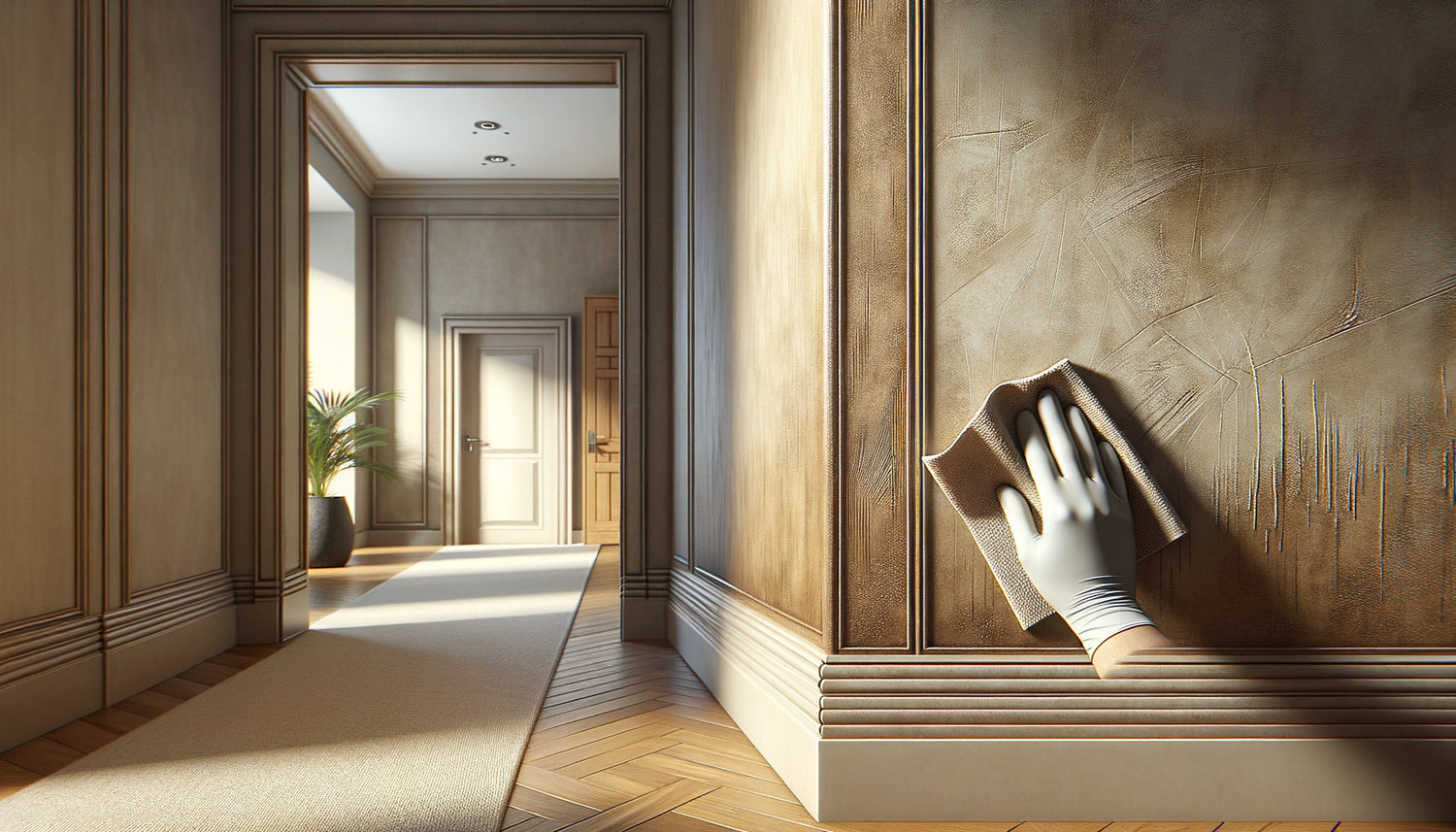
Every six months, a simple application of colorless metalloplastic wax – the kind used for car bodies – revives protection and maintains abrasion resistance. Fifteen minutes of work for lasting peace of mind.
Transform your hallways into elegant galleries
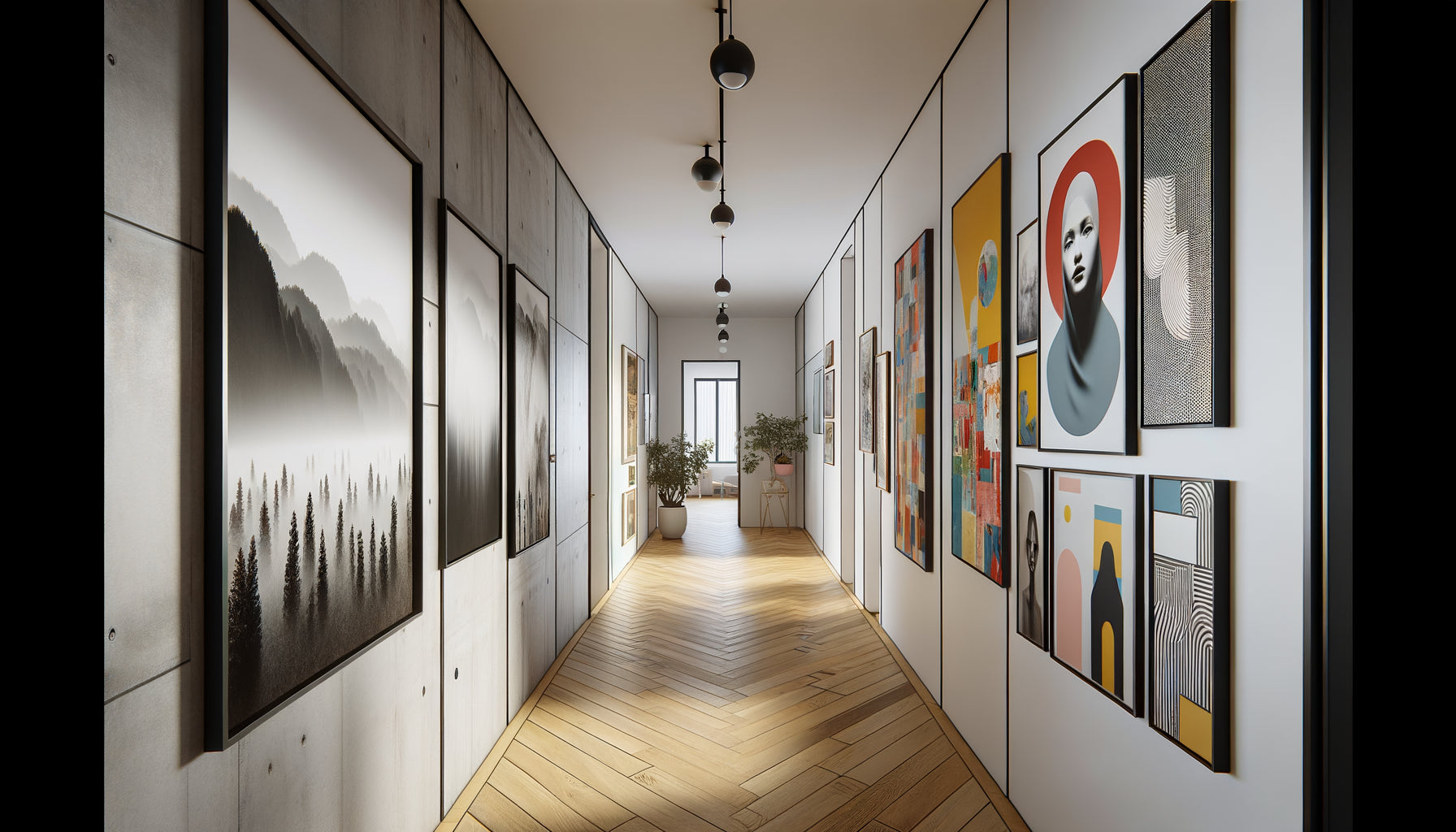
Discover our exclusive collection of hallway art that enhances your walls while naturally diverting attention from friction areas.
Composing your finishing system: the zone strategy
Rarely is a single finish sufficient. Smart hallways combine several solutions according to the zones of solicitation.
My proven formula for a typical hallway: wood paneling or waxed plaster up to 120 cm in height (maximum friction zone), then satin paint above (less stressed area). This visual separation structures the space while optimizing resistance where it is needed.
In corners – these points of intense friction where everyone corrects themselves –, I even recommend installing discreet metal corner protectors or painted wood reinforcements. Visually invisible when well done, they absorb impacts instead of your finish.
Another field-tested trick: apply an additional protective wax to critical areas, even on satin paint. This sacrificial layer is easily renewed and significantly extends the life of the underlying finish.
Living with your finishes: accepting fertile imperfection
Let's end with a liberating truth: no finish remains eternally pristine. The best solutions are not those that resist everything – they do not exist – but those that age harmoniously.
Signs of life are part of a place's history. A hallway that is too perfect seems uninhabited, almost unsettling. Smart finishes allow these micro-marks while avoiding visible degradation.
Look at medieval monasteries, Venetian palaces, Parisian mansions: their hallways bear centuries of passages, and yet they radiate. Because their finishes – stones, lime plasters, waxed woodwork – were designed to absorb time rather than fight it.
Your hallway can achieve this serenity. Choose abrasion-resistant finishes suited to your actual use, maintain them consistently but without obsession, and let your interior live.
In a few years, you will discover with amazement that these surfaces that you thought fragile have weathered the seasons without needing any retouching. This peace of mind, this confidence in the durability of your decor, is priceless.
And when the time comes – in ten, perhaps fifteen years – when a renovation is needed, it will be by aesthetic choice, out of a desire for change, never due to an urgent need caused by deterioration. That's exactly the freedom that good finishes provide.