I remember this endless hallway in an apartment in the 16th arrondissement. Three meters long, narrow, banal. The owner had told me: "It's just a passageway, no one pays attention to it." Three weeks later, after installing a series of six black and white photographs of Parisian doors, that same hallway became the subject of conversation for every visitor. It was no longer a passageway: it was an experience.
Here's what the right artistic choice brings to your hallway: a visual coherence that naturally guides the eye, an affirmed personality that transforms the space into a private gallery, and a harmonious balance between dynamism and serenity. Three benefits that radically transform the perception of this space, too often neglected.
The frustration is always the same: you hesitate between the graphic rigor of a series of photographs and the visual richness of varied paintings. You fear that repetition will be tiresome, or conversely, that too much diversity will create chaos. You imagine investing time and money to ultimately obtain a shaky result that weighs down the space instead of sublimating it.
Rest assured: this dilemma actually hides a magnificent opportunity. Your hallway already has the clues that will guide you to the right choice. Its length, its brightness, its role in your daily life are already speaking. You just need to learn to listen to them. In the lines that follow, I reveal the method I have been applying for fifteen years to transform any hallway into a true visual signature of the home.
The hidden anatomy of your hallway reveals everything
Before even thinking about artworks, observe your space as an architect would view a blank canvas. The length dictates the rhythm. A hallway less than two meters long requires restraint: three to four works maximum, whether photographic or pictorial. Beyond three meters, you enter the territory of the series, where repetition becomes a narrative force.
The width influences boldness. In a narrow passage less than one meter wide, paintings with bright colors and complex compositions can suffocate. Photographic series, with their often controlled palette, then create a welcome breath. Conversely, a hallway that is wide, more than 1.20 meters, can absorb the chromatic and stylistic variety of several paintings without losing its unity.
Then comes light, this silent accomplice. A hallway bathed in natural light makes the colors of the paintings sing, reveals nuances, amplifies contrasts. In a dark space or artificially lit space, black and white or sepia photographs gain a theatrical depth that colored paintings sometimes struggle to achieve.
Photographic series: the power of the narrative thread
A photographic series tells a linear story. Six photos of European windows, four portraits of old doors, five landscapes of the same coast at different times: thematic repetition creates a visual connecting thread that transforms walking into a contemplative stroll.
The major advantage? Instant consistency. You don’t have to worry about style discrepancies, palette or frame mismatches. A series immediately establishes its visual vocabulary. The eye travels from one image to the next without interruption, in a smooth movement that optically lengthens the space.
I applied this approach in a four-meter hallway where four closed doors coexisted. Seven square photographs of twilight skies, all in the same shades of rose powder and pearl gray, spaced regularly. The result: the hallway was transformed into an airy gallery where the eye no longer bumps into the doors, but glides over a continuous visual breath.
When to prioritize photographic series
Opt for photographic series if your hallway is narrow (less than one meter), long (more than three meters), or if it serves several rooms in a constant flow. The series is particularly suitable for minimalist, Scandinavian or contemporary interiors where graphic rigor naturally finds its place.
Also choose this option if you are looking for visual tranquility. Photographic series, especially in black and white or grayscale, lower the level of sensory stimulation. Ideal for a hallway leading to bedrooms, where soothing is more important than excitement.

Varied paintings: mastered eclecticism
At the opposite end of the spectrum, varied paintings offer an incomparable sensory richness. An abstract landscape, an expressionist portrait, a figurative still life: each work becomes a window into a distinct universe. This diversity creates visual stopping points, invites you to pause, transforms the hallway into a cabinet of curiosities.
The approach works beautifully in eclectic, bohemian or classic interiors where mixing styles is part of the decorative DNA. I recently worked on a hallway in a master's house where an antique oil painting depicting a hunting scene coexisted with two botanical watercolors and a vibrant contemporary acrylic. Far from the dreaded chaos, the ensemble exuded a defined personality, that of passionate collectors.
But be warned: variety demands an invisible discipline. Without a unifying link – a common color palette, an underlying theme, or coordinated frames – you quickly slide into chaotic accumulation. The secret lies in what I call the "rule of three anchor points": find three recurring elements (a dominant color, a type of frame, a portrait or landscape orientation) that create a consistent breath despite the apparent diversity.
When to Dare Varied Paintings
Varied paintings thrive in wide (over 1.20 meters), bright, and relatively short (under three meters) hallways. They are suitable for transitional spaces serving living areas – living room, office, library – where visual energy stimulates rather than overwhelms.
Choose this path if your interior already celebrates the mix of eras and styles, if you own works acquired over time and want to offer them a common scene, or if you aspire to create a personal gallery effect that tells your aesthetic journey.
The Hybrid Solution: The Best of Both Worlds
What if the real answer lay between the two extremes? I discovered this approach by accident, during a project where budget limitations restricted the number of photographs in an intended series. We complemented four black and white architectural photographs with two small abstract paintings with emerald green touches – the only color present in the hallway via a rug.
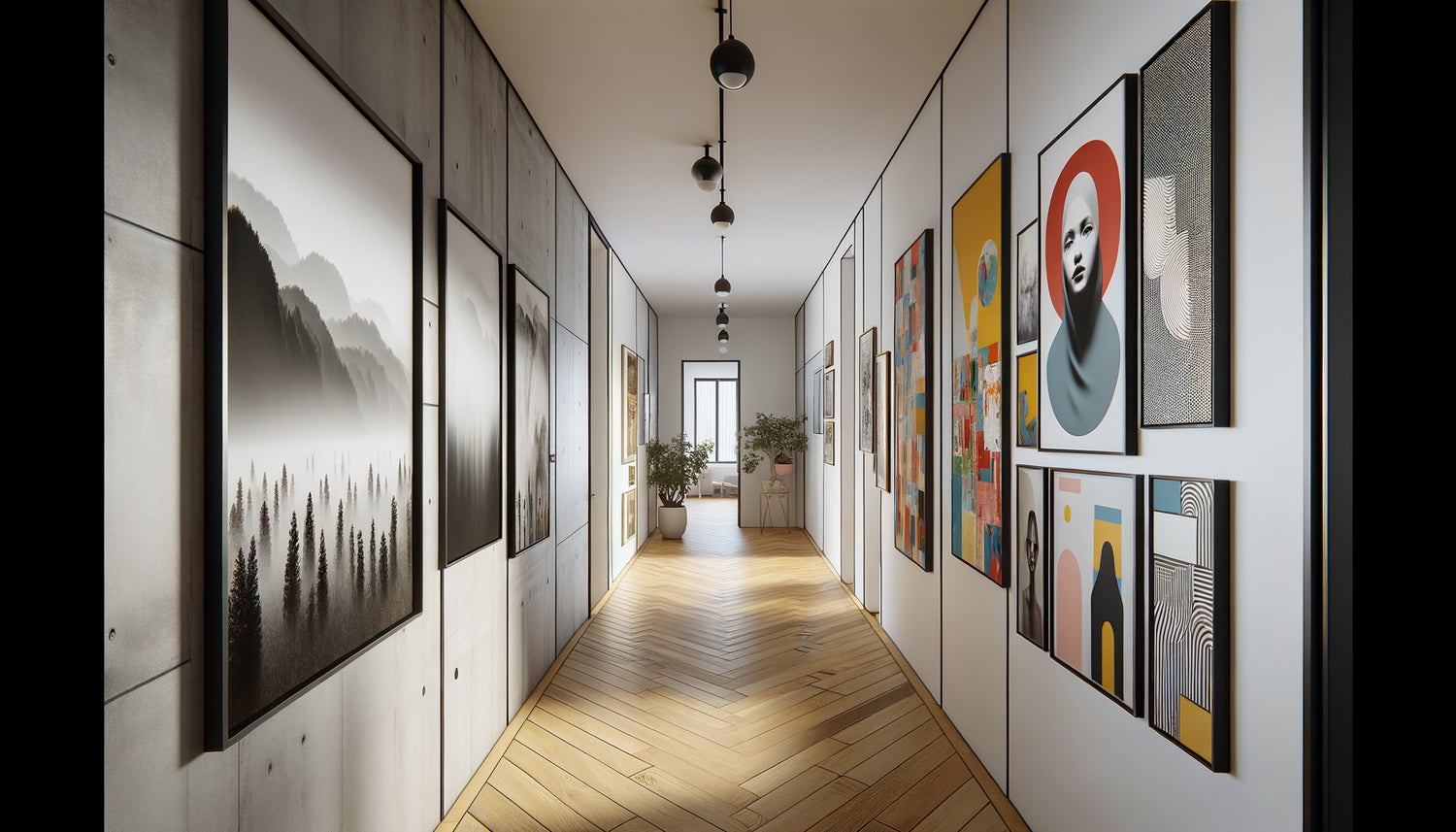
The result exceeded our expectations. The photographs established the visual structure, the rhythm, the breath. The two paintings created surprise accents, exclamation points in an otherwise regular sentence. This hybridization works remarkably well when you respect a golden rule: the series must represent at least 70% of the total display.
Specifically, in a hallway welcoming six artworks, install four or five photographs in series, then slip one or two paintings into strategic locations – often at the beginning and end of the journey, like an introduction and conclusion to your visual narrative.

The Mistakes That Instantly Ruin Harmony
Some wrong turns come back with a disarming regularity. The first: mixing formats and orientations without intention. Alternating portrait and landscape, small and large, creates a tiring visual instability. If you choose variety, at least maintain consistency in formats or orientations.
Second trap: ignoring the hanging height. The center of each work should be between 1.50 meters and 1.60 meters from the floor – the natural height of the gaze. In a hallway, this consistency becomes crucial because the eye cannot take the necessary distance to compensate for differences.
Third frequent mistake: underestimating the importance of spacing. Between each work, maintain a regular distance of 5 to 10 centimeters. This geometric discipline unifies even the most heterogeneous sets. In my projects, I often use a simple piece of cardboard cut to the right dimension to ensure regularity.
Finally, the cardinal sin: choosing only with your eyes, without considering daily rhythm. How many times a day do you walk through this hallway? Ten, twenty, thirty times? A soothing photographic series will be less tiring than a collection of intense expressionist paintings. Your aesthetic choice must dialogue with your daily reality.
Your hallway deserves more than just a passage
Discover our exclusive collection of wall art for hallway that transform each transition into a memorable visual experience, whether they form harmonious series or carefully balanced eclectic compositions.
Your hallway is already speaking to you: listen to it
At the end of this journey, one truth emerges: there is no universal answer, only personalized answers. Your choice between photographic series and varied paintings depends on the anatomy of your space, your aesthetic sensitivity, and the role that this hallway plays in your daily life.
Photographic series offer coherence, fluidity and visual tranquility. Varied paintings bring richness, personality and sensory stimulation. Intelligent hybridization combines structure and surprise. Three legitimate paths to a single goal: transform a neglected transition space into a visual signature of your home.
Tomorrow morning, before going to work, stop for a minute in your hallway. Observe the light, feel the width, imagine your gaze traveling along the wall. This silent observation will blow you the answer. And when you hang the first artwork, you'll immediately know if you listened to your space or simply followed a trend. The difference between these two approaches? It is measured in years of daily satisfaction.
Frequently asked questions
How many artworks should you plan for a 3-meter hallway?
For a three-meter hallway, aim for between four and six works depending on their format. If you opt for a photographic series, five medium-sized pieces (40x50 cm) create an ideal rhythm with spacing of 8 to 10 centimeters. For varied paintings, limit yourself to a maximum of four works to avoid visual saturation. The rule of thumb: in a narrow hallway, always prioritize breathing space over accumulation. A slightly under-decorated wall will always look more elegant than an overloaded one. Start with fewer artworks than planned, live with that arrangement for a few weeks, then adjust if necessary. This progressive approach avoids costly mistakes and respects the natural balance of your space.
Can you mix black and white photographs with colorful paintings?
Absolutely, but this combination requires a precise strategy. The black and white of the photographs should represent at least 70% of your arrangement to establish a stable visual base. Colorful paintings then intervene as strategic accents, ideally placed at the beginning or end of the hallway. Choose paintings whose color palette remains restricted – two or three colors maximum – to maintain consistency. I have achieved magnificent results by combining five black and white architectural photographs with two botanical watercolors in sage green tones. The secret? The paintings pick up on the tones present elsewhere in the hallway – the rug, a painted door, a luminaire. This chromatic resonance creates a natural dialogue between the different works despite their technical differences.
How to choose between identical frames and varied frames?
Frames constitute the invisible unifying link of any arrangement. For a photographic series, identical frames naturally reinforce coherence – same color, same baguette width, same style. This is the safest and most elegant option. For varied paintings, you can allow for slight variation in the frames, but always maintain one common point: either the color (all black, all natural wood, all white), or the style (all modern and sleek, all classic molded). The golden rule: the more different your works are stylistically, the more similar your frames should be. Conversely, a very coherent photographic series can tolerate subtle variation in frames without losing its unity. When in doubt, uniformity of frames remains your best ally to create instant visual harmony.