In the hushed waiting room of an integrative medicine center in Copenhagen, I observed a fascinating scene: three patients, attending different consultations, found themselves hypnotized by the same reproduction hanging on the wall. Not a soothing landscape nor any abstraction, but a vibrant work of concentric circles and colorful spirals signed Hilma af Klint. One of them murmured: "I already feel better just looking at it."
Here's what Hilma af Klint’s art brings to holistic care spaces: a vibrational dimension that harmonizes energies, a universal visual language that transcends words, and a profound spiritual intention that resonates with alternative therapeutic approaches. This Swedish pioneer of abstraction, long overlooked, has become the preferred artist for practitioners who consider the visual environment as a therapeutic tool in its own right.
Many holistic therapists desperately seek to create spaces that truly promote healing. They accumulate soulless decorative works, multiply conventional new age symbols, but their patients remain in nervous anticipation, impermeable to the atmosphere meant to soothe them. The problem? These artistic choices lack spiritual authenticity and energetic coherence.
Yet, there is an artistic approach that precisely meets these needs. Hilma af Klint’s work was not created to decorate, but to transmit subtle frequencies. Her paintings are the result of twenty years of mediumistic and spiritual research, designed as bridges between the visible and the invisible, between matter and spirit.
Let's discover together why this visionary artist has become essential in the world of holistic care, and how her creations literally transform the therapeutic experience.
An intuitive artist who painted to heal, not to exhibit
Hilma af Klint was not an ordinary artist seeking recognition. Trained at the Royal Academy of Fine Arts in Stockholm, she deliberately abandoned her promising career as a traditional painter to follow a radically different path. In 1896, she joined a spiritualist group named “The Five,” composed exclusively of women practicing spiritism and deep meditation.
What fundamentally distinguishes Hilma af Klint is her creative intention. Her monumental abstract works, created as early as 1906 – well before Kandinsky or Mondrian –, were not intended for galleries. She considered them as visual transmissions of spiritual teachings received during mediumistic sessions. Each form, each color, each composition followed a precise protocol dictated by what she called the “Higher Masters.”
This intentional dimension resonates deeply with the modern holistic approach. When a naturopath, acupuncturist, or energy therapist chooses a work by Hilma af Klint, they are not simply hanging a decoration: they are installing a vibratory tool designed with therapeutic awareness. The artist herself claimed that her paintings should « wait for their time » before being understood. This time seems to be ours, where medicine and spirituality reconcile.
The universal geometric language that speaks to the unconscious
Observe any work from the series « The Ten Largest » or « The Swan »: you will immediately recognize spirals, circles, ovals, perfect symmetries. These forms are not accidental. Hilma af Klint drew on a universal symbolic repertoire present in all spiritual traditions – from Tibetan mandalas to cathedral roses, from alchemical diagrams to Vedic representations.
In a holistic care center, this sacred geometry functions as a silent but powerful language. It activates what Carl Jung called the « collective unconscious », these archetypes deeply rooted in the human psyche. An anxious patient, confronted with Hilma af Klint's harmonious forms, unconsciously feels an alignment effect, even without intellectually understanding what they are looking at.
Practitioners of chromotherapy particularly appreciate her palette: deep blues evoking spiritual serenity, soft pinks symbolizing universal love, bright yellows representing the awakening of consciousness. Each color in Hilma af Klint corresponds to a specific vibrational frequency, a concept that finds a direct echo in color therapies practiced in alternative medicine.
Symmetry as a tool for recentering
The omnipresent symmetry in Hilma af Klint's work is not just aesthetic. It creates a natural focal point that helps the gaze – and by extension, the mind – find its center. In a waiting room where apprehension reigns, or in a consultation room where the patient must reconnect with themselves, this symmetry acts as a soothing visual anchor.
Therapists specializing in guided meditation sometimes use her works as visualization supports. The balanced structure of the compositions facilitates entry into a meditative state, allowing patients to let go of the mind to access deeper layers of their being.

When the invisible becomes visible: affinity with energetic practices
The very essence of Hilma af Klint's work rests on a fundamental principle: to make the invisible visible. Her paintings attempt to capture subtle dimensions of reality – auras, energy flows, spiritual planes – exactly what holistic practitioners seek to perceive and balance.
An acupuncturist works with Qi, this vital energy circulating in meridians. A magnetic healer channels energy flows. A Reiki practitioner harmonizes chakras. All these professionals share with Hilma af Klint a visionary energetic view of existence. When they hang her works in their care spaces, they create total vibrational coherence between their practice and their environment.
Hilma af Klint's « Altarpieces » series are particularly popular. Designed as veritable secular altars, these monumental triptychs evoke religious retables while transcending any specific doctrine. They create a non-denominational sacred space, perfectly suited to care centers that welcome patients of all beliefs or no belief.
The « spiritual recognition » effect in patients
Here is a phenomenon reported by many holistic therapists: when they install a work by Hilma af Klint in their office, a surprising number of patients recognize it or exclaim « This artist! ». Since the record exhibition at the Guggenheim Museum in 2018-2019 which attracted more than 600,000 visitors, Hilma af Klint has become a cultural icon within spiritual communities.
This recognition immediately creates an implicit common ground. The patient intuitively understands that they are in a space where the spiritual dimension of health is taken seriously. The work becomes a marker of shared values, a subtle signal that this care place adopts a holistic and open vision of healing.
For less familiar patients, Hilma af Klint's works spark curiosity and open conversations. How many consultations began with a question about this « strange colorful painting » before evolving into discussions about vital energy, the mind-body connection, or the subtle dimensions of being? Art then becomes a pedagogical tool facilitating the introduction to holistic concepts.
Historical and artistic legitimacy
Beyond the spiritual dimension, choosing Hilma af Klint also brings cultural credibility to alternative care spaces. It's not a generic esoteric poster, but an artist recognized by the world’s leading museums, studied in universities, celebrated by art historians.
This legitimacy reassures some skeptical or new patients to holistic approaches. The artistic excellence of Hilma af Klint elevates the entire therapeutic environment, signaling professionalism and cultural refinement.

How to integrate this energy into your care space
Integrating works inspired by Hilma af Klint into a holistic healing center requires intentional consideration. It's not simply about filling walls, but about creating a coherent vibrational ecosystem.
Prioritize high-quality reproductions that respect the subtle nuances of colors. Giclée printing on canvas or art paper preserves essential chromatic vibrations. Medium to large formats (minimum 60x80 cm) allow compositions to deploy their energetic presence without overwhelming the space.
Location is enormously important. Hilma af Klint's works work wonderfully facing patients sitting – in waiting rooms to prepare a receptive state, or in consultation rooms as a focal point during sessions. Some meditation practitioners place them at eye level when lying down, transforming the ceiling into a meditative portal.
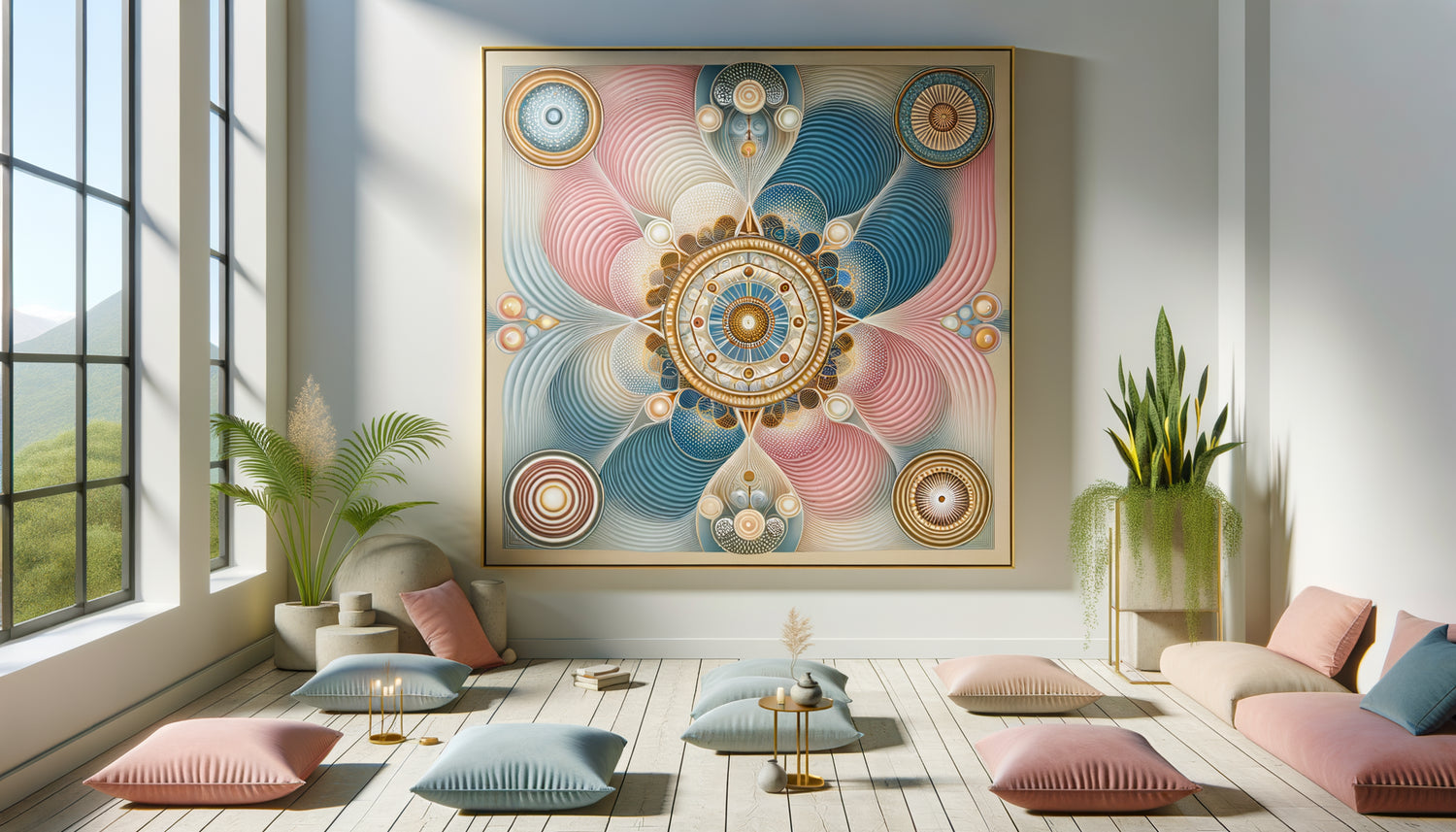
Combine them with a clean environment. The visual complexity of Hilma af Klint's works requires a restrained context: white walls or in neutral tones, minimalist furniture, soft natural light. Let the work breathe, surrounded by empty space that amplifies its energetic presence.
Transform your care space into a sanctuary of healing
Discover our exclusive collection of wall art for medical offices that harmonizes refined aesthetics and therapeutic intention to create the ideal vibrational environment.
Beyond decoration: a therapeutic tool in its own right
The most advanced practitioners no longer consider Hilma af Klint's works as mere decorative elements, but as true extensions of their therapeutic practice. Some actively integrate them into their care protocols.
Sophrologists invite their patients to focus on a reproduction during breathing exercises, using the shapes as a support for concentration. Kinesiologists report that the presence of these works facilitates muscle testing, as if the harmonized energetic environment made the body more readable. Bach flower consultants note that their consultations have become deeper and more intuitive since they installed a large reproduction in their office.
This active use perfectly aligns with Hilma af Klint's own vision for her art: not objects to be passively contemplated, but catalysts of transformation, tools to access expanded states of consciousness and facilitate healing at all levels – physical, emotional, mental, and spiritual.
The cumulative effect on practitioners themselves is remarkable. Working daily in the presence of these works nourishes their own energetic alignment, protects them from compassion fatigue, and maintains their connection to the sacred dimension of their therapeutic mission.
Your healing space deserves this vibrational coherence
Imagine your next patients stepping through the threshold of your practice. Before you even exchange a word, their nervous system captures the visual harmony, their chakras resonate with the colored frequencies, their mind subconsciously recognizes the archetypal symbols. They have already entered the therapeutic space, already open to transformation.
The legacy of Hilma af Klint reminds us that authentic art, created with spiritual intention, possesses real power. In a world where holistic approaches are gaining recognition, where more and more people seek care that honors all dimensions of their being, your aesthetic choices become therapeutic statements.
Start with a single work, placed intentionally. Observe how it transforms the atmosphere, how your patients react, how your own practice deepens. Hilma af Klint's art has been waiting for over a century to fulfill its mission: to facilitate awakening and healing. Your healing space could be its next field of action.
Frequently Asked Questions
Do Hilma af Klint's works suit all types of holistic practices?
Absolutely, and that is precisely their strength. Whether you practice acupuncture, naturopathy, energetic osteopathy, Reiki, sophrology or any other holistic approach, Hilma af Klint's works function as a universal language. Their abstraction allows each patient to project their own interpretation without feeling confronted with a specific belief system. They create a non-denominational sacred space that respects all spiritual sensitivities. Practitioners find that these works facilitate entry into a receptive state, regardless of the type of care offered. Their dimension, both scientific – through geometry – and spiritual – through intention – resonates with the very essence of the holistic approach that considers human beings in their entirety body-mind.
How to explain the choice of this art to patients not sensitive to spirituality?
You don’t need to mention Hilma af Klint’s mediumnistic dimension if it doesn't resonate with your patient. Simply present her as a pioneer of abstract art, predating the male names usually cited. Highlight the soothing effect of colors and harmonious shapes, a fact scientifically documented in environmental psychology. You can also evoke the fascinating historical aspect: a visionary female artist whose work remained secret for decades. The pure beauty of her compositions speaks for itself, even to those who are not interested in the spiritual dimension. Many patients will simply appreciate the aesthetic refinement and cultural sophistication that these works bring to your space. The energetic effect operates anyway, whether or not the conscious mind understands it.
What size and location to prioritize for an individual consultation room?
For a consultation room where you receive patients one-on-one, prioritize a medium to large format (between 60x80 cm and 100x120 cm) placed within the natural field of vision of the patient sitting or lying down. The ideal is a position slightly above eye level when the patient is seated, creating an invitation to look without forcing attention. Avoid placing the work directly behind you if you are facing the patient – this would divide their attention. Prefer a side wall or facing the patient, where their gaze can naturally rest during moments of silence or introspection. For treatment rooms with massage tables, some practitioners install the artwork on the ceiling or on the wall facing the table, transforming relaxation time into a contemplative experience. Ensure soft and natural lighting that reveals the subtleties of color without creating reflections. The space around the work should remain uncluttered to avoid diluting its energetic impact.