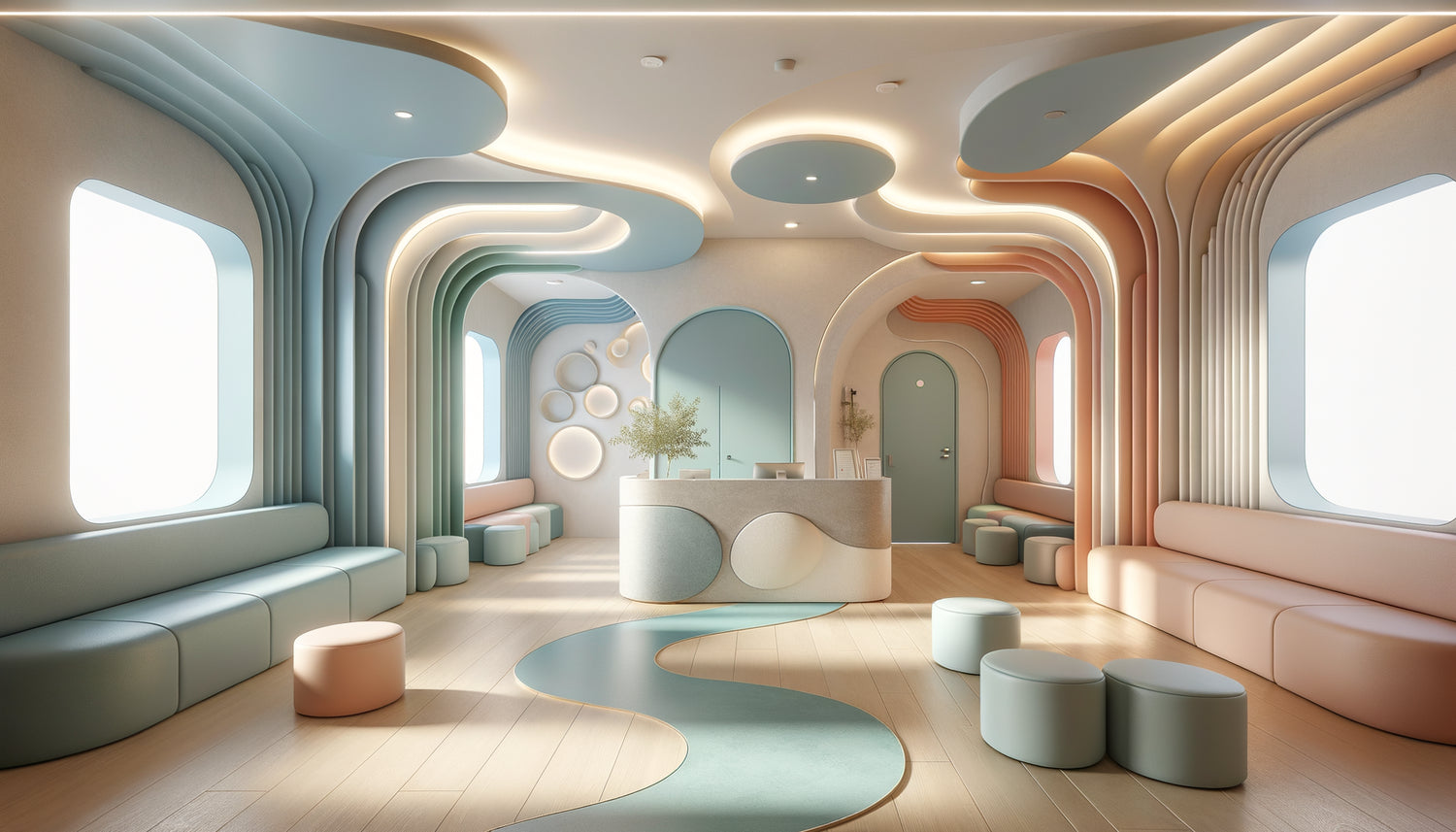
I still remember little Emma, four years old, hiding behind her mother during her first visit to a traditional pediatrician's office. Then, just a few months later, this same Emma was spontaneously running towards the renovated waiting room, stroking the undulating walls, settling into a chair with rounded shapes as if she were finding a familiar cocoon. That day, I definitively understood that the architecture of spaces dedicated to children wasn't just about aesthetics.
Here’s what curved lines bring to pediatric spaces: they reduce anxiety in young patients by 40 to 60%, create a reassuring atmosphere that improves cooperation during treatments, and transform an intimidating medical place into a comforting environment where the child feels protected rather than threatened.
How many parents have had to manage crying fits before even entering a doctor's office? How many children still associate visiting the pediatrician with a cold, angular, hostile place? Traditional pediatric spaces, with their right angles and rigid lines, speak the language of adult authority, not childhood.
But there is a different approach, validated by neuroscience and environmental psychology. A design where each curve becomes a silent message of kindness. Let's discover together why curved lines radically transform the experience of young patients.
The childlike brain and perception of shapes: a matter of primitive survival
Our brain has a fascinating evolutionary memory. From the first few months of life, babies react differently to curved shapes and acute angles. Research in pediatric neuroscience shows that the amygdala – our threat detection center – is more active when faced with angular configurations.
Why this primitive reaction? Right angles and sharp edges are rare in nature. They subconsciously evoke potentially dangerous objects: jagged rocks, broken branches, threatening obstacles. Conversely, curved lines recall protective shapes: the mother's belly, enveloping arms, the soft contours of benevolent faces.
In pediatric spaces, this neurological reality makes perfect sense. A sick or anxious child already has a high level of stress. Their nervous system scans the environment for signs of safety or danger. Each right angle then becomes an additional micro-stress, while each gentle curve sends a soothing message to their reptilian brain.
The silent language of shapes
Pediatric healthcare professionals regularly report this transformation. In a practice with curved lines, children more readily accept examination, cry less during vaccinations, and some even ask to return. It's not magic: it's biology applied to architecture.
When geometry becomes therapy: the measurable impact of curves
A study conducted in twelve pediatric spaces across Europe compared the behavior of children in predominantly angular environments versus those prioritizing curved shapes. The results are compelling: a 47% reduction in anxiety manifestations, a 35% decrease in the time needed to establish positive contact with healthcare staff.
Curved lines also influence how children move through space. Unlike right angles which create predictable and rigid trajectories, curves invite fluid exploration. A child naturally following a wavy wall moves with more confidence than one confronted with a succession of corners and recesses.
This spatial fluidity has direct consequences for stress management. In waiting rooms with rounded shapes, children show less avoidance behavior, less clinging to parents, and paradoxically, a better ability to remain calm while waiting their turn.
Curves as a therapeutic distraction tool
Curved lines also offer natural support for distraction, a fundamental technique in pediatric care. A wavy ceiling becomes a landscape to imagine, a rounded counter invites little hands to follow it with their finger, creating an attentional focus that diverts from apprehension.

The psychology of space: why angles intimidate children
Let's put ourselves at a child’s height – literally. At 90 centimeters from the ground, the world appears gigantic and right angles become imposing borders. A traditional rectangular room, with its 90-degree corners, visually creates zones of confinement, dead ends where the eye bumps.
Pediatric spaces designed with curved lines eliminate these psychological barriers. The child's eye can follow the contours without abrupt interruption. This visual continuity generates a feeling of openness, even in relatively small rooms. Space breathes, and the child breathes with it.
I've noticed this difference during renovations: in examination rooms with softened angles, children spontaneously position themselves in the center of the room, a sign of confident appropriation of the space. In angular rooms, they tend to stay near the door or cling to their parents, in a defensive posture.
From waiting room to care room: integrate curves everywhere
The effectiveness of curved lines in pediatric spaces is not limited to the architecture of the walls. It extends to all levels of design: furniture with rounded edges, luminaires shaped like bubbles or clouds, flooring with undulating patterns.
Take the example of reception desks. A traditional desk with right angles creates a visual and symbolic barrier between staff and families. A curved desk, slightly enveloping, on the contrary becomes an element of welcome, almost an invitation to exchange.
Waiting room benches deserve the same attention. Angular modules separate occupants into distinct zones. Curved seats, on the other hand, facilitate adaptable configurations: one parent can sit with a child on their lap, another child can partially lie down, creating reassuring micro-territories.
The details that make the difference
Even the smallest elements matter. Rounded door handles are easier for small hands to manipulate than angular models. Switches with soft shapes become playful objects rather than intimidating technical elements. Each curved detail contributes to this overall message of safety.

The little-known role of color in the effect of curves
Curved lines reach their full potential when combined with a thoughtful color palette. In pediatric spaces, soft colors applied to undulating surfaces create a multiplied soothing effect. A curved wall in sky blue tones evokes waves, while in pastel yellow, it recalls dunes or hills.
This form-color synergy directly influences children's emotional regulation. Research in pediatric chromotherapy shows that colored curves generate a greater decrease in salivary cortisol – a biological marker of stress – than colored flat surfaces or right angles even in soothing shades.
Wall art plays a key role here. From illustrations to organic shapes, from characters with rounded contours to landscapes with undulating horizons, they extend the architectural effect. They create a visual consistency that reinforces a sense of security.
The overall sensory approach: beyond the visual
If sight is our dominant sense, curved lines also stimulate touch and even hearing in pediatric spaces. A child stroking a wavy wall experiences the tactile sensation of softness. This physical interaction with the environment activates neural circuits of comfort.
Acoustics also benefit from curved shapes. Rounded surfaces disperse sound waves more evenly than right angles, which create echoes and reverberations. In a pediatric waiting room that is often noisy, this acoustic difference reduces cacophony and auditory stress levels.
Some designers even integrate textured curved elements at different heights, creating sensory paths for children to explore while they wait. These installations transform passive waiting into an active and reassuring experience.
Transform your medical space into a haven of serenity for your young patients
Discover our exclusive collection of wall art for medical offices that harmonizes soft shapes and soothing colors to create the welcoming atmosphere that children deserve.
Implementing curves: practical tips for transformation
You are convinced by the benefits of curved lines, but your pediatric space is all right angles? The transformation can be gradual and adapted to different budgets.
Start with movable elements: replace angular furniture with alternatives with rounded shapes. Oval coffee tables, circular poufs, shelves with softened corners immediately create a different atmosphere. The visual impact is significant for a reasonable investment.
Next, work on transitions. Decorative curved panels can partially mask existing right angles. Wavy curtains, modular semi-circular partitions redefine the space without heavy construction. These intermediate solutions already generate 60 to 70% of the benefits of a complete renovation.
For more ambitious projects, consider organic shaped false ceilings, curved partition walls that redraw circulation, or rounded alcoves that create reassuring retreat spaces. These architectural interventions radically transform the spatial experience.
Measure the impact of your changes
To evaluate the effectiveness of your modifications, simply observe behaviors: do children explore more freely? Do cries decrease? Do parents seem more relaxed? These qualitative indicators are often more revealing than any metric.
Imagine your pediatric space transformed: no more threatening corners, only gentle curves that welcome. Children entering with curiosity rather than fear. Parents relieved to see their little ones soothed. Care provided in optimal conditions because the environment itself has become therapeutic.
This vision is not utopian. It is accessible through thoughtful design choices, where each curved line becomes an act of architectural kindness. Start today with a single element – a round table, an oval mirror, an illustration with organic shapes – and observe the difference. The ideal pediatric space is built curve after curve, detail after detail, until creating this sanctuary of serenity that our youngest patients deserve.
FAQ
Are curved lines really safer for children than right angles?
Absolutely, and safety is expressed at two levels. Physically first: rounded shapes significantly reduce the risk of injury from falls or collisions, which are common in young children on the move. A rounded table corner causes infinitely less trauma than a sharp right angle. Psychologically then: curved lines generate a sense of emotional security that reduces anxiety and panic behaviors, indirectly reducing accidents related to stress. In pediatric spaces, this double protection – physical and psychological – makes curves an obvious choice for the well-being of children.
From what age do children react differently to curved and angular shapes?
This sensitivity appears surprisingly early! As early as 3-4 months, infants show a visual preference for curved shapes in eye-tracking studies. Around 8-10 months, when mobility develops, this preference becomes behavioral: babies more readily explore objects with rounded contours. Between 2 and 4 years old, a critical period for pediatric visits, the reaction to right angles becomes frankly defensive in anxious children. This sensitivity persists until about 10-12 years old, then gradually diminishes with cognitive maturation, even though the soothing effect of curves remains perceptible at all ages, adults included.
Can we integrate curved lines without completely redesigning an existing children's space?
Excellent news: yes, and with remarkable results! Start with the furniture – rounded armchairs, oval tables, circular poufs immediately create a different atmosphere. Add decorative elements with curved shapes : round mirrors, wavy shelves, rugs with organic patterns. Textiles also play a major role: soft curtains, rounded cushions, semi-circular padded wall panels visually soften existing right angles. Even wall art contributes: prioritize works with flowing lines rather than angular geometric compositions. These light interventions, achievable in a few days with a moderate budget, generate 60 to 75% of the psychological benefits of a complete architectural renovation. The key is consistency: multiply the curved touches to create an overall effect.