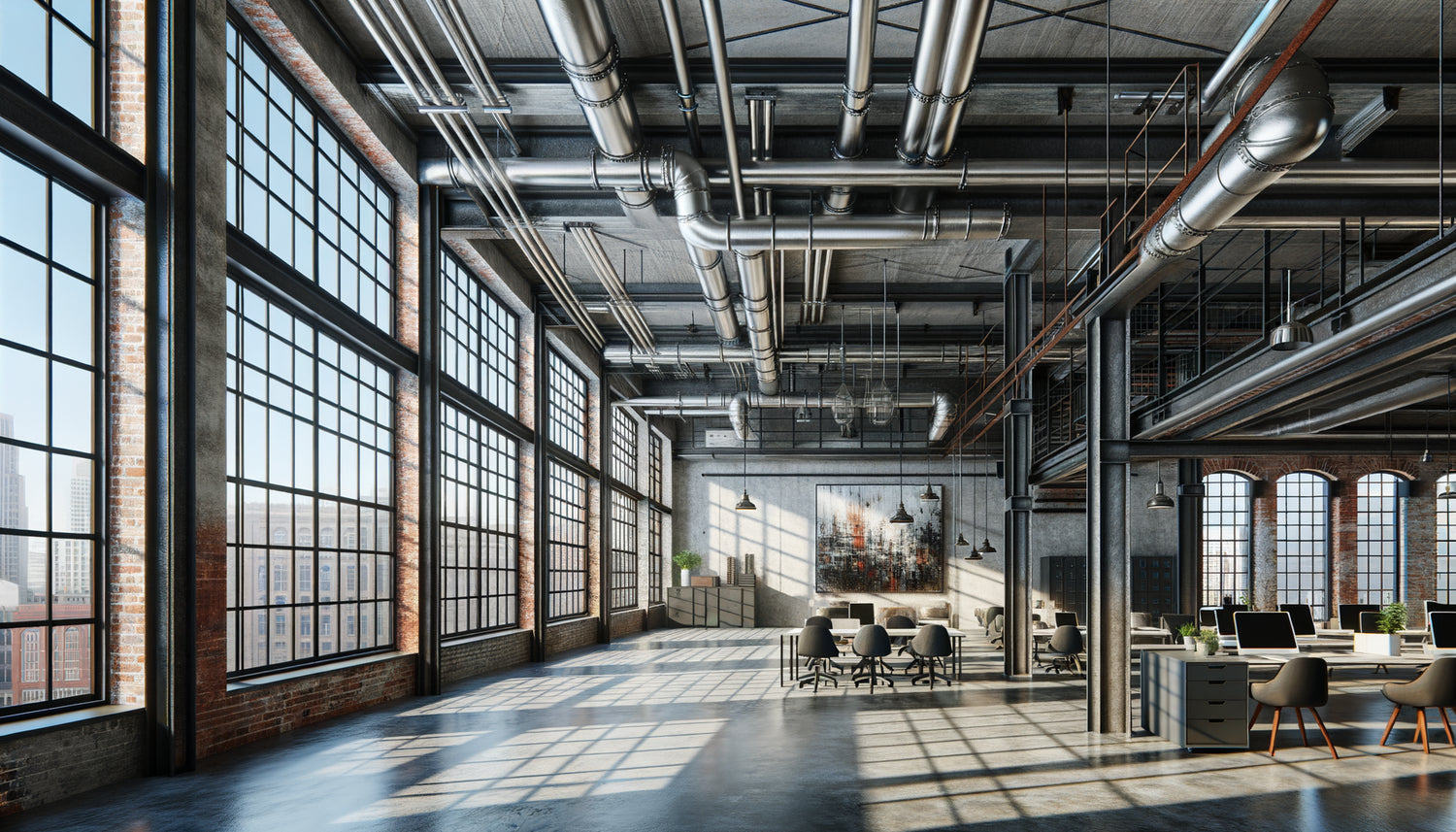
When I crossed the threshold of this law firm nestled on the third floor of a former textile mill, I immediately understood why so many professionals today choose renovated lofts. These spaces, with their exposed metal beams and immense industrial windows, tell a story of transformation. But one question kept coming back: how to dress these brick walls without betraying the soul of the place while asserting professional credibility?
Here's what industrial-style paintings bring to your loft law firm: natural architectural consistency, an affirmation of modern professional identity, and that rare ability to transform a raw space into a place of authority without losing its character.
Many lawyers installed in renovated lofts hesitate. They fear that the industrial style might be too cold, too austere to reassure their clients. They imagine that urban contemporary art lacks seriousness, that it is absolutely necessary to opt for classic or refined abstract works to appear credible. This uncertainty paralyzes them, and their walls remain bare for months, even years.
Yet, the answer is right in front of you, in the architecture of your space itself. The industrial style is not a passing trend: it is an authentic expression of your environment. When art dialogues with metal structures, exposed pipes, and raw textures, it creates a harmony that reinforces your image rather than diluting it.
In this article, you will discover why industrial paintings are not only compatible with renovated loft law firms, but how they become the most strategic choice to assert a distinct and memorable professional identity.
When architecture dictates the visual language
A renovated loft is never neutral. Its cast iron columns, patinated brick walls, and dizzying ceilings already create a powerful visual vocabulary. Introducing industrial-style paintings into this context is not a matter of decorative choice, but of narrative consistency.
I have observed how a large triptych in oxidized metal and resin, representing abstract urban structures, instantly transformed a meeting room. Rather than fighting the raw aesthetics of the place, the work amplified it, creating continuity between architecture and art. Clients immediately perceived that this firm understood its environment, that it fully embraced it.
This architectural consistency makes all the difference. When you hang an industrial painting in a loft, you are not decorating: you reveal the essence of the place. Metallic hues, rough textures, and geometric compositions echo the structural elements around you. The eye naturally flows from exposed beams to wall works, creating a fluid visual path.
The subtle balance between authority and modernity
A law firm must inspire confidence, expertise, stability. Many think that only classic works can convey these values. It is ignoring the symbolic power of industrial style.
Industrial paintings, with their metal structures, assemblages of raw materials, and rigorous compositions, evoke solidity, construction, and durability. A raw steel frame surrounding a work with precise architectural lines communicates as much authority as a traditional academic landscape, but with an added dimension: assumed modernity.
In a renovated loft, this modernity becomes a strategic asset. Your clients, whether they are entrepreneurs, creatives, or leaders of innovative companies, recognize in your space their own vision of the professional world. You are not confined to the dusty codes of a rigid profession: you are a contemporary advocate who understands current issues.
I have seen firms specializing in new technologies law, intellectual property, or business law use industrial style paintings as a visual signature. These works became conversation starters, markers of identity that immediately differentiated these professionals from their competitors located in conventional offices.

Materials that speak the same language
One of the most fascinating aspects of the marriage between industrial paintings and renovated lofts lies in the dialogue of materials. Metal, aged wood, polished concrete, exposed brick: your space is already a composition of raw and authentic textures.
Industrial style works exploit these same materials. A painting incorporating recycled metal, deliberately rusted elements, reclaimed wood or inclusions of industrial glass creates a material resonance with your environment. This tactile consistency reinforces the impression of authenticity and in-depth reflection.
In a firm that I accompanied, the choice of a series of three paintings combining Corten steel and mineral pigments transformed the reception hall. Visitors almost instinctively touched the works (before being told it was better to refrain), so much did the continuity between the building's metal columns and the painting frames seem natural.
Create functional zones through art
Renovated lofts often present a spatial challenge: how to define distinct functional spaces in vast open volumes without erecting partitions that would destroy the character of the place?
Industrial-style tableaux, with their strong visual presence, become remarkably effective zoning tools. A large vertical artwork behind a consultation desk instantly creates a focal point that defines the client reception area. An imposing horizontal composition in the waiting area visually anchors this space and distinguishes it from circulation areas.
I've observed how a four-meter-wide industrial polyptych, installed on a brick wall, transformed a simple hallway into a memorable welcome gallery. Clients naturally progressed to the meeting room, guided by this visual sequence that rhythmically paced their journey.
This strategic use of artworks does more than just decorate: it structures the spatial experience of your visitors, offering them clear visual cues while preserving the fluidity characteristic of lofts.

The color palette that unifies the space
The industrial style revolves around a recognizable color palette: metallic grays, deep blacks, bright whites, rusted ochres, steel blues. These shades are naturally found in the architecture of your loft: the patina of beams, the gray of concrete, the nuances of old brick.
Choosing industrial artworks that exploit this same color range creates an immediate visual harmony. But be careful: harmony does not mean monotony. The best offices I have visited used this neutral base to introduce strategic accent touches.
A predominantly gray and black artwork, punctuated by a vibrant rust orange, can subtly recall exposed brick while creating an emotional warmth point. A work playing on black and white contrasts amplifies the natural brightness provided by your loft's large industrial windows.
This color consistency ensures that your loft-renovated office does not look like a contemporary art showroom, but a considered professional space where every visual element contributes to a consistent overall experience.
Beyond aesthetics: the subliminal message
Choosing industrial-style tableaux for your office sends subtle yet powerful messages to your clients and partners. You assert a pragmatic approach, rooted in reality. You value authenticity over superficial appearances. You embrace a modern positioning without denying solid foundations.
These implicit values particularly resonate with an entrepreneurial clientele, leaders who have themselves built, transformed, and renovated their businesses. They recognize in your space the same principles that guide their own projects: transforming the existing, revealing hidden potential, creating value from solid structures.
One client confided to me that he had chosen this firm precisely because the space reflected his own business philosophy. The industrial artworks, with their recycled materials and transformation aesthetics, visually embodied the legal approach he was seeking: pragmatic, innovative, rooted in economic reality.
Transform your loft into a memorable professional signature
Discover our exclusive collection of artwork for law firms that perfectly harmonize industrial aesthetics and professional authority.
Visualize the transformation of your space
Imagine walking through the door of your firm tomorrow morning. The morning sun filters through the large industrial windows, illuminating the metal structures of your main industrial artwork. Your clients arrive, look up at this work that dialogues with the raw architecture, and immediately understand that they are in a different place.
They don't just see a decorated workspace: they perceive consistency, intention, an affirmed identity. Your renovated loft is like no other firm, and this singularity becomes your signature. Recommendations flow in because your clients remember you, your space, that impression of authenticity that marked them.
Start by identifying the main wall of your reception area. Observe how light circulates there, what architectural textures surround it. This is where your first industrial style artwork will find its place, creating that visual anchor point that transforms your loft into a truly exceptional firm.
Frequently Asked Questions
Isn't the industrial style too cold for a law firm?
This is a concern I often hear, but it’s based on a misunderstanding between industrial style and a neglected space. A quality industrial artwork, with its rich textures, subtle metallic nuances, and thoughtful composition, actually creates sophisticated warmth. The authenticity of raw materials brings a human dimension that overly smooth or impersonal works never achieve. In a renovated loft, this authenticity resonates with the building's history itself, creating a welcoming atmosphere precisely because it is true, without artifice. Add well-considered lighting, and these artworks reveal unsuspected depths that captivate the eye while reassuring your clients.
How to choose the right size for an artwork in a loft with large volumes?
Renovated lofts often have impressive ceiling heights that can be intimidating when choosing artworks. The essential rule: never undersize. A small painting lost on a huge brick wall will create a disconcerting unfinished effect. For a main wall in a reception area, aim for artworks at least 47 to 59 inches wide, or even more if your space allows. Industrial style artworks are best when imposing: their robust aesthetic admirably supports large dimensions without ever seeming ostentatious. Favor horizontal formats that visually widen the space, or vertical compositions to accentuate the already generous height of your ceiling. Don't hesitate to create wall compositions by combining several works that dialogue with each other.
Can I mix industrial style with other types of artworks in my office?
Absolutely, and it’s often desirable to avoid a monotonous showroom effect. The key lies in the consistency of materials and tones rather than absolute stylistic uniformity. You can perfectly combine a large industrial artwork in your main space with black and white urban architecture photographs in individual offices, or abstract works with metallic hues in meeting rooms. What matters is that these different pieces share a common visual vocabulary: subdued color palette, presence of authentic textures, structured compositions. In an office located in a renovated loft, this controlled diversity creates micro-atmospheres that enrich the spatial experience while preserving the overall identity. Simply avoid stylistic ruptures that are too brutal, which disorient the visitor and dilute your professional message.