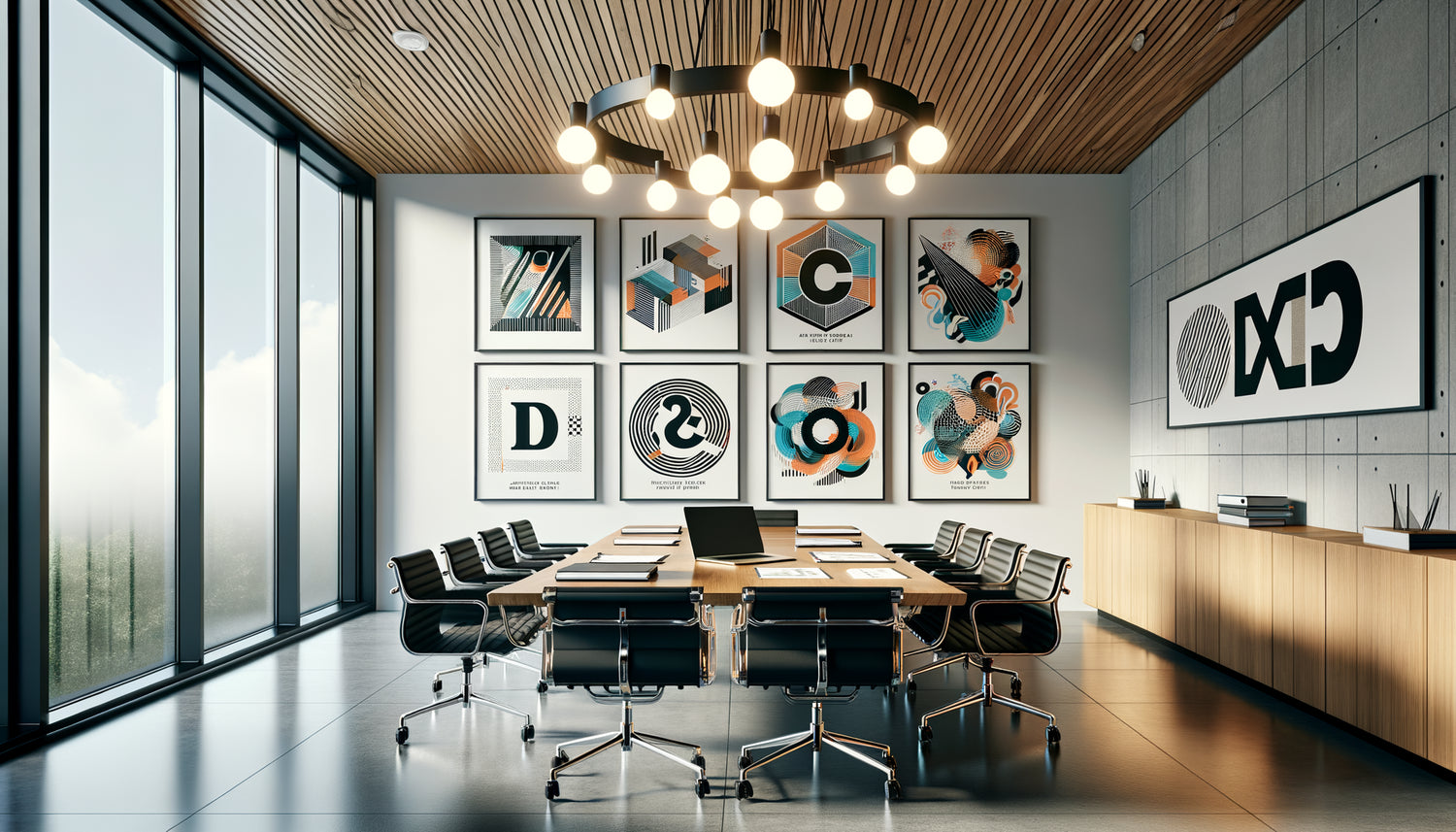
During my first visit to an intellectual property law firm, I was struck by a monumental Saul Bass lithograph dominating the wall behind the senior partner's desk. It wasn't a random decorative choice. In these spaces where patents, trademarks and creations are defended, graphic art becomes a silent manifesto, a statement of intent that dialogues with the very essence of their profession.
Here's what graphic art brings to intellectual property law firms: it visually embodies the protection of creation, it establishes an immediate emotional connection with creative clients, and it asserts the firm’s expertise in understanding aesthetic and legal issues.
Many business firms are content with neutral landscapes or generic urban photographs. But in the field of intellectual property, this approach misses a unique opportunity: to demonstrate, through the very choice of artworks, that the firm deeply understands the value of artistic creation. How to create an environment that speaks directly to designers, artists and innovators who walk through the door?
Graphic art is not just decoration. It's tangible proof that the firm grasps the creative dimension of its profession. Let me explain why this artistic presence radically transforms the perception of a legal space.
When the artwork becomes an argument: consistency between profession and aesthetics
An intellectual property law firm defends what is intangible: a typeface, a logo, a design. Displaying graphic artworks creates an immediate resonance between the firm’s mission and its visual environment. I advised a Parisian firm specializing in trademarks that chose to hang a series of original Cassandre posters. Every client entering instantly recognized the historical value of these protected graphic creations.
This consistency is not superficial. It communicates a deep understanding: the firm doesn't just deal with abstract files, it protects creative visions. Graphic art thus becomes a natural extension of legal expertise. A Milton Glaser poster or a Warhol screenprint recall that behind every brand, every design patent, there is a creative act that deserves protection.
Creative clients – designers, graphic studios, innovative companies – immediately feel this connection. They are not facing cold lawyers, but professionals who value creation to the point of integrating it into their own space. This first impression conditions all trust relationships.
The waiting room that inspires confidence
Waiting for an important meeting always generates some tension. In an intellectual property law firm, clients often arrive with fragile projects, unprotected creations, innovations they fear will be copied. The visual environment plays a crucial calming role.
I’ve noticed that high-quality graphic artworks transform that anxious anticipation into a moment of inspiration. A vintage Toulouse-Lautrec poster under museum framing, a typographic composition by Herb Lubalin, a creation by Shepard Fairey: these pieces tell stories of successful creativity, artistic visions becoming heritage. They suggest that the firm understands the creative journey in its entirety.
This atmosphere subtly reassures: if the firm invests in protecting and enhancing graphic artworks for its own walls, it will apply the same care to the creations of its clients. The space becomes a tacit promise of professionalism.
The detail that changes everything
A firm I advised took this logic even further: each graphic artwork displayed is accompanied by a small plaque mentioning the creator, the date, and the protection status (copyright, trademark, public domain). This subtle educational approach shows that intellectual property is not an abstract concept, but applies concretely to the creations around us.

A visual language that speaks to innovators
The clients of intellectual property firms are not all lawyers. They are creators, designers, entrepreneurs who think in images, shapes, and colors. For them, a visually stimulating environment is not a luxury, it’s a cognitive necessity.
Graphic art establishes a common language. When an industrial designer comes to file a design patent, they appreciate seeing the firm display a work by Dieter Rams or a Bauhaus poster. It's not name-dropping; it's mutual recognition: we speak the same aesthetic language, we understand the value of design.
This visual connection paradoxically facilitates technical discussions. The client feels that their aesthetic concerns will be understood, that the firm will not reduce their creation to dry legal paragraphs. Graphic art humanizes the legal space, making it accessible to creative minds.
Works that tell the story of protected creativity
Each graphic artistic movement has its iconic legal battles. Graphic art in an intellectual property firm can become a subtle narrative tool, telling the history of creative protection through the decades.
An Art Nouveau poster by Mucha evokes the beginnings of copyright applied to decorative arts. A Pop Art screen print recalls the battles surrounding artistic appropriation. A contemporary street art creation raises current questions about ephemeral works and their protection. Each piece becomes a silent history lesson.
The specialist lawyers I meet appreciate this educational dimension. During appointments, these artworks sometimes serve as starting points to explain complex concepts. 'Look at this Shepard Fairey poster: it perfectly illustrates the tension between homage and counterfeiting.' Graphic art becomes a support for reflection.
The balance between classic and contemporary
The most inspiring firms mix historical graphic works and contemporary creations. This coexistence shows that intellectual property protects both heritage and innovation. A Toulouse-Lautrec lithograph dialogues with a digital print by an emerging designer: same dignity, same protection, same value.

Beyond decoration: a strategic positioning
Displaying graphic artworks in an intellectual property firm is a sophisticated marketing positioning. This differentiates the firm from generalist structures that treat IP as a simple branch of commercial law.
This visual specialization attracts a specific clientele: creative studios, fashion houses, design agencies, innovative startups. These clients seek legal partners who understand their universe, not just their legal needs. Graphic art signals this understanding before even the first exchange.
I have noticed that firms that invest in authentic graphic works – originals, limited editions, collector's pieces – strengthen their credibility. They are not simply decorating; they collect and protect, exactly what they offer to their clients. This consistency is powerful.
Graphic art as a reflection of the evolution of law
Intellectual property law is constantly evolving, adapting to new forms of creation. Contemporary graphic artworks in a firm show this intellectual agility. A 3D artistic print, an augmented reality creation captured in image, an algorithmic typography: these choices signal that the firm understands current issues.
This modernity reassures innovative clients. They don’t want a firm stuck in the practices of the 20th century, but experts who anticipate tomorrow's legal questions. Avant-garde graphic art becomes proof of this forward-looking vision.
Your professional space deserves artworks that tell your expertise
Discover our exclusive collection of wall art for Law Firms that will transform your legal environment into a creative inspiration space.
Create an environment that inspires as much as it protects
Intellectual property firms who choose graphic art are not simply decorating their walls. They are creating a coherent visual ecosystem where each element recalls that creation has value, that innovation deserves protection, that aesthetics is not secondary but central.
Imagine walking through the door of a firm where a Saul Bass poster greets your gaze, where a Banksy screen print questions the limits of artistic appropriation, where a Massimo Vignelli typography celebrates creative rigor. You are not in a traditional law firm. You are in a space that understands your creative approach, that values your work even before legally protecting it.
This atmosphere changes the nature of discussions. Conversations are no longer only about clauses and filings, but about creative vision, artistic intention, and the patrimonial value of what is created. Graphic art elevates dialogue, making it richer, more human.
The next time you visit an intellectual property firm, observe the walls. If they are adorned with authentic graphic artworks, you will know that you are facing professionals who not only master the law: they understand the soul of creation. And that’s exactly what your project needs.
Frequently Asked Questions
Why graphic art rather than other forms of art in an intellectual property firm?
Graphic art has a direct relationship with the areas protected by intellectual property firms: trademarks, logos, designs, typography, commercial visual creations. Unlike abstract painting or sculpture, graphic art shares the same DNA as the creations that the firm legally defends. A historical poster, a designer's screen print, or a typographic composition immediately speaks to creative clients – agencies, designers, innovative companies. These works create a cultural resonance that facilitates connection between legal expertise and creative reality. Furthermore, graphic art has often been at the center of iconic legal battles over copyright, counterfeiting, or artistic appropriation, making it a particularly relevant and meaningful choice.
Do intellectual property firms choose original works or reproductions?
The most image-conscious firms prefer original artworks or authenticated limited editions, precisely because it demonstrates their understanding of the value of protected creation. Displaying a cheap reproduction in a firm that defends copyright would be contradictory! Original vintage posters, signed lithographs, numbered screen prints, or limited edition prints show that the firm applies to its own environment the principles it defends for its clients. Some firms even develop true collections, sometimes in partnership with galleries or emerging artists, creating an authentic commitment to contemporary creation. This approach is not just aesthetic: it builds professional credibility with a demanding creative clientele.
How does graphic art influence the perception of potential clients?
The visual environment of a firm immediately shapes client trust. When a creator enters a space adorned with quality graphic artworks, they intuitively feel that their aesthetic concerns will be understood. This first impression is decisive: it signals that the firm does not consider creation as a mere abstract legal object, but as an artistic vision having cultural and emotional value. Studies on professional environments show that clients unconsciously evaluate a firm's expertise through its aesthetics. A generic space suggests a standardized approach; a visually coherent space with specialization suggests in-depth expertise. Graphic art thus becomes a marketing differentiation tool that attracts a creative clientele and strengthens the firm’s reputation as a natural partner of innovators and designers.