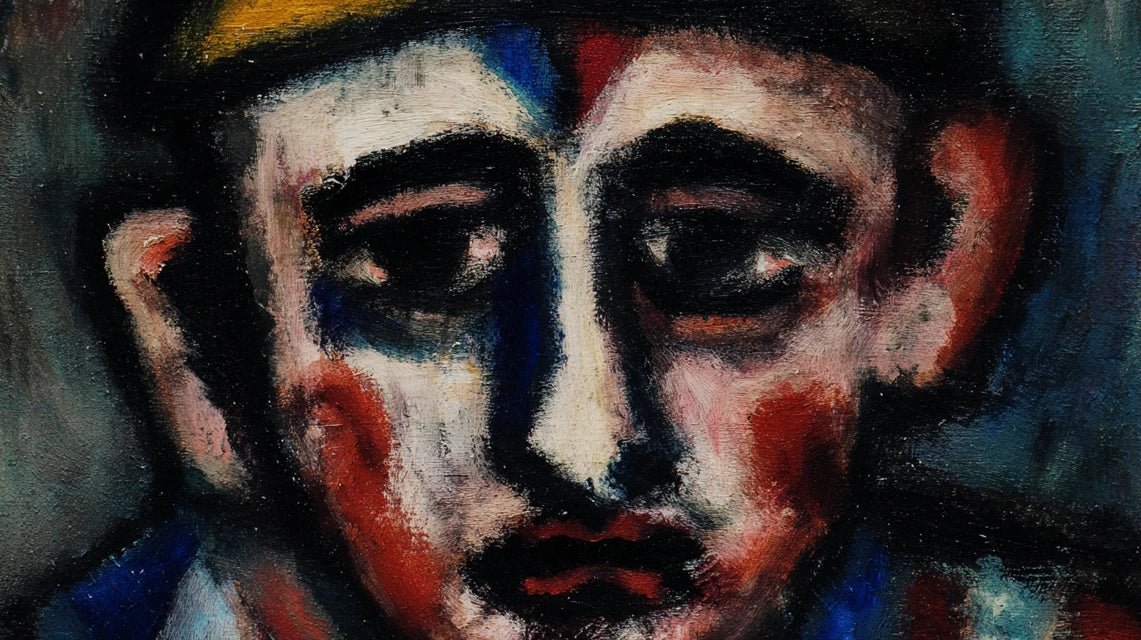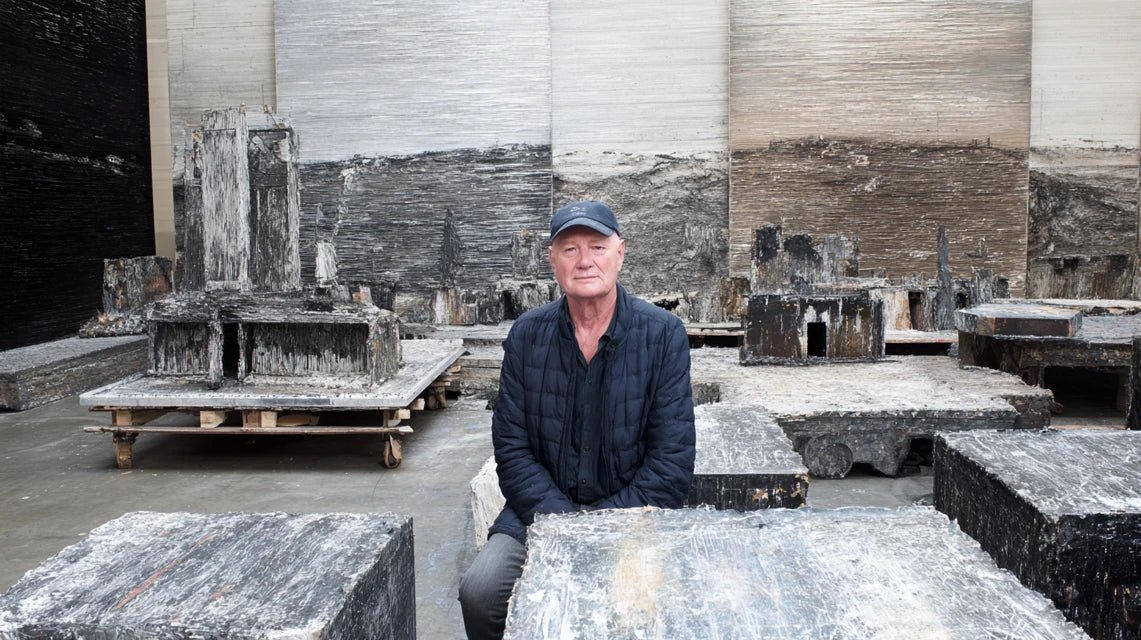
Imagine a man standing in a landscape of ruins, holding in his hands sheets of lead burning and handfuls of ashes still warm.
In the fumes of the workshop, Anselm Kiefer transforms the collective pain of Germany into artistic matter, sculpting literally the memory in concrete towers, lead books and calcined straw fields.
Born a few weeks before the Nazi surrender in 1945, this alchemist of memory has never ceased to probe the gaping wounds of History to extract a shocking artistic truth.
Discover how Anselm Kiefer became the sculptor of German consciousness, transforming the heaviest materials into works of unparalleled spiritual power.
Anselm Kiefer: the giant of contemporary German art who sculpts History
Understanding Anselm Kiefer means understanding how an artist can carry on his shoulders the weight of the history of a whole nation and transform it into disturbing beauty.
| Key biographical details | Artistic legacy |
|---|---|
|
Full name: Anselm Kiefer Birth: March 8, 1945, Donaueschingen, Germany Nationality: German Residence: Croissy-Beaubourg, France |
Movement: German Neo-Expressionism Style: Gesamtkunstwerk, alchemy of materials Flagship work: Margarethe (1981) Innovation: Artistic transmutation of lead and ashes |
But before delving into the universe of this man who dialogues with Paul Celan and the Kabbalah, it is first necessary to understand where this creative urgency comes from.
The roots of Anselm Kiefer: childhood in the ashes of the Reich
Donaueschingen, March 1945. In this small town in the Black Forest, near the French and Swiss borders, a child is born who literally grows up on the ruins of the Third Reich.
The child of bombings: Anselm Kiefer survives the bombings that ravage his region of Baden-Württemberg. This formative experience, where destruction meets birth, will forever mark his artistic vision. The little boy plays in the rubble, collects shards of glass and twisted pieces of metal - first materials for a future work.
After brief studies of law and literature, the young man feels an irresistible call to fine arts. He joins the Karlsruhe Academy and then that of Freiburg in the 1960s.
The principle of broken silence: From its beginnings, Kiefer understands that art must break the imposed silence on Nazism. For him, ignoring this history means condemning it to repeat itself. This conviction shapes his revolutionary approach to artistic material.
Anselm Kiefer in Divided Germany: Art Facing Silence
The Germany of the 1960s-70s lives in collective denial. The country, divided between FRG and GDR, refuses to confront its Nazi past. This era of forced silence becomes Kiefer's creative soil.
While the students of May 68 question parental authority, Kiefer questions historical authority. He rejects collective amnesia and chooses direct confrontation with memory.
His contemporaries - Georg Baselitz, Markus Lüpertz, Jörg Immendorff - also explore this wounded German identity, but Kiefer pushes introspection further than anyone else.
The Germany of the time values conceptual art and arte povera. Kiefer, however, chooses monumentalism and raw materiality - a revolutionary artistic choice.
The alchemist of collective trauma: Where his generation flees the past, Kiefer transforms it into raw material. He understands that art can operate an alchemical transmutation: transforming the lead of History into the gold of consciousness.
Anselm Kiefer's learning years: from Düsseldorf to provocation
In 1970, the young Kiefer knocks on the door of the Düsseldorf Academy to meet Joseph Beuys, the undisputed master of German total art.
This meeting with Beuys - a former Luftwaffe pilot turned shaman of contemporary art - revolutionizes his vision. Beuys teaches him that all materials can become art: fat, felt, honey, wax.
Kiefer pushes this logic to the extreme by incorporating straw, ashes, lead and earth into his first canvases. His works become deliberately fragile, temporary, perishable.
But it was in 1969 that he achieved his most resounding coup, even before meeting Beuys.
This learning period shapes his conviction: art must disturb to awaken consciences.
Anselm Kiefer's provocations: when art defies collective amnesia
1969: a young man of 24 travels across Europe with a camera, creating the series "Occupations" (Besetzungen) which will trigger a continental scandal.
In the ruins of Rome, on the beaches of Normandy, in front of the monuments of Paris, Kiefer photographs himself performing the Nazi salute. These black and white images freeze Europe in stunned silence.
Later, in 1983, a new provocation: he appears at the press conference for his exhibition at the Museum of Modern Art in Paris wearing a German military uniform.
Art as exorcism: "My biography is the biography of Germany," he declares. For Kiefer, these provocations are neither voyeurism nor neo-Nazism, but a collective exorcism exercise. He forces society to face what it prefers to forget.
These controversies reveal his revolutionary conception of art as surgery on collective memory.
The Revolutionary Art of Anselm Kiefer: from Neo-Expressionism to Alchemy
From the 1980s, Kiefer develops his unique artistic language, blending monumental painting, sculpture and installation in works of unparalleled power.
It was in 1981 that he created his most famous masterpiece: "Margarethe", a canvas measuring 280 x 400 cm which will redefine German contemporary art.
Margarethe by Anselm Kiefer: when straw becomes memory
"Margarethe" is inspired by the poem "Todesfuge" (Fugue of Death) by Paul Celan, a survivor of the Shoah. On the canvas, erect stalks of straw symbolize the golden hair of Aryan Germany, while the ashes evoke Jewish victims.
This work reveals Kiefer's genius: to transform raw materials into universal symbols. The straw becomes hair, the ash becomes memory.
The revolutionary techniques of Anselm Kiefer: modern alchemy
Kiefer revolutionizes art by incorporating lead as an artistic material as early as 1971. This metal, traditionally associated with alchemy and transmutation, becomes his signature.
Anselm Kiefer facing his contemporaries: a solitary path
When Georg Baselitz paints his inverted figures and Gerhard Richter explores photorealism, Kiefer chooses the path of mystical monumentalism.
In 1980, at the Venice Biennale, his works are alongside those of Baselitz in the German pavilion. The contrast is striking: where Baselitz questions representation, Kiefer questions History itself.
OUR RECOMMENDED PRODUCTS
This international recognition paves the way for an even more ambitious period of creation.
The complex personality of Anselm Kiefer: between mysticism and pragmatism
Behind the monumental artist lies a man fascinated by Kabbalah, alchemy and universal mythologies. His personal library is filled with books on Robert Fludd, 16th-century physician and mystic.
In 1993, a major event: Kiefer leaves Germany to settle in Barjac, in the Gard region of France. He acquires an old magnanerie and 35 hectares of land to transform it into a giant artistic laboratory.
In La Ribaute, his French studio, Kiefer lives like a modern alchemist: he ages his works in the open air, subjecting them to the weather, allowing rust and patina to work their temporal magic.
This search for material authenticity reveals his philosophy: art must bear the traces of time, as memory bears the scars of history.
Anselm Kiefer's global consecration: from Düsseldorf to the Louvre
Recognition comes gradually. After the scandal of the 1970s, the 1980s see Kiefer establish himself on the international art scene.
2007: a historic event. Kiefer becomes the first artist to inaugurate the program Monumenta at the Grand Palais in Paris. His titanic installation transforms the space into a cathedral of memory.
The market value of Anselm Kiefer: an investment in history
The art market quickly recognizes the exceptional value of his works. Represented by galleries Gagosian, Thaddaeus Ropac and Yvon Lambert, Kiefer deliberately refuses to participate in art fairs to preserve the authenticity of his approach.
| Period | Average value | Record sale |
|---|---|---|
| 1980s-1990s | €50,000 - €500,000 | €1.2 million (“Sulamith”, 1989) |
| 2000s-2010s | €500,000 - €2,000,000 | $3.6 million (“To the Unknown Painter”, 2011) |
| Current market (2020-2025) | €1,000,000 - €3,000,000 | €4.2 million (monumental sculpture, 2023) |
These prices reflect the recognition of Kiefer as one of the world's greatest contemporary artists.
Anselm Kiefer today: the most influential living artist
At nearly 80 years old, Kiefer continues to create with astonishing energy. In 2021, he takes over the Grand Palais Éphémère with "For Paul Celan", fifteen years after his first Monumenta.
Since 2009, he has lived and worked in Croissy-Beaubourg near Paris, in a former warehouse of 36 000 square meters where he creates his monumental works.
The influence of Anselm Kiefer on global contemporary art
His impact extends far beyond Germany. Artists like Kehinde Wiley, Julie Mehretu or Kara Walker acknowledge his influence in their approach to art as a tool of collective memory.
His technique of the "lead book" has inspired an entire generation of artists exploring the materiality of memory and the sculpture of time.
Recognizing the Kieferian legacy: Look for works in current art that combine raw materials and historical references, that question collective memory through matter, that transform pain into beauty. This alchemical approach to art bears Kiefer's spiritual signature.
Anselm Kiefer in world collections: a universal heritage
His works enrich the collections of the Louvre, the Centre Pompidou, the MoMA, the Tate Modern and the Guggenheim. In 2007, he became the first living artist to be integrated into the permanent collections of the Louvre.
This universal presence confirms Kiefer as one of the major artistic voices of our time.
🎁 Special offer for readers
Because you took the time to learn, enjoy 10% discount on your first order:
⏰ Valid 72h after reading • Applicable to all our products
Frequently asked questions about Anselm Kiefer: understand everything about the artist
Anselm Kiefer is a German painter and sculptor born in 1945, considered one of the most influential living artists. He is famous for his monumental works that explore German memory, particularly the Shoah and Nazism, using raw materials such as lead, ashes and straw. His revolutionary approach transforms art into a tool of collective memory.
After studying law and literature, Kiefer trained at the Karlsruhe and Freiburg Academies in the 1960s. His pivotal meeting with Joseph Beuys at the Düsseldorf Academy in 1970-1972 revolutionized his artistic vision. Beuys taught him total art and the use of unconventional materials, an approach that Kiefer pushes to the extreme with his alchemical materials.
Kiefer develops a unique artistic alchemy technique, integrating lead, ashes, straw, earth and resins into his paintings and sculptures. He deliberately allows his works to age in the open air, to be subjected to the weather and the patina of time. This material approach transforms art into a living process, where each work physically bears the traces of History.
Recognition comes gradually after the controversies of the 1970s. His participation in the 1980 Venice Biennale with Georg Baselitz marks a turning point. The 1990s saw his global consecration, culminating with Monumenta at the Grand Palais in 2007 and his entry into the Louvre the same year. He received the Wolf Prize in 1990 and the Praemium Imperiale in 1999.
Kiefer's works reach peaks on the international market. His paintings sell for between 1 and 3 million euros, his sculptures between 500,000 and 2 million euros. The absolute record exceeds 4 million euros. This valuation reflects his position as a major living artist, represented by the world's leading galleries such as Gagosian and Thaddaeus Ropac.
Kiefer revolutionizes contemporary art by demonstrating that art can be a tool for collective memory and historical catharsis. His material approach inspires a generation of artists exploring history, identity and materiality. His "lead book" technique and his mystical monumentalism influence creators from around the world, from Kehinde Wiley to Julie Mehretu.
The eternity of Anselm Kiefer: when art transcends History
Anselm Kiefer teaches us that art can be more than aesthetics: it can be spiritual alchemy. By transforming the lead of History into the gold of consciousness, he proves that beauty can be born out of direct confrontation with our shadows.
His message resonates today with a particular acuity. In a world where historical amnesia is threatening, where populisms are resurging, Kiefer's work reminds us that art has the power to awaken consciences and to transform collective pain into shared wisdom.
Discovering Kiefer means accepting that art can disturb us in order to better reveal ourselves. It means understanding that true beauty sometimes arises from confrontation with the unspeakable.
The living legacy of memory: Let yourself be transformed by the alchemical power of Kiefer. His art invites us to transform our own individual and collective wounds into raw material for our spiritual evolution. For like him, we can all become sculptors of our own memory.