🎨 Imagine a painter born during the bombardments of the Paris Commune in 1871, trained in the ancestral art of stained glass, who will transform human suffering into transcendent spiritual beauty.
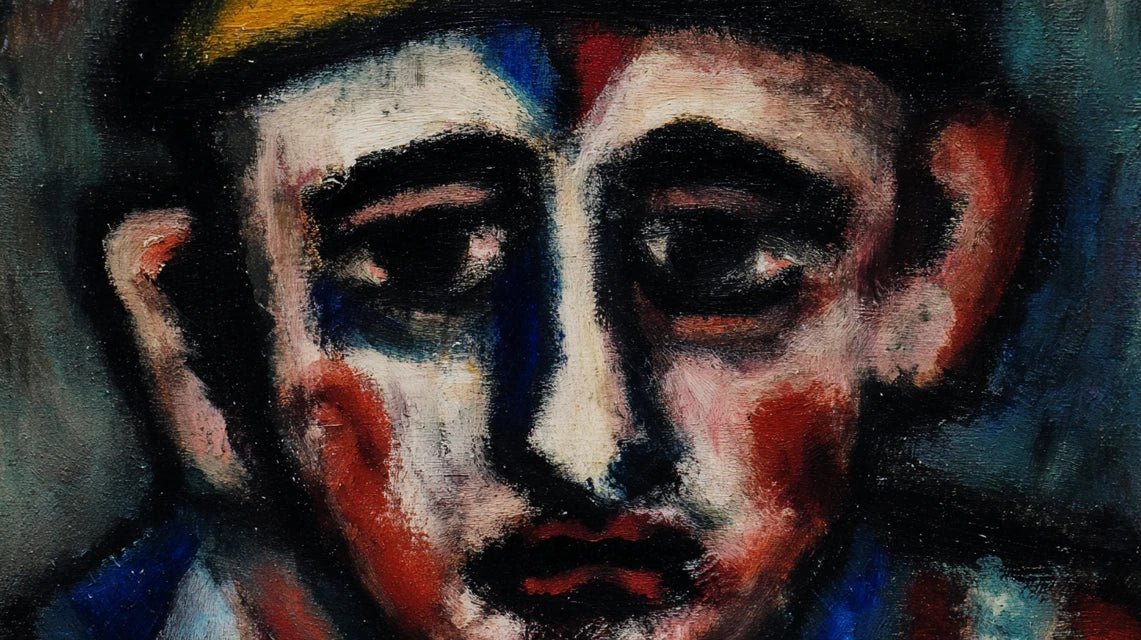
Georges Rouault embodies this figure of a mystical artist of the 20th century, the one who knew how to give a luminous soul to the most tormented faces of his time. His sad clowns, his agonizing Christs and his pathetic prostitutes areveal a touching universal humanity.
Why does this master of French Expressionism still fascinate today? How did his thick black outlines and stained glass colors innovate modern religious art? This biography reveals the man behind the work, his mystical doubts and his spiritual genius.
Discover the artist who transformed religious painting into universal art of compassion - a lesson in humanity through the brushes of a visionary.
Georges Rouault : the Expressionist painter of modern spirituality
Understanding Georges Rouault means grasping how an artist can transform human misery into transcendent beauty. Far from clichés about religious art, Rouault revolutionized the representation of the sacred in drawing on the most raw realities of his time.
| Key biographical details | Artistic legacy |
|---|---|
|
Full name : Georges-Henri Rouault Birth date : May 27, 1871, Paris Death date : February 13, 1958, Paris Nationality : French |
Movement : French Expressionism Style : Expressionist spiritualism Key work : Miserere series Innovation : Stained glass technique applied to painting |
This unique alliance between artisan training and mystical vision forged a creator unlike any other in 20th-century art.
Georges Rouault as a child : spiritual formation in the Belleville suburbs
Young Georges grew up in Belleville, a popular neighborhood where his father, a cabinetmaker at Pleyel teaches him to love noble materials and meticulous work. His maternal grandfather, Alexandre Champdavoine institutes him into the works of Courbet, Manet and Daumier.
📅 The foundational apprenticeship (1885) : At 14, Georges begins an apprenticeship with Tamoni, a master glazier. This five-year training in the art of stained glass will definitively mark his style: thick black outlines, vibrant colors edged in black, inner luminosity of tones. The young artisan restores the stained glass windows of Saint-Séverin, a Gothic church in the heart of Paris.
🎨 The creative principle revealed as early as 1894: Rouault wins the Prix Chenavard for "The Infant Jesus among the doctors." This work already reveals his unique ability to spiritualize academic art.
With his classmates Henri Matisse, Albert Marquet and Henri Manguin, he discovers the revolutionary possibilities of pure color.
Georges Rouault and the Belle Époque: an artist against the tide
🏛️ At the end of the 19th century, Paris shines as a world artistic capital. The Impressionism triumphs, the official Salons dominate, and the bourgeoisie discovers modern art. Rouault evolves in this effervescence but maintains a unique path.
Under the protection of Gustave Moreau, master of symbolism, he develops a mystical approach to art. The Musée Gustave Moreau opens in 1903, and Rouault becomes its first curator at the age of 32.
His contemporaries - the Fauves - Matisse, Derain, Vlaminck - explore pure colors for the joy of living. Rouault, on the other hand, uses this chromatic revolution to express spirituality and human suffering.
Traumatic events - Dreyfus affair, rising social tensions - foster his pessimistic but compassionate vision of humanity. He frequents Catholic intellectual circles around Léon Bloy.
⚡ Rouault's originality around 1900: While his peers celebrate joyful modernity, he paints the marginalized, prostitutes, sad clowns. He creates a social art of Christian inspiration, unique in its time.
This total independence sets him apart from the Parisian avant-gardes.
Georges Rouault period 1898-1910: the ordeal of creative solitude
The death of Gustave Moreau in 1898 plunges Rouault into a deep crisis. He loses his spiritual and artistic guide, finds himself isolated facing the responsibilities of the museum and his creative doubts.
Between 1900 and 1905, he goes through his "dark period." His paintings of prostitutes (Filles 1903) and courts scandalize with their expressive crudeness. The critics reject him, the public does not understand.
A decisive encounter changes his trajectory: Jacques Maritain, a Thomist philosopher, becomes his friend and spiritual confidant. This friendship nourishes his profound religious conversion around 1905.
Despite the material difficulties, Rouault refuses compromises. He participates in the first Autumn Salons (1903-1905) alongside the Fauves, while maintaining his personal path.
These years of adversity forge his character as an uncompromising artist and his conviction that art must serve a higher truth.
Georges Rouault scandal 1905: when religious art shocks the bourgeoisie
⚡ At the Salon d'Automne of 1905, Rouault exhibits with the Fauves but his works are disturbing due to their expressionist darkness. His "Filles" with distorted faces and his "Judges" grimacing prompt indignation and incomprehension.
The critic Louis Vauxcelles denounces "these nightmare masks." The Catholic bourgeoisie is offended that a religious painter is representing social decadence with such expressive violence.
Rouault fully embraces his vision: to him, showing moral ugliness is necessary to reveal spiritual beauty by contrast. He draws inspiration from the Gospels and Pascal.
💭 His artistic philosophy revealed in 1907: "I paint a Christ outraged by his executioners... because I believe in the reality of these executioners. A tree against the sky has the same interest, the same character as the face of a human being."
These controversies strengthen his determination to create a modern Christian art, liberated from academic conventions and bourgeois sensibilities.
His break with decorative art consolidates his status as a prophetic artist.
Georges Rouault and the Miserere series: 20th century religious art
🎨 Around 1912-1914, Rouault finds his full artistic maturity. The death of his father triggers a deep meditation on the human condition, which will give birth to his masterpiece: the series Miserere.
This transformation coincides with his meeting with Ambroise Vollard in 1913. The famous art dealer buys all the contents of his studio for 49,150 francs, liberating Rouault from material constraints.
Miserere by Georges Rouault: 58 engravings for suffering humanity
Initially titled "Miserere and War", this monumental series occupies Rouault from 1914 to 1948. The 58 engraved plates interweave the Passion of Christ and the suffering of World War I, creating a universal meditation on the human condition.
Each engraving combines aquatint, etching and roulette to create effects of material and light reminiscent of his childhood stained glass windows. The thick black outlines structure compositions of unparalleled expressive power.
Georges Rouault's revolutionary technique: from stained glass to modern painting
Rouault transfers the aesthetics of medieval stained glass to contemporary painting. His thick black halos delineate colored areas that seem to radiate inner light. This unique technique allows him to combine formal modernity and traditional spirituality.
Georges Rouault facing Matisse and Picasso: the spiritual path
Unlike Matisse who explores decorative joy, or Picasso who deconstructs forms, Rouault affirms the primacy of spiritual content over formal innovation.
A revealing anecdote: in 1925, during a joint exhibition, a critic asked Rouault what distinguished him from his contemporaries. His response: "They paint for the eyes, I paint for the soul."
OUR RECOMMENDED PRODUCTS
This spiritual approach radically distinguishes Rouault from the other masters of Parisian modern art.
Georges Rouault private life: faith in service of art
Behind the mystic artist lies a simple man, deeply Catholic and attached to family values. His religious conversion around 1895 fundamentally influences his artistic vision and his choices in life.
In 1908, he married Marthe Le Sidaner, sister of the painter Henri Le Sidaner. This marriage brings him emotional stability and moral support. The couple will have four children, including Isabelle Rouault who will become guardian of his work.
Rouault leads an austere, almost monastic existence, entirely dedicated to his art. He works in his studio with exemplary discipline, relentlessly reworking his canvases until the obsession for perfect detail.
This spiritual quest transpires in his human relationships: fidelity to his friends, generosity towards those in need, rejection of Parisian artistic frivolity.
Georges Rouault consecration 1920-1958: from scandal to glory
🏆 International recognition arrives gradually in the 1920s. The Museum of Modern Art in New York dedicates exhibitions to him in 1945 and 1953. In France, he receives honors: Officer of the Legion of Honor in 1925.
A symbolic moment: in 1929, Serge Diaghilev commissions him to create the sets and costumes for "The Prodigal Son" for the Ballets Russes. This prestigious collaboration confirms his status as a major artist.
Market value of Georges Rouault: evolution of prices and records
The evolution of his valuation reflects the progressive recognition of his genius. His works today reach peaks in the international market.
| Period | Average value | Record sale |
|---|---|---|
| 1920-1958 (during his lifetime) | 5,000 - 20,000 francs | First institutional sales |
| 1960-1990 (posthumous) | 50,000 - 200,000 € | "Girl at the circus": 1.2 million € (1990) |
| 2000-2025 (current market) | 30,000 - 100,000 € | "Harlequin": 346,080 € (2018, Sotheby's) |
The works on the circus theme remain the most sought after, followed by religious subjects and the series Miserere.
Georges Rouault late life 1950-1958: spiritual testament of a master
🕊️ His last years reveal an artist appeased, whose colors lighten and the technique is refined. The landscapes and bouquets of flowers bear witness to a rediscovered mystical serenity.
In 1947, in a radical and mysterious gesture, Rouault burns 300 of his paintings which he deems unworthy of his artistic heritage. This voluntary destruction confirms his absolute spiritual requirement. He dies on February 13, 1958 and receives national funeral honors.
Influence of Georges Rouault on contemporary spiritual art
His impact extends far beyond traditional religious art. Contemporary artists such as Anselm Kiefer or Gerhard Richter draw from his spiritual quest. His technique of painted stained glass inspires modern sacred art.
The School of Paris of the 1950s-60s rediscovers his expressionist innovations. The new Fauves of Germany study his ability to combine formal violence and mystical depth.
🎯 Recognizing Rouault's legacy today: Look for works in contemporary art that combine expressionism and spiritual quest. His lesson endures: modern art can express the sacred without renouncing formal innovation.
Where to discover Georges Rouault: museums and main collections
🏛️ His major works are at the Centre Pompidou (Paris), the Museum of Modern Art, Paris, the Museum of Modern Art (New York), and at the Phillips Collection (Washington). The Musée Gustave Moreau preserves his early masterpieces.
The Georges Rouault Foundation (created in 1992) preserves his legacy and organizes exhibitions and research. For a complete discovery, visit his engravings at the Print Room of the National Library.
🎁 Special offer for readers
Because you took the time to inform yourself, enjoy 10% discount on your first order:
⏰ Valid 72h after reading • Applicable to all our products
Frequently asked questions about Georges Rouault expressionist painter
Georges Rouault (1871-1958) was a French expressionist painter, renowned for his religious works with thick black outlines and his depictions of clowns, prostitutes, and figures of Christ. Trained as a glazier, he revolutionized modern religious art by applying the aesthetics of stained glass to painting. His series Miserere (58 engravings) remains his masterpiece, a universal meditation on human suffering.
Rouault first apprenticed as a glazier-restorer (1885-1890) with Tamoni, a crucial experience that shaped his unique style. Simultaneously, he studied at the School of Decorative Arts and then entered the Fine Arts School (1891) in the studio of Gustave Moreau. This Symbolist master encouraged him to develop a mystical approach to art, influencing him durably in his artistic spiritual quest.
Rouault develops a unique technique inspired by medieval stained glass: thick black outlines delineate colored areas that seem to radiate inner light. He superimposes layers of paint (glazes and impastos) to create effects of texture and depth. This method combines formal modernity and traditional spirituality, making him a precursor to religious expressionism.
His recognition comes from his unique ability to spiritualize modern art. Unlike the avant-gardes of his time (cubism, fauvism), he creates an expressionism with a mystical dimension. The Museum of Modern Art in New York dedicated two retrospectives to him (1945, 1953). His artistic independence, innovative technique, and spiritual depth make him an essential master of 20th-century art.
Prices vary depending on the themes: €30,000 to €100,000 for an average painting, but works of the circus can exceed €300,000. The record remains "Circus Girl" sold €1.2 million (Christie's, 1990). Engravings from Miserere are negotiated between €1,000 and €4,000 each. His rating remains stable, supported by museums and international collectors.
Rouault influences contemporary art by demonstrating that formal innovation and a spiritual quest can coexist. Artists such as Anselm Kiefer draw inspiration from his mystical research. His approach revolutionized modern religious art, freed from academic conventions. The Georges Rouault Foundation perpetuates his legacy, proving the relevance of his humanistic vision in a desacralized world.