Imagine a man perched 18 meters high in the Sistine Chapel, his neck twisted backward, painting with dripping paint in his eyes for four consecutive years... This man revolutionized Western art by creating one of the most admired works in the world, while swearing he was a sculptor, not a painter.
Michelangelo Buonarroti embodied the boundless creativity of the Italian Renaissance. A man with a volcanic personality nicknamed "Il Divino" by his contemporaries, he transformed each block of marble into an eternal masterpiece and each wall into a theater of humanity. His genius touches the universal: the David of Florence embodies heroic strength, the Pietà in Vatican City expresses divine beauty, and the Sistine Chapel ceiling tells the story of creation.
Why does this artist continue to fascinate more than 450 years after his death? How could one man alone revolutionize sculpture, painting, and architecture at the same time? Discover the story of a prodigious genius who pushed the boundaries of art and humanity.
In this comprehensive biography, dive into the universe of Michelangelo, from his Tuscan origins to his eternal masterpieces, and understand why his art still transcends centuries today - a journey to the heart of the Renaissance and artistic genius.
Michelangelo Buonarroti: The Universal Genius of the Italian Renaissance
Understanding Michelangelo means grasping the very essence of the Italian Renaissance and discovering how one man could embody the ideal of the complete artist. Far from the legends surrounding his figure, the true story of Michelangelo Buonarroti reveals an obsessive, perfectionist, and revolutionary creator who defined aesthetic codes for future centuries.
| Biographical Highlights | Artistic Legacy |
|---|---|
| Full name: Michelangelo di Lodovico Buonarroti Simoni Born: March 6, 1475 in Caprese, Tuscany Died: February 18, 1564 in Rome (88 years old) Nationality: Florentine of the Florentine Republic |
Movement: High Italian Renaissance Style: Heroic realism and terribilità Flagship work: Sistine Chapel ceiling Innovation: Fusion of ancient art and Christian emotion |
Michelangelo transforms each artistic challenge into an aesthetic revolution, creating a visual language that still influences contemporary art.
Michelangelo's Origins: The Birth of a Genius in Tuscany
In the small castle of Caprese in Tuscany, born on March 6, 1475, the man who would revolutionize Western art. The Buonarroti family, descended from a fallen aristocratic lineage, lived modestly but retained nobility's pride and ambitions. His father, Ludovico Buonarroti, municipal magistrate, fiercely opposed his son’s artistic aspirations, considering art a degrading activity for their social standing.
The founding trauma - The early death of his mother: Michelangelo lost his mother at the age of 6 and grew up in a family of stonemasons who taught him how to handle chisels and hammers. This first introduction to sculpture profoundly marked the child, who discovered in marble a language more expressive than words. Years later, he would confide: "With my nurse's milk, I sucked burins and hammers.".
At 13 years old, despite his father’s reluctance, Michelangelo entered the prestigious workshop of Domenico Ghirlandaio in Florence. This renowned master trained the Florentine artistic elite, but the young apprentice quickly distinguished himself by his volcanic character and exceptional talent. It was here that he broke his nose in a fight with Pietro Torrigiano, a scar that would mark his face for life and symbolize his nascent "terribilità."
The revelation of the Medici garden: In 1490, Lorenzo de' Medici the Magnificent noticed the young man’s talent and welcomed him into his prestigious garden of ancient sculptures. This encounter radically changed Michelangelo’s destiny, who discovered the masterpieces of antiquity and mingled with the greatest Renaissance intellectuals: Ange Politien, Marsile Ficin, and Pic de la Mirandole.
This humanist education forged Michelangelo's revolutionary artistic vision, which would fuse ancient beauty and Christian spirituality.
Michelangelo and his time: the Italian Renaissance in full effervescence
The Italy of the late 15th century experienced an unprecedented cultural revolution. Exchanges with the Orient enriched Italian cities, archaeological discoveries revealed the treasures of antiquity, and patrons competed in their artistic commissions. Florence embodies this renaissance: the Medici transform the city into a global artistic laboratory.
Michelangelo grew up in this atmosphere of creative emulation where the greatest geniuses coexist: Leonardo da Vinci, Botticelli, Ghirlandaio, Donatello. Each artist pushes the technical and aesthetic limits, creating a stimulating competition that reveals exceptional talents. The rediscovery of ancient texts and classical proportions inspires a new vision of art, more realistic and expressive.
The Italian Wars and political upheavals create a climate of instability that drives artists to seek protection from the powerful. The popes Julius II and Leo X transform Rome into a new Athens, attracting the best creators to glorify Christianity. This rivalry between Florence and Rome stimulates creation and allows Michelangelo to develop his grandiose vision.
The emergence of the Protestant Reformation gradually transforms the relationship with religious art. Michelangelo, witnessing these changes, adapts his artistic expression to translate the new spiritual concerns of his time. His later works reflect this transition between the burgeoning optimism and the anxieties of the Counter-Reformation.
The artist as a mirror of his time: Michelangelo perfectly embodies the contradictions of his era - a devout Christian fascinated by pagan art, a Florentine republican in the service of the popes, a Renaissance man foreshadowing the Baroque. This complexity nourishes the richness and modernity of his work.
Michelangelo's early struggles: forging a steel character
Micheangelo's first commissions already reveal his explosive temperament and perfectionist demands. In Rome in 1496, at only 21 years old, he has to prove himself in a city where the most fierce artistic competition in Europe reigns. His first patrons quickly discover that they are dealing with an uncompromising artist, capable of breaking a contract if his creative vision is questioned.
His Bacchus of 1497 perfectly illustrates this period. Commissioned by Cardinal Raffaele Riario, this bold sculpture of the Roman god drunk displeases the prelate who rejects it, judging the work too provocative. Far from being discouraged, Michelangelo fully embraces this sensual representation that foreshadows his ability to shock and fascinate simultaneously. The work will eventually find a buyer in the banker Jacopo Galli, first of a long series of collectors captivated by the artist's audacity.
The commission of the Pietà in 1498 represents a true technical and spiritual challenge. Cardinal Jean Bilhères de Lagraulas demands a work of absolute beauty to honor the memory of King Charles VIII. Michelangelo, aware of the stakes, works day and night on a block of Carrara marble, sculpting up to 20 hours per day to meet the one-year deadline.
These experiences forge Michelangelo's legendary character: obsessive perfectionism, refusal of artistic compromise, and this famous "terribilità" that impresses as much as it intimidates his interlocutors. He develops his creative philosophy based on the idea that sculpture liberates the divine form imprisoned in matter.
These Roman years establish his reputation as a genius but difficult artist, preparing for future epic confrontations with the popes.
Michelangelo the rebel: scandals and ruptures that shaped his art
Michelangelo's art divides and provokes from his earliest works. His revolutionary vision of human representation challenges the artistic and religious codes of his time. Unlike artists of his time who seek harmony and serenity, Michelangelo favors dramatic expression and emotional power, creating a style that disturbs as much as it fascinates.
The controversy truly erupts with the Sistine Chapel ceiling. Commissioned in 1508 by Pope Julius II to represent the twelve apostles, Michelangelo radically transforms the project. He imposes his grandiose vision: nine scenes from Genesis surrounded by 300 figures, including many "ignudi" (male nudes) that scandalize the clergy. These athletic and sensual bodies in a place of worship question traditional religious morality.
The Pope himself becomes impatient with Michelangelo's delays and refusals to show progress on the work. The artist works alone, refusing any help, creating constant tension with his patrons. Julius II even threatens to throw him from the scaffolding! But Michelangelo stands firm, aware of creating a revolutionary masterpiece.
The provocative signature of the Pietà: Annoyed at hearing visitors attribute his Pietà to another sculptor, Michelangelo sneaks into St. Peter's Basilica at night and carves his name ostentatiously on the Virgin’s strap. This signature, unique in his work, testifies to his pride and need for recognition, while challenging traditional Christian humility.
The Last Judgment (1536-1541) unleashes an even more violent controversy. This monumental fresco presents over 400 completely nude characters, including Christ, in an apocalyptic vision that breaks with traditional iconography. Critics denounce this "assembly of nudes in a holy place." Some characters will even be covered with draperies later, ironically nicknamed "braghettoni" (the padded).
Micheangelo fully embraces these controversies, seeing them as proof that his art transcends conventions to reach a superior spiritual truth.
Michelangelo revolutionary: the invention of terribilità and grand art
The years 1501-1512 mark the creative peak of Michelangelo and his transformation into an artistic revolutionary. Returning to Florence, he undertakes the David, a technical challenge considered impossible: transforming a damaged and abandoned block of marble into an absolute masterpiece. This commission perfectly symbolizes his ability to transcend material limitations through his creative genius.
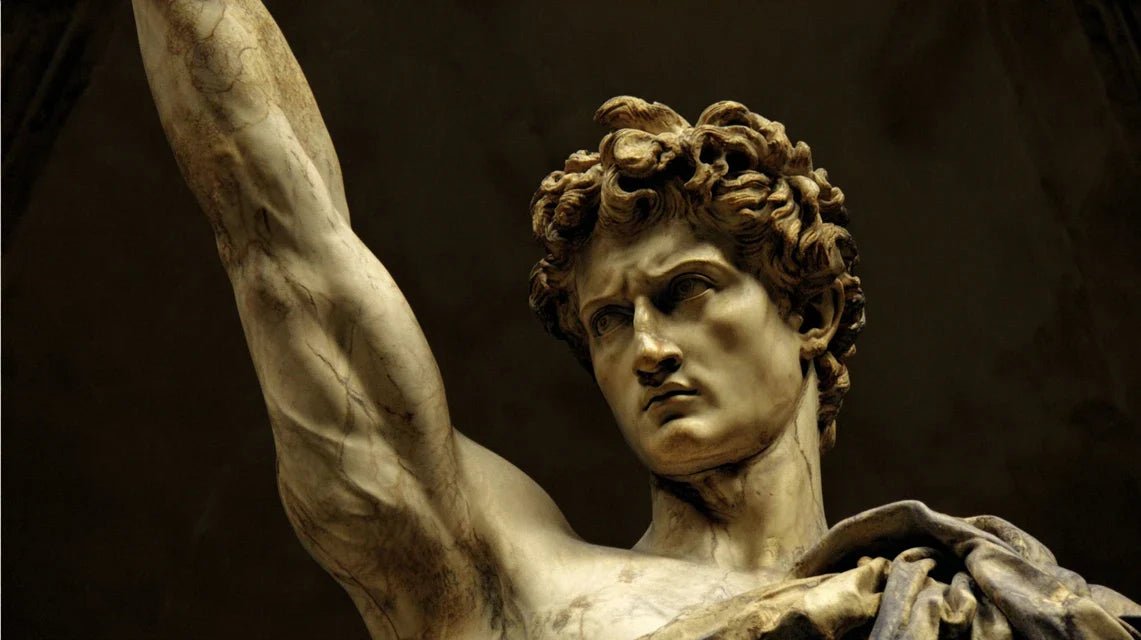
David revolutionizes Renaissance sculpture by abandoning decorative tradition to prioritize dramatic expression. Unlike Donatello’s youthful David, Michelangelo creates a 5.17-meter hero with taut muscles, a determined gaze, captured in the instant preceding the battle against Goliath. This representation of psychological and physical strength alike invents a new sculptural language.
Michelangelo's David: embodiment of heroic power
Completed in 1504 after three years of labor, David synthesizes ancient art and the burgeoning Renaissance ideal. Michelangelo deliberately corrects anatomical proportions: oversized hands, head, and torso create a striking effect of dramatic power. This deliberate disproportion reveals his mastery of visual and psychological effects, anticipating Baroque art.
The statue immediately becomes a symbol of Republican Florence facing external threats. Its installation in front of the Palazzo Vecchio transforms the artwork into a political manifesto, a major innovation that influences modern public art.
Michelangelo's revolutionary technique: from marble to emotion
Michelangelo develops a revolutionary sculptural approach based on the idea that the statue already exists in the marble, it is enough to free the imprisoned form. This philosophical conception radically transforms sculpting practice: he works by direct subtraction, without preparatory models, creating an intimate dialogue with the material.
His innovation of non-finito (unfinished) appears in his later works: partially polished surfaces alongside raw areas, creating dramatic effects of light and shadow. This technique, considered modern, influences sculptors up to Rodin and beyond.
Michelangelo facing his contemporaries: Leonardo da Vinci and Raphael
Rivalry with Leonardo da Vinci stimulates artistic innovation. When Florence simultaneously commissions Michelangelo the Battle of Cascina and Leonardo the Battle of Anghiari to decorate the Palazzo Vecchio, the confrontation reveals two opposing visions: Leonardo’s refined intellectualism versus Michelangelo’s expressive power.
With Raphael, younger and admiring, relations remain cordial despite competition. Raphael draws inspiration from Michelangelo's innovations while developing his personal style, creating a creative emulation beneficial to the Renaissance art.
OUR RECOMMENDED PRODUCTS
This period establishes Michelangelo as an absolute reference of Western art, a position he still holds today.
Michelangelo the man: between tormented genius and profound spirituality
Behind the legendary artist lies a complex and tormented personality. Michelangelo cultivates creative solitude, preferring the intimacy of his studio to the social events of Florence or Rome. His "difficult and impossible" character, according to Pope Leo X, hides extreme sensitivity and constant spiritual demands that nourish his creation.
His personal relationships reveal a man deeply attached to a few chosen friendships. His correspondence with Vittoria Colonna, marchioness and poetess, testifies to an intense spiritual relationship that influences his later works. This cultured aristocrat inspires Michelangelo's most beautiful sonnets and directs his reflection towards a more inner spirituality.
The passionate friendship with the young nobleman Tommaso dei Cavalieri reveals Michelangelo’s ability to sublimate personal emotion into artistic creation. The poems he dedicates to him are among the finest in Italian literature, revealing an unknown poetic talent that equals his sculptural genius.
His profound religiosity shines through in all of his late work. A sincere man of faith, Michelangelo painfully experienced the spiritual crises of his time. His latest Pietàs express a spirituality torn between hope for salvation and anguish of damnation, reflecting the concerns of the nascent Counter-Reformation.
This inner richness constantly nourishes his art and explains the emotional depth of his masterpieces.
Michelangelo's recognition: from fame in his lifetime to today's art market
Unlike many artists, Michelangelo knew fame and fortune during his lifetime. From the Pietà in 1499, his reputation exceeded Italian borders. At the age of 24, he became the most sought-after artist in Europe, an exceptional situation that allowed him to impose his creative and financial conditions on the most powerful patrons.
The ultimate consecration came with the inauguration of the Sistine Chapel ceiling in 1512. This achievement transformed Michelangelo into a living legend, nicknamed "Il Divino" by his contemporaries. Orders poured in from all over Europe, and the artist could choose his projects according to his creative aspirations rather than financial necessity.
The exceptional value of Michelangelo's works on the market
Today, Michelangelo’s works achieve exceptional valuations on the international art market. Their extreme rarity - most sculptures and frescoes are preserved in museums or monuments - makes each new attribution sensational.
| Period | Average value | Record sale |
|---|---|---|
| During his lifetime (1475-1564) | Exceptional commissions: 450-3000 gold ducats | Tomb of Julius II: 10,000 gold ducats planned |
| Posthumous recognition (1564-1900) | Invaluable works, property of institutions | No sales, protected heritage |
| Contemporary market (1900-2024) | Drawings: €500,000 to €5 million | The resurrected Christ: £8.1 million (2000) |
These valuations reflect not only rarity but also the continued influence of Michelangelo on contemporary art.
Michelangelo's death in 1564: birth of an eternal artistic myth
Michelangelo passed away on February 18, 1564 in Rome, at the exceptional age of 88, after dedicating his last years to the reconstruction of St. Peter's Basilica. His death marked the end of the High Renaissance and the beginning of his transformation into a universal artistic myth. He left unfinished his last Rondanini Pietà, a poignant testament from a creator who was still sculpting days before his disappearance.
His funeral in Rome attracts an immense crowd, a testimony to popular veneration. But in accordance with his wishes, his body was secretly transferred to Florence where he rests in the church of Santa Croce, a monument to the glory of great Florentines. This transfer symbolizes the artist's unwavering attachment to his native city.
Michelangelo's influence on contemporary and modern art
The artistic legacy of Michelangelo transcends centuries and movements. His influence can be found in Bernini who develops the baroque theatricality inspired by the Michelangelesque "terribilità". Rodin rediscovers the expressive power of the "non-finito" and adapts it to modern sensibilities. More recently, contemporary artists such as Ai Weiwei or Jeff Koons draw inspiration from his ability to transform art into a manifesto.
Modern architecture retains the lessons of Michelangelo: Le Corbusier studies the dome of St. Peter's, Frank Gehry draws inspiration from his spatial innovations. This continued influence proves the anticipatory modernity of the Renaissance genius.
How to recognize Michelangelo's influence today: Observe in contemporary art the search for expressive monumentality, the dramatic use of space, the valorization of the human body as a vector of emotion, and this ambition to create works that transcend their time to become universal.
Where to discover Michelangelo today: guide to global collections
The masterpieces of Michelangelo constitute an exceptional artistic pilgrimage. In Florence, the Gallery of the Academy preserves the original David in a specially designed architectural setting. In Rome, St. Peter's Basilica houses the Pietà and the Sistine Chapel offers the most intense spiritual and aesthetic experience. The Bargello Museum in Florence presents the early works, revealing the evolution of creative genius.
This Michelangelo geography allows for a progressive discovery of the artist, from prodigious apprentice to absolute master.
🎁 Special offer for readers
Because you took the time to inform yourself, enjoy 10% discount on your first order :
⏰ Valid 72h after reading • Applicable on all our products
Frequently asked questions about Michelangelo Buonarroti
Michelangelo di Lodovico Buonarroti Simoni was born on March 6, 1475 in a family of small Tuscan nobility fallen into disrepair in Caprese. Orphaned by his mother at the age of 6, he grew up with a wet nurse in a family of stonemasons who taught him how to use sculpting tools. This modest origin explains his visceral attachment to manual labor and his philosophy that "art is born from pain and toil".
Michelangelo followed an exceptional training path: apprenticeship with Domenico Ghirlandaio (1488-1490), then protection of Lorenzo de' Medici the Magnificent who introduced him to ancient masterpieces in his sculpture garden. This double training - artisanal technique and humanist culture - forged his revolutionary vision, merging traditional know-how and aesthetic innovation. He completed his training by studying directly with the masters: Donatello, Ghiberti, and especially ancient art which he copied and reinterpreted.
The "terribilità" refers to this unique quality of Michelangelo that inspires a fear mixed with admiration in viewers of his works. This aesthetic innovation broke with the serene harmony of the Renaissance art to favor dramatic expression and emotional power. Technically, it is translated by the exaggeration of proportions (oversized hands and head of David), expressive contortions of bodies, and this ability to represent physical and psychological effort in marble.
Michelangelo achieved exceptional fame thanks to three factors: revolutionary technical innovation (ability to sculpt works considered impossible), unique artistic versatility (simultaneous excellence in sculpture, painting, architecture and poetry), and modern dramatic vision that fascinates his contemporaries. His works perfectly meet the grandiose ambitions of the Italian Renaissance. From the age of 25, he became the most sought-after artist in Europe, a situation which allowed him to impose his creative conditions.
Michelangelo's works achieve exceptional valuations but remain extremely rare on the market. His main sculptures and frescoes belong to institutions (Vatican, national museums). Only preparatory drawings occasionally appear for sale: from €500,000 to €5 million depending on importance. The record belongs to the "Christ Resurrected" sold for £8.1 million in 2000. This scarcity and these valuations reflect his status as an absolute artist whose influence transcends centuries.
Michelangelo's influence on contemporary art remains major through several innovations: expressive monumentalism (works that impress with their scale and emotional power), the "non-finito" technique taken up by Rodin and modern sculptors, art as manifesto (ability to transform the work into a political or spiritual symbol). From architects like Le Corbusier to contemporary artists like Ai Weiwei, all draw on his revolutionary approach to space and human expression.
Michelangelo today: why his genius continues to fascinate us
More than 450 years after his disappearance, Michelangelo remains the absolute embodiment of artistic genius. His work transcends centuries because it touches on the universal human experience: the search for beauty, the expression of emotion, the spiritual quest and this eternal aspiration to overcome our limitations. Each new generation rediscovers in his creations echoes of their own concerns.
His modernity lies in his visionary ability: Michelangelo anticipates Baroque art through its theatricality, foreshadows modern art through its expressionism, and prefigures contemporary art through its conceptual dimension. The David remains a symbol of heroic resistance, the Pietà expresses universal sorrow, and the Sistine Chapel tells the story of humanity with unparalleled dramatic force.
Beyond aesthetic admiration, Michelangelo teaches us absolute creative demands and the refusal of artistic compromise. His example inspires all those who aspire to transform their passion into excellence, their vision into concrete reality. His creative extravagance reminds us that true art is born from the ambition to overcome the impossible.
The Michelangeloesque inspiration for our time: Discovering Michelangelo means understanding that genius is born from the meeting of mastered technique, personal vision and creative boldness. His legacy encourages us to cultivate our own excellence, to reject mediocrity, and to believe in our ability to create something exceptional and eternal.