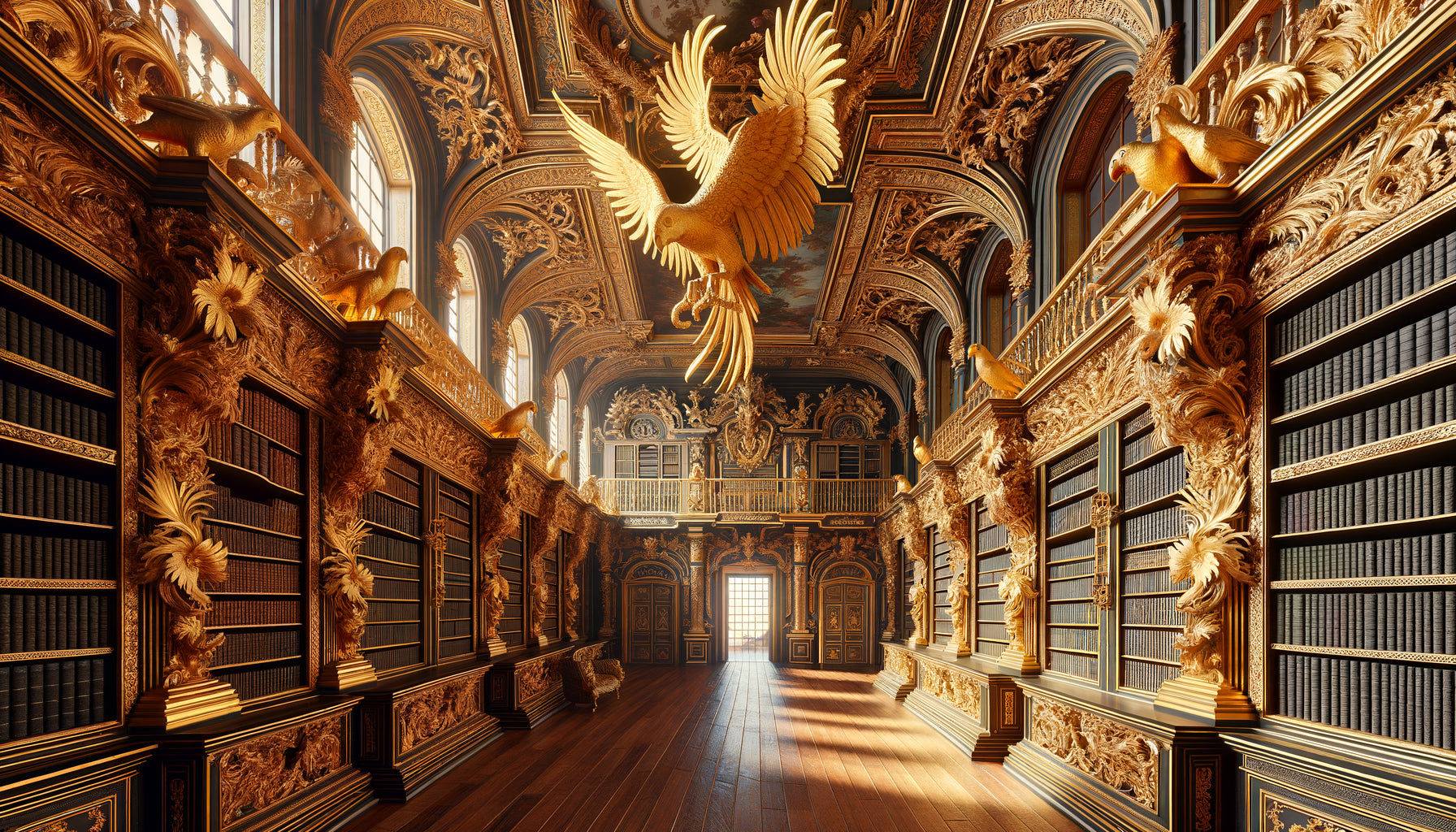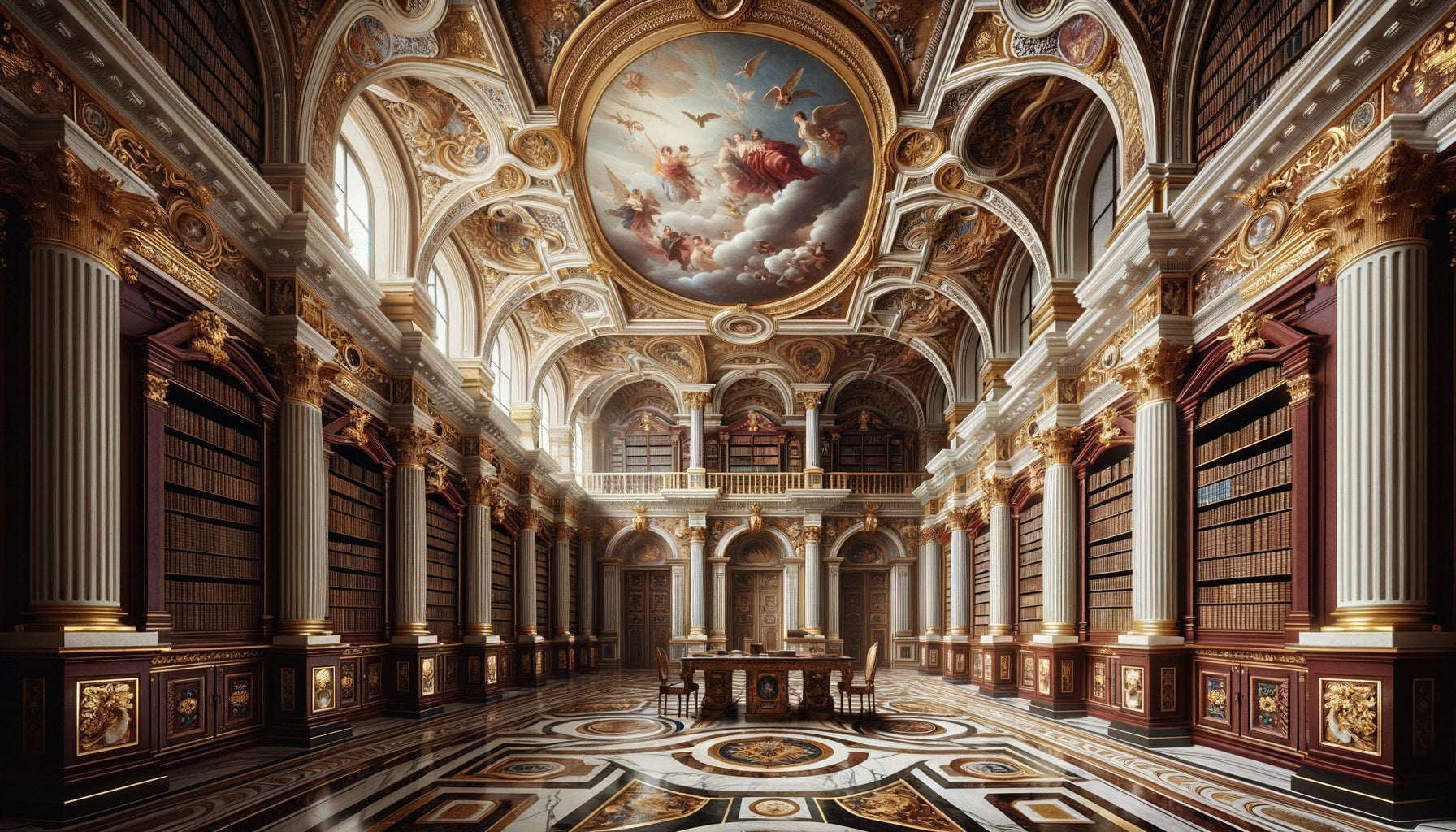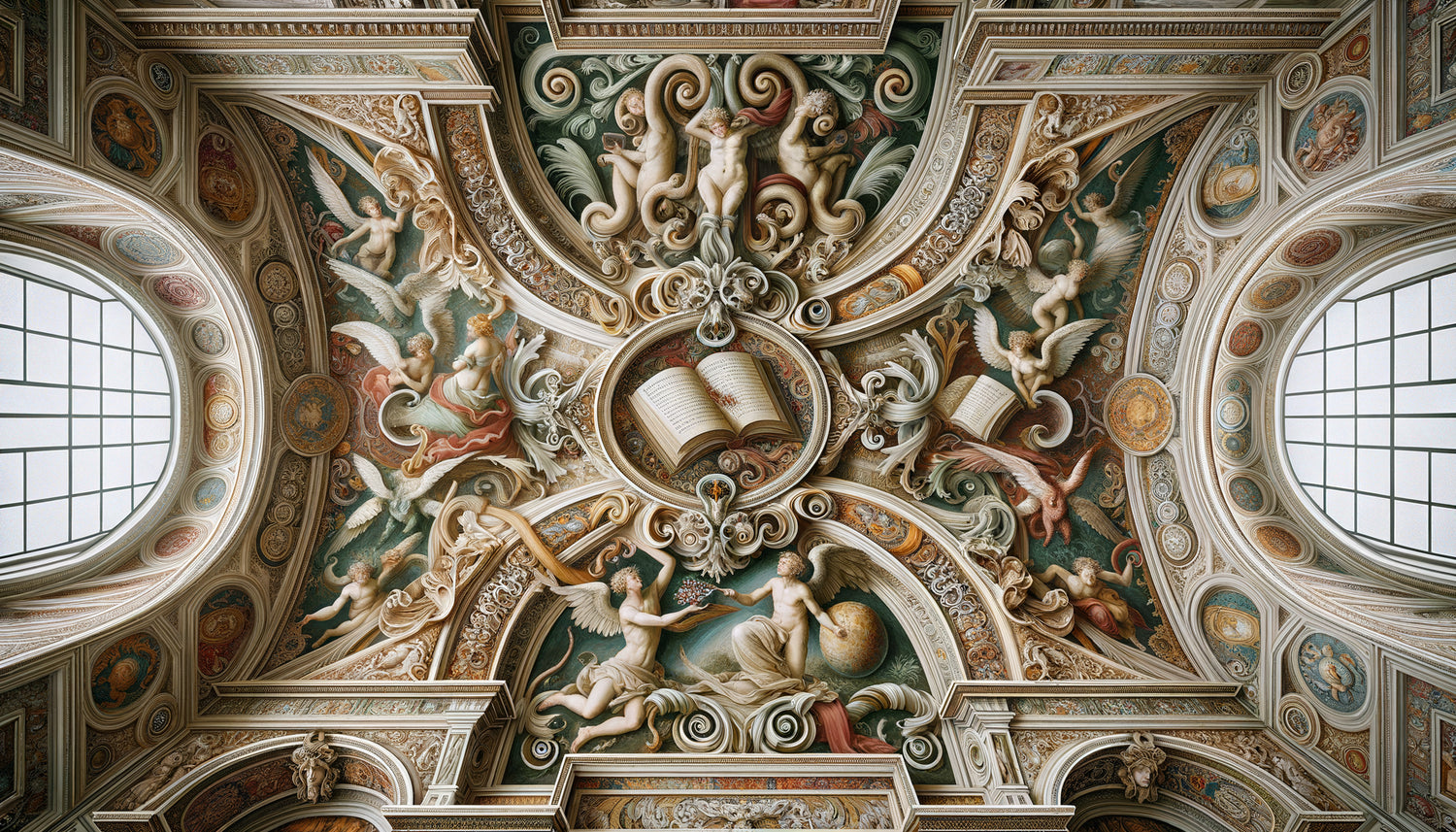
Look up in a Renaissance Italian library. Beyond the precious books aligned, a strange universe unfolds on the vaults and paneling: hybrid creatures, grimacing masks, impossible arabesques, bodies transforming into foliage. These painted grotesques fascinate as much as they disorient. Why did these Renaissance scholars, eager for reason and harmony, choose to surround their temples of knowledge with these fantastic chimeras?
Here's what the symbolism of grotesques in Renaissance libraries reveals: a celebration of imagination as a driver of knowledge, a tribute to intellectual metamorphosis through reading, and an invitation to transcend the boundaries of the known. These decorations are not mere decorative ornaments, but a painted philosophical program.
Faced with these enigmatic frescoes, we often remain perplexed. How do we decipher these visual codes from another era? What did these winged monsters, smiling sphinxes, and vegetal intertwines really mean that seem to defy all logic? The temporal distance deprives us of the keys to reading that humanists of the Cinquecento naturally possessed.
Yet, understanding this symbolism transforms our gaze on Renaissance art and enriches our own relationship with reading spaces. These libraries then become places of initiation, where every painted detail participates in an initiatory journey into the universe of knowledge. Let me guide you through this fascinating world where strangeness becomes meaningful.
The rediscovery of the Domus Aurea: when ancient Rome inspires the Renaissance
It all begins in the 1480s, when young Roman artists venture into recently discovered underground cavities. These grottos – hence the term grotesque – are actually the buried halls of the Domus Aurea, the golden palace of Emperor Nero. On the miraculously preserved vaults, they discover a stunning decorative repertoire: fantastic creatures, impossible candelabras, continuous metamorphoses between animal, vegetable and mineral realms.
Raphael, Pinturicchio, Giovanni da Udine descend into these spaces by torchlight, frantically sketching these motifs forgotten for fifteen centuries. This resurrection of the ancient ornamental vocabulary perfectly corresponds to the humanist spirit: to find the wisdom of the Ancients to regenerate the present. Grotesques thus become the visual language of this Renaissance, literally this re-birth cultural.
In princely and monastic libraries, adopting this repertoire meant joining a prestigious lineage. Italian Renaissance libraries such as that of the Vatican, the Laurentian in Florence or the ducal palace of Urbino are adorned with these strange frescoes. The choice is never arbitrary: these decorations carry a profound philosophical message about the very nature of knowledge.
The secret language of hybridations: metamorphosis and knowledge
At the heart of the symbolism of grotesques lies the idea of metamorphosis. A human body extends into vegetable tendrils, a fish tail becomes floral arabesque, a woman's bust emerges from a flower calyx. This fluidity of forms is not gratuitous: it illustrates the very process of intellectual transformation.
For humanists, reading and studying provoke a mutation of the soul. One does not enter a library unchanged. Each book read modifies our intimate substance, makes us go from one state to another. The painted grotesques materialize this invisible process visually. They constantly remind the reader that he himself is in metamorphosis, in perpetual becoming through knowledge.
Chimera creatures as guardians of the threshold
The sphinxes, griffins, harpies and other hybrid creatures that populate the library grotesques play a role of initiatory guardians. In ancient mythology, the sphinx posed mortal riddles. Here, these figures recall that access to knowledge is not direct: it requires decipherment, patience, initiation. The library becomes a sacred space protected by these fantastic sentinels.
This protective dimension is doubled by an apotropaic function. Grimacing masks, grotesque faces ward off the evil eye, drive away ignorance and superficiality. Only prepared minds, capable of surpassing the apparent monstrosity to grasp its profound meaning, deserve to access the intellectual treasures preserved within these decorated walls.

The infinite arabesque: knowledge as an endless interweaving
Carefully observe the Renaissance library grotesques: they have neither beginning nor end. The motifs follow in continuous arabesques, respond from one vault to another, create complex networks of visual correspondences. This decorative structure carries a vision of knowledge as an interconnected system.
Contrary to a linear conception of knowledge, humanists prefer the idea of a network of universal correspondences. Each discipline dialogues with others, poetry illuminates philosophy which informs theology which joins cosmology. Grotesques, through their vegetable entanglements and continuous metamorphoses, visually embody this organic unity of knowledge.
The fantastic candelabras that often structure these compositions symbolize intellectual illumination. They rise towards the sky while deploying their ramifications laterally, like the mind that rises through study while expanding its fields of understanding. This aspiring verticality combines with exploratory horizontality to create a total symbolic space.
Nature as a secret alphabet: deciphering the book of the world
The grotesque paintings from Renaissance libraries are teeming with meticulously observed plant and animal elements, even within their fantastical compositions. This massive presence of nature is not decorative; it recalls that the world itself is a book to be deciphered, the Liber Naturae of theologians.
For scholars of the Cinquecento, influenced by neoplatonism, the visible universe is woven with signatures and correspondences that only the initiated eye can read. Each plant, each animal carries a hidden meaning, participates in a network of universal symbols. The grotesques, by hybridizing these natural elements according to impossible combinations, invite us to go beyond appearances to access the deep structures of reality.
The chromatic vocabulary of grotesques
The palette of Renaissance grotesques favors precious pigments: lapis lazuli for celestial blues, vermilion for vibrant reds, gold for luminous highlights. These color choices create an atmosphere that is both refined and dreamlike. Saturated colors, often on a white or ivory background, generate a feeling of lightness, as if these creatures floated in an immaterial space.
This dazzling brightness deliberately contrasts with the supposed seriousness of study. It recalls that the quest for knowledge, far from being austere, must remain joyful, even playful. Libraries adorned with grotesques become spaces of intellectual delight, where the eye feasts as much as the mind is instructed.

When the strange becomes familiar: integrating grotesques into our contemporary interiors
This symbolic richness of Renaissance grotesques finds a new echo today in our contemporary reading spaces. Far from being dusty curiosities, these motifs possess an astonishing modernity: they celebrate imagination, the transgression of boundaries, and the playful dimension of culture.
Integrating references to Italian grotesques into a personal library or office creates a unique atmosphere, both sophisticated and intriguing. This can take various forms: framed reproductions of details from Renaissance frescoes, wallpapers inspired by the arabesques of Giovanni da Udine, decorative objects echoing the hybrid creatures dear to humanists.
The key is to preserve the original spirit: creating an environment that stimulates the imagination as much as it invites concentration. Grotesques remind us that reading and learning are adventures, journeys into unknown territories where we ourselves risk metamorphosis. Our reading spaces should materialize this promise of transformation.
Transform your library into a temple of erudite imagination
Discover our exclusive collection of Library wall art that captures the spirit of Renaissance curiosity cabinets and enriches your reading spaces with an inspiring symbolic depth.
Creating one's own symbolic vocabulary: drawing inspiration without copying
Rather than literally reproducing Renaissance grotesques, the most fertile approach is to grasp their compositional principles to create your own visual universe. What are your personal symbols of knowledge and metamorphosis? Which creatures, real or imaginary, embody for you intellectual curiosity?
This personal approach echoes the spirit of the humanists who reinvented ancient motifs rather than copying them servilely. A contemporary library adorned with references to grotesques becomes a space of cultural affirmation, which proclaims that knowledge comes through imagination, that intellectual rigor never excludes creative fantasy.
Grotesques also teach us the art of ornamental density without saturation. Despite their complexity, these compositions always preserve a readability, a visual breathing space. This lesson in balance remains valuable for arranging our interiors: how to enrich without cluttering, adorn without stifling, stimulate the gaze without tiring it.
The library as a microcosm: reflecting the universe in an intimate space
Ultimately, the symbolism of grotesques in Renaissance libraries responds to a total ambition: to make the library a microcosm, a miniature universe that reflects and contains the entirety of the world. Books hold human knowledge; painted grotesques, with their visual encyclopedia of natural and fantastic forms, symbolize the infinite diversity of creation.
This design transforms each library into a theatrum mundi, a world theater where the drama of knowledge perpetually unfolds. The reader who enters this space becomes an actor in this universal quest. Grotesques accompany them, protect them, and remind them of the nobility and audacity of their endeavor.
Even today, our personal libraries can aspire to this cosmic dimension. Not through grandiloquence, but through attention to significant details, by selecting objects and images full of meaning, by creating an atmosphere conducive to intellectual elevation. Grotesques teach us that the physical environment profoundly influences the quality of our thoughts.
The painted grotesques of Italian Renaissance libraries offer us a timeless message: authentic knowledge requires imagination, courage in the face of the strange, and acceptance of metamorphosis. These fantastic creatures, far from being mere ornaments, outline a philosophy of knowledge where rigor and fantasy, reason and dream intertwine harmoniously.
Looking up at these vaults adorned with smiling chimeras, Renaissance scholars remembered that their intellectual quest would transform them. They would emerge from their library different, enriched, transformed by the books they had read. This promise of transformation remains the most beautiful function of any space dedicated to reading.
May your own library, modestly inspired by these Italian masterpieces, become in turn a place of happy metamorphoses. Choose decorative elements that question, intrigue, and open the imagination rather than close it. Dare the strange, the offbeat, the hybrid: it is in these interstices that the most fertile thoughts germinate. Start with a single detail – an engraving, an object, a color – that carries this intention of creative transgression, and observe how your relationship to reading is subtly transformed.
Frequently Asked Questions about Renaissance Library Grotesques
Why are these motifs called grotesques?
The term grotesque comes from the Italian grottesca, derived from grotta (cave). It refers to the circumstances of their rediscovery: in the 1480s, Roman artists explored the underground rooms – resembling caves – of Nero's Domus Aurea, the buried palace. On the preserved vaults, they discovered these fantastic decorations forgotten since antiquity. The name is therefore directly linked to the archaeological context of their resurrection. This etymology also emphasizes their mysterious, almost chtonic character: these motifs emerge from the depths of the earth and time, carrying a buried wisdom. Contrary to the pejorative meaning that the word will later take, at the Renaissance, grotesque simply designates this rediscovered ornamental style, without negative connotation. It is a technical vocabulary that identifies a family of specific motifs: hybridizations, arabesques, fantastic candelabras, masks, continuous metamorphoses between natural kingdoms.
How to integrate the spirit of Renaissance grotesques into a modern library?
Successful integration doesn't necessarily involve literal reproduction, but capturing the spirit: celebration of imagination, playful dimension of culture, symbolic density without heaviness. Start with subtle touches: a framed reproduction of a detail from Raphael's frescoes in the Vatican Loggia, wallpaper on a wall panel echoing stylized plant arabesques, decorative objects (vases, sculptures) evoking hybrid creatures. Prioritize a light palette – off-whites, celadon blues, soft greens, touches of gold – that recalls the original frescoes' chromatic lightness. Introduce plant elements (climbing plants, framed herbariums) that echo the natural vocabulary of grotesques. The key is to create an atmosphere where the eye can wander, discover details, where imagination is stimulated as much as concentration is favored. A library inspired by grotesques should remain a space of active serenity, never visual saturation.
Did grotesques have a religious function in monastic libraries?
The question is complex because grotesques occupy an ambiguous position in Christian iconography. On the one hand, their fantastic, sometimes licentious character aroused the suspicion of some theologians who saw them as Pagan frivolities. On the other hand, they were widely adopted in religious contexts, including in monastic libraries. This acceptance can be explained by several factors: first, the endorsement of Antiquity conferred cultural legitimacy upon them. Secondly, their symbolic dimension – metamorphosis, passage between states, protection against evil – could receive a Christian interpretation. The hybrid creatures recalled the complexity of divine Creation, the mysteries that only faith and study allow us to penetrate. In monastic libraries adorned with grotesques, such as some rooms in the Vatican, these motifs coexisted with biblical scenes, creating a complete iconographic program where profane knowledge and divine revelation complemented each other. Grotesques then embodied the irreducible share of mystery, the alterity that escapes human reason and calls for intellectual humility.