Imagine pushing the heavy wooden doors of an 18th-century Brazilian library. The scent of aged leather and tropical essences envelops you. Looking up, you discover a painted ceiling where parrots with vibrant plumage mingle with baroque angels, where lush palms surround Portuguese coats of arms. These colonial libraries represent a unique moment in design history: the fusion between European rigor and the exuberance of Brazilian nature. How did Portuguese artisans and local creators manage to achieve this fascinating marriage between two worlds? Here's what integrating tropical motifs into Portuguese colonial libraries in Brazil reveals to us: an art of decorative compromise that respects the solemnity of knowledge while celebrating the generosity of the host land, sculpting and painting techniques of remarkable virtuosity, and above all, a hybrid cultural identity that transcends borders.
Many believe that colonial libraries strictly followed European canons, completely ignoring the local context. This reductive vision overlooks the extraordinary creativity of Brazilian artisans. Others imagine these spaces as simple transplants of Portuguese Baroque, without understanding the decorative revolution taking place within them. The truth? Portuguese colonial libraries in Brazil invented a totally unprecedented visual language, where each tropical motif carried a precise meaning, political as much as aesthetic.
The silent dialogue between Europe and the tropics
Portuguese colonial libraries in Brazil were born in a particular context: the Crown wanted to assert its intellectual presence in its overseas territories, but local artisans brought their own vision. The Real Gabinete Português de Leitura in Rio de Janeiro, inaugurated in 1887, perfectly embodies this creative tension. Its strictly Portuguese neo-Manueline facade hides an interior where tropical motifs gradually infiltrate.
In older libraries, such as that of the Monastère de São Bento in Rio, built in the 17th century, the integration of tropical motifs begins timidly. Portuguese sculptors trained in the European Baroque school discover local woods with extraordinary veins: jacaranda, peroba, pau-brasil. These tropical woods possess nuances and textures unknown in Europe, prompting artisans to adapt their technique.
The first tropical motifs appear in the secondary elements of the decor: a palm leaf slipped into a classic laurel wreath, a tiny parrot perched on a phylactery. This gradual integration is evidence of a subtle cultural negotiation. Portuguese commissioners gradually accept this tropicalization, noting that these local elements reinforce the unique identity of their Brazilian libraries.
Tropical fauna and flora as decorative vocabulary
In Portuguese colonial libraries in Brazil during the 18th century, tropical motifs become a veritable symbolic system. Ara parrots, with their red and blue plumage, adorn the corners of painted ceilings. Their presence is not insignificant: these birds represent mastered exoticism, nature domesticated by European civilization. Artists often paint them holding scrolls bearing Latin inscriptions, creating a striking contrast between the wild and the learned.
Imperial palms gradually replace traditional Corinthian columns in some decorative compositions. Instead of acanthus leaves, lush palm fronds crown the pilasters. This botanical substitution radically transforms the atmosphere of colonial libraries. Where European decor evokes measure and classical balance, tropical motifs infuse a sense of vitality and abundance.
Tropical fruits as sculptural ornaments
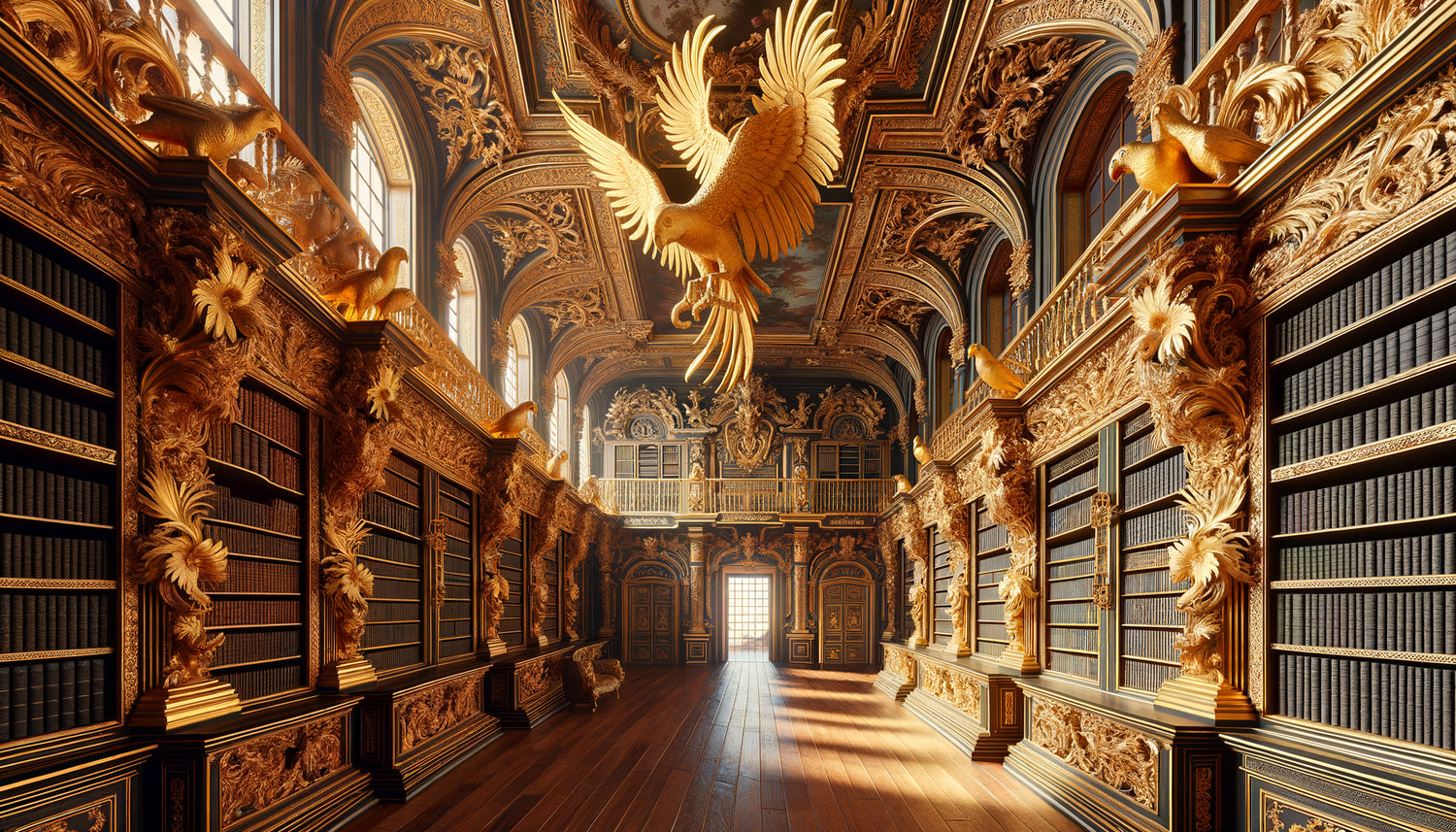
Sculpted pineapples frequently appear in Portuguese colonial libraries in Brazil, particularly in the tops of bookshelves. This fruit, a symbol of hospitality since antiquity, takes on a new dimension in the tropical context. Brazilian sculptors treat it with astonishing realism, reproducing each scale with almost botanical precision.
Passion fruit clusters, banana bunches, and even cacao pods appear in friezes and cartouches. These elements, unthinkable in a European library of the same era, create a unique atmosphere. They constantly recall that the knowledge preserved within these walls is enriched by the discovery of the New World, that the books themselves often tell of Brazil's natural riches.

Integration techniques: when tropical craftsmanship meets baroque
The integration of tropical motifs into Portuguese colonial libraries in Brazil relies on specific techniques. Artisans develop what could be called tropical baroque, a style that retains the dramatic structure of European baroque while enriching it with a Brazilian visual palette.
The technique of talha dourada (gilded sculpture using gold leaf) is reinterpreted with local motifs. In the Library of São Bento Monastery in Salvador de Bahia, sculpted panels blend Baroque cherubs and capuchin monkeys, creating a composition that would have scandalized European purists but fascinates with its audacity. These monkeys, treated with the same artistic dignity as traditional putti, sometimes hold books or measuring instruments, establishing an unexpected parallel between wild nature and the quest for knowledge.
Painted ceilings: tropicalized celestial frescoes
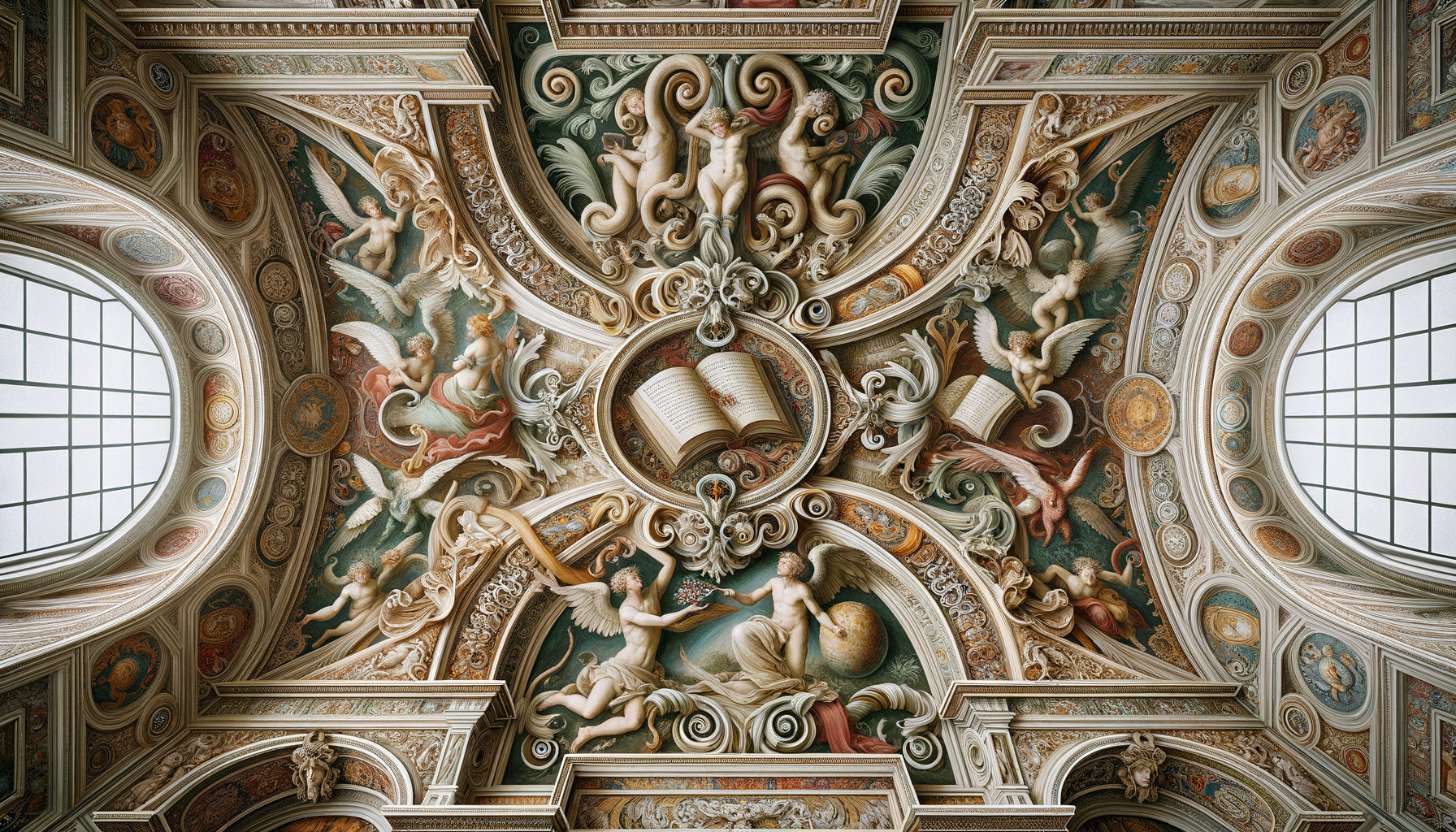
The ceilings of colonial Portuguese libraries in Brazil are the spaces where tropical motifs flourish most freely. Painters create illusionistic perspectives where traditional European skies are populated with exotic birds. Toucans coexist with seraphs, blue morpho butterflies flutter around Baroque clouds.
In some libraries, artists paint flowering vines that seem to climb along the walls and gradually invade the ceiling, creating a feeling of immersion in the tropical forest. This lush vegetation remains organized according to the principles of Baroque composition: symmetry, balance, visual hierarchy. Tropical motifs do not create chaos; they enrich an existing order.
Brazilian wood essences: raw material turned decorative motif
The colonial Portuguese libraries in Brazil reveal a fascinating peculiarity: the material itself becomes a decorative element. Jacaranda da Bahia, with its purple veins and tight grain, is used not only for its strength but also for its intrinsic beauty. Portuguese carpenters, accustomed to European oaks with uniform tones, discover woods whose natural chromatic variations create spectacular visual effects.
The shelves in some libraries deliberately alternate different tropical essences: panels of pau-brasil orange red are juxtaposed with sections in peroba golden yellow, creating polychrome compositions without resorting to paint. This technique, born from the exceptional availability of precious woods in Brazil, transforms colonial libraries into veritable natural mosaics.
Sculptors also exploit the mechanical characteristics of these tropical woods. Jacaranda, exceptionally dense and resistant, allows for sculptures of impossible finesse with European essences. Palm leaves carved reach a lacework delicacy, parrot feathers are detailed with almost photographic precision.

The chronological evolution: from timid to triumphant
The integration of tropical motifs into Portuguese colonial libraries in Brazil follows a revealing chronological trajectory. In the 17th century, the first monastic libraries adopted a cautious approach. Tropical motifs remained confined to peripheral spaces: bases of columns, corners of ceilings, backs of doors.
In the 18th century, a turning point occurs. Libraries such as that of the Monastery of Mafra (although located in Portugal but influenced by artisans returning from Brazil) show an increasing acceptance of this hybrid aesthetic. Tropical motifs migrate to prestigious locations: main facade, central ceiling, framing of the main doors.
The 19th century marks the apogee of this synthesis with the Real Gabinete Português de Leitura. Here, tropical motifs are no longer tolerated guests but constitutive elements of the library's identity. Stained glass windows integrate stylized representations of Brazilian flora, wrought ironwork picks up the shapes of vines, even bronze luminaires imitate tropical flowers.
The contemporary legacy: reinterpreting colonial libraries
The integration of tropical motifs into Portuguese colonial libraries in Brazil offers valuable lessons for contemporary design. These historical spaces demonstrate that it is possible to marry intellectual rigor and decorative exuberance, European tradition and local identity, without one dominating or erasing the other.
Contemporary Brazilian designers draw inspiration from this legacy to create private libraries that reinterpret this colonial aesthetic. Wallpapers reproduce historic painted ceilings, contemporary sculptures revisit baroque parrots with modern materials, parquet floors alternate tropical essences in geometric compositions inspired by colonial shelving.
This decorative approach transcends simple pastiche. It recognizes that our reading and reflection spaces can celebrate both the universal and the particular, honor the tradition of the book while affirming a specific cultural identity. Portuguese colonial libraries in Brazil teach us that culture is never fixed, that it constantly feeds on borrowings, adaptations, creative métissages.
Your reading space deserves a soul as rich as these historic libraries
Discover our exclusive collection of Library paintings that capture the spirit of these extraordinary places where knowledge dialogues with tropical beauty.
Conclusion : when books meet the tropics
Portuguese colonial libraries in Brazil remind us of an essential truth: the most beautiful spaces often arise from the unexpected encounter between different traditions. By integrating tropical motifs into their decor, these libraries created more than just a unique architectural style. They invented a new way to design places of knowledge, no longer as austere temples but as visual celebrations of knowledge and life.
Today, when arranging your own library or reading corner, be inspired by this creative boldness. Don't be afraid to mix influences, to introduce a touch of exuberance into a traditionally restrained space. Dare the parrot near the classics, the sculpted palm tree near the old bindings. Create your own dialogue between order and vitality, between tradition and personal identity. Your books will shine even more.
FAQ : Your questions about tropical colonial libraries
Were tropical motifs in colonial libraries accepted by the Portuguese authorities?
Yes, but gradually. At the beginning of the 17th century, Portuguese sponsors preferred strict European Baroque canons. However, geographical distance and the growing influence of local artisans allowed for increasing creative freedom. By the 18th century, these tropical motifs were not only tolerated but valued as markers of a distinct Brazilian identity. Ecclesiastical and civil authorities understood that colonial libraries had to reflect their context in order to assert their local legitimacy. The mixing of styles became a source of pride rather than transgression, celebrating the Portuguese empire as a multicultural space.
Can we be inspired by these libraries to decorate a contemporary space without falling into pastiche?
Absolutely, and it's even recommended! The spirit of Portuguese colonial libraries in Brazil lies in the principle of decorative blending, not literal copying. For a contemporary interior, retain the essential lesson: marry understated structure with touches of natural exuberance. Opt for minimalist wooden shelving, then add tropical graphic elements via textiles, artworks, or a few sculpted objects. The trick is to maintain balance: 70% classic restraint, 30% tropical accents. Choose stylized patterns rather than realistic ones, prioritize quality over quantity, and ensure that each tropical element dialogues with your book collection rather than visually dominating it.
What are the best-preserved Portuguese colonial libraries in Brazil to visit?
The Real Gabinete Português de Leitura in Rio de Janeiro remains a must-see, with its tropical motifs masterfully integrated into a neo-Manueline structure. The library of the Monastery of São Bento, also in Rio, offers an older example of this stylistic fusion, with exceptional wood sculptures. In Salvador de Bahia, the library of the Monastery of São Bento features an even more tropicalized version, with remarkable decorative exuberance. The Biblioteca Nacional do Brasil in Rio also preserves fascinating colonial elements. To visit them, check the often restricted hours, some requiring prior authorization. Allow several hours per library: these spaces deserve slow and contemplative observation to fully appreciate the richness of detail and the ingenuity of integrating tropical motifs into every corner.