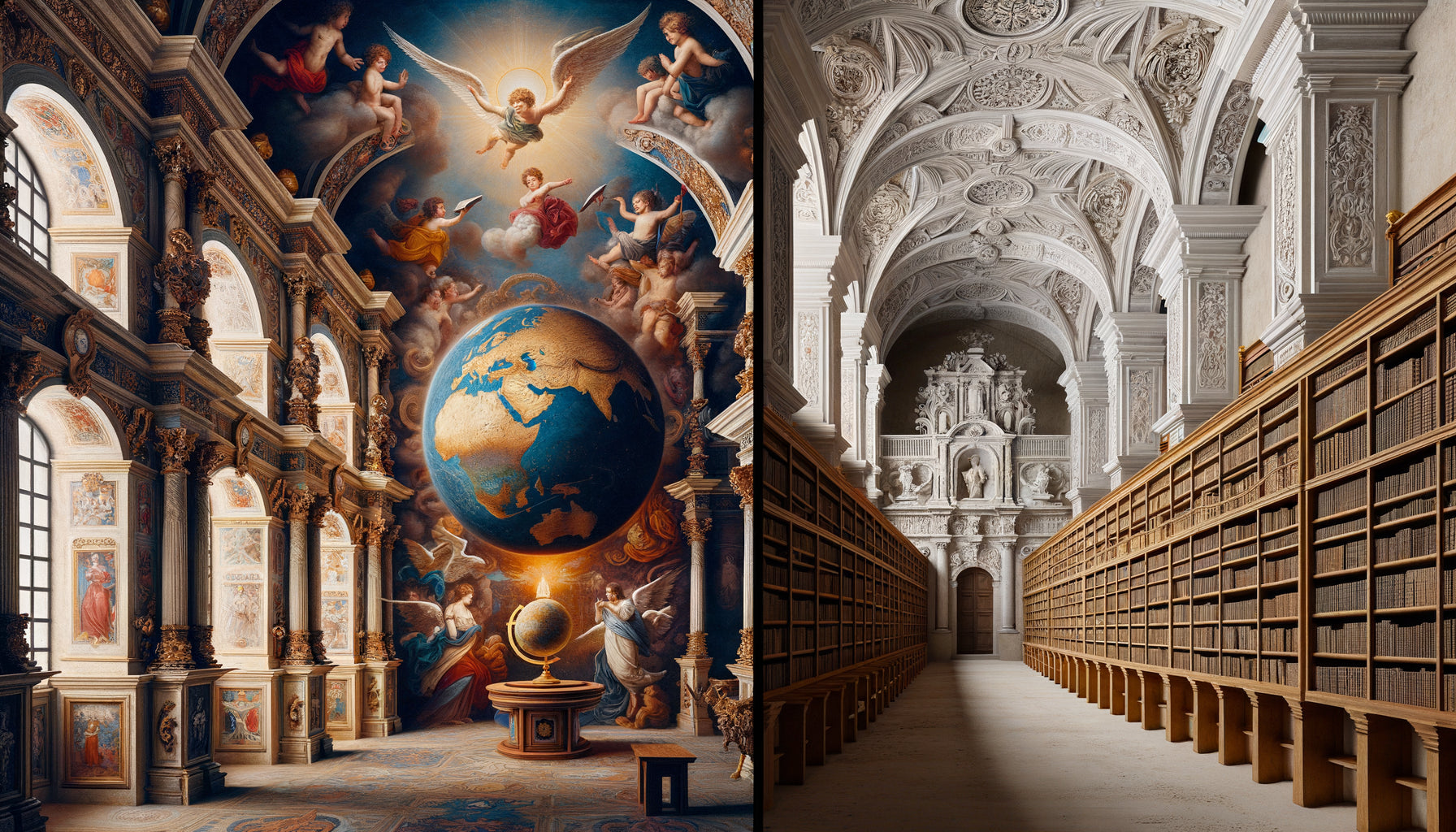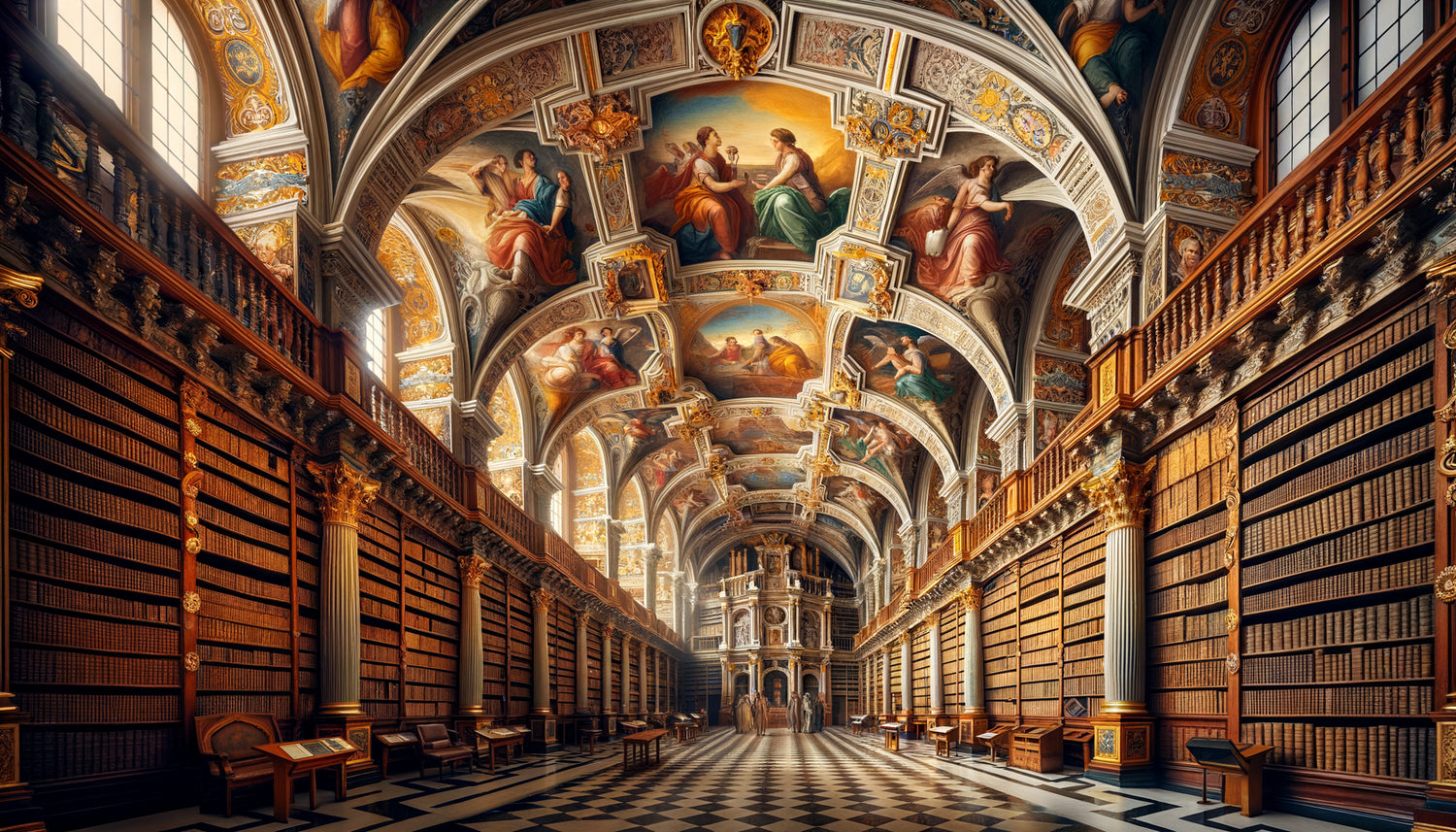
Imagine a library where every fresco, every allegory, every architectural curve tells a story spanning millennia. Where the ceiling itself becomes a 500-square-meter philosophical manifesto. This is precisely what Philip II of Spain orchestrated at El Escorial, creating one of the most dizzying iconographic cycles ever conceived for a place of knowledge. It's not simply decoration: it’s a complete cosmogony painted above the books.
Here's what the iconographic cycle of El Escorial reveals: A total vision of human knowledge divided into seven liberal arts, a triumphant Catholic theology facing the Protestant Reformation, and a demonstration of the intellectual power of the Spanish monarchy at its peak.
You may have already felt overwhelmed by these grand historical libraries, unable to decipher the symbols adorning their walls. This feeling of being faced with an indecipherable code, a visual language that only scholars can understand. Rest assured: even specialists take years to unravel the threads of this iconographic labyrinth.
In this article, I'll take you to decode this masterpiece of visual complexity. You will discover why Philip II chose to transform a simple library into a cathedral of knowledge, and how every detail contributes to a grand project that far exceeds the mere preservation of books.
When a visionary king transforms a library into a philosophical manifesto
In 1567, when Philip II commissions the decoration of the El Escorial library, he is not simply seeking to beautify a space. The Spanish monarch pursues a monumental ambition: to create a microcosm of all human knowledge under a single ceiling. He entrusts this mission to Pellegrino Tibaldi, a mannerist painter trained in the innovations of Michelangelo.
The result surpasses anything that existed before. Where other royal libraries were content with a few medallions or coats of arms, El Escorial develops an iconographic program of unparalleled density. The 54-meter-long barrel vault becomes the support for a veritable visual encyclopedia.
What immediately strikes you is the rigorous structure of the cycle. Seven main compartments correspond to the seven liberal arts of the Middle Ages: grammar, rhetoric, dialectic, arithmetic, music, geometry, and astronomy. Each discipline is personified by a monumental allegorical figure, surrounded by scenes illustrating its history and applications.
The seven liberal arts: an architecture of knowledge suspended
Look up in this library, and you witness a rare sight: knowledge organized as a cosmology. Grammar opens the cycle, represented as a matron teaching the alphabet to children. Around her are scenes showing the invention of writing, the first grammarians, the transmission of language.
Further on, Rhetoric appears holding her traditional attributes, accompanied by Cicero and Demosthenes. Each liberal art thus unfolds its own visual universe, creating a stratification of references that requires an encyclopedic culture to be fully appreciated.
But the complexity of the iconographic cycle of El Escorial lies mainly in its interconnections. The frescoes converse with each other through a network of symbolic correspondences. Arithmetic responds to Music with mathematical proportions. Geometry finds its echo in Astronomy. Everything answers, everything complements itself.
References that weave Antiquity and the Renaissance
What makes the program even more vertiginous is the accumulation of historical references. Tibaldi and his assistants populated the frescoes with more than 200 identifiable characters: Greek philosophers, Arab scholars, saints doctors of the Church, legendary inventors.
Pythagoras meets Saint Thomas Aquinas. Ptolemy dialogues with Alfonso X of Castile. This coexistence between pagan wisdom and Christian doctrine perfectly illustrates the Catholic humanism of the Counter-Reformation: all true knowledge leads to Christ, even that of the Ancients.

A political theology painted on the ceiling
But the iconographic cycle of El Escorial is not limited to an abstract celebration of knowledge. It also carries a political and religious message of implacable clarity. Let us not forget the context: we are in the midst of a confessional war, and Philip II wants to be the champion of Catholicism against the Reformation.
At the center of the vault, dominating the whole, is a representation of Philosophy crowning Theology. The message is clear: all human knowledge finds its fulfillment and justification in Catholic doctrine. Reason serves faith, never the other way around.
This hierarchy is read in the spatial organization itself of the cycle. The liberal arts occupy the side compartments, like servants arranged around a master. Theology reigns at the zenith, culminating point of the intellectual edifice. It is a visual architecture of knowledge that reflects Philip II's worldview.
Hermetic symbols for initiates
The complexity reaches its climax in the details. Latin inscriptions run all around the frescoes, quoting Aristotle, Seneca, the Bible. Hermetic symbols dot the borders: armillary spheres, mathematical instruments, alchemical emblems.
Some elements remain debated by art historians. What significance should be given to such an unusual gesture? Why does this character appear in this compartment rather than another? The iconographic cycle works on several levels of reading, from the most obvious to the most esoteric.
A monumental artistic project mobilizing all of Europe
Understanding the complexity of this cycle also requires measuring the scale of the project. Tibaldi worked with a team of around thirty artists for nearly seven years. Some specialized in the main figures, others in ornamental grotesques, and still others in cartouches and inscriptions.
The creative process itself reveals a rare sophistication. Detailed iconographic programs were written by theological and humanist advisors to Philip II, including the librarian Benito Arias Montano. Each fresco was the subject of discussions, adjustments, and successive validations.
This collaborative method explains in part the conceptual density of the result. The cycle does not arise from individual inspiration, but from a collective will for completeness. Every detail has been weighed, debated, justified by scholarly references.

The lasting influence on the iconography of European libraries
The impact of the Escorial cycle on the history of library decoration is considerable. It establishes a model for representing knowledge that will be imitated, adapted, and reinterpreted for two centuries throughout Catholic Europe.
Its direct influence can be found in the library of Strahov Monastery in Prague, in that of Melk Abbey in Austria, or in the National Library of Vienna. Everywhere, the same principle: to transform the ceiling into a cosmology, to make the library a temple of knowledge where every decorative element instructs as much as it embellishes.
But none of these later achievements will equal the systematic complexity of the original. The Escorial remains unique in its total ambition, its willingness to embrace the entirety of human knowledge in a single coherent program.
Transform your personal library into a sanctuary of knowledge
Discover our exclusive collection of Library paintings that capture the essence of great historical libraries and bring intellectual depth to your interior.
When beauty becomes discourse: art in service of power
It would be naive to see in this cycle only a disinterested celebration of knowledge. The library of El Escorial is also a propaganda tool of extreme sophistication. Philip II does not simply collect books; he stages his intellectual and spiritual legitimacy.
Each visitor entering this space immediately understood the message: the King of Spain rules over an empire where knowledge is organized, mastered, and put at the service of the Catholic faith. It is a demonstration of cultural power against the Protestant courts of Northern Europe.
The complexity itself of the cycle participates in this strategy. The more difficult it is to decipher, the more impressive it is. The more references it accumulates, the more it signals the erudition of its commissioner. Hermeticism becomes proof of superiority.
How to look at this masterpiece today?
Visiting the library of El Escorial today is experiencing that fascination mixed with vertigo that comes from great total works. You cannot see everything, understand everything in a single visit. The gaze jumps from one fresco to another, seeks to follow the connections, gets lost in the details.
It is precisely this effect that the creators of the cycle were seeking. A work that exceeds the capacity for immediate perception, which imposes return, study, meditation. A work that recalls the infinity of knowledge facing human finitude.
Successive restorations have preserved the brilliance of the original colors. Lapis lazuli blues mingle with golds, vermilion reds dialogue with emerald greens. This chromatic richness adds even more to the visual density of the whole.
The iconographic cycle of El Escorial remains today what it was in the 16th century: a summit of intellectual and artistic complexity, a challenge launched to the viewer, an invitation to raise your gaze towards the spheres of knowledge. In your own reading space, even modest, you can be inspired by this ambition: to make the library not just a simple storage space, but a place that speaks, inspires, elevates. Each work you hang there then becomes more than decoration: it becomes a window open onto the infinite world of ideas.
Frequently Asked Questions
Can we visit the library of El Escorial and see the iconographic cycle?
Yes, the library of El Escorial is open to the public as part of the tour of the Royal Monastery, a UNESCO World Heritage site. You will be able to admire the entire cycle painted by Tibaldi, although the lighting is deliberately controlled to preserve the frescoes. I recommend that you allow time for this visit: careful observation of the ceiling requires at least 30 to 45 minutes. Audio guides are available to identify the main allegories and understand the organization of the iconographic program. The site is located about 50 kilometers northwest of Madrid, easily accessible by train or car.
Why do we talk about an iconographic cycle rather than simply frescoes?
The term iconographic cycle refers to a coherent set of images that form a narrative or develop a complete intellectual program. At El Escorial, it is not a matter of juxtaposed independent frescoes, but of a unified system where each element finds its meaning in relation to the others. It's like a visual book whose chapters must be read to understand the overall message. This notion of cycle implies a logical progression, internal correspondences, a conceptual architecture. It distinguishes major programmed achievements from simple decorations, even magnificent ones. An iconographic cycle is always the result of a precise intellectual intention, often carried by a cultured patron such as Philip II.
How to draw inspiration from this complexity to decorate your own library?
You obviously don't need to reproduce 500 square meters of frescoes! The inspiration to take from El Escorial is the idea of thematic coherence in decorating your reading space. Choose a guiding thread: a historical period, a field of knowledge, a color palette inspired by ancient illuminations. Then select some works that dialogue with each other rather than a heterogeneous accumulation. A portrait of a philosopher can respond to an antique celestial map, which itself echoes a reproduction of a medieval manuscript. Create levels of reading in your decoration: one element immediately visible, and others details that the eye discovers gradually. It is this stratification that gives depth to an interior and transforms a simple library into an inspiring place.