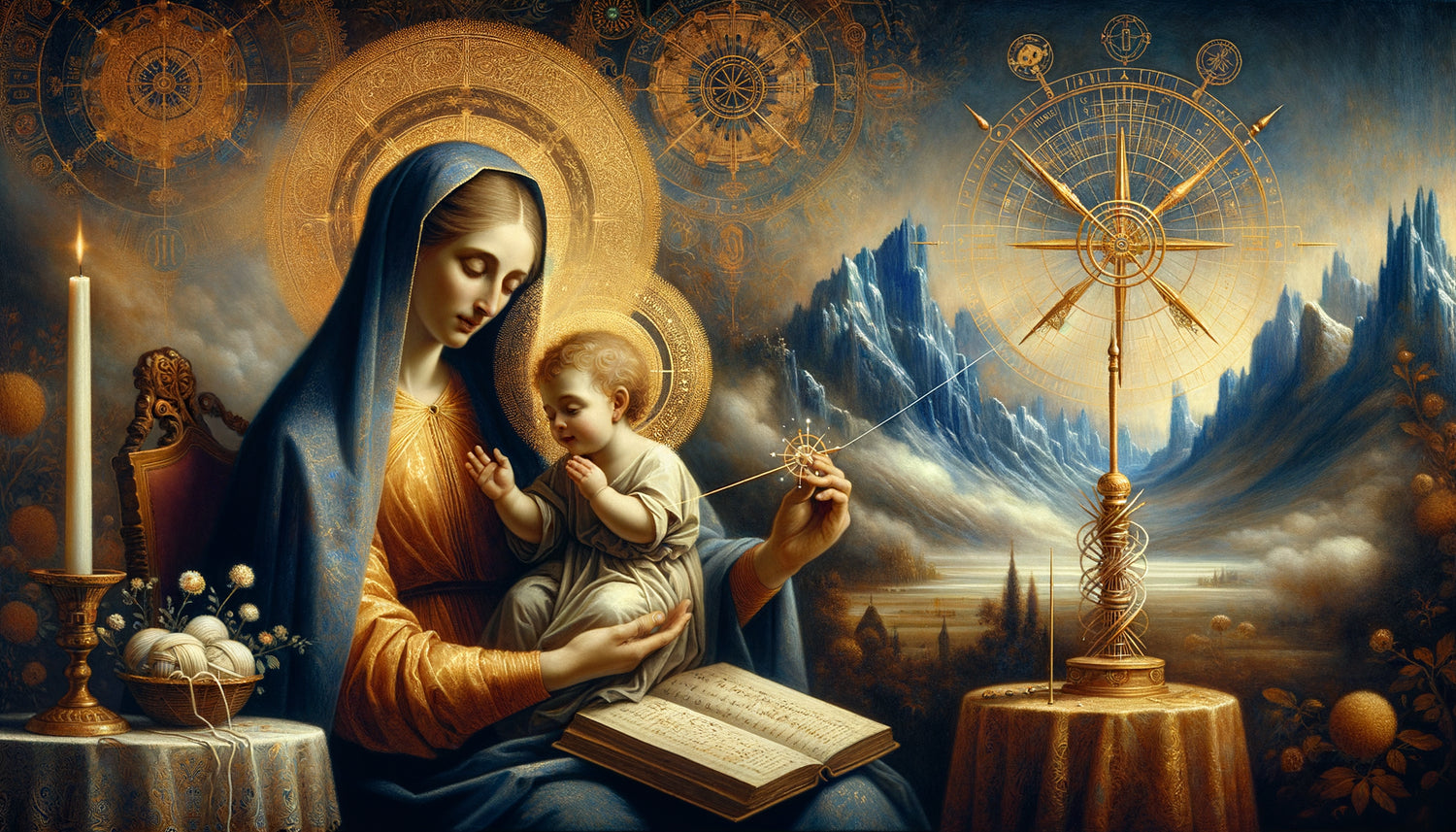
In my Florentine workshop, between alchemical manuscripts and reproductions of ancient masters, a small painting by Leonardo has always fascinated me: The Madonna of the Rocks. For fifteen years deciphering esoteric symbols in Renaissance art, I understood that what appears to be an innocent maternal scene actually hides a hermetic language of vertiginous depth. This spindle that the Child Jesus grasps with such intensity is not just a toy – it's the key to a secret teaching that Leonardo reserved for initiates.
Here's what the hermetic symbolism of The Madonna of the Rocks reveals: a meditation on destiny and sacrifice, a dialogue between matter and spirit, and an alchemical teaching on inner transformation. Three dimensions that few viewers perceive at first glance.
You may be standing in front of a reproduction of this work, intrigued by this strange composition but unable to decipher what Leonardo really wanted to convey. Classical interpretations speak of premonition of the Cross, but remain on the surface. Rest assured: the hermetic language of the Renaissance follows precise codes, and once you have the reading keys, each element illuminates with a new meaning.
I propose an initiatory journey into the hidden strata of this painting, where painting becomes a philosophical treatise and every detail vibrates with an esoteric intention.
The cruciform spindle: first degree of initiation
In the hermetic tradition that Leonardo studied diligently, the spindle represents the axis mundi, this invisible column that connects earth to sky. When the Child Jesus turns towards this cross-shaped object, almost abandoning his mother's breast, he accomplishes the first gesture of the initiate: recognizing his spiritual destiny. This movement is not a child's game – it’s a conscious acceptance of the path of transformation.
The Madonna gently tries to hold her son back, creating this dramatic tension that runs through the entire composition. This mother-child dialectic perfectly illustrates the fundamental hermetic conflict: the attraction of matter (the Mother, the Earth, the body) against the call of the spirit (the spindle-cross, the Sky, the spiritual mission). Leonardo knew the texts of the Corpus Hermeticum where the soul must free itself from earthly attachments to accomplish its ascent.
In my research on alchemical symbols of the Renaissance, I discovered that the spindle appears in several hermetic manuscripts as the instrument that spins destiny. The Greek Fates spin with their spindle the lives of mortals. Here, the Child grasps his own spindle – he becomes master of his destiny, a conscious actor rather than a passive victim.
The cross hidden in the everyday tool
What’s brilliant about Leonardo’s
The spindle spins the wool, transforming raw material into usable thread. In hermetic language, this transformation of raw material into purified substance exactly represents
The cosmic landscape: nature as a hermetic temple
Behind the figures, Leonardo unfolds one of those bluish landscapes he was so adept at. But for those who know how to read hermetic symbols, it’s not just a backdrop. These rugged rock formations, these winding paths, this misty atmosphere that dissolves contours – all of this composes an
In the hermetic tradition that Leonardo frequented at the Medici court and in Florentine neoplatonic circles,
I spent hours comparing this landscape with descriptions of initiatory journeys in alchemical texts contemporary to Leonardo. The resemblance is striking. The path to hermetic knowledge is never straight – it winds, rises, descends, sometimes disappears into the mist before reappearing.
Water and stone: the alchemical elements
If you look closely, you will distinguish streams in this landscape of
The union of water and stone in this landscape represents the union of opposites, what hermeticists called

The coded gestures: an initiatory choreography
In the hermetic art of the Renaissance, every gesture counts. Hands are never placed randomly – they transmit a silent teaching. In The Madonna of the Rocks, observe the child's hand grasping the cruciform object firmly: it is a voluntary, determined grip. It’s not the hesitant hand of a toddler grabbing a toy – it’s the resolute gesture of one who accepts his mission.
The Virgin's hand, gently placed on the Child in an attempt to hold him back, forms a striking contrast. This gestural opposition creates an energy dynamic that any initiate to hermetic mysteries can decipher: the ascending movement of the spirit against the descending gravity of matter.
I studied the hermetic chiromancy treatises that Leonardo possessed in his library. In these texts, the position of the fingers, the orientation of the palms, the tension of the muscles communicate spiritual states. The hands in this painting tell a story of spiritual choice, of tension between maternal love and cosmic destiny.
The gaze that pierces the veils
The child's gaze fixes intensely on the spindle. In hermetic iconography, the concentrated gaze symbolizes active contemplation, this ability to see beyond appearances. The Child is not looking at a simple object – he is contemplating the mystery of his incarnation and his future passion. This piercing gaze penetrates the veils of material illusion to reach spiritual truth.
The Virgin, for her part, looks at her son with a melancholic expression that Leonardo rendered with devastating subtlety. Her gaze expresses knowledge – she too sees what that spindle means. This double conscious vision makes this scene much more than a domestic anecdote: it is a silent dialogue between two beings who share the knowledge of a terrible and sacred mystery.
The golden light: hermetic illumination
In The Madonna of the Rocks, Leonardo bathes the scene in a warm, almost golden light that contrasts with the cold blues of the distant landscape. This chromatic opposition is not accidental. In hermetic and alchemical tradition, gold symbolizes spiritual enlightenment, the culmination of the Great Work.
The figures of the Virgin and Child are enveloped in this golden light that seems to come from nowhere – or rather, which emanates from themselves. It is an inner light, that of awakened spiritual consciousness. In the hermetic texts that Leonardo annotated, this divine light is described as the visible manifestation of the presence of the Divine within the human soul.
Leonardo's sfumato, this technique of imperceptible transitions between shadow and light, beautifully serves this hermetic symbolism. The contours dissolve, the boundaries blur – exactly as in the mystical experience where separations between matter and spirit, human and divine, gradually fade away.

When art becomes a philosophical treatise
What has fascinated me for fifteen years in The Madonna of the Spindles, is this ability that Leonardo had to encode a complete philosophical teaching into an apparently simple scene. For the uninitiated spectator, it is a charming representation of the Madonna and Child. For those who possess the keys to hermetic reading, it is a treatise on destiny, free will, spiritual transformation.
Leonardo belonged to those circles of Renaissance intellectuals who studied the newly rediscovered hermetic texts, translated from Greek by Marsile Ficin. These texts claimed to transmit the wisdom of ancient Egypt, a secret knowledge about the nature of the universe and the divine potential of man. The spindle in this painting is not only a prefiguration of the Cross – it is a polysemic symbol that works on several levels of simultaneous reading.
At the Christian exoteric level: foreshadowing of the Passion. At the hermetic esoteric level: representation of the cosmic axis and alchemical transformation. At the Neoplatonic philosophical level: illustration of the conflict between soul and body. This stratification of meaning is typical of Renaissance hermetic art.
Let hermetic wisdom inspire your interior
Discover our exclusive collection of paintings inspired by famous artists that transform your space into a sanctuary of beauty and profound meaning.
Leonardo's initiatory legacy
When I contemplate The Madonna of the Spindle today, after all these years of studying hermetic symbols, I realize that Leonardo left us much more than a painting. He passed down a method of perception, an invitation to look beyond the surface of things.
The spindle becomes a cross, the domestic tool becomes a cosmic instrument, the maternal scene becomes spiritual initiation. This ability to see correspondences between different levels of reality – that is precisely what the hermetic tradition taught. 'As above, so below,' proclaimed the Emerald Tablet, the foundational text of hermetism that Leonardo knew perfectly.
In your own contemplation of this work, whether in front of the original or a quality reproduction, try to adopt this hermetic gaze. Don't settle for the first reading. Look for correspondences, symbolic echoes, nested levels of meaning. This is how Leonardo wanted his works to be viewed – as enigmas to decipher, doors to open towards a deeper understanding.
The hermetic symbolism of The Madonna of the Spindle reminds us that true art transcends mere representation. It becomes a vehicle for transformation, a mirror of our own spiritual questions, an invitation to awaken consciousness. This small, discreet painting hides a universe of meanings – exactly as, according to hermeticists, our material world hides spiritual mysteries for those who know how to perceive them.
Start today to look differently. Choose a work that attracts you – a reproduction by Leonardo, a Renaissance painting, any creation that resonates with you. Look at it for a long time, in silence. Look for the symbols, question each element, let the multiple meanings emerge gradually. This is how art becomes an initiatory path, and how your ordinary gaze transforms into hermetic vision.
Frequently Asked Questions about the Hermetic Symbolism of The Madonna of the Spindle
Do you need to be an expert in esotericism to understand the hermetic symbols in this painting?
Absolutely not, and that’s the beauty of Léonard’s approach. You don’t need to master alchemy or Neoplatonic philosophy to feel the depth of *The Madone aux fuseaux*. The painting works on several levels simultaneously. At first glance, you perceive the emotional tension between mother and child, the strangeness of this spindle that attracts so much attention from the toddler. This is already a valid and moving reading. Then, with a few keys to understanding like those I share here, you begin to see additional symbolic layers. The spindle is no longer just a spindle – it becomes a cosmic axis, foreshadowing the cross, an instrument of transformation. This progressive discovery is precisely what Léonard was seeking: that each viewer, according to their level of preparation, discovers what they are ready to see. Simply start by observing carefully, asking yourself: why is this element placed there? What emotion does it evoke? Hermetic symbols speak as much to intuition as to intellect.
Did Léonard really want to encode a secret hermetic message?
The historical evidence is convincing. Léonard frequented the Neoplatonic circles of Florence where hermetic texts, freshly translated from Greek, were studied with passion. His notebooks contain explicit references to alchemical and hermetic concepts. He owned books on these subjects in his personal library. In the Renaissance, encoding multiple meanings into works of art was not an exception – it was the norm among cultured artists. Hermetism was not considered marginal esotericism, but a respectable philosophy that complemented Christianity rather than opposed it. Marsile Ficin, the translator of the *Corpus Hermeticum*, was a Catholic priest! In *The Madone aux fuseaux*, the accumulation of symbols traditionally associated with hermetism – the spindle-cosmic axis, the initiatory landscape, the golden light, the coded gestures – cannot be coincidental. Léonard was too precise, too intentional in every detail for these elements to be coincidences. Yes, he deliberately built this painting as a disguised hermetic teaching in a conventional religious scene.
How can I learn to decode other hermetic symbols in Renaissance art?
Start by familiarizing yourself with the basic symbols of Hermetic and alchemical tradition: the four elements (earth, water, air, fire), metals (gold for the sun/perfection, silver for the moon/transformation, etc.), symbolic animals (serpent for hidden wisdom, eagle for ascending spirit, lion for solar strength). Then, carefully observe Renaissance artworks, always asking yourself: why is this element present? In The Madone aux fuseaux, why a spindle rather than another object? Look for correspondences: between the top and bottom of the composition (reflecting the fundamental Hermetic principle), between warm and cool colors, between the gestures of the characters. Read some introductory texts on Renaissance hermeticism – not necessarily the technical treatises of alchemy, but rather works on the cultural history of this period. You will discover that Hermetic thought permeated the entire intellectual culture of the time. Visit museums with this new perspective, taking the time to contemplate each work for a long time. With practice, you will develop this symbolic intuition that will allow you to perceive the multiple layers of meaning that the masters of the Renaissance carefully wove into their creations.