Florence, 1485. Imagine entering the Tornabuoni Chapel of Santa Maria Novella. Your eyes rise to the monumental frescoes depicting the life of the Virgin and St John the Baptist. But suddenly, something surprising catches your eye: among the saints and angels, you recognize the faces of living Florentines, city notables, members of the commissioning family. This audacity, this masterful fusion between sacred and profane, is the signature of Domenico Ghirlandaio, master of integrated portraiture.
Here's what Ghirlandaio’s integration of patrons brings: a shocking humanization of religious scenes that makes the divine accessible, a subtle social enhancement that transforms the patron into an eternal witness to faith, and a narrative continuity that makes sacred history dialogue with contemporary history. You might wonder how an artist could dare to place ordinary mortals in divine scenes without shocking the Church? How did these portraits serve the ambitions of Florence’s great families? Ghirlandaio's art answers these questions with an elegance that has crossed centuries. I will reveal the masterful techniques of this artist who revolutionized religious frescoes by making patrons true actors in sacred storytelling.
Portraiture as a Legitimate Act of Devotion
In Florence during the Quattrocento, integrating one’s portrait into a religious fresco was not considered an act of vanity but a public demonstration of piety. Ghirlandaio perfectly understood this spiritual and social dynamic. Patrons who financed chapel decorations were not simply seeking earthly glory: they were investing in their eternal salvation.
The painter strategically positioned patron portraits in attitudes of prayer or respectful contemplation. In the Sassetti Chapel of Santa Trinita, Francesco Sassetti and his wife Nera Corsi appear kneeling, hands clasped, gaze turned towards the central scene of the Nativity. Their presence does not interrupt the religious narrative: it enriches it by showing that faith transcends eras.
This approach allowed Ghirlandaio to satisfy two seemingly contradictory requirements: celebrating his patrons while respecting the primacy of the spiritual message. Religious frescoes thus became spaces where the temporal and the eternal meet, where the living mingled with saints in a carefully orchestrated harmony.
The Subtle Art of Visual Hierarchy
Ghirlandaio mastered the delicate balance between highlighting and discretion. His integrated portraits respected a precise visual hierarchy that preserved the centrality of sacred figures. Patrons never occupied the center of the composition: they stood on the sides, often in the foreground, creating an effect of testimony rather than direct participation in the divine action.
In his frescoes at Santa Maria Novella, the artist arranged the members of the Tornabuoni family as privileged spectators witnessing biblical events. Their size was slightly reduced compared to the holy figures, creating a spatial depth that clearly distinguished the earthly world from the celestial realm. This technique d'intégration allowed the portraits to be immediately recognizable without dominating the scene.
The treatment of clothing also revealed this subtlety: while the saints wore timeless draperies with vibrant colors, the patrons appeared in their contemporary attire, rich but understated. This difference in dress visually anchored the distinction between sacred history and contemporary presence, while enhancing the elegance of the commissioners.
The strategic placement in architectural space
The architect of his own success, Ghirlandaio used painted architecture to create natural niches for his portraits de mécènes. Fictitious columns, arches, and staircases allowed the patrons to be visually isolated while keeping them within the narrative continuum. This sophisticated spatial organization transformed the wall surface into a multi-level theater where each character occupied their rightful place.

When patrons become biblical characters
But Ghirlandaio sometimes went even further: he dared to lend the features of his patrons to minor characters in the biblical narrative. In the scene of the Visitation à Santa Maria Novella, the Florentine women accompanying Mary and Elizabeth bear the recognizable faces of the Tornabuoni ladies and their social circle. This integration strategy was even bolder than simple portraiture as a witness.
The artist meticulously chose which biblical characters could receive the features of contemporaries. Never Christ, the Virgin, or the major saints: always the background figures, the followers, the servants, the passersby in the crowd. These personnages bibliques incarnés by Florentines created a powerful emotional bridge between the viewer and the sacred event.
This technique radically transformed the reception of the work. The faithful of Santa Maria Novella could literally recognize themselves in the sacred story, making biblical events no longer distant and abstract, but tangible and current. The religious fresco thus became a mirror in which Florence contemplated its spiritual dimension.
The collective portrait: celebrating an entire clan
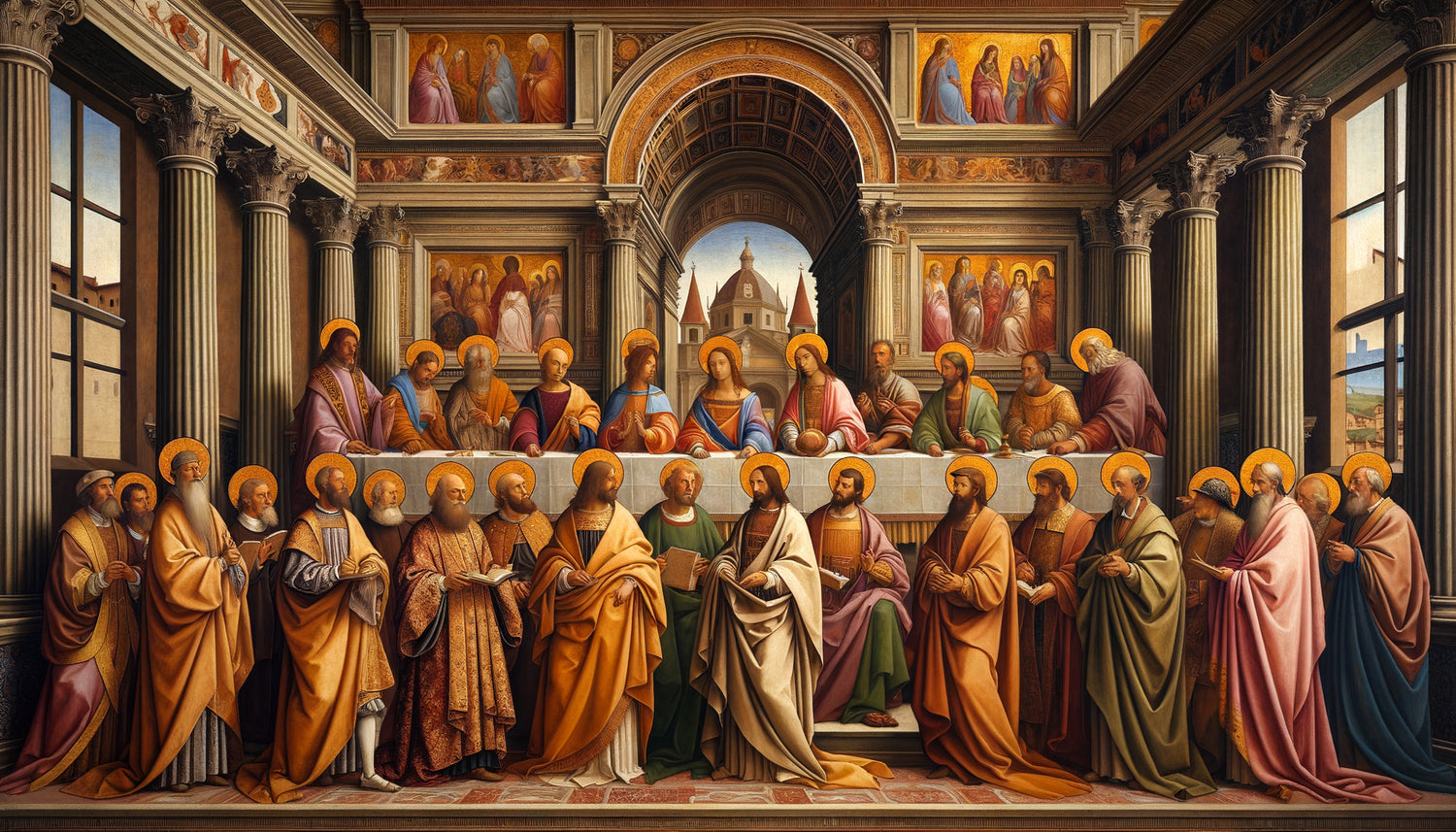
One of Ghirlandaio's major innovations was to integrate not one or two patrons, but entire collective portraits. In the Tornabuoni Chapel, there are more than twenty members of the family and their entourage distributed across the different scenes. This gallery of portraits transformed the chapel into a true dynastic monument.
The painter organized these groups with a keen sense of social composition. Men on one side, women on the other, respecting the conventions of the time. The elders in the foreground, the younger ones slightly recessed. Each face was individualized with extraordinary attention to physiognomic details: the shape of the nose, the hairline, the characteristic gaze. These family frescoes constituted veritable visual archives of the great Florentine lineages.
This collective approach also served a political function: it affirmed the cohesion of the clan, its numerical power, and its anchoring in the religious life of the city. Patrons did not present themselves as isolated individuals but as representatives of a lasting dynasty. Ghirlandaio thus became the visual chronicler of Florentine aristocracy.
Immortality through painting
Beyond immediate social recognition, these integrated portraits offered patrons something more valuable: immortality. Five centuries later, we know the faces of Giovanna degli Albizzi, Francesco Sassetti, and Giovanni Tornabuoni thanks to Ghirlandaio's talent. The religious fresco became eternal memory, guaranteeing that these names and faces would cross generations.

Modernizing the decor: Florence enters the Gospel
Ghirlandaio didn't just integrate the faces of his contemporaries: he literally transplanted Florence into biblical scenes. The painted architectures reproduced the palaces, squares, and monuments of the Tuscan city. In the Birth of the Virgin in Santa Maria Novella, Anne’s room strangely resembles a 15th-century Florentine patrician chamber, with its Renaissance furniture and ladies in contemporary costumes.
This visual updating created a striking sense of familiarity. The faithful recognized their city in sacred history, as if biblical events had taken place on their own streets. Patrons found a double valorization: not only were their faces immortalized, but their lifestyle was elevated to the setting for divine mysteries.
Clothing, jewelry, and hairstyles reflected Florentine fashion of the time with documentary precision. For art historians, these Ghirlandaio frescoes are now invaluable sources on daily life during the Renaissance. For his commissioners, they affirmed that Florence was indeed the New Jerusalem, the spiritual and cultural center of the Christian world.
Let the spirit of the Renaissance illuminate your interior
Discover our exclusive collection of paintings inspired by famous artists that will transform your walls into personal galleries where the history of art meets your story.
The technical legacy: a model for future generations
The method of integrating patrons developed by Ghirlandaio profoundly influenced his contemporaries and successors. His workshop, one of the most important in Florence, trained young artists who would spread these techniques throughout Italy. Among his apprentices was the young Michelangelo, who certainly observed how his master orchestrated these complex compositions blending sacred and portrait.
Commissioners of other Florentine churches began to demand similar integrated portraits in their own chapels. What was innovation became convention, then tradition. Ghirlandaio had established a new standard: a religious fresco worthy of the name must now celebrate both divine glory and that of its earthly financiers.
This evolution marked a turning point in the very conception of religious art. Painting was no longer only a medium for collective and anonymous devotion: it also became a space for individual and family representation. Art patronage changed in nature, moving from selfless offering to calculated identity investment.
Your own contemporary chapel
Today, when we admire the frescoes of Ghirlandaio, we understand that this artist solved a complex equation: how to assert one's identity without eclipsing the spiritual message, how to leave one's mark on eternity without falling into condemnable vanity. His portraits of patrons touch us because they reveal our universal desire to be recognized, remembered, immortalized.
In our contemporary interiors, we pursue this same quest in a different way. We choose works that resemble us, that tell our story, that affirm our values. Like the Tornabuoni or the Sassetti, we create our own private chapels where art represents and transcends us. Ghirlandaio's lesson remains relevant: authentic art creates a dialogue between the work and the one who contemplates it, transforming space into a theater of our deepest aspirations.
Dare as these Florentine patrons did: surround yourself with works that elevate you while reflecting you. The legacy of Ghirlandaio reminds us that art is never neutral; it always bears the mark of those who wanted, financed, and contemplated it. Make your home a place where every glance at your walls becomes an encounter with beauty and with yourself.
Frequently Asked Questions about Patron Portraits in Religious Art
Did patrons pay more to be depicted in the frescoes?
Absolutely, and it was even explicitly stated in the contracts. Funding an entire chapel with frescoes already represented a considerable sum for the time – often equivalent to several years of income for a patrician family. The integration of personalized portraits constituted an additional service that significantly increased the total cost. Ghirlandaio negotiated these details precisely: the number of portraits, their relative size, and their location in the composition. The more visibility the patron desired, the greater the investment. Some contracts even specified the quality of pigments to be used for the clothing of the commissioners – ultramarine blues, made from lapis-lazuli imported from Afghanistan, were particularly expensive. This economy of portraiture testifies to the social and spiritual importance attached to this eternal presence in sacred space.
Did the Church see this as a condemnable act of pride?
This is a fascinating question that reveals the complexity of the Italian Renaissance. The Church adopted a pragmatic position: it needed the funding of wealthy families to embellish its buildings and assert its magnificence. Contemporary theologians developed a subtle justification: as long as the portrait was depicted in an attitude of humble devotion, it constituted a pious offering rather than a manifestation of pride. The kneeling posture, hands clasped in prayer, gaze averted towards the sacred scene rather than the viewer – all these elements signaled the submission of the mortal to the divine. Ghirlandaio excelled in this rhetoric of ostentatious humility. Moreover, the Church considered that these portraits encouraged other faithful to follow the example of generous patrons, thus creating a healthy emulation in religious patronage. The system worked admirably as long as the codes of visual propriety were respected.
Can these frescoes still be seen today?
Yes, and it is one of the extraordinary joys of a trip to Florence! The main frescoes by Ghirlandaio containing portraits of patrons are perfectly accessible. The Tornabuoni Chapel in Santa Maria Novella church remains the most spectacular and well-preserved ensemble – you will easily spend an hour identifying all the portraits integrated there. The Sassetti Chapel at Santa Trinita offers a more intimate experience, in a smaller space where one feels truly close to the depicted characters. These works have survived for over five centuries thanks to the impeccable technique of fresco, where pigments are applied to fresh plaster and become literally part of the wall. Careful restorations carried out in the 20th century have restored much of their original splendor. Standing in these chapels is sharing space with these Florentines of the Quattrocento who still look at us across the centuries – a moving experience that I recommend to any art lover.