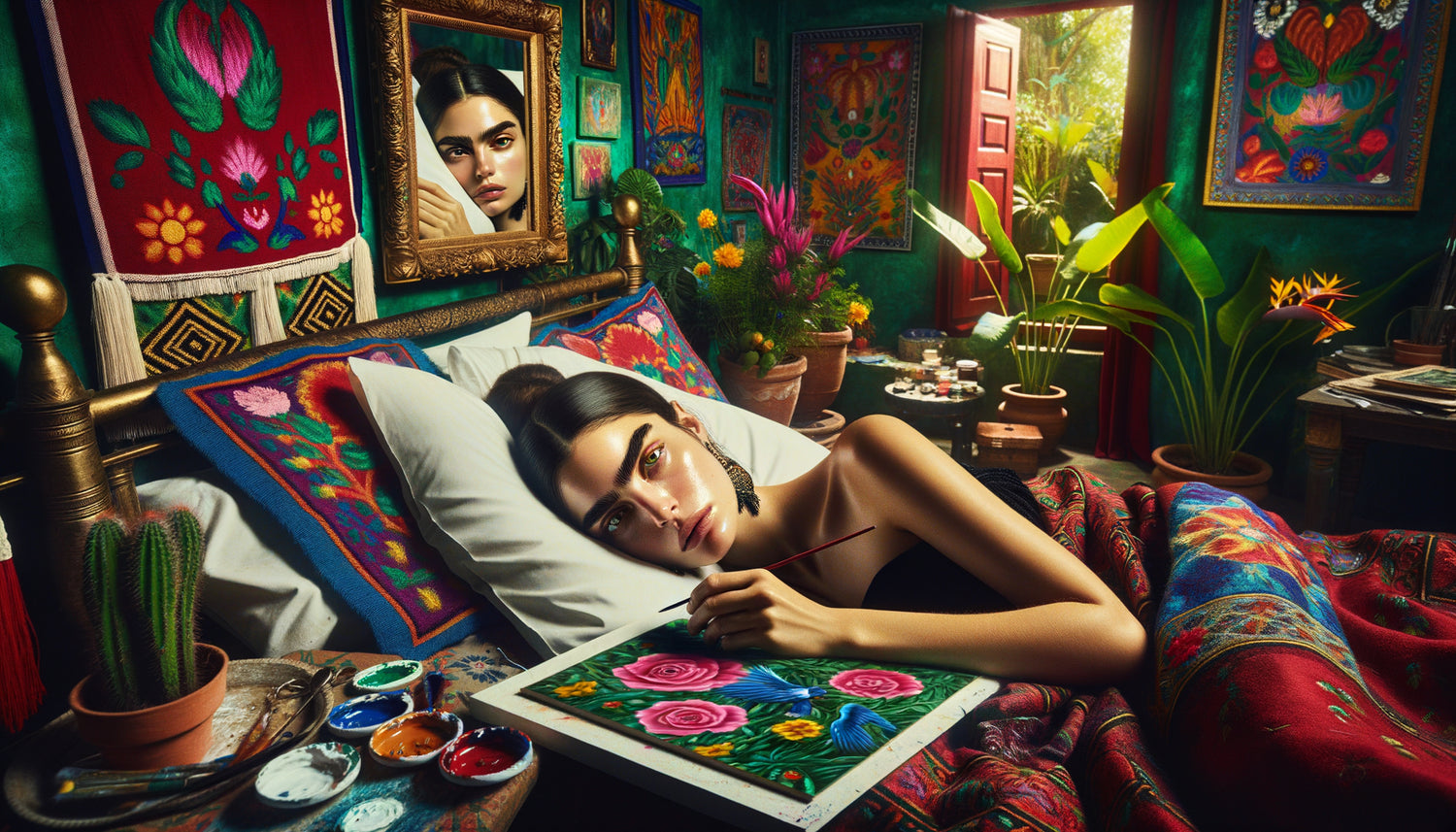
Facing the mirror in her bedroom, a woman paints herself again and again. The same fiery gaze, the same arched eyebrows, the same flowers in her hair. More than fifty times. This obsessive repetition is not narcissism — it's an act of survival, of resistance, of constructing an identity fragmented by pain. Here's what Frida Kahlo’s self-portraits reveal: an intimate exploration of identity, a political affirmation of the Mexican female body, and a transformation of suffering into creative power. You might wonder why this artist dedicated so much energy to representing herself, when the world offered so many other subjects. This seemingly simple question hides a profound story, that of a woman who, facing forced immobility, made her own face a territory of freedom. Let me guide you through the intimacy of these canvases where each self-portrait becomes a mirror of the human soul, a silent manifesto, an uninterrupted conversation with oneself. You will discover that beyond simple representation, these works speak to us all.
The mirror hung from the ceiling: when accident shapes the artist
The story begins with tragedy. On September 17, 1925, Frida Kahlo, 18 years old, survives a tram accident that breaks her spine in three places, fractures her pelvis, ribs, and perforates her abdomen. Bedridden for months, surrounded by casts and suffering, she receives from her mother a gift that will change the history of art: a mirror fixed to the canopy of her bed, and an easel adapted for painting while lying down.
This mirror is not just an accessory — it's the window to her only accessible subject. Impossible to go out, to capture landscapes, to depict street scenes. Her world shrinks to four walls, to the pain that throbs, and to this face that fixes her in the reflection. Frida Kahlo’s self-portraits are born first from a practical necessity: painting what she can see. But this physical constraint quickly becomes an artistic liberation.
This forced immobility creates a rare intimacy with her own image. Where other artists paint one or two self-portraits in their career, Frida produces more than fifty-five on one hundred forty-three canvases. She observes her features with surgical intensity, noting every change, every scar, every nuance of emotion. Her self-portraits become a visual diary, a chronicle of her own existence when the body refuses to obey.
“I paint my own reality”: exploring fragmented identity
Frida Kahlo declares: “I paint self-portraits because I am so often alone, because I am the person I know best.” This simple sentence hides a more complex truth. Her self-portraits do not seek to capture a fixed identity, but to explore its multiple facets. Each canvas reveals a different aspect: the wounded Frida, the Mexican Frida, the Frida in love, the betrayed Frida, the barren Frida.
In The Two Fridas (1939), she literally duplicates herself. Two versions of herself hold hands—one in a traditional Tehuana dress, the other in a European Victorian gown. Hearts are visible, connected by a vein that bleeds. This double self-portrait illustrates her search for identity between tradition and modernity, between Mexico and Europe, between the beloved woman and the abandoned woman. Frida Kahlo’s self-portraits do not capture a face; they map a soul in constant motion.
This exploration goes beyond narcissism. She questions what it means to be a woman in a patriarchal society, to be Mexican in a world dominated by European aesthetics, to be disabled in a body that rejects motherhood. Each self-portrait poses a question: Who am I today? What remains of me after the pain, after Diego, after the surgeries?

The body as a political territory
Frida Kahlo’s self-portraits are deeply political. At a time when Mexican art is searching for its post-revolutionary identity, she dresses in Tehuana clothing, wears traditional flower headdresses, asserts her indigenous heritage. Her face becomes a nationalist manifesto, a claim of Mexican beauty against European canons.
She paints her unibrow, the slight fuzz above her upper lip—features that an Western woman of the time would have hidden. In her self-portraits, she even exaggerates these characteristics, transforming what society considers “flaws” into attributes of pride. She refuses to conform to imposed standards of feminine beauty. Each self-portrait becomes an act of resistance, an affirmation that her body, as it is—broken, mixed, non-conforming—deserves to be represented, celebrated, immortalized.
This political dimension extends to her representation of suffering. Unlike artists who idealize, Frida shows her orthopedic corsets, her broken spines, her tears. In The Broken Column (1944), her torso opens onto a cracked Ionic column, her body is pierced with nails. These raw images refuse complacency, demand that we face pain head-on. Frida Kahlo’s self-portraits give visibility to the suffering female body, long relegated to silence.
Dialogue with Diego and construction of myth
Diego Rivera, her husband, a celebrated muralist, paints monumental frescoes for the people. Frida, on the other hand, paints small and intimate works, initially for herself. But this intimacy becomes universal. Her self-portraits are also a conversation with Diego—the man she passionately loves, who constantly betrays her. In several self-portraits, she inscribes him on her forehead, literally within her thoughts. In others, painted after their separations, she depicts herself cut in two, bleeding.
These self-portraits document a tumultuous relationship, but they do more than that: they establish Frida as an artist in her own right. Diego was the star; she could have remained “the wife of.” By painting herself tirelessly, using her face as a recognizable icon, she builds her own artistic identity. Frida Kahlo's self-portraits become her signature, her exclusive territory. No one else can paint Frida like Frida.
This repetition also creates a myth. Seeing this face with thick eyebrows, these flowers in her hair, this intense gaze repeatedly, Frida becomes an image, almost a brand. She consciously constructs her public persona through these self-portraits. It is a survival strategy in the art world: to be immediately recognizable, to create a visual style so strong that it transcends trends.

The creative solitude: painting to exist
“I am not sick, I am broken,” says Frida. Her long periods of hospitalization, her thirty-two operations, her days immobilized create a deep loneliness. In these moments, painting self-portraits becomes a way to affirm her existence. I see myself, therefore I am. I paint myself, therefore I persist. Each brushstroke is proof of life.
This solitude is not only physical; it is existential. Frida feels misunderstood, alien in her own body, separated from the world by chronic pain. Self-portraits fill this void. They create an inner dialogue, a companionship. When she paints herself, she is no longer alone—she is both the observer and the observed, the artist and the muse, the subject and the object.
The backgrounds of her self-portraits reveal this interiority. Rarely realistic spaces, rather symbolic landscapes: lush jungles, stormy skies, empty spaces. These settings do not locate Frida in a geographical place but in an emotional state. Each self-portrait maps an inner territory, a unique psychological moment. The repetition of the same face paradoxically highlights the constant transformation of being.
The Legacy: When a Face Becomes an Icon
Today, Frida Kahlo's face is everywhere: t-shirts, mugs, posters, Instagram filters. This ubiquity proves the power of her strategy. By obsessively painting herself, she created an immortal image. Frida Kahlo’s self-portraits have transcended their status as works of art to become cultural symbols. They speak of resilience, feminism, cultural pride, and transforming pain into beauty.
But this popularization also raises questions. Has the image become so familiar that we forget to look? Behind the iconic eyebrows and flower crowns lies a psychological complexity, a real pain, a sophisticated artistic intelligence. Each self-portrait deserves to be contemplated as a unique enigma, not as a repetition of the same motif.
For today's creators, Frida’s example teaches that limitation can become liberation. Confined to her bed, she turned constraint into strength. She shows us that exploring a single subject deeply—even and especially oneself—can reveal the universal. Frida Kahlo’s self-portraits prove that you don't need to travel far to create works that transcend time and borders.
Let Frida’s Audacity Inspire Your Interior
Discover our exclusive collection of wall art inspired by famous artists that transforms your space into an intimate gallery, each piece telling a story of passion and authenticity.
Your Own Mirror
Frida Kahlo’s self-portraits remind us of a simple truth: knowing oneself is a lifelong pursuit. She spent years exploring her face, and each canvas reveals something new. It's not narcissism; it's inner archaeology. She digs beneath the surface, seeks the truth under appearances, refuses easy answers.
You don't need to paint fifty self-portraits to understand this lesson. But perhaps you can ask yourself: When did I take the time to really look at myself? Not in the quick morning mirror glance, but with the attention Frida paid to her features, her emotions, her transformations. Her self-portraits invite us to this exploration, to a courageous confrontation with ourselves.
In your living space, leave room for this introspection. A reproduction of a Frida Kahlo self-portrait can become more than decoration—a daily reminder that your own story, your own face, your own scars deserve to be honored. As she did with a mirror on the ceiling and an unwavering will, transform your limitations into portals of discovery.
Frequently Asked Questions
How many self-portraits did Frida Kahlo actually paint?
Frida Kahlo created approximately fifty-five self-portraits out of a total of one hundred forty-three paintings, representing nearly 40% of her work. This exceptionally high proportion is explained by several converging factors: her reduced mobility following the 1925 accident and her numerous operations which limited her accessible subjects, her quest for identity in a complex personal and cultural context, and her conscious desire to construct a recognizable artistic image. Contrary to popular belief, this production was not uniform over time — she intensified her self-portraits during periods of emotional or physical crisis. Each self-portrait differed significantly from the others in its symbolism, background, and emotional state, making this series a true visual chronicle of her inner life rather than a simple repetition.
Was Frida Kahlo narcissistic for painting herself so much?
No, and this interpretation profoundly misses the nature of her work. Narcissism implies excessive admiration of oneself and a search for flattering perfection — yet Frida Kahlo's self-portraits show exactly the opposite. She represents her pain, her tears, her medical corsets, her broken body, her difficult emotions. She exaggerates traits considered non-conforming to beauty standards (unibrow, slight mustache). Her self-portraits are tools of psychological exploration and political acts of identity affirmation, not vain celebrations. The repetition comes from a practical necessity (limited mobility), deep loneliness (she was the only constant companion), and a philosophical quest (who am I after so many transformations?). Seeing her self-portraits as narcissistic reveals above all our cultural discomfort with a woman who appropriates the gaze, who refuses to be merely an object and becomes a subject.
How to integrate a Frida Kahlo self-portrait into a modern decor?
Frida Kahlo’s self-portraits possess an emotional intensity that demands thoughtful placement. In a modern interior, prioritize a wall where the artwork can breathe, ideally facing a space for contemplation—a reading chair, a meditation corner, or visible from your creative office. Avoid cluttering the adjacent wall; Frida deserves space. The vibrant colors of her canvases (turquoise, Mexican pink, deep greens) harmonize beautifully with contemporary neutral tones—think soft grays, off-whites, light woods. To create a visual dialogue, add botanical elements (her self-portraits are full of plant references) or textiles with geometric patterns that recall Mexican craftsmanship without falling into cliché. Lighting is crucial: soft, direct light highlights the intensity of her gaze. A Frida self-portrait is not just a decorative touch—it’s a presence, almost a silent conversation that enriches your living space daily.