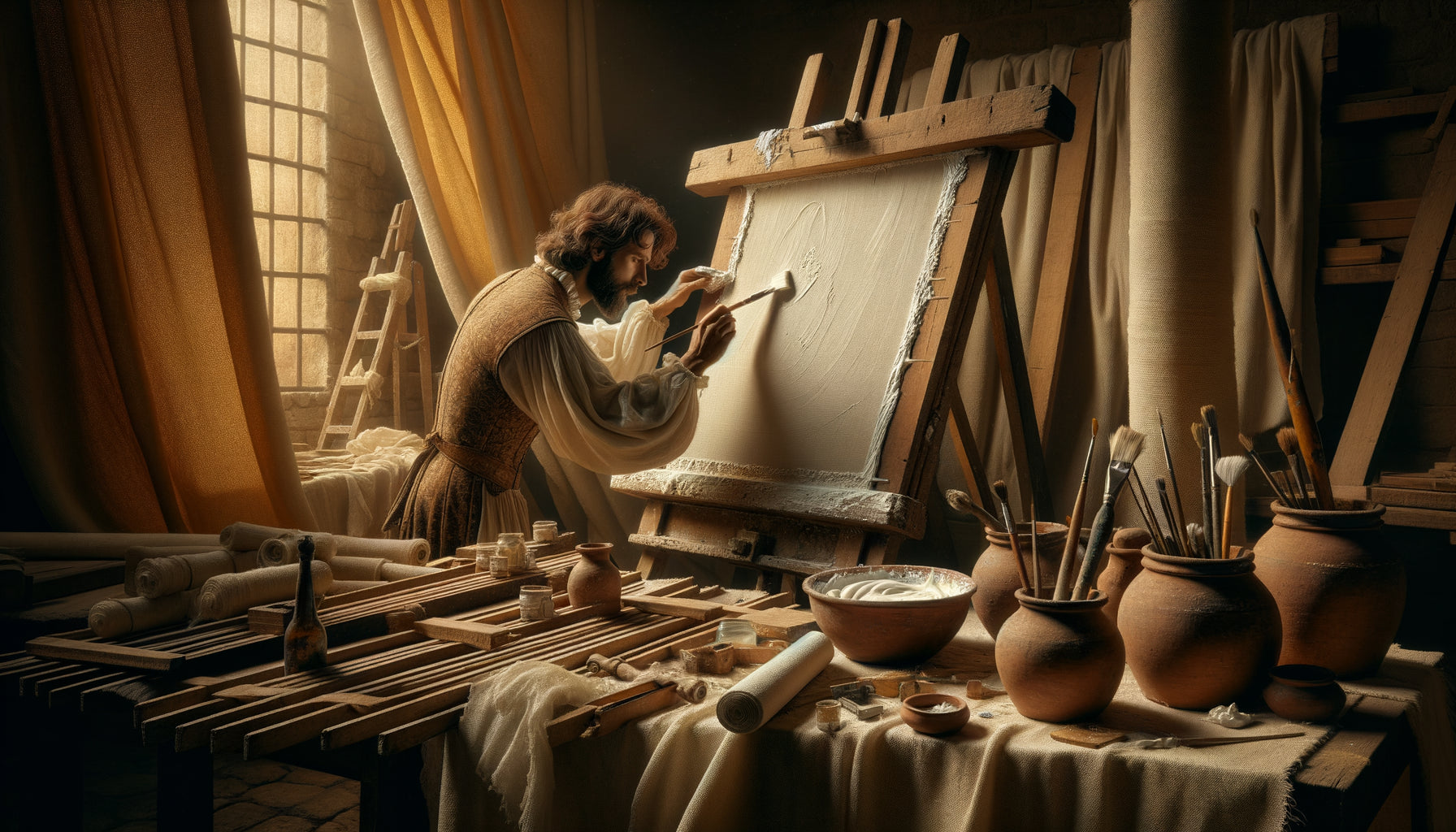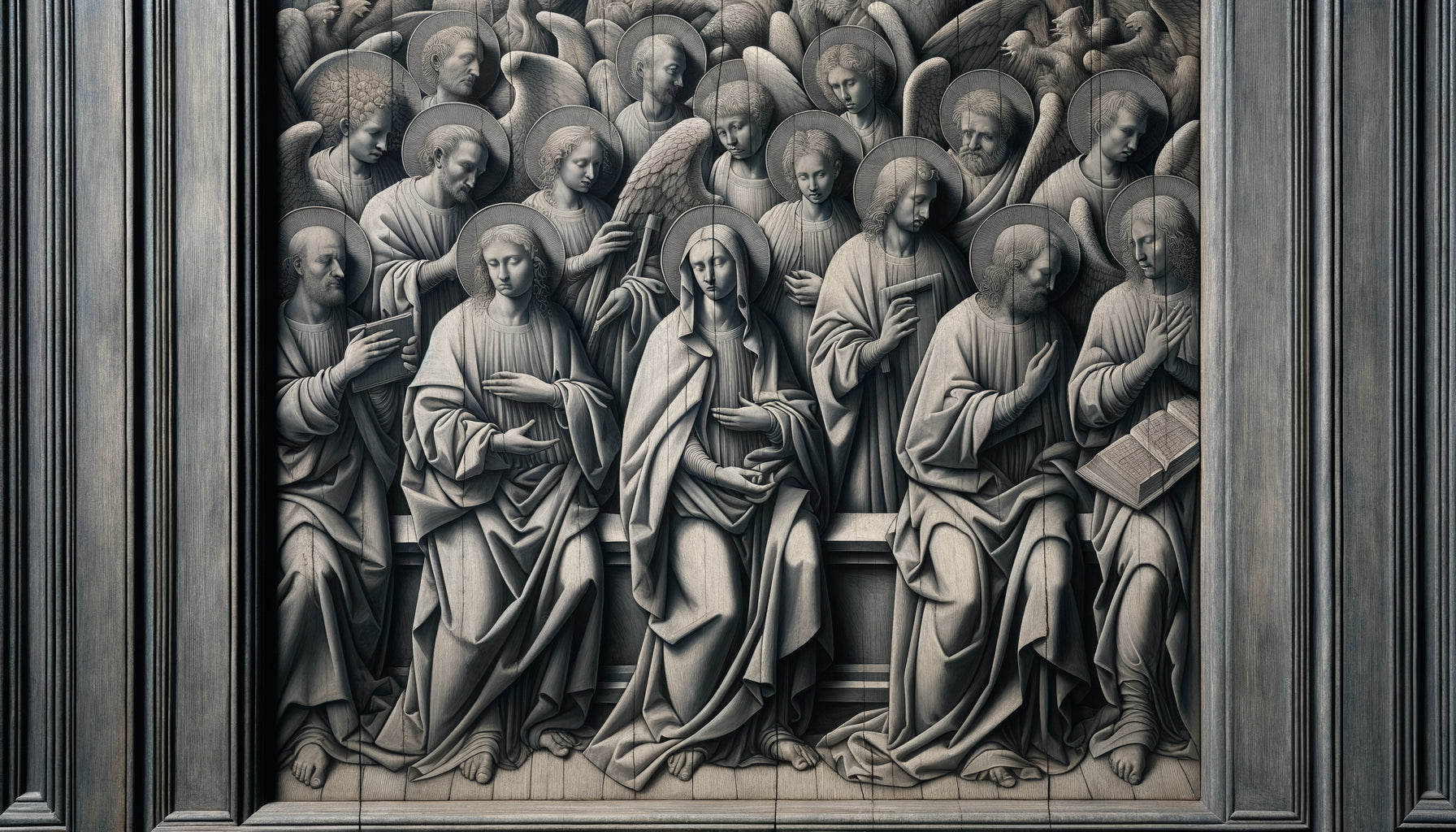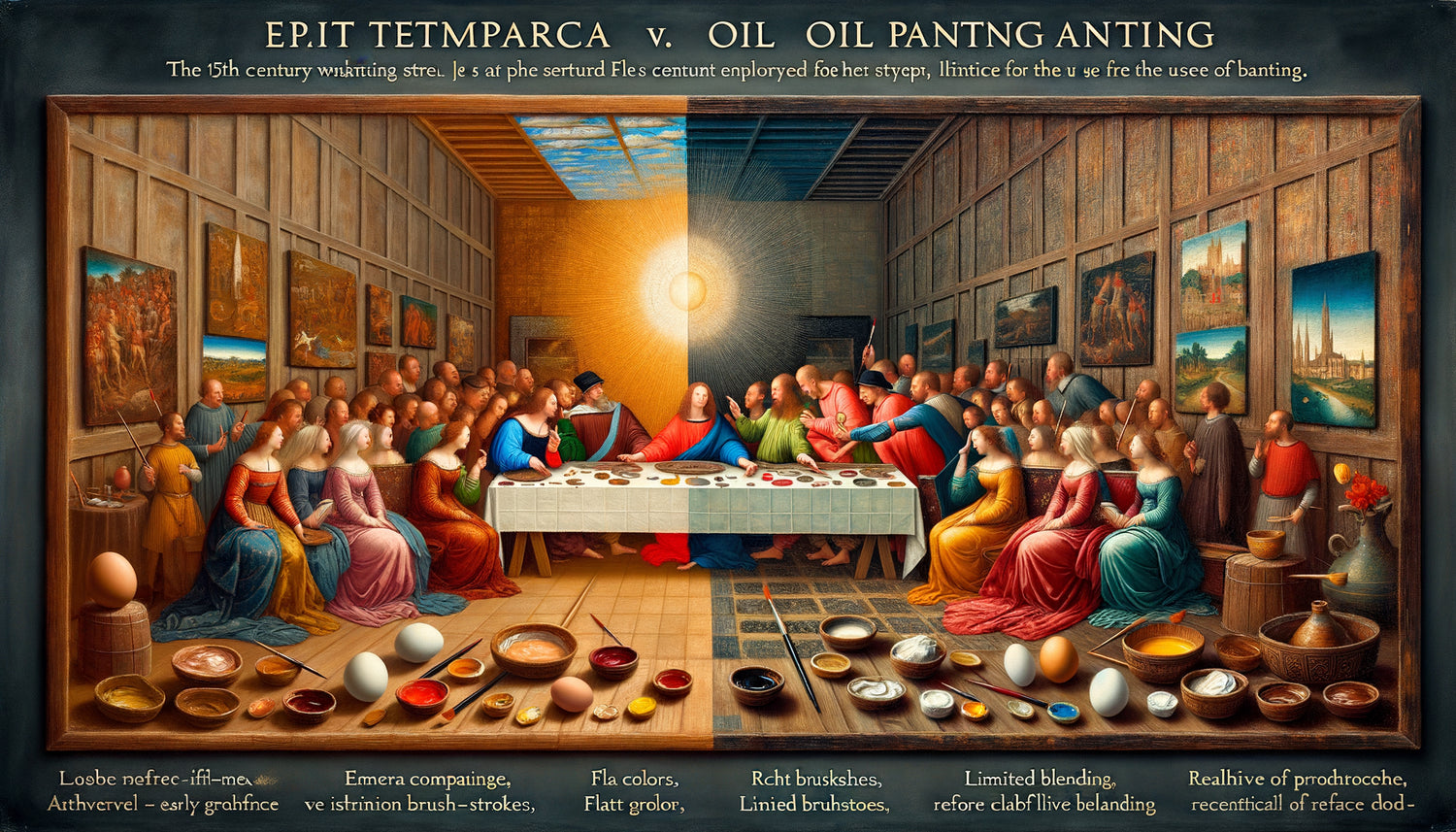
In the silent workshop of a 15th-century Florentine master, a gesture changes everything. The brush glides across the wooden panel with an unprecedented fluidity. Pigments no longer dry in minutes but remain malleable for hours, sometimes days. Colors blend into each other as if by magic. This moment marks one of the most spectacular turning points in art history: the transition from tempera to oil painting.
Here's what this technical revolution brought to artists: an unprecedented freedom to repent and correct, a new chromatic depth capable of capturing light itself, and an ability to represent textures with astonishing realism. These three advances literally transformed painting, shifting it from an art of speed and certainty to one of contemplation and perfectibility.
Have you ever admired an old portrait where the light seems to emanate from the canvas, where velvets appear tangible, where the subject's gaze pierces you? This visual magic that we take for granted in museum masterpieces simply did not exist before the adoption of oil painting. Artists working with tempera had to contend with frustrating limitations: immediate drying, inability to blend tones, matte and powdery colors.
Rest assured, this story is not just an anecdote for art historians. It directly illuminates the works you contemplate, collect, or wish to integrate into your interior. Understanding this revolution develops a more discerning eye on the paintings that surround you.
I invite you to delve into this technical mutation that redefined what it meant to paint, and discover how a simple change of medium opened up creative possibilities that previous generations could never have imagined.
Rediscovering Time: When Painting Ceases to Be a Race Against the Clock
Imagine having to finish a face in less than twenty minutes. That was the reality of tempera painters. This technique mixed pigments with an aqueous binder – usually egg yolk or animal glue – which dried with relentless speed. Each brushstroke was final. Mistakes had no place, or almost.
Artists developed meticulously executed strategies: they divided their compositions into separate areas to be treated, carefully prepared color mixtures in advance, applied paint in thin parallel strokes to gradually build volumes. The result? Works of admirable precision, but also of a certain rigidity.
The arrival of oil painting disrupts this time constraint. Pigments ground in linseed or walnut oil remain fresh for hours, even days depending on the thickness of the layer. This new plasticity offers artists an unheard-of luxury: the time to reflect, adjust, and perfect. A nose misplaced? You can correct it. A shadow too harsh? You gently blend it with the adjacent tone.
This temporal freedom radically transforms the creative process. Painting becomes meditation rather than a sprint. Artists can now work alla prima, wet-on-wet, blending colors directly onto the canvas to achieve subtle transitions impossible with tempera. Jan van Eyck, considered one of the pioneers of this technique in Flanders, exploits this potential to create gradients of supernatural softness in his famous portraits.
Reinvented depth: how light began to live in painting
Here is perhaps the most spectacular transformation: the ability of oil paint to capture and restore light. This magic rests on a simple but revolutionary physical property: the transparency of successive layers.
With tempera, pigments mixed with water or egg produced an opaque and matte film. Light bounced off the surface without penetrating the pictorial matter. The colors remained on the surface, literally. Oil paint, on the other hand, creates depth. Thanks to glazes – these thin translucent layers superimposed – light penetrates the strata of paint, bounces back from the white priming of the support, and emerges enriched, loaded with complex nuances.
This glazing technique allows for stunning visual effects. A red is no longer simply a red applied in a flat color, but the result of several translucent layers that create an unprecedented chromatic vibration. Complexions come to life: you can superimpose rosy, ochre, greenish tones to recreate the complexity of human skin with its veins, transparencies, and subtle variations.
Venetian masters such as Titian or Giorgione will take this approach to its peak. Their canvases seem to radiate from within, as if a light source were imprisoned beneath the painted surface. This inner luminosity, impossible to achieve with tempera, becomes the signature of the great colorists of the Renaissance and Baroque.
Gold is no longer mandatory to make a work shine
Significant detail: before oil painting, artists had to resort to actual gold leaf to represent divine light or precious elements. With the new chromatic possibilities of oil, a simple yellow glaze could produce a comparable luminous effect, making art gradually more accessible and freeing artists from dependence on precious materials.

The tactile realism: when painting makes you believe you can touch
Run your hand (mentally!) over a portrait by Van Eyck. You would swear you could feel the texture of the velvet, the coolness of the pearl, the softness of a small dog's fur. This tactile illusion represents one of the major achievements of the pictorial revolution brought about by oil paint.
Tempera, with its matte and relatively uniform rendering, did not allow for visual differentiation between materials as precisely. All surfaces shared this same powdery quality, this same flatness. Oil introduces the notion of pictorial texture. Depending on the thickness of application, the dilution of the medium, the gesture of the brush, one can create thick impasto for thick fabrics, smooth and shiny surfaces for metals, transparent glazes for veils.
This ability to modulate the pictorial matter itself opens up a vertiginous expressive field. Rembrandt would masterfully exploit this possibility some centuries later, constructing his portraits with generous impasto in the areas of light and dark glazes in the shadows, thus creating an almost sculptural relief on the canvas.
The Flemish painters of the 15th century, pioneers of this approach, develop a virtuosity in representing materials that amazes their Italian contemporaries. In their compositions, one immediately distinguishes the satin from the cloth, the copper from the bronze, the marble from the wood. This tactile differentiation of textures considerably enriches the available visual vocabulary.
Color unleashed: from limited to almost infinite chromatic
Another less visible but fundamental revolution: the expansion of the color palette. Tempera imposed strict restrictions on color mixtures. Some pigments reacted poorly to the aqueous binder, others changed appearance when drying, creating unpleasant surprises for the artist.
Oil proves to be a much more stable and universal binder. It accepts a wider range of pigments, including some that were problematic in tempera. Above all, it preserves color intensity after drying. What you paint is what you get – a considerable advantage for planning complex color harmonies.
Optical blends also become more sophisticated. By layering glazes of different colors, artists create shades impossible to achieve by simple mechanical mixing on the palette. A green created by overlaying a blue glaze and a yellow glaze has a depth and vibration that a directly mixed green cannot match.
This new chromatic richness is particularly evident in landscapes. Skies gain subtlety, distances atmosphere. Aerial perspective – this gradual fading of colors and contrasts with distance – becomes achievable with photographic precision thanks to the modulated glazes of oil paint.

Large format becomes possible: painting monumentally without constraint
A technical detail with major consequences: oil paint adheres perfectly to canvas, this lightweight and economical textile support. Tempera, on the other hand, generally required rigid supports such as wood or wall (fresco). This limitation considerably restricted possible dimensions – a wooden panel that was too large would warp and crack.
The adoption of canvas as a preferred support, made possible by the adhesive qualities of oil, frees artists from dimensional constraints. Monumental compositions can now be created and transported, rolled up to be moved, cover entire walls without painting them directly.
This logistical flexibility encourages formal ambition. The large Baroque machines, the vast Romantic landscapes, the Impressionist plein air compositions – all become conceivable thanks to this revolutionary combination of oily medium and textile support. The mobility of art changes radically, exchanges between artistic schools intensify.
An art that travels and influences more quickly
A major cultural consequence: stylistic innovations now circulate more easily. A canvas can cross Europe without damage where a wooden panel risked being broken. This accelerated circulation of works fertilizes artistic exchanges and accelerates the evolution of styles.
Want to live with these masterpieces in your home?
Discover our exclusive collection of wall art inspired by famous artists that captures the chromatic richness and luminous depth inherited from this pictorial revolution.
A living legacy: why this revolution still touches us today
Five centuries after its widespread adoption, oil painting remains the preferred medium of millions of contemporary artists. This exceptional longevity is a testament to the depth of the technical revolution that began in the 15th century.
Every painting you admire in a museum or gallery, every reproduction that adorns your interior, carries this legacy within it. The pictorial possibilities opened up by the transition from tempera to oil have shaped our very conception of what a painting is: an object capable of capturing light, differentiating textures, creating the illusion of depth, fixing subtle chromatic harmonies.
This technical revolution made possible entire artistic movements. Without it, there would be no Leonardo's sfumato, those vaporous transitions between shadow and light that give the Mona Lisa its mystery. No Caravaggio’s chiaroscuro, those dramatic contrasts between illuminated areas and deep darkness. No vibrant Impressionistic colors, where juxtaposed pure color strokes create shimmering optical mixtures.
When you choose a work for your living space, you unconsciously extend this story. You invite into your daily life the result of this technical mutation that has redefined the possibilities of pictorial art. The depth of a Venetian landscape, the luminosity of a Flemish portrait, the textile richness of a Dutch still life – all these qualities that move us today stem directly from this silent revolution that occurred in the workshops of the Renaissance.
Look differently at the paintings around you. Behind every play of light, every convincing texture, every deep color, lies this patient technical conquest that has freed the gaze of artists and enriched ours. Oil painting hasn't just changed how we paint, it has transformed what we can see and feel in front of a canvas.
Frequently Asked Questions
Why didn't artists immediately abandon tempera?
The adoption of oil painting was a gradual process that took over a century. Several reasons explain this slow transition. First, tempera was a perfectly mastered technique with its own aesthetic qualities – its matte brightness, its linear precision – which some artists appreciated. Secondly, oil required learning new gestures, new recipes, a longer drying time that disrupted the organization of workshops. Finally, cultural and corporate resistance existed: guilds of painters had their traditions, their manufacturing secrets jealously guarded. Some Italian masters continued to use tempera for mural frescoes or combined the two techniques (tempera for the sketch, oil for the finishing touches). This prolonged coexistence shows that technical revolutions never impose themselves brutally, but negotiate with established practices.
Can we still see the difference between tempera and oil on old works?
Absolutely, and the eye quickly learns to distinguish between the two techniques. Tempera works have a matte surface, almost powdery, with colors of a certain luminous clarity but without depth. Transitions between tones are made by visible hatching or juxtaposition of color areas rather than progressive blending. In contrast, oil paintings reveal a more varied surface – sometimes glossy in glazes, sometimes textured in impastos – with more saturated colors and vaporous transitions. Visual depth is also an indicator: if you feel that the light comes from inside the painting rather than bouncing off the surface, you are probably facing oil. In museums, look at Italian panels from the early 15th century (often tempera) then Flemish works of the same period (oil): the contrast will jump out at you.
Has this technical revolution had an impact on the subjects depicted?
A fascinating question that reveals how much technique and content influence each other. Yes, oil painting encouraged certain pictorial genres that particularly exploited its qualities. Psychological portraiture gains subtlety thanks to the delicate transitions of skin tones and the ability to capture the gaze. Still life literally explodes as an autonomous genre in the Netherlands in the 17th century, artists competing in virtuosity in rendering textures: transparency of glass, velvety fruit, shine of metals. Atmospheric landscape, with its vaporous distances and nuanced skies, becomes possible thanks to modulated glazes. Even religious painting evolves: sacred scenes gain humanity and physical presence when bodies acquire this palpable flesh that oil allows. New technical possibilities have literally opened up new thematic territories, proving that the history of art is never only a history of ideas, but also a history of materials and gestures.