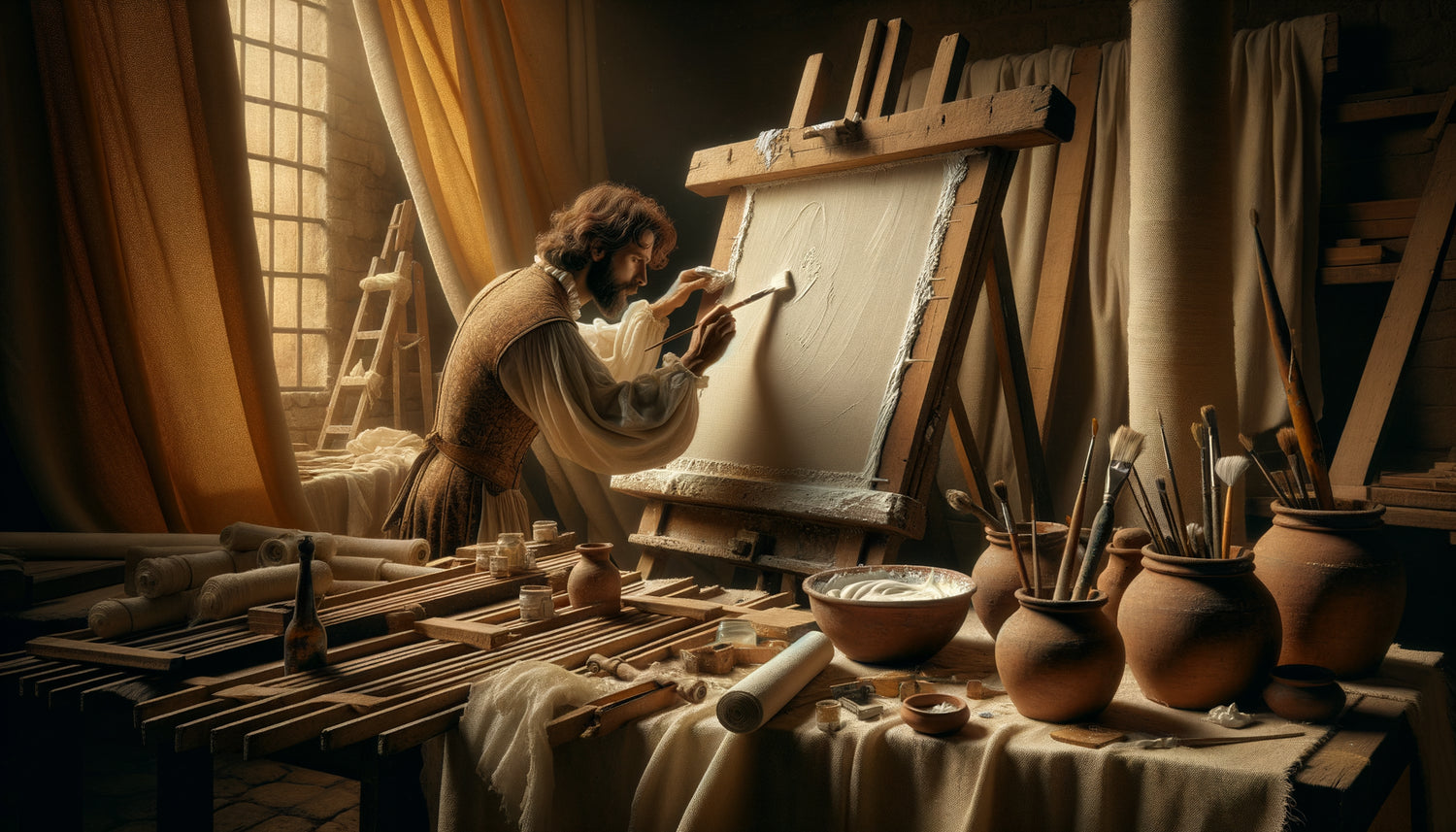
In the silent workshop of a 15th-century Florentine master, the scent of animal glue mingles with that of freshly woven linen. Even before touching a brush, the painter dedicates several days to an essential task: preparing his work surface. This crucial step, now largely forgotten, determined the durability and brilliance of a work for centuries to come.
Here's what this ancestral preparation reveals: total artisanal mastery of creation, a deep intimacy with materials, and a conception of time radically different from our era of instant production. Three dimensions that transformed each painting into a technical adventure as much as an artistic one.
Today, we buy our stretched canvases, primed, ready to use. Convenient, certainly. But this standardization cuts us off from a millennial know-how where each artist orchestrated the entirety of his creative process, from the raw support to the final touch. How did these masters proceed? What technical secrets guaranteed the longevity of their masterpieces? Let's delve into the fascinating behind-the-scenes look at canvas preparation before the industrial era.
The choice of fabric: a strategic decision
Even before thinking about the actual preparation, the painter had to select his textile support. Linen was overwhelmingly dominant, particularly prized in Flemish and Italian workshops for its exceptional resistance and ability to accept primer layers. Its smooth texture offered an ideal surface for meticulous details.
Hemp, rougher and more economical, seduced less affluent workshops or those favoring large formats intended to be viewed from afar. Its robustness compensated for its coarser grain. Some Venetian painters, such as Tintoretto, used it deliberately to create particular texture effects.
Cotton canvas remained rare in Europe before the 17th century, its import cost reserving it for exceptional orders. Each fiber possessed its own personality, directly influencing the final rendering. Masters developed marked preferences, jealously passed on to apprentices.
The ancestral art of mounting without standardized frames
Without the uniformity of modern frames, painters made their own structures or collaborated with trusted carpenters. Assembled wooden frames varied considerably: some used simple nailed boards, others sophisticated mortise and tenon assemblies.
Fabric tension required particular expertise. Too tight, the canvas risked tearing during humidity variations. Insufficiently tight, it bulged under the weight of pictorial layers. Artisans used rudimentary tension keys – wooden corners gradually hammered in – or fixed the fabric directly to rigid panels.
A common practice was to mount the canvas on a temporary frame for preparation, then relax it and re-mount it on the final frame after complete drying of the primers. This method prevented deformations caused by the shrinkage of the fabric during the sizing process.

The Collage: The Invisible Foundation of the Masterpiece
This first layer constituted the very soul of the preparation. Rabbit skin glue, obtained by prolonged cooking of skins and tendons, reigned supreme in workshops. Its recipe varied according to regional traditions: some added honey for flexibility, others garlic as a preservative.
Application was done hot, the liquid glue penetrating deeply into the textile fibers. The painter worked quickly, section by section, to prevent the gelatin from setting before having uniformly impregnated the fabric. Too thick, it created a brittle surface; too diluted, it did not ensure the necessary waterproofing.
Some Italian masters preferred flour paste, less expensive, sometimes mixed with oil to improve its flexibility. Northern workshops experimented with casein glues, extracted from curdled milk. Each choice reflected a balance between material availability, local climate and desired effect.
Drying, a Test of Patience
Between the collaging and the next step, several days passed. The canvases dried horizontally in well-ventilated rooms, protected from dust and excessive humidity. This wait was not passive: the painter monitored any irregularities, lightly sanded the asperities with pumice stone.
The Primer: Building the Skin of the Painting
On top of the encollé canvas came the primer or preparation, this white layer that transformed the raw fabric into a pictorial surface. The gesso, a mixture of animal glue and finely ground chalk (or plaster), constituted the classic formula passed down since the Middle Ages.
The traditional Florentine recipe required up to eight successive layers, each sanded after drying to obtain a remarkably smooth surface. The Venetians, more pragmatic, often settled for three to four thicker layers. This technical difference partly explains the distinct styles: the Florentines favored precise outlines and meticulous details, while the Venetians developed a more coloristic and gestural approach.
Ground lead, ground in linseed oil, offered a richer alternative, particularly appreciated in Flanders. This oil-based preparation, which took longer to dry, created a slightly absorbent surface ideal for subtle glazes. Rubens would perfect this technique, achieving those luminous skin tones that characterize his work.
Tinted preparations, a secret of luminosity
Contrary to the common idea of a white preparation, many workshops tinted their primers. A neutral grey ground facilitated the assessment of tonal values. The Venetians favored red ochre or Sienna earth preparations, which warmed skin tones and created an overall chromatic harmony.
Some masters even applied an imprimatura, a thin, translucent layer of color applied to dry white gesso. This film – often green earth, yellow ochre, or transparent brown – optically unified the surface and served as a median tone for the painting.

Alternative supports: when wood reigned
It must be remembered that until the 16th century, canvas remained a minority. Wood panels were dominant: poplar in Italy, oak in the North. Their preparation followed equally rigorous rituals. The boards, sawn and dried for years, were assembled, glued, covered with fine cloth (the marouflage), then coated with multiple layers of gesso.
The gradual transition to canvas is explained by several factors: ease of transport due to lightness, possible larger dimensions, and lower cost. But above all, the canvas offered flexibility allowing works to be rolled – a decisive advantage for itinerant artists or distant commissions.
When tradition meets contemporary inspiration
This intimate knowledge of materials, this methodical construction of the painted surface, reveals a philosophy where the work was born from the preparatory gestures. Each painter developed his secret recipes, his tricks of the trade, creating an invisible but determining material signature.
Today, some contemporary artists are rediscovering these ancestral techniques, fascinated by the incomparable quality of the surfaces obtained. This quest for material depth resonates with our contemporary desire for authenticity and craftsmanship.
Extend this journey into the world of old masters
Discover our exclusive collection of paintings inspired by famous artists that perpetuates the technical and aesthetic heritage of these great creators, to transform your interior into a personal art gallery.
The living legacy of a forgotten know-how
Understanding how painters prepared their canvases before the industrial era is grasping the extent of their artisanal mastery. This total intimacy with materials – from the choice of textile fiber to the final layer of primer – shaped their gaze and gesture. The painting did not begin with the first touch of color, but with the selection of raw linen.
This slow productivity, these repeated gestures with patience, this respect for drying times, embody a relationship with creative time that is the opposite of our digital instantaneity. Yet, the extraordinary durability of these works – some spanning five centuries without major alteration – testifies to the relevance of these ancestral methods.
The next time you contemplate an old painting in a museum, imagine those entire days dedicated to preparing the simple white surface. Beneath the vibrant colors and masterful compositions lies this invisible foundation, built layer upon layer, which still carries the vision of the master today.
Frequently asked questions about the preparation of old canvases
How long did it take to prepare a canvas before starting to paint?
The complete preparation of a canvas generally took between two and four weeks, depending on the complexity of the recipe followed. The initial sizing required 3 to 5 days of drying. Then each layer of gesso required an additional 24 to 48 hours, with intermediate sanding. Workshops always kept several canvases in preparation at different stages, allowing for a continuous workflow. This wait was never perceived as a constraint, but as an integral part of the creative process. Apprentices learned that patience guaranteed durability : a hasty preparation condemned the work to premature degradation. Some particularly meticulous masters waited several months before considering a surface perfectly stabilized and ready to receive paint.
Why did old painters use animal glue rather than other glues?
Hide glue possessed unique properties perfectly suited to pictorial needs. Its reversibility allowed future restorers to intervene without destroying the artwork – a quality that modern synthetic adhesives do not always offer. Its natural flexibility accompanied the movements of the fabric during humidity variations, avoiding cracks and lifting. Moreover, this glue created a slightly absorbent surface ideal for the adhesion of subsequent pictorial layers. Its universal availability – every community had tanners and butchers providing the raw materials – made it an economical and practical choice. Finally, its perfect chemical compatibility with traditional pigments and binders (oil, egg, resins) guaranteed material cohesion of all strata of the painting, a crucial factor in preservation.
Can canvases still be prepared using these old methods today?
Absolutely, and a growing number of contemporary artists are rediscovering these traditional techniques. The materials remain accessible: hide glue granules, Champagne chalk or Meudon white, purified linseed oil. Several specialized suppliers even offer complete kits with detailed instructions. Practice requires space, time and patience – resources rarer than the ingredients themselves. Art restoration workshops perpetuate this know-how with scientific rigor, precisely documenting historical recipes. Specialized training teaches these methods in some art and conservation schools. Beyond nostalgia, these handcrafted preparations offer optical qualities and durability that industrial primers struggle to match. For the artist seeking a deep connection with their medium, this approach radically transforms the relationship to creation.