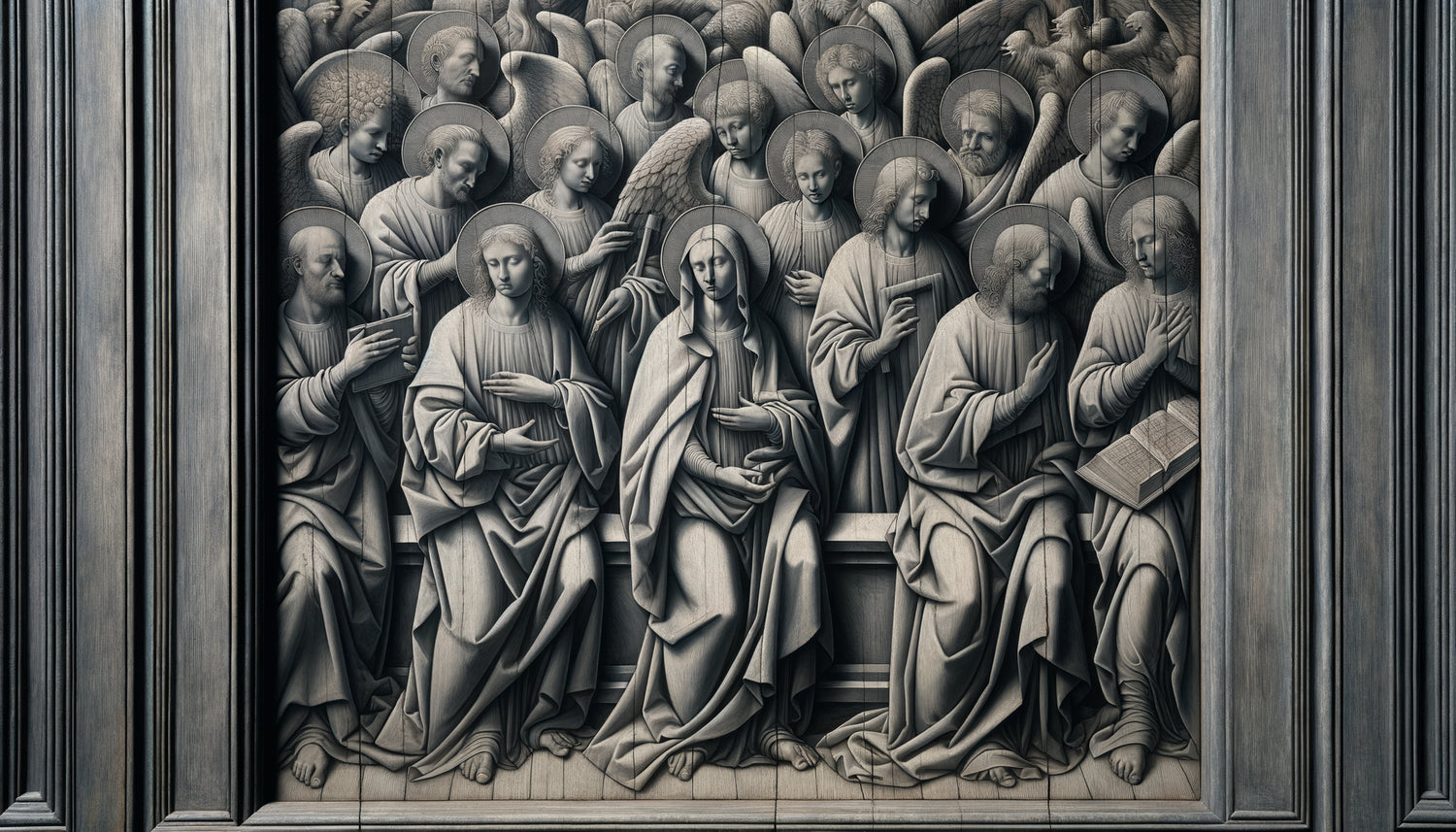
In the Flemish and Dutch workshops of the 15th century, a fascinating pictorial practice unfolded on the hidden faces of altarpieces and shutters: grisaille. These surfaces, visible only when the work was closed, became the scene of a chromatic alchemy where painters competed in virtuosity by limiting themselves to shades of gray. This technique, far from being a simple decorative constraint, revealed an extraordinary technical mastery and carried profound spiritual symbolism.
Here's what the grisaille technique brought to the backs of shutters: an economy of means allowing for faster execution, a striking contrast with the colorful explosion of the inside of the altarpiece, and a meditative dimension evoking sculpted stone. These gray surfaces transformed the opening of the altarpiece into a true liturgical revelation.
Yet, many lovers of ancient art face a misunderstanding: why so much talent invested on surfaces destined to remain closed most of the year? How did these masters manage to create volume, depth and emotion with such a restricted palette?
The reality is more accessible than one might imagine. Flemish painters had developed precise protocols, passed down from workshop to workshop, combining meticulous preparation, specific grinding of pigments, and layering of transparent glazes.
In this article, we delve into the secrets of this ancestral technique, explore lost and rediscovered recipes, and discover how this monochrome approach continues to inspire contemporary decoration and current art.
The art of painting in monochrome: foundations of Flemish grisaille
The grisaille technique rested on a seemingly simple principle: creating the illusion of relief and three-dimensionality by using only tonal variations of gray. On the backs of shutters of altarpieces, this approach allowed painters to represent saints, donors and biblical scenes with remarkable economy of means.
The process began with meticulous preparation of the support. The oak panels, carefully assembled, first received several layers of animal glue, then a preparation based on chalk and glue called gesso. This white and smooth surface constituted the essential bright background to the technique.
Painters mainly used three pigments for their grisailles: bone black or ivory black, obtained by calcination, lead white for the lights, and sometimes a touch of umber to warm certain areas. These pigments were ground with extreme fineness in clarified linseed oil, creating a smooth paste allowing imperceptible transitions.
The preparatory drawing: invisible foundation
Before any coloring, masters created an extremely precise preparatory drawing. Some used the technique of poncif: a perforated board on which charcoal was stamped to transfer the pattern. Others traced directly onto the white ground with a dry point or a fine brush dipped in diluted ink.
This underlying drawing already determined all tonal values. Painters precisely planned where the highlights, mid-tones and deep shadows would be. This crucial step revealed their masterful understanding of modeling and anatomy.
The secrets of execution: layering and patience
The true magic of grisaille of shutter reverses lay in the methodical stratification of pictorial layers. Contrary to a common misconception, these works were not executed in a single session but required several successive interventions.
The first layer, called sketch or first setup, established the general masses. Painters applied a uniform medium gray over the entire composition, reserving areas destined for the brightest lights. This relatively diluted layer dried quickly.
Next came the proper modeling. With successive touches of grays progressively enriched with black, the artisan created volumes. The technique used varied depending on the masters: some worked by cross-hatching, others by imperceptible blends obtained with soft brushes made of squirrel or marten hair.
Glazes: the soul of depth
The most subtle step was to apply glazes: extremely thin layers of paint. These successive veils, composed of highly diluted black pigment and sometimes enriched with resin, created an atmospheric depth impossible to achieve otherwise.
Painters used these glazes to unify the whole, soften overly brutal transitions and create this sensation of diffuse light characteristic of Flemish grisailles. Each glaze required complete drying time, sometimes several days, before the next application.
Some masters added a slight tint to their grisailles. Jan van Eyck and his contemporaries sometimes used a touch of green earth in the flesh tones to evoke the underlying complexion, or a touch of ochre in the architectures to suggest limestone.

Symbolism and liturgical function of grisaille
Beyond the technical prowess, the grisaille on the reverse sides of shutters carried a profound spiritual dimension. In medieval Christian liturgy, altarpieces remained closed during periods of penance, notably Lent. The faithful then contemplated these monochrome figures evoking sculpture, sobriety and contemplation.
This appearance of sculpted stone was not accidental. Painters deliberately sought to imitate the bas-relief, creating the illusion that these saints and prophets were carved from marble or alabaster. This simulation of sculptural volume amplified the effect of revelation when the shutters opened onto the colorful interior.
The grisaille technique thus established a visual and theological hierarchy: the outer world, temporal and austere, represented in gray, contrasted with the celestial and eternal splendor displayed inside the altarpiece. This formal opposition reinforced the spiritual message of the work.
The practical economy of an aesthetic constraint
On a more pragmatic level, grisaille presented considerable economic and technical advantages. Colored pigments, particularly lapis lazuli for blues or vermilion for reds, were extremely expensive. Reserving these precious colors for the interior of the altarpiece made it possible to optimize the sponsor's budget.
Furthermore, the technique used for the reverses allowed for faster execution. Once the method was mastered, a skilled workshop painter could complete a grisaille figure in a few days, whereas a polychrome version would have taken several weeks.
Regional variations: from Bruges to Cologne
While Flemish grisaille constitutes the archetype of this technique on reverse sides of shutters, other regional schools developed their own approaches. In Bruges workshops, the manner was particularly refined, with smooth transitions and extreme attention to detail in clothing and architecture.
The Ghent painters, slightly more expressive, sometimes introduced more marked contrasts, creating more dramatic figures. The Brussels school, on the other hand, favored a more graphic approach, with drapery folds treated in an almost linear manner.
In Germany, colonial painters employed a tinted variant, incorporating more brown and ochre tones into their grisailles. This slightly warmer approach created a different atmosphere, less cold than the purely gray gradations of the Flemish.
The innovations of the 16th century
At the turn of the 16th century, some innovators like Hieronymus Bosch and his contemporaries enriched the traditional technique. They sometimes introduced slight touches of local color into their grisailles: a red on a cross, a blue on a Virgin's mantle, creating subtle visual accents without breaking the monochrome unity.
This evolution marked a transition to a more pictorial and less symbolic conception of shutter reverses, gradually announcing the abandonment of this practice in favor of entirely colored surfaces.
Be inspired by the mastery of the great masters
Discover our exclusive collection of famous artist inspired paintings that capture the essence of these ancestral techniques and will transform your interior into a true art gallery.

The contemporary legacy: when grisaille inspires current design
The grisaille technique is not just a thing of the past. Many contemporary artists and interior designers draw inspiration from this sophisticated monochrome approach. The resurgence of the Scandinavian style and minimalism brings back into fashion this sober and elegant aesthetic.
In current wall decoration, grayscale murals directly evoke the heritage of Flemish shutter reverses. This often unconscious lineage is a testament to the permanence of certain aesthetic codes through the centuries.
Artists like Gerhard Richter with his gray abstract paintings, or photographers working exclusively in black and white, extend this tradition of voluntary chromatic restriction as a means of intensified expression. The constraint becomes a source of creativity, exactly as it was for 15th-century painters.
Reinventing Grisaille in Your Interior
To integrate this aesthetic into a contemporary interior, several approaches are available to you. A large grayscale painting can create a soothing focal point in a colorful living room. Reproductions of grisaille altarpiece panels, properly framed, bring a touch of history and sophistication.
The technique can also inspire personal creative projects. Painters discover that working in grayscale is an excellent exercise for mastering tonal values before tackling color. This pedagogical approach was indeed used in art academies until the 19th century.
Rediscovering Masters: Where to Contemplate These Wonders
The finest examples of grisaille on shutter reverses can be found in several European institutions. The Ghent Altarpiece by the Van Eyck brothers features grayscale figures of astonishing quality on its closed shutters. The illusion of sculpture reaches a rarely equaled perfection.
At the Louvre Museum, several detached panels from Flemish altarpieces allow for a close study of the technique employed by the masters. The Metropolitan Museum in New York also preserves magnificent examples, including works by Hans Memling.
In Bruges, the Groeninge museum offers an exceptional immersion into early Flemish art, with several altarpieces presenting their original grayscale shutters. Observing these works in situ, in the subdued light of the rooms, allows you to fully understand the effect sought by the artists.
For those who wish to deepen their technical understanding, some museums offer artistic practice workshops where one can experiment with the grisaille technique, under the guidance of restorers or specialized artists.
Conclusion: The Timeless Elegance of Creative Constraint
The grisaille technique that painters used for the reverses of shutters teaches us a fundamental aesthetic lesson: voluntary limitation of means, far from impoverishing artistic expression, can on the contrary intensify it. These monochromatic surfaces, born of liturgical and economic constraints, have become masterpieces of technical virtuosity and visual subtlety.
Today, as we are overwhelmed by the escalation of visual and chromatic stimuli, this sober and meditative approach resonates with a surprising topicality. It invites us to rediscover the beauty of austerity, the richness of nuances, the depth hidden in apparent simplicity.
Start by carefully observing a quality reproduction of the reverse side of a Flemish panel. Let your gaze become accustomed to the tonal subtleties, the softness of the modeling, the intelligence of the light. You will discover a visual universe of unsuspected richness, where every shade of gray tells a story of patience, mastery and timeless beauty.
FAQ : Your questions about the grisaille technique
Why did painters use grisaille rather than color on the backs of panels?
Grisaille responded to several imperatives at once, both practical, economic and symbolic. From a liturgical point of view, the reverses of the panels were only visible during periods of penance such as Lent, where sobriety was required. The monochrome appearance evoking carved stone reinforced this meditative dimension. Economically, it made it possible to reserve expensive pigments (lapis-lazuli, vermilion) for the polychrome interior of the altarpiece. Technically, grisaille was executed more quickly than a composition in colors, while allowing painters to demonstrate their virtuosity in rendering volumes and modeling. This apparent constraint thus became an artistic space in its own right.
What specific pigments made up Flemish grisailles?
Flemish painters used an extremely restricted but carefully selected palette. The main pigment was bone black or ivory black, obtained by calcination of bones, which offered a deep and stable black. Lead white, despite its toxicity, was the reference white for its remarkable opacity and smoothness. Some masters added a touch of natural terra umber or green earth to slightly warm certain areas, particularly complexions, thus creating a slightly tinted grisaille. These pigments were ground very finely in clarified linseed oil, sometimes enriched with a little dammar resin to accelerate drying and increase gloss. The quality of the grinding and binder was crucial to obtain these imperceptible transitions characteristic of the technique.
Can one practice the grisaille technique oneself with modern materials?
Absolutely, and it's even an excellent exercise to develop your understanding of tonal values! With contemporary materials, practice becomes very accessible. Simply use titanium white (non-toxic) and ivory black in tube, bound with oil or acrylic according to your preference. Acrylic offers the advantage of quick drying, allowing you to layer coats more quickly. Start with a primed white surface (canvas or prepared wood panel), create an accurate drawing, then work in successive layers from light to dark. The key is patience: build your volumes gradually with light touches rather than seeking immediate results. Many online tutorials, inspired by ancient techniques, can guide you step by step. This practice, beyond its historical interest, considerably improves your mastery of light and modeling in painting.