On a Sunday morning in 1886, on the island of La Grande Jatte, Georges Seurat places his last dot of pure color. Before him, silhouettes emerge as if by magic: shimmering robes, luminous umbrellas, and that little spotted dog whose fur seems to vibrate under the sun. Yet, upon closer inspection, the miracle dissolves into thousands of juxtaposed colored dots. This is not ordinary painting; it's science applied to art, an optical revolution that transforms our eye into a color-mixing chamber.
Here’s what Seurat’s pointillist technique brings: unparalleled luminosity impossible to achieve through traditional mixing, an optical vibration that gives life to immobile subjects, and a scientific precision in the reproduction of natural textures like spotted fur. Three revolutions in one method.
You may be admiring reproductions of pointillist works without understanding why these paintings seem more alive, brighter than others. Why does this animal’s fur appear so realistic when it is composed only of dots? Frustration often comes from this misunderstanding: we see the magical effect without grasping the mechanism that orchestrates it.
Rest assured, Seurat's technique is based on simple optical principles that any art lover can understand. You don't need any scientific training to appreciate how chromatic divisionism transforms isolated dots into vibrant spotted fur. I promise you that at the end of this article, you will look differently at every spot, every animal motif in art.
The revolution of the dot: when science meets the brush
Georges Seurat was not like other painters. Trained at the École des Beaux-Arts, he spent his evenings studying Michel-Eugène Chevreul's scientific treatises on simultaneous color contrast and Ogden Rood’s research on modern color theory. His obsession? Understanding how our eye actually perceives color.
The fundamental discovery that changes everything: we do not see colors as they are painted, but as they mix on our retina. When Seurat places a blue dot next to a yellow dot, our brain does not see two distinct dots at normal distance, but a sensation of bright green much more intense than a green obtained by mixing pigments on the palette.
This technique, called divisionism or pointillism, is based on the methodical juxtaposition of small touches of pure color. Seurat completely abandons pigment mixing, this ancestral practice that inevitably dulls tones. He applies his colors directly to the canvas, undiluted, in tiny dots that our visual system merges.
Decoding spotted fur: the art of optical recomposition
Imagine you have to paint a Dalmatian. The traditional approach would be to first paint a white background, then add black spots. Simple, but terribly flat. Seurat proceeds radically differently for his spotted animals.
To optically recompose a spotted coat, the master of pointillism decomposes each area into its luminous components. A dark spot on an animal is never uniformly black. It contains bluish reflections where light strikes obliquely, brown nuances in transition areas, and touches of violet in deep shadows.
Seurat's technique for coats follows a rigorous three-step process. First, he meticulously observes the animal and analyzes how light interacts with each area of the coat. Next, he mentally decomposes each spot into its constituent spectral colors. Finally, he applies these pure colors in juxtaposed dots, leaving it to the viewer's eye to reconstitute the overall impression.
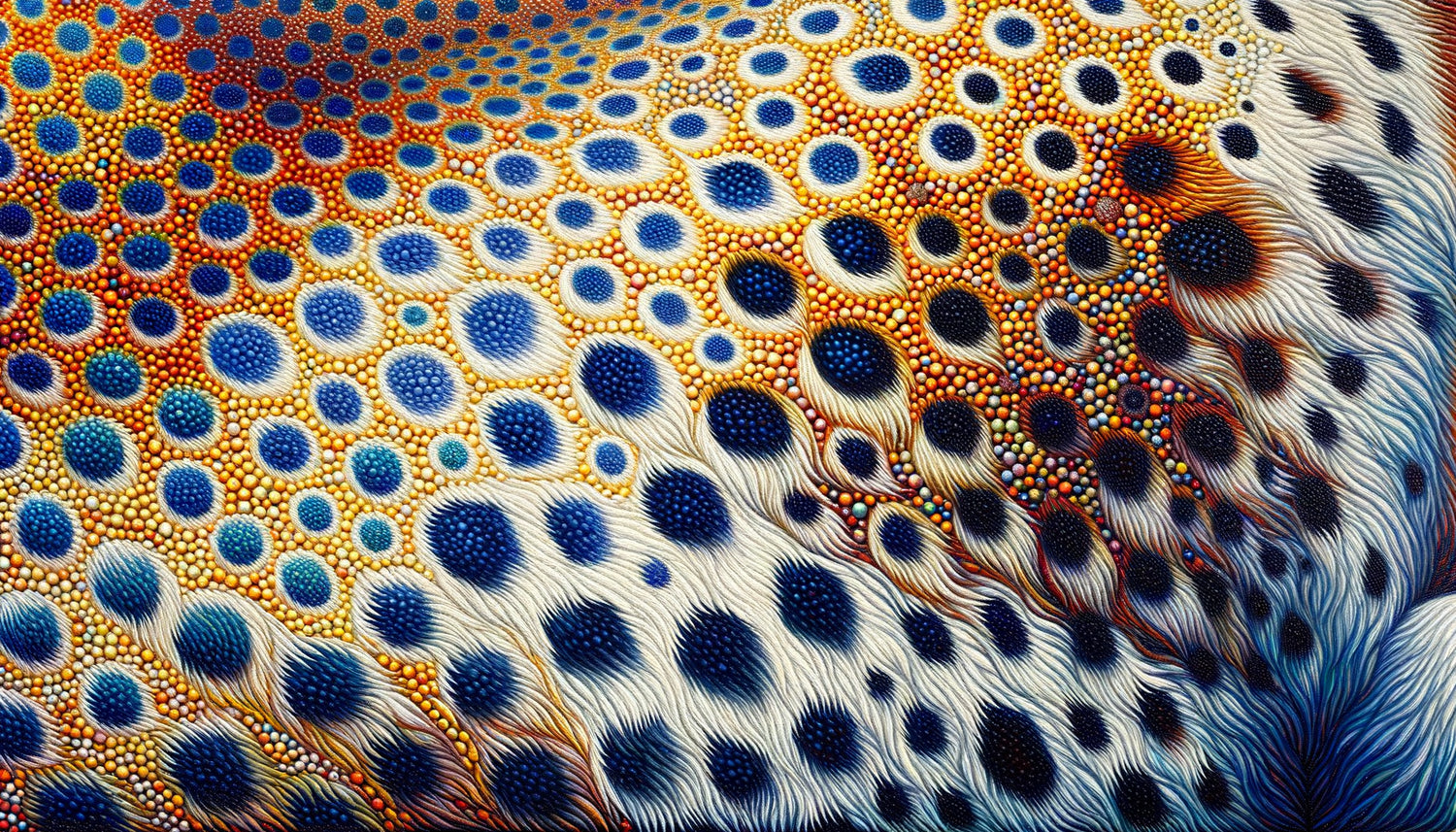
Consider an ochre spot on the back of a feline. Where a classical painter would mix ocher and white, Seurat juxtaposes points of pure orange, lemon yellow, bright white, and even complementary touches of violet. At a distance, these dots blend into a vibrant spot that seems to capture natural light with astonishing intensity.

The secret of simultaneous contrasts applied to animal patterns
Seurat's true innovation in rendering spotted coats lies in his use of simultaneous contrast. This optical principle discovered by Chevreul stipulates that a color influences the perception of its neighbor, mutually intensifying their brilliance.
When Seurat paints the transition between a light area and a dark spot on the coat, he doesn't just juxtapose light and dark. He introduces complementary colors at the borders: orange next to blue, red near green, yellow against violet. These contrasts create an optical vibration at the boundary of the spots, giving the impression that the coat literally vibrates before our eyes.
This technique explains why animals represented in pointillism seem more alive than their counterparts in traditional painting. The spotted coat of a dog in a Seurat work is not static: it trembles, it captures ambient light, it breathes. Each colored dot dialogues with its neighbors to create an illusion of movement and texture.
The transition areas between the spots are particularly fascinating. Seurat accumulates points of intermediate hues there, creating an optical gradient impossible to achieve by classical blending. The edge of a black spot on a white background will never be a sharp line, but a progressive mosaic of optical grays composed of expertly orchestrated blue, violet, brown and white dots.
The scientific palette: what colors for what effects?
Contrary to popular belief, Seurat did not use all the colors of the rainbow. His palette was rigorously selected according to scientific criteria. For spotted coats, he favored a restricted set of pure pigments with high luminosity.
Primary and secondary colors formed the heart of his palette: cobalt blue, vermilion red, cadmium yellow, emerald green, orange and violet. To this were added zinc white for the lights and very little black, which he considered optically dead. To create dark areas in the coats, Seurat preferred to juxtapose deep blue, purple and brown.
The strength of this limited palette? An exceptional chromatic coherence. All elements of the painting, from the spotted coat of an animal to the grasses of the meadow, share the same basic colors, creating a natural visual harmony. It is this unity that makes pointillist works seem bathed in a homogeneous light, as if the entire scene were photographed at the same moment under the same sun.

Distance and perception: the magic equation of pointillism
A crucial parameter determines the success of pointillism in rendering coats: observation distance. Seurat meticulously calculated the size of his dots according to the final format of the work and the distance from which it would be viewed.
For his large mural compositions such as A Sunday on La Grande Jatte, the dots measure approximately 2 to 4 millimeters. At a distance of three meters, they blend perfectly into continuous tones. For smaller formats intended to be seen up close, Seurat reduced the size of his touches to almost imperceptible micro-dots.
This relationship between dot size and distance creates a fascinating effect: a pointillist work offers two radically different experiences. From afar, you perceive a realistic, luminous and coherent spotted coat. As you approach, the image gradually disintegrates into a constellation of pure colors, revealing the underlying optical construction. This duality transforms each contemplation into an active discovery.
The legacy of pointillism in contemporary animal art
More than one hundred and thirty years after Seurat's first experiments, his pointillist technique continues to profoundly influence animal art. Contemporary artists specializing in representations of spotted animals - leopards, dalmatians, butterflies, exotic birds - regularly draw inspiration from his principles of optical decomposition.
The advent of digital printing, in fact, scientifically validated Seurat’s intuition. Our screens work exactly on the same principle: millions of colored pixels juxtaposed that our eye merges into continuous images. Every photo of spotted fur displayed on your smartphone is a modern application of chromatic divisionism.
In interior decoration, reproductions of pointillist works depicting spotted animals bring a unique dimension. Their ability to capture and reflect ambient light makes them lively depending on the lighting and time of day. A pointillist painting of a leopard will never be exactly the same at sunrise as in evening light: the colored points interact differently with each quality of light.
Transform your interior with the optical magic of the animal kingdom
Discover our exclusive collection of animal paintings that capture this unique luminous vibration, where each spotted fur tells a story of color and light.
Applying Seurat’s lessons: inspiration for your space
How to integrate this understanding of pointillism into your decorative choices? Seurat’s technique teaches us universal principles about perception of patterns and textures.
Firstly, the lesson of distance: a spotted or pointillist pattern works differently depending on where it is in your room. A divisionist patterned work placed facing the sofa, 3-4 meters away, will reveal its full visual coherence. Too close, it may appear fragmented and disturbing.
Secondly, the importance of natural light: like Seurat’s works, representations of spotted fur come into their own near a source of light that makes contrasts vibrate. Prefer walls perpendicular to windows rather than directly facing them, to avoid reflections while benefiting from flat lighting that accentuates the visual texture.
Thirdly, chromatic consistency: Seurat shows us that a restricted palette of pure colors creates more harmony than a profusion of mixed tones. If you choose a work depicting a spotted animal, pick up two or three of its dominant colors in your textiles and accessories to create a chromatic dialogue in the room.
The patience of the dot: a philosophy of looking
Beyond the pure technique, Seurat’s pointillism embodies a profound artistic philosophy. Each painting required months of meticulous work, dot by dot, with no possibility of quick correction. This methodical slowness radically opposes our era of instant visual consumption.
Contemplating a pointillist work depicting a dappled coat is accepting the need to slow down your gaze. It’s understanding that beauty emerges from the patient accumulation of minute details. It's recognizing that our perception itself is an active process of reconstruction, not a simple passive reception of images.
This lesson finds a particular echo in our contemporary interiors. Faced with the saturation of ephemeral digital images, hanging a representation of a dappled animal inspired by divisionism is anchoring a point of slow contemplation into your daily life. It's inviting the gaze to settle, to deconstruct, to rebuild, to discover.
The pointillist technique that Seurat developed to optically recompose dappled coats is not just a historical curiosity. It’s a revolution in our understanding of visual perception, a striking demonstration that we don't see with our eyes, but with our brain. Each dot of pure color is a note in an optical symphony where our visual system plays the role of conductor.
From now on, when you observe a dappled coat - whether it’s painted, photographed or real - you will no longer be able to ignore this dance of colors that takes place on your retina. You will understand that each spot is a composition of lights, that each transition is a gradient of complementary shades. Your gaze has transformed: you now see as Seurat saw, optically decomposing the world into its fundamental colored particles.
Start with a simple exercise this week: observe a dappled animal - a cat, a dog, even an image - and try to mentally decompose the colors of its coat. You will be surprised to discover how many unsuspected shades are hidden in what you thought was a simple brown or black spot. This is the first step towards a richer, more conscious perception of the luminous complexity of living things.
Frequently Asked Questions about Seurat’s Pointillism
Why did Seurat use dots instead of traditional brushstrokes?
The reason is purely scientific and optical. Seurat had understood thanks to the work of Chevreul and Rood that colors mixed on the palette lose luminosity and intensity. When you mix blue and yellow to get green, the result is always duller than a pure green. On the other hand, if you place tiny dots of pure blue and yellow side by side, your eye mixes them at a distance and perceives an optical green much brighter and more vibrant. This technique, which he called divisionism, made it possible to obtain dappled coats with a luminosity impossible to reproduce with traditional methods. The dots also ensured that each color remains pure until applied to the canvas, without contamination from neighboring pigments. It was a complete revolution of pictorial practice, transforming the brush into an instrument of scientific precision rather than a tool of gestural expression.
How long did it take Seurat to paint a painting in pointillism?
Patience was the first quality required to practice pointillism in the manner of Seurat. His masterpiece A Sunday on La Grande Jatte took him approximately two full years of work, with thousands of hours spent meticulously applying each dot. To understand this slowness, imagine that a single square centimeter of dappled fur could contain between 50 and 100 points of different colors, each needing to be placed exactly in the right spot with the correct shade. Seurat never worked outdoors for his large compositions: he first made preparatory studies on site, scientifically analyzed the necessary colors, then executed the final work in a workshop with rigorous methodicalness. This slowness was not a defect but a technical necessity: each point had to dry completely before applying neighboring points to avoid any accidental mixing that would ruin the desired optical effect. It was this monastic discipline that gave his dappled fur its extraordinary luminous precision.
Can the principles of pointillism be applied to modern decoration?
Absolutely, and in multiple ways! The optical principles discovered by Seurat are universal and work in all visual contexts. In decoration, you can apply chromatic divisionism by choosing textiles or wallpapers with micro-patterns that create optical colors from a distance: a fabric with tiny blue and yellow dots will appear luminous green when viewed from the sofa. Mosaic tiles in a bathroom work exactly according to this principle, creating optical gradients impossible with solid tiles. For walls, some stamping painting techniques create subtle pointillist effects that give depth and vibration to surfaces. Modern LED RGB lighting also creates optical mixes: several juxtaposed colored light sources produce mixed hues by the eye rather than physically. Even the choice of artwork follows these principles: a divisionist representation of a dappled animal will change appearance depending on ambient lighting, creating a dynamic decorative element that evolves throughout the day, much more lively than a standard photographic print.