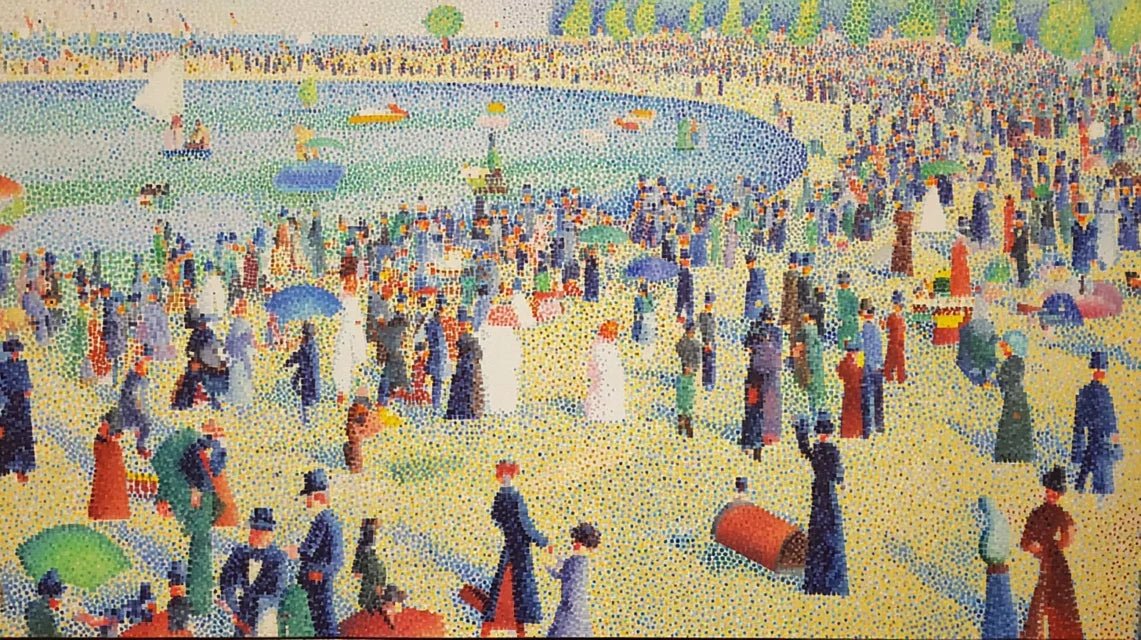
Imagine a young man of 25 years old revolutionizing art with thousands of colored dots, transforming painting into an exact science where each color obeys precise mathematical laws.
In the quiet workshop of Montmartre, Georges Seurat meticulously applies his revolutionary technique: pointillism. Each dot of pure color dialogues with its neighbors to create, at a distance, a luminous harmony of striking beauty.
🎨 This biography will reveal how a discreet and methodical painter created an entire artistic movement, the neo-impressionism, by applying the scientific discoveries of his time to pictorial art.
Discover the fascinating story of Georges Seurat (1859-1891), the inventor of pointillism who transformed painting into a laboratory of colors - an artistic revolution pixel by pixel
Georges Seurat : the French pioneer of scientific neo-impressionism
Knowing Georges Seurat goes beyond admiring his works: it's understanding how a genius of 31 years old revolutionized modern art by applying science to beauty.
| Biographical highlights | Artistic legacy |
|---|---|
|
Full name : Georges-Pierre Seurat Birth date : December 2, 1859, Paris Death date : March 29, 1891, Paris Nationality : French |
Movement : Neo-impressionism
Georges Seurat : bourgeois childhood and early artistic revelation
Georges-Pierre Seurat was born on December 2, 1859 in a bourgeois Parisian family. His father, Antoine Chrysostome Seurat, bailiff, has a reserved and secretive character that his son will inherit.
The discovery that changes everything : At 16 years old, young Georges discovers art thanks to his aunt Anaïs Haumonté, wife of a canvas merchant who paints as an amateur. This family encounter awakens his passion for colors and determines his artistic vocation.
The scientific student: From 1876, Seurat studied Charles Blanc's "Grammar of Drawing Arts", discovering the laws of simultaneous color contrast by Eugène Chevreul. This scientific approach to art already shapes his future method.
Georges Seurat in the effervescence of the 1880s
Seurat evolves in Paris during the Belle Époque, a period of scientific and artistic innovation where Impressionism dominates the pictorial scene.
The 1880s see the birth of new scientific theories about color and visual perception. The works of chemist Eugène Chevreul and American Ogden Nicolas Rood revolutionize the understanding of optical phenomena.
While Monet, Renoir and Pissarro explore the fleeting moment and pure emotion, Seurat seeks a more systematic and lasting approach to art.
The era encourages innovation: the Eiffel Tower is built (1887-1889), symbolizing the alliance between technique and beauty that Seurat translates into his painting.
A visionary of his time: Unlike Impressionists who prioritize spontaneous emotion, Seurat seeks to create timeless art based on scientific laws, anticipating the conceptual art of the following century.
Georges Seurat facing initial rejections from the official Salon
Returning from military service in 1880, Seurat moved into a small studio 16 rue de Chabrol with his friend Aman-Jean, dedicated to mastering monochrome drawing for two years.
In 1883, he presented portraits of his mother and Aman-Jean at the official Salon, accepted but unnoticed. That same year, he undertook his first major work: "A Bathing Scene at Asnières".
1884 marks a decisive turning point: the official Salon rejects his "Bathing Scene". This revolutionary work, combining nascent pointillist technique and classical composition, defies the traditional jury.
Faced with this rejection, Seurat reacts with determination. He participates in the creation of the Group of Independent Artists, a "no-jury, no-prize" association where he exhibits his "Bathing Scene" in June 1884.
These years of training forge his character as an independent innovator, ready to revolutionize art rather than conform to established tastes.
Georges Seurat and the scandal of revolutionary pointillism
The appearance of pointillism in 1884 provokes a real upheaval in the Parisian art world, dividing critics and the public.
Seurat's technique - these thousands of points of pure color juxtaposed - scandalizes due to its "artificial" and "mechanical" appearance. Critics first speak of "confettiism" with disdain.
Only the critic Félix Fénéon immediately understands the ongoing revolution. He coins the term "neo-impressionism" and passionately defends this new aesthetic in his chronicles.
The philosophy of the scientist-artist: "Art must be based on precise scientific laws," Seurat asserts. He rejects Impressionist improvisation to favor a rigorous method based on optics and color psychology.
This intellectual approach to art even divides the Impressionist movement: Pissarro temporarily adopts pointillism, while Monet, Renoir and Sisley withdraw from the eighth Impressionist exhibition of 1886 to protest against the presence of the neo-impressionists.
These polemics, far from discouraging Seurat, strengthen his conviction to open a new path for modern art.
Georges Seurat and the birth of scientific pointillism
Between 1884 and 1886, Seurat develops his revolutionary technique in creating his absolute masterpiece: "A Sunday on La Grande Jatte.
This monumental canvas of 3 meters by 2 requires two years of meticulous work. Seurat creates more than 60 preparatory studies, analyzing each effect of light and each colored harmony.
A Sunday at La Grande Jatte: masterpiece of pointillism by Georges Seurat
This iconic work reveals Seurat’s vision: to transform Parisian modernity in a timeless classical composition. The Sunday bourgeois become sculptural figures, frozen in a luminous eternity.
The pointillist technique reaches its perfection here: each point of pure color - red, yellow, blue and their derivatives - creates, through optical mixing, nuances of infinite richness.
Georges Seurat’s revolutionary techniques: scientific divisionism
Seurat names his method "divisionism" or "chromoluminarism." He divides his canvas into squares, assigning a motif to each section, as did the Egyptian painters of antiquity.
Georges Seurat compared to Monet and the masters of Impressionism
Unlike Monet who paints the instant, Seurat seeks the universal and the timeless. His thoughtful compositions oppose Impressionist spontaneity.
While Renoir favors chromatic sensuality, Seurat constructs his harmonies according to precise mathematical laws, foreshadowing the conceptual art of the 20th century.
OUR RECOMMENDED PRODUCTS
This technical revolution paves the way for the avant-gardes of the following century: fauvism, cubism and abstract art.
Georges Seurat: the secret personality of the pointillist master
Seurat cultivates mystery and discretion. Tall, elegant, with "velvet eyes" according to his contemporaries, he contrasts with the bohemian image of the Parisian artist.
His secret liaison with Madeleine Knobloch, a young model he paints in "Young Woman Powdering Herself", is not revealed until his death. This discretion reflects his introverted character, inherited from his father.
Seurat works with a quasi-obsessive method, spending hours calculating proportions and colored harmonies. This scientific rigor is reflected in the geometric order of his compositions.
The man behind the artist reveals an extreme sensitivity masked by an apparent methodological coolness.
Georges Seurat: from incomprehension to posthumous consecration
The recognition of Seurat is established gradually after 1886, when "A Sunday on La Grande Jatte" fascinates the Impressionist exhibition despite the controversies.
The neo-impressionist movement conquers Europe: Brussels (1887), then Holland, Germany and Italy discover this French pictorial revolution.
Value and market price of Georges Seurat's works
The evolution of Seurat’s price reflects the progressive recognition of his artistic genius and his historical influence.
| Period | Average value | Record sale |
|---|---|---|
| Living (1880-1891) | 500-2000 francs | Confidential sales to collectors |
| Posthumous (1891-1950) | Regular growth | Major museum acquisitions |
| Contemporary market | Millions of euros | Absolute records at auction |
Today, Seurat’s works are among the most valuable in modern art, testifying to their fundamental historical importance.
Georges Seurat: premature death in March 1891
Seurat dies suddenly on March 29, 1891, at the age of 31, probably from an infectious angina or diphtheria. His son, Pierre-Georges, born in February, dies two weeks later from the same illness.
His last work, "The Circus", remains unfinished, and is exhibited at the Salon des Indépendants a few days after his death. This canvas symbolizes the abrupt interruption of an artistic revolution in progress.
Influence of Georges Seurat on modern contemporary art
The legacy of Seurat transcends centuries: the Fauvism of Matisse extends his coloristic research, the Cubism takes up his geometrization, the optical art of the 1960s revisits his visual discoveries.
Contemporary digital art intuitively finds the pointillist principle: each pixel on a screen functions like the color points of Seurat, creating the image through optical synthesis.
Recognizing Seurat's legacy today: Observe printing tram techniques, digital visual effects, or even contemporary mosaics - all unconsciously apply the discoveries of the master pointillist.
Collections and museums: where to admire the works of Georges Seurat
🏛️ "A Sunday on La Grande Jatte": Art Institute of Chicago
🏛️ "Bathers at Asnières": National Gallery, London
🏛️ "The Circus": Musée d'Orsay, Paris
📅 Regular exhibitions celebrate his lasting influence on modern art.
The work of Seurat continues to inspire artists and researchers, proving the perpetual modernity of his scientific vision of art.
🎁 Special readers offer
Because you took the time to learn, enjoy 10% discount on your first order:
⏰ Valid 72h after reading • Applicable to all our products
Frequently asked questions about Georges Seurat and his pointillist art
Georges-Pierre Seurat (1859-1891) was a French painter who invented pointillism. Born into a bourgeois Parisian family, he developed a revolutionary technique based on the science of color, applying thousands of pure color points to create visually stunning optical harmonies.
Seurat developed his technique by studying the works of Eugène Chevreul on simultaneous color contrast and Ogden Nicolas Rood on modern optics. Trained at the École des Beaux-Arts under Henri Lehmann, he combined classical training and scientific research to create divisionism.
Georges Seurat: The eternal modernity of the French pointillist genius
More than a century after his disappearance, Georges Seurat continues to fascinate by his unique ability to combine science and beauty, methodological rigor and aesthetic emotion.
His pointillism goes far beyond technical innovation: it reveals a prophetic vision of art as a universal language, founded on perceptual laws that directly touch our sensitivity.
Discovering Seurat means understanding how a visionary artist can radically transform our view of the world, teaching us to see beauty in precision and harmony in order.
Art as a constant revelation: The work of Seurat teaches us that authentic beauty is born from the meeting between intelligence and sensitivity, offering each viewer a unique experience of discovery and lasting cultural enrichment.