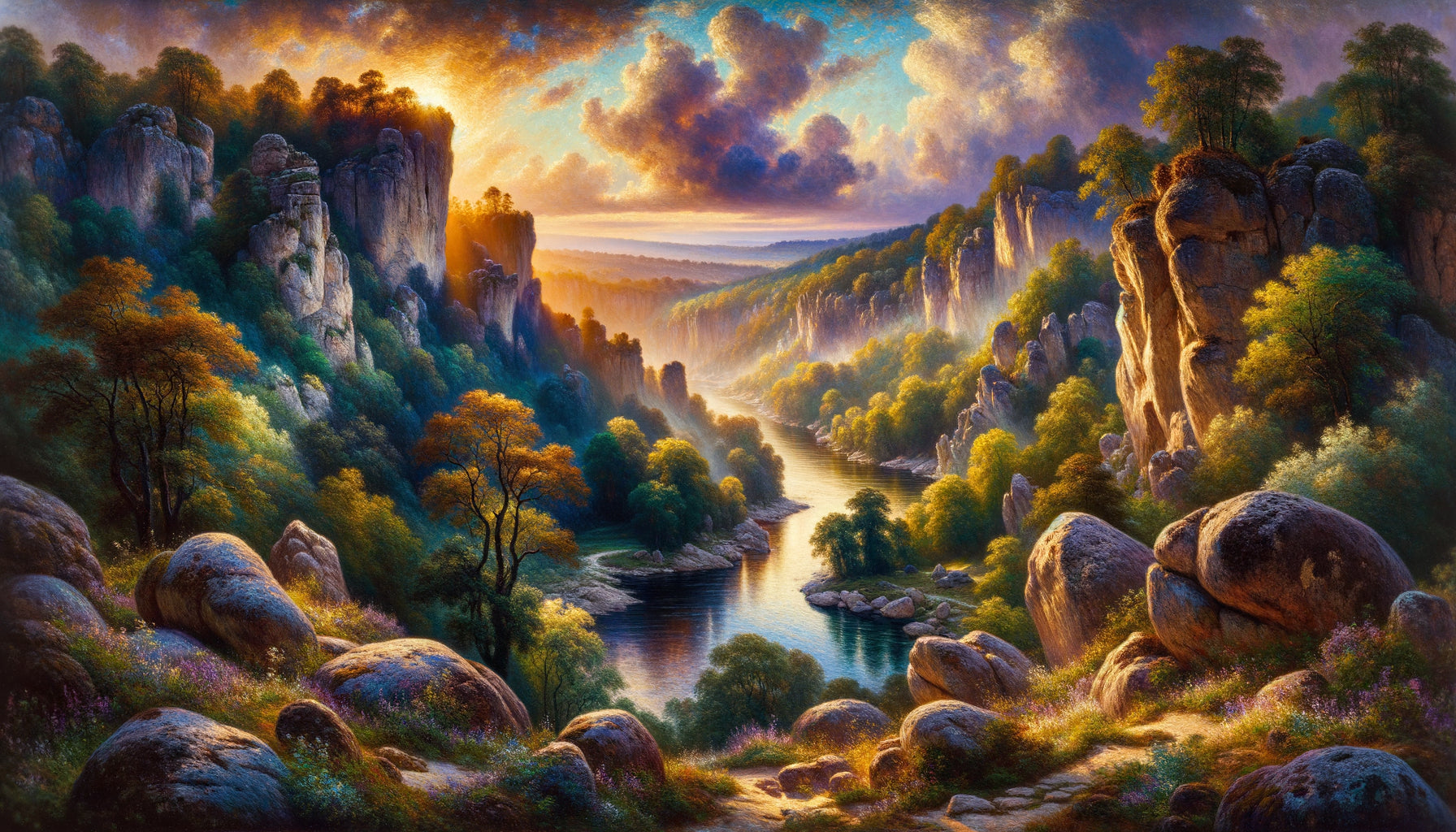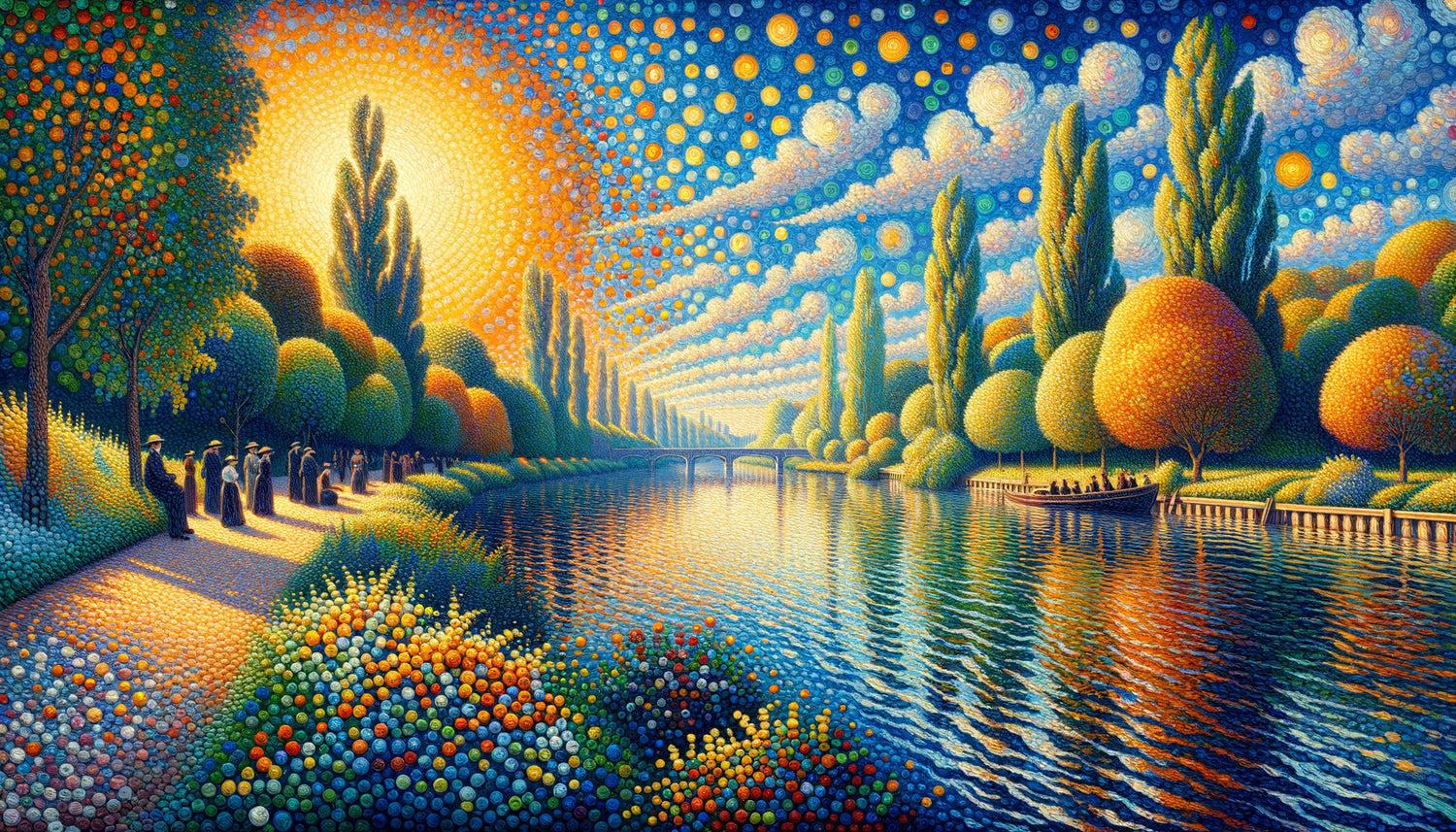
Imagine yourself in front of a painting that seems to vibrate with light, where each shade pulsates like a chromatic heartbeat. From afar, you distinguish a bucolic scene with harmonious colors. But approach: the magic happens. What you thought were blended strokes turns out to be thousands of colored points, juxtaposed with mathematical precision. This is the hypnotic effect of Seurat's pointillist technique, a revolution that transforms painting into an optical symphony.
Here's what Seurat's technique brings: unparalleled brightness achieved without mixing pigments, a scientific structure that gives rhythm to each composition, and a timeless modernity that continues to inspire designers and interior creators.
Perhaps you have admired reproductions of Impressionist landscapes without understanding what made them so different, so vibrant. How can an artist create so much depth with simple small points? And above all, why does this approach fascinate so many lovers of contemporary art and refined decoration?
Rest assured: the pointillist method is not reserved for art historians. Understanding its principles is discovering a new way to look at color, light and space – essential notions for anyone seeking to create visually captivating atmospheres.
In this article, you will discover the secrets of constructing Seurat's pointillist landscapes, understand his revolutionary approach, and grasp why this technique continues to influence modern aesthetics.
The revolution of the point: when science meets emotion
Georges Seurat did not paint like his Impressionist contemporaries. Where Monet let his brush dance intuitively, Seurat calculated. His pointillist technique, which he himself called divisionism, is based on a fascinating optical principle: instead of mixing colors on the palette, he deposited them pure on the canvas, in the form of tiny distinct touches.
The viewer's eye does the rest. At a suitable distance, our brain fuses these colored points to create intermediate shades brighter than any pigment mixture. A cobalt blue placed next to a lemon yellow will produce a vibrant green in our perception – a green more brilliant than if Seurat had physically mixed those two colors.
This revolutionary approach transforms each pointillist landscape into a living optical experience. Seurat's rural scenes seem bathed in pulsating natural light, as if the air itself vibrated between the trees and silhouettes.
The anatomy of a landscape: structure and methodical composition
To construct his landscapes, Seurat proceeded with the rigor of an architect. Each painting began with in-depth study: preparatory sketches, Conte pencil value studies, meticulous color research. Nothing was left to chance.
The invisible grid of harmony
Seurat organized his compositions according to precise geometric principles. Horizontal lines suggest calm, vertical lines stability, and diagonal lines dynamism. Take A Sunday on La Grande Jatte: behind the apparent spontaneity of this scene of a stroll lies an elaborate mathematical structure, where each character occupies a position calculated according to the golden ratio.
In his pointillist landscapes – the banks of the Seine, the Norman ports – this organization becomes more subtle but remains present. The horizon lines harmoniously divide the space, the masses of vegetation balance open areas, creating that feeling of natural order which makes his works so soothing.
The scientific palette
Seurat did not choose his colors based on feeling. Influenced by Chevreul's theories on simultaneous contrasts and Ogden Rood’s research on color, he developed precise chromatic ranges for each area of his paintings. A sky was never simply blue: it was a skillful orchestration of cobalt, Prussian blue, touches of violet and hints of orange-pink that captured all the nuances of the atmosphere.
This Seurat technique gave his landscapes an unprecedented luminous quality. Even shadows were constructed with complementary colors rather than black or brown, creating that characteristic transparency of pointillism.

The rhythm of the dot: patience and precision
Creating a pointillist landscape required monastic patience. Seurat worked slowly, applying each touch of paint with metronomic precision. A medium-sized painting could take months, or even years of diligent work.
The pointillist dot itself evolved according to the areas of the painting. Contrary to what one might think, Seurat did not uniformly cover his canvas with identical dots. In the skies, the touches became wider and smoother. In the vegetation, they became denser and more irregular. On water surfaces, they stretched slightly to suggest reflections and movement.
This variation in application created a visual texture that brought each element of the landscape to life. The grass seemed to shimmer, the water sparkled, the trees breathed – all thanks to this subtle modulation of the touch.
Captured light: Seurat's atmospheric obsession
If Seurat perfected his pointillist technique, it was to capture something elusive: the exact quality of light at a given moment. Each landscape was an atmospheric study where air, distance and ambient brightness became the true subjects.
Observe The Pont de Courbevoie or La Seine à la Grande Jatte: the atmosphere is almost palpable. The slight haze that softens distant contours, the warmth of a summer afternoon that seems to vibrate in the air, the coolness of a shaded bank – all are rendered with a scientific accuracy that paradoxically touches directly on emotion.
This ability to translate light phenomena makes Seurat's pointillism a fascinating tool for anyone interested in visual atmospheres. Today's designers find in these compositions the same search for chromatic balance and atmospheric consistency that they apply in their space creations.

Contemporary legacy: from easel to wall
Seurat's technique resonates particularly in our era where pixelated screens and digital printing have familiarized us with the construction of images by points. There is something prophetic about this approach that anticipated our modern relationship to the image.
Integrating a pointillist landscape into a contemporary interior creates a fascinating dialogue between rigor and sensitivity, between structure and emotion. These works bring a rare contemplative quality, an invitation to slow down the gaze, to approach then step back, to play with perception.
The characteristic luminous vibration of pointillism harmonizes particularly well with minimalist interiors where every decorative element must justify its presence. A painting inspired by this technique becomes a focal point that enriches the space without weighing it down, bringing color and depth with measured elegance.
Let pointillism transform your space
Discover our exclusive collection of landscape paintings that captures the luminous vibration and chromatic harmony of the great masters.
When viewing becomes an experience
What makes Seurat's pointillist technique so fascinating is that it transforms the act of looking into an active experience. You do not passively consume a pointillist landscape – you participate in its creation through your own perception.
This interaction between the work and the viewer creates a unique relationship. Each time you walk past the painting, depending on the daylight, your mood, your distance, you discover it differently. Colors seem to change, shapes are revealed or fade, the composition breathes.
It is this living quality that makes pointillism more than just a painting technique: it is a philosophy of vision, an invitation to look at the world with more attention, to perceive the infinite nuances that compose each scene, each moment.
Imagine your space transformed by this vibrant presence. A wall becoming a window onto a landscape where light does not simply represent itself but seems truly to emanate from the painted surface. You now have the keys to understand what makes these works so powerful, so timeless. All that remains is to let this optical revolution enter your daily life, to welcome this colorful vibration that, as Seurat wanted, makes light dance on your walls.