In my London workshop where I restore archaeological pieces for private collectors and international museums, I have held a fragment of a Palmyrene relief depicting a camel alongside a deity. This small limestone stele, worn by seventeen centuries of history, told a fascinating story: that of a civilization where animals were not mere decorative motifs, but messengers between multiple cultural worlds.
Here's what the animal art of Palmyra reveals: a unique fusion between Hellenistic aesthetics and oriental symbolism, a visual vocabulary that transforms each creature into a cultural ambassador, and a decorative approach that still inspires our contemporary interiors today.
You may be fascinated by ancient art but perplexed by the complexity of cultural influences intertwined in these millennial works. How can you distinguish what belongs to local tradition from what comes from Alexander's conquests? This question has haunted art historians for decades.
Rest assured: by observing the animals depicted in Palmyrene art, we have an extraordinarily clear key to reading. These creatures sculpted in stone tell us, better than texts, the story of a unique cultural crossroads.
I invite you to discover how Palmyra created a totally original artistic language, and why this lesson in cultural harmony still resonates in our contemporary spaces.
The Palmyrene camel: much more than an animal of the desert
During my restoration of sculpted funeral banquets from Palmyra, I was struck by the recurrence of the camel in local iconography. Unlike Greco-Roman representations that favored horses and lions, Palmyrene artisans gave the camel a place of honor in their compositions.
This choice was not arbitrary. The camel embodied the economic identity of Palmyra, this caravan city that owed its prosperity to trans-desert trade. But its artistic representation paradoxically borrowed from Greek canons: harmonious proportions, precise anatomical rendering, contrapposto pose adapted to the animal.
This fusion between local subject and Hellenistic technique perfectly characterizes Palmyrene syncretism. Sculptors did not blindly copy Greek models, nor did they adhere to an archaic Semitic tradition. They created a third way, recognizable at first glance.
The eagle and the serpent: when gods borrow wings
In the temples of Bêl and Baalshamîn, the animals associated with the deities reveal an even more complex syncretism. The eagle, attribute of Zeus in the Greek pantheon, accompanies Palmyrene gods in a totally original way.
I have restored several votive altars where the eagle appears not in its classic Greco-Roman posture, but in a typically oriental frontal composition. The bird looks directly at the faithful, its wings spread framing the god as in ancestral Mesopotamian iconography.
The serpent, another recurring animal, illustrates this Palmyrene cultural ambiguity. Sometimes represented in the Greek manner as an attribute of Asclepius, sometimes according to Eastern codes as a chthonic symbol and protector, it navigates between two symbolic universes without ever fully belonging to either.
This iconographic fluidity is evidence of a cosmopolitan society where cultural references naturally overlapped, creating a unique visual vocabulary that enriched each animal representation with multiple readings.

Guardian lions: a local tradition reinvented
Among all the creatures of Palmyrene art, the lion holds a particular position. An animal absent from the Syrian desert but omnipresent in the Near Eastern imagination for millennia, it perfectly embodies the question of syncretism.
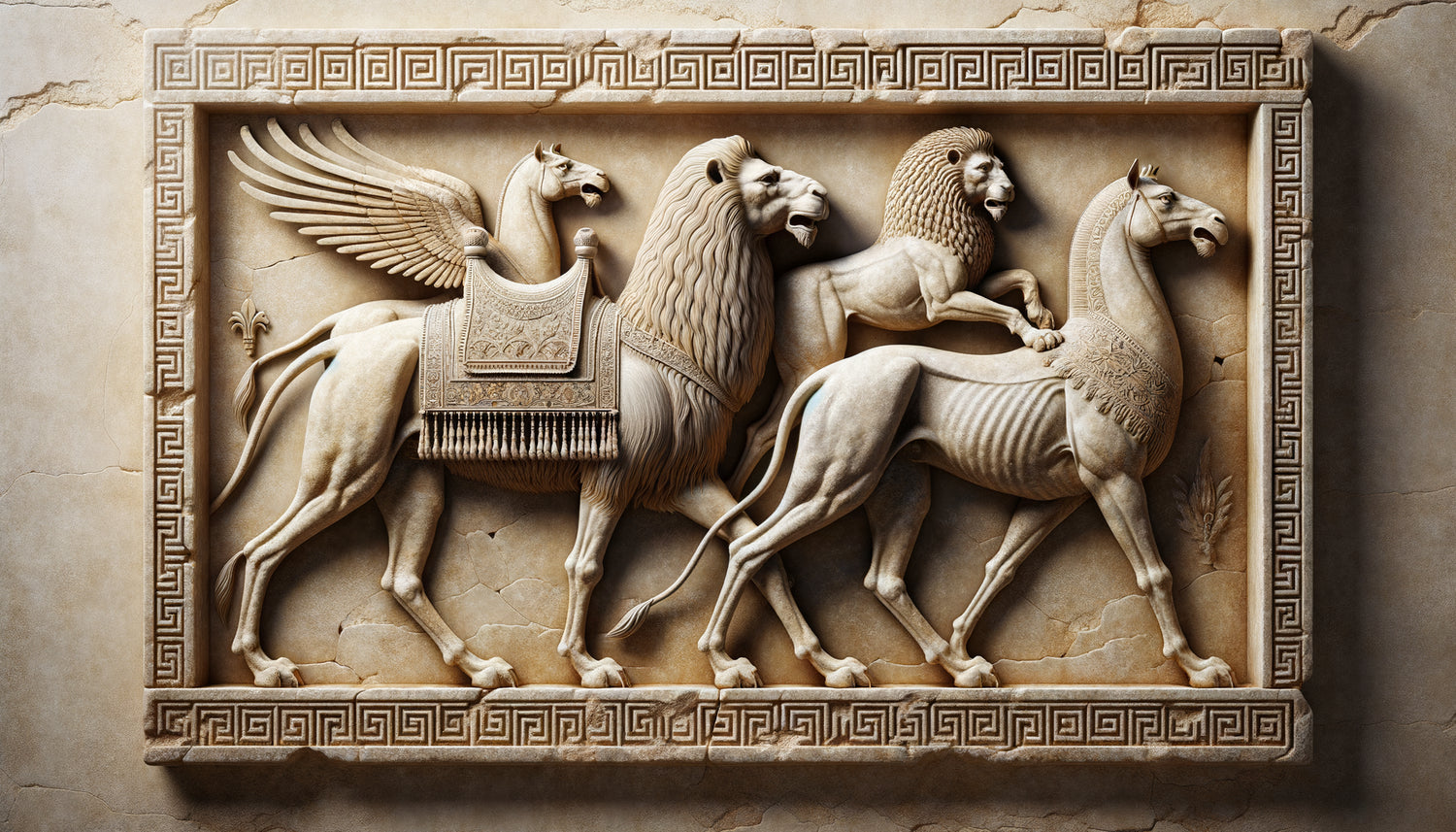
The lions of Palmyra guard tombs according to a centuries-old Mesopotamian tradition. Yet, their stylistic treatment reveals a mastery of Hellenistic sculpture techniques: detailed musculature, mane worked in individual strands, expressive gaze.
What I discovered when studying these sculptures is that Palmyrene artisans were not seeking to choose between local tradition and Greek influence. They deliberately created a visual synthesis that affirmed their specific identity. A Palmyrene lion looks like neither an Assyrian lion nor a Greek lion: it is recognizable among thousands.
This approach finds a fascinating echo in contemporary decoration, where multiple cultural references create interiors rich in meaning and stories.
Domestic bestiary and sculpted daily life
Beyond mythological and symbolic animals, Palmyrene art offers us a valuable testimony to everyday life through representations of domestic animals.
Sculpted funeral banquets show scenes where dogs, poultry, and sometimes even cats appear. These familiar animals are treated with touching naturalism, far from the rigid conventions of official art.
This intimate dimension reveals that Palmyrene syncretism was not only a matter of educated elites navigating between Greek and Eastern references. It was a daily lived reality, where influences naturally mixed in all aspects of social life.
Domestic reliefs show horses harnessed in the Parthian style, but represented with perspective techniques inherited from Hellenistic art. Doves peck at the ground in compositions borrowing from Roman art, but integrated into scenes of typically Semitic libation.

Hybrid Creatures: The Invention of a Visual Pantheon
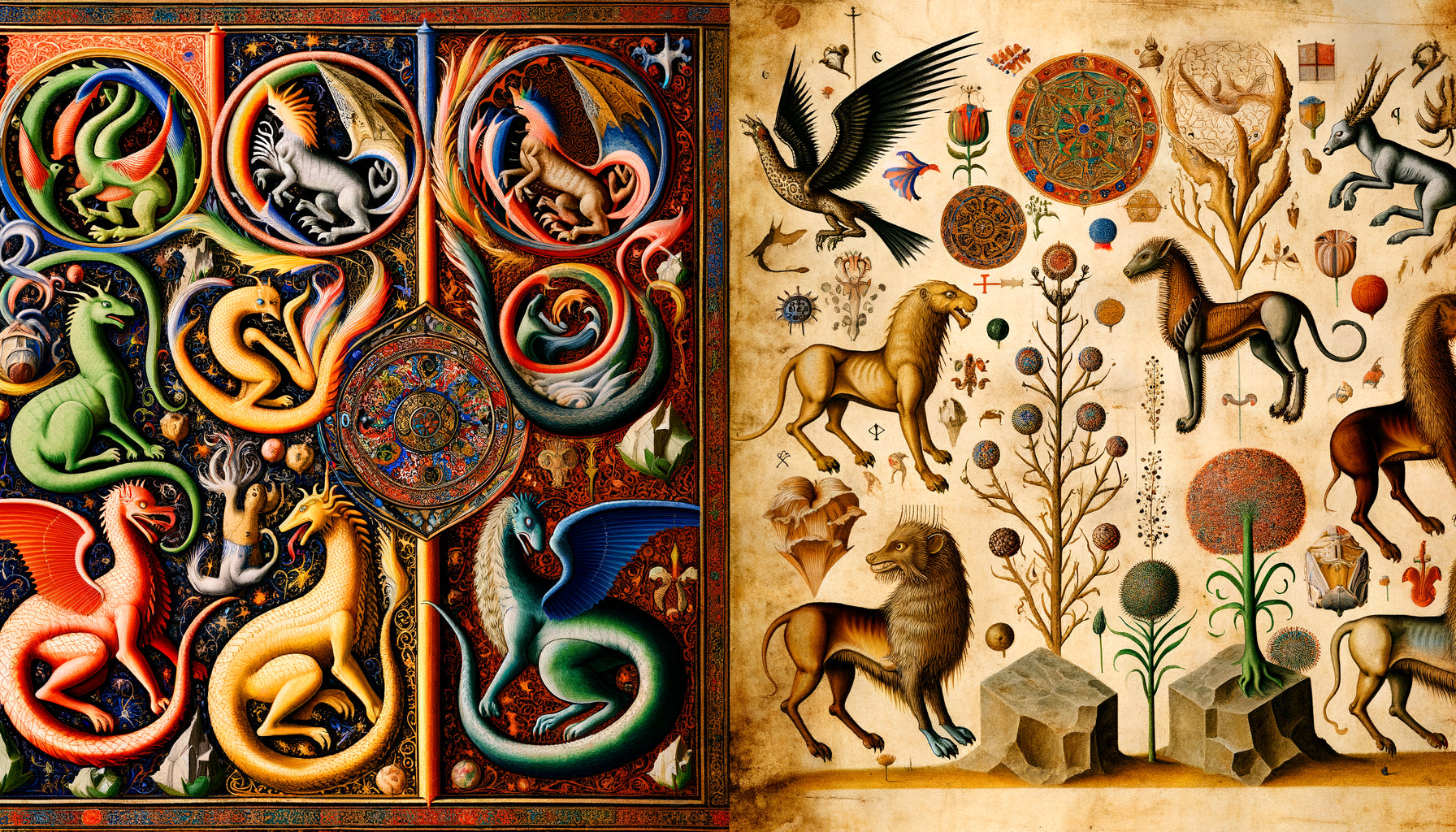
The most fascinating aspect of Palmyrene animal art may lie in its hybrid creatures. Griffins, sphinxes, chimeras populate the friezes and capitals with remarkable creative freedom.
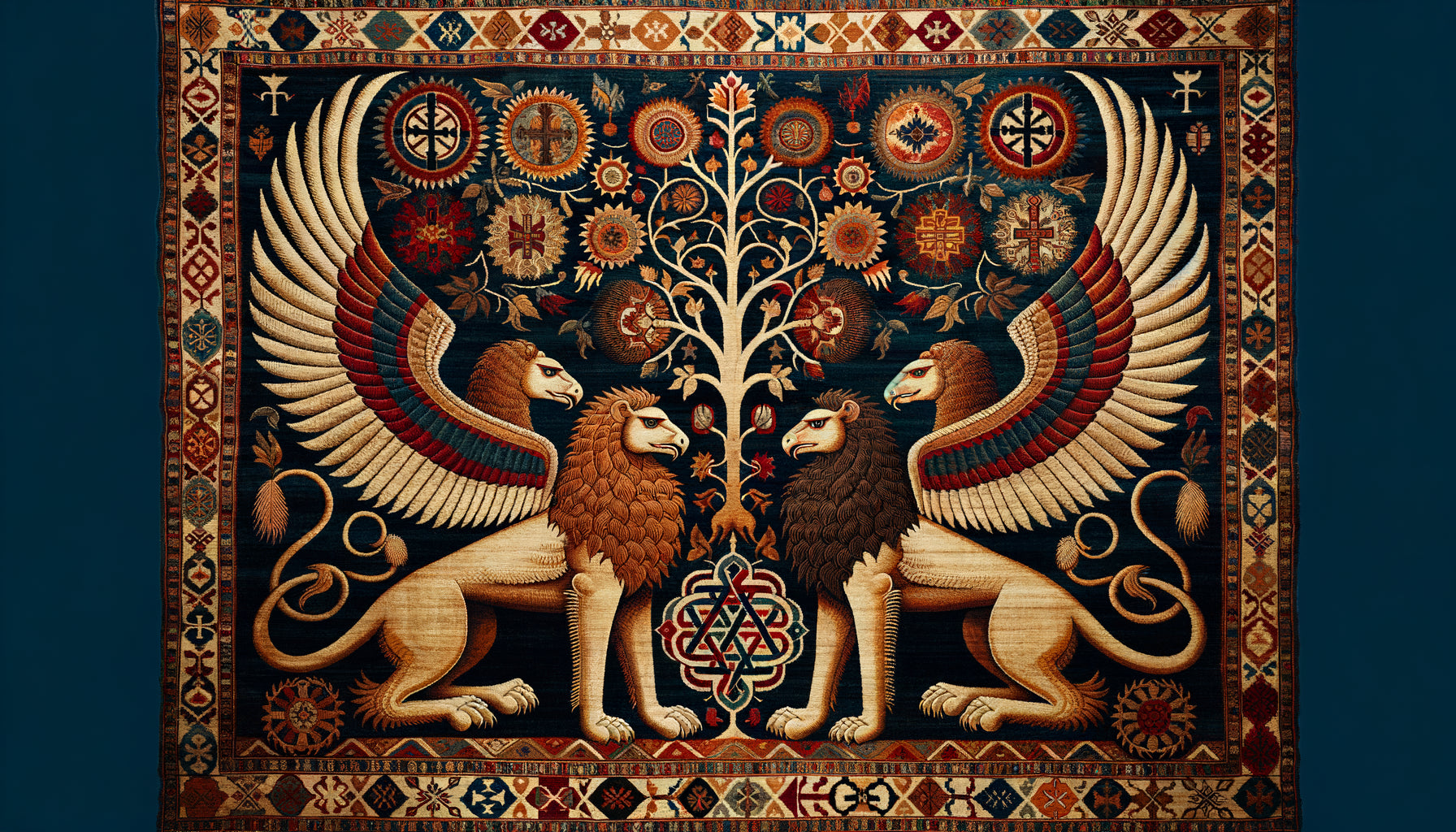
These fantastic beings are not mere copies of Greek or Persian models. Palmyrene artisans reinvented them by combining elements from different iconographic traditions. A Palmyrene griffin may have wings treated in a Greek style, a body inspired by Achaemenid art, and a head borrowing from Egyptian conventions.
This freedom of composition reveals a culture artistic deeply syncrétique par essence. Palmyra did not passively import external models: it digested them, transformed them, fused them to create an original visual language that was its own.
When restoring these pieces in my workshop, I am always impressed by the aesthetic coherence that emerges from these assemblages. Despite the diversity of references, the final result possesses an undeniable stylistic unity, a recognizable Palmyrene signature.
Bring the majesty of ancient traditions into your interior
Discover our exclusive collection of animal paintings that celebrate the symbolic richness of creatures throughout history and cultures.
A Lesson in Cultural Harmony for Today
After thirty years spent restoring and studying Palmyrene art, my conviction has been strengthened: these animals sculpted two millennia ago still speak to us today.
The syncrétisme palmyrénien was neither a simple aesthetic fad nor a bland compromise between contradictory traditions. It was an authentic cultural creation, born of a society that had made dialogue between civilizations its very identity.
The animals of Palmyra – whether they are desert camels, guardian lions, divine eagles or fantastic creatures – embody this ability to create beauty from diversity. They teach us that it is possible to honor one's local roots while being enriched by external influences, to preserve one's identity while opening up to the world.
This lesson resonates particularly in our contemporary interiors, where we often seek to combine varied cultural references. Like Palmyrene artisans, we can create a personal harmony by blending elements from different horizons, provided we do so with intention and consistency.
Imagine your living space transformed by this Palmyrene philosophy: decorative pieces that tell multiple stories, that dialogue between traditions, that create a unique visual language reflecting you. Animals, these universal messengers that cross all cultures, then become the ambassadors of your own decorative syncretism.
Start simply: choose an animal representation that speaks to you, whether inspired by ancient or contemporary art, and let it dialogue with your other objects. This is how the most fascinating interiors are born, those that tell a personal story by summoning references from everywhere.
Frequently Asked Questions
What really distinguishes Palmyrene art from classical Greco-Roman art?
This question often comes back to me during the expertise I carry out. Palmyrene art is distinguished by its characteristic frontality: characters and animals look directly at the viewer, unlike the three-quarter pose favored by the Greeks. In addition, the proportions are slightly different, with a tendency towards elongation of bodies and stylization of details that recalls Eastern traditions. Palmyrene animals also possess a hieratic presence, a formal dignity that contrasts with Greek naturalism. Finally, the treatment of surfaces reveals a typically oriental linear approach, where contours are strongly marked, rather than the modeling in volumes of Hellenistic sculpture. It is this unique combination that makes a Palmyrene piece immediately recognizable to an experienced eye.
Why were animals so important in Palmyrene funerary art?
In Palmyrene funerary art, animals played several essential roles that went beyond mere decoration. Firstly, they embodied the social status of the deceased: a camel signaled a prosperous caravan merchant, a horse a notable person. Secondly, some animals like lions possessed an apotropaic function, protecting the tomb from evil forces. Thirdly, creatures associated with deities ensured the spiritual protection of the dead in the afterlife. This multi-layered approach reflected a worldview where animals served as mediators between the earthly and divine realms, between the living and the dead. Sculpted funerary banquets often included domestic animals to evoke the continuity of daily life in the afterlife, a belief shared by several Eastern cultures. This symbolic richness explains why animals occupy such a central place in Palmyrene funerary iconography.
How to incorporate inspiration from Palmyrene art into a contemporary decor?
It is an exciting question that my collector clients often ask me! The spirit of Palmyra translates beautifully into a contemporary interior through several approaches. First, adopt the principle of syncretism: mix pieces from diverse cultural origins creating intentional visual dialogues. A modern animal painting can coexist with a reproduction of an antique relief if you create consistency through colors or materials. Next, prioritize frontal animal representations, which create a strong presence and engage the gaze, characteristic of the Palmyrene aesthetic. Opt for limestone tones – beiges, ochres, warm grays – that evoke the original sculptures. Finally, do not fear cultural contrasts: Palmyrene art teaches us that richness is born from harmoniously orchestrated diversity. A decor inspired by Palmyra celebrates travel, cultural openness and the creation of a unique personal visual language.