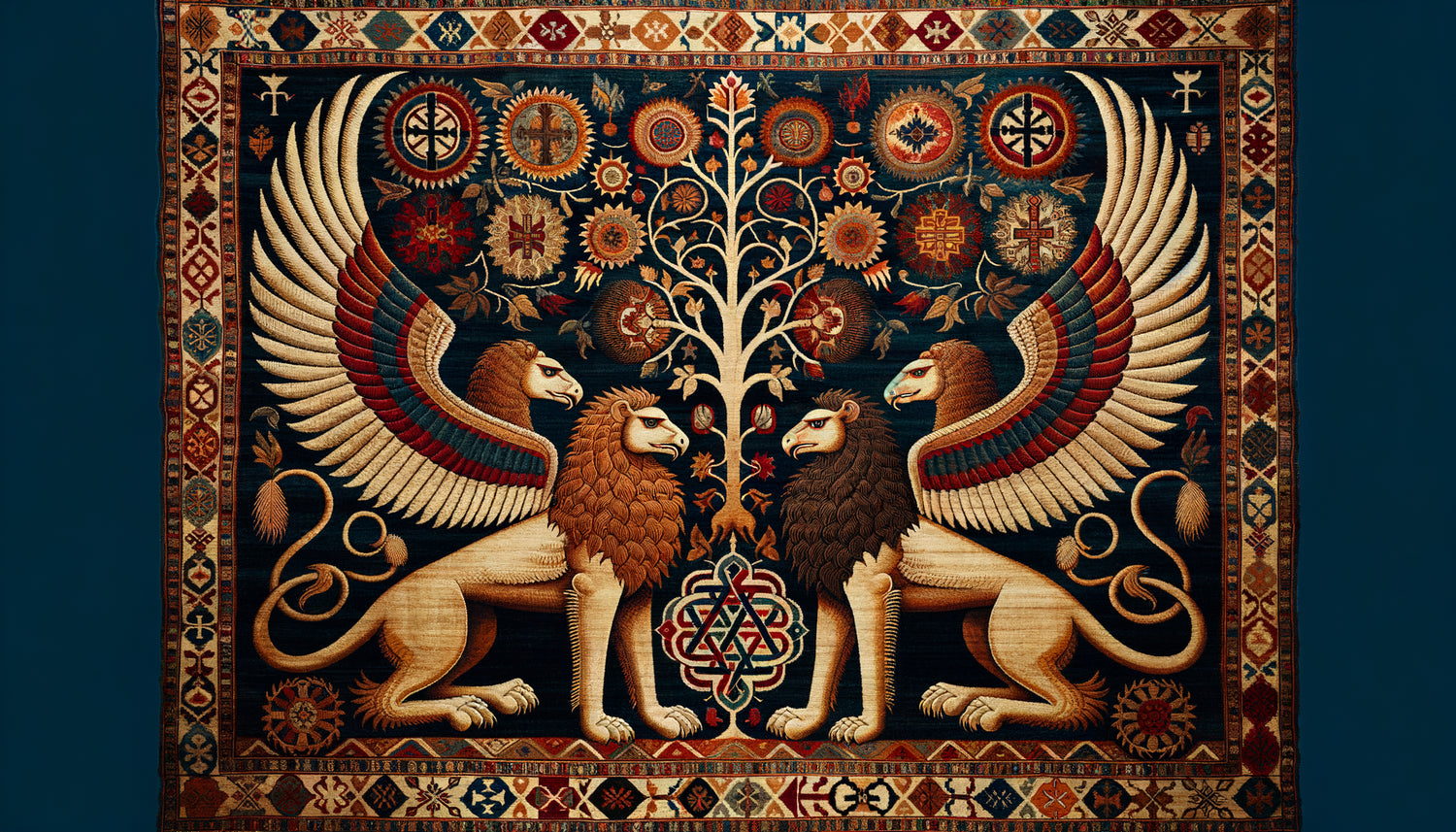
I acquired my first medieval Armenian rug twelve years ago, at an auction in London. What instantly fascinated me wasn't the quality of the natural pigments nor even the fineness of the weaving, but these two eagles facing each other, separated by a stylized tree of life. Their converging gazes created a palpable tension, as if the rug were breathing. This encounter triggered an obsession that has accompanied me ever since: deciphering the secret language of animals facing each other in these extraordinary works.
Here's what the meaning of animals facing each other in medieval Armenian rugs brings to your interior: millennia-old symbolic depth that transforms space into a cultural sanctuary, a visual conversation between opposing forces that energizes neutral rooms, and an authentic connection with the ancestral craftsmanship of the Caucasus that anchors your decor in real history.
Many believe these animal motifs are simply decorative, exotic arabesques without true meaning. This misconception deprives their spaces of the narrative richness these rugs have carried since the Middle Ages. You may be missing a complex symbolism that could transform your living room into a place of visual meditation.
Rest assured: understanding this iconography requires no expertise in Armenian art history. Medieval weavers created a universal language, based on archetypes that our unconscious instinctively recognizes. It just takes learning to look carefully.
In this article, I reveal the keys to reading these symmetrical animal compositions, their origin in Eastern Christian cosmology, and how to integrate these meaningful pieces into your contemporary decor without falling into a dusty museum.
The cosmic principle of sacred duality
In medieval Armenian rugs, the arrangement of animals facing each other is never random. It embodies the fundamental principle of cosmic duality: day and night, sky and earth, spiritual and material. Each pair of animals facing each other represents this creative tension that maintains the universe in balance.
Armenian weavers, deeply steeped in Eastern Christianity, visually translated complex theological concepts. Two lions facing off symbolize the guardian force protecting the entrance to the sacred, inspired by the lions of Judah mentioned in Scripture. Two doves facing each other evoke the Holy Spirit in dialogue, ascending prayer and descending grace.
What I discovered examining dozens of pieces from the 13th to the 15th centuries is that the central axis between the animals functions as a symbolic portal. This empty space, often adorned with a tree of life or a stylized cross, represents the spiritual dimension accessible through contemplation. Placing such a rug in your space literally creates a meditative focal point.
The tree of life as mediator
Between animals facing each other, the tree of life plays a crucial role. It is not simply decorative: it represents Christ as a bridge between opposites. In medieval Armenian tradition, this tree also evokes Mount Ararat, the axis of the world connecting the earthly to the celestial. The stylized branches often create eight subdivisions, a number symbolizing resurrection in Christian symbolism.
The symbolic hierarchy of the species represented
Not all animals facing each other carry the same symbolic weight. I have established a classification based on my iconographic research and discussions with curators at the Museum of History of Armenia in Yerevan.
The eagles facing each other occupy the top of the hierarchy. Symbols of spiritual power and prophetic vision, they frequently appear in medieval Armenian carpets intended for churches or noble families. Their spread wings create an ascending geometry that raises the gaze and, symbolically, the soul. A carpet with eagles facing each other would be perfect for a study or library where intellect is required.
The lions face to face represent sacred strength and protection. In Armenian iconography, they guard thresholds, ward off evil. Their perfect symmetry evokes balanced divine justice. These motifs work beautifully in entrances or hallways, where they assume their original protective role.
The deer or gazelles facing each other symbolize the soul thirsting for God, a direct reference to Psalm 42. Their mirrored representation suggests shared spiritual quest, the community of believers. These softer motifs are suitable for bedrooms or relaxation areas, where they inspire contemplative serenity.
The peacocks facing each other embody immortality and resurrection, thanks to the medieval belief that their flesh did not corrupt. Their spread tails create natural mandalas, perfect for meditation or yoga spaces.

When animals tell the story of Armenia
The arrangement of animals facing each other in medieval Armenian carpets also reflects the tormented history of this people. Armenia, situated between Persian, Byzantine and Ottoman empires, developed a cultural identity based on resistance and preservation.
Symmetrical compositions express this geopolitical tension: two equal forces facing each other without violent confrontation. The precarious balance between mirrored animals can be read as a metaphor for medieval Armenian diplomacy, navigating between rival powers.
I’ve noticed that rugs produced during periods of relative stability (particularly under the Cilician kingdom in the 12th-14th centuries) feature more peaceful facing animals, separated by abundant floral motifs. Those woven during invasion periods show creatures that are more tense, with prominent claws, the central space reduced to a simple geometric pillar.
The inscriptions hidden in the borders
The borders framing the facing animals often contain prayers in ancient Armenian, sometimes so stylized that they resemble abstract motifs. These inscriptions transform the rug into a portable liturgical object, a personal chapel. Examine the borders carefully with a magnifying glass: you might discover fragments of the Lord's Prayer or the Hail Mary woven into the wool.
How to integrate these rugs steeped in symbolism into a contemporary interior
The question I am systematically asked by my clients: how to welcome these medieval Armenian rugs without turning your living room into an ethnographic exhibition?
My first rule: let the symmetrical composition breathe. These rugs function as floor paintings. Avoid cluttering them with furniture. A minimalist Ligne Roset or B&B Italia sofa creates a fascinating temporal contrast with the facing animals. Clean contemporary furniture highlights the narrative richness of the rug without visual competition.
Second tip: respect the ritual orientation. In their original context, these rugs were oriented according to precise symbolic axes. If your room allows it, position the rug so that the facing animals are parallel to your main circulation axis. You will regularly pass in front of this symbolic portal, creating a daily spatial ritual.
Lighting radically transforms the perception of these works. Gentle zenithal lighting (2700K LED) reveals the depth of natural pigments and accentuates the visual tension between the facing creatures. Avoid side lighting that flattens the reliefs of the weaving.
The association with contemporary art
I love creating unexpected dialogues: a medieval Armenian rug with facing eagles under a large format photograph by Sebastião Salgado, for example. The two works share a monumental and spiritual quality that transcends their respective eras. This juxtaposition creates a conversation between aesthetic traditions that your guests will not forget.

Recognizing the Authenticity and Value of a Medieval Armenian Rug
The market for Armenian rugs is unfortunately polluted by reproductions and fanciful attributions. After examining hundreds of pieces, I have developed some criteria for recognition.
The medieval Armenian knotting technique mainly uses the symmetrical Turkish (ghiordes) knot, but with a specific density: between 90 and 200 knots per square decimeter for quality pieces. Authentic facing animals exhibit subtle asymmetry despite their mirrored composition. Medieval weavers worked freehand, without precise patterns. This organic irregularity is a sign of authenticity.
The natural pigments age in a characteristic way. Madder red turns to pinkish brown, indigo develops gray nuances. A uniform bright red on a supposed 14th-century rug betrays the use of synthetic dyes post-1860. Be wary also of colors that are too harmonious: medieval dyers worked in batches, creating chromatic variations from one section to another of the carpet.
Wear must be consistent. A six-century-old rug shows natural abrasion of passageways, but pigments remain visible in the depth of the fibers. Artificial wear (sanding, chemical treatment) flattens the wool evenly and destroys this colored stratification.
The Spiritual Dimension in Everyday Life
Living with a medieval Armenian rug with facing animals imperceptibly transforms your relationship to domestic space. These objects carry a contemplative charge that slows down time.
Several clients have confided in me that they develop unprogrammed rituals: a morning coffee break facing the lions, an end-of-day meditation observing the symmetrical pigeons. The rug becomes an anchor point, a spatial landmark that structures inner life.
This symbolic presence also works as an antidote to digital immediacy. An object of six centuries, hand-woven over several years, embodies a temporality radically opposed to our screens. Its mere presence reintroduces long duration into our fragmented existences.
The facing animals also pose a daily philosophical question: how to manage oppositions without destructive conflict? This medieval interrogation resonates powerfully with our contemporary polarizations. The rug thus becomes an object of thought, not just decoration.
Let animal symbolism transform your interior
Discover our exclusive collection of animal paintings that capture the same symbolic power in contemporary creations accessible.
Conclusion: The living legacy of a woven wisdom
The meaning of animals facing each other in medieval Armenian carpets extends far beyond academic exercise. These symmetrical compositions offer a complete cosmology, a system of thought where each creature confronted embodies a philosophical or spiritual truth. Integrating such a piece into your home is welcoming centuries of Caucasian wisdom, transforming your floor into a habitable mandala.
Start simply: visit a specialized auction house, a reputable dealer, or even a textile museum. See how facing animals create this magnetic tension in space. Imagine that presence in your home, that silent dialogue between opposing forces that would enrich your daily life. Decoration is never as powerful as when it carries meaning.
FAQ: Your questions about medieval Armenian carpets
What is the difference between an Armenian carpet and a Persian carpet with animals?
Excellent question that comes up constantly! Medieval Armenian carpets are distinguished by their specific Christian iconography and more angular geometry. While Persian carpets favor floral curves and a naturalization of creatures, Armenian facing animals are more stylized, almost heraldic. The Armenian palette uses more deep reds (cochineal, madder) and intense indigo blues, reflecting the pigments available in the Caucasus. Above all, the strict symmetrical arrangement of facing animals is much more systematic in Armenian production, where it responds to Eastern Christian symbolic imperatives absent from Islamic Persian iconography. Technically, Armenian knotting often presents a slightly lower density (paradoxically allowing better durability) and Caucasian sheep wool with a particularly lanolin touch. If you hesitate in front of a piece, examine the central space between the animals: a stylized cross or an eight-branched tree of life usually indicates an Armenian origin.
How to maintain a medieval Armenian carpet on a daily basis?
Caring for a medieval Armenian rug requires a respectful but non-phobic approach. These pieces have survived centuries precisely because they are robust! Regular vacuuming (once a week) remains your best ally, but always in the direction of the pile, never across it. Use a brushless nozzle that would not tear the old fibers. Every three months, turn the rug over to equalize wear and light exposure. Regarding stains, react immediately with absorbent paper, without rubbing. For a deep cleaning, you must consult a specialist in antique textiles, never a standard carpet cleaner who would use products too aggressive for natural pigments. Pets also deserve protection from direct UV rays which fade vegetable dyes: install UV window films or filtering curtains. Finally, let your rug breathe: once a year, hang it outdoors in the shade on a dry day to eliminate mites naturally. This Caucasian traditional practice preserves fibers better than any chemical treatment.
Does a medieval Armenian rug represent a good investment?
The investment dimension of medieval Armenian rugs depends on several factors, but overall, yes, these pieces constitute a smart tangible asset. The market for antique Caucasian textiles has increased by 180% in value between 2005 and 2023 according to Artprice indices, significantly outperforming inflation. Several reasons explain this appreciation: the decreasing rarity (many have disappeared during the Armenian genocide of 1915), the increasing interest of collectors for Eastern Christian art, and the late museum recognition of these works long eclipsed by Persian rugs. An authentic 14th-century Armenian rug with animals confronted well preserved can reach from 25,000 to 80,000 euros depending on size and iconographic complexity. But be careful: investment only makes sense if the attribution is certain (require a written expertise from a recognized specialist), the state of conservation is acceptable (old restorations admitted, but not massive reconstruction), and the provenance is documented. Unlike stocks, you live with this investment every day, which gives it a usage value that financial assets do not offer. My recommendation: first buy for symbolic love at first sight, consider financial appreciation as a welcome but secondary bonus.