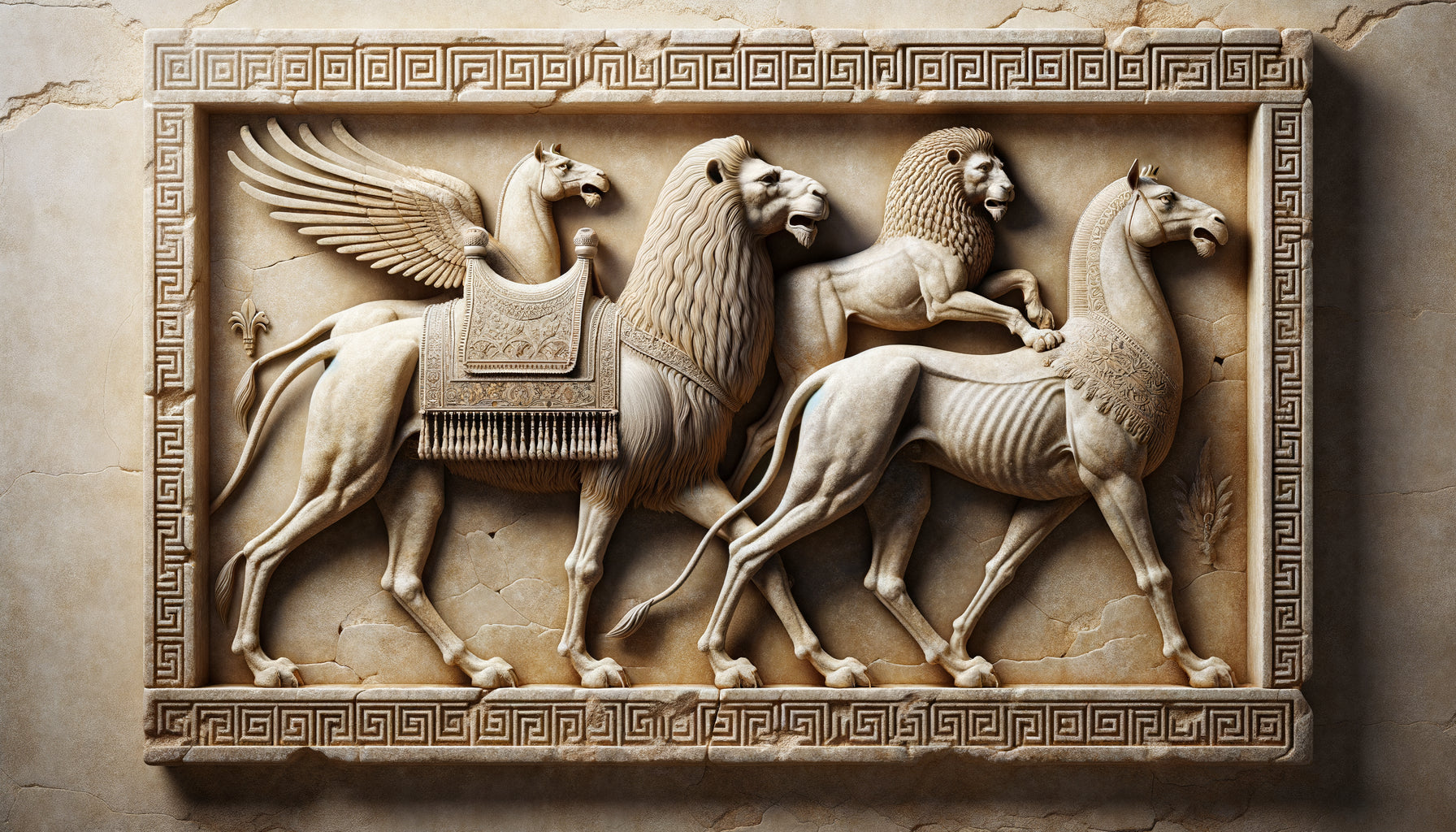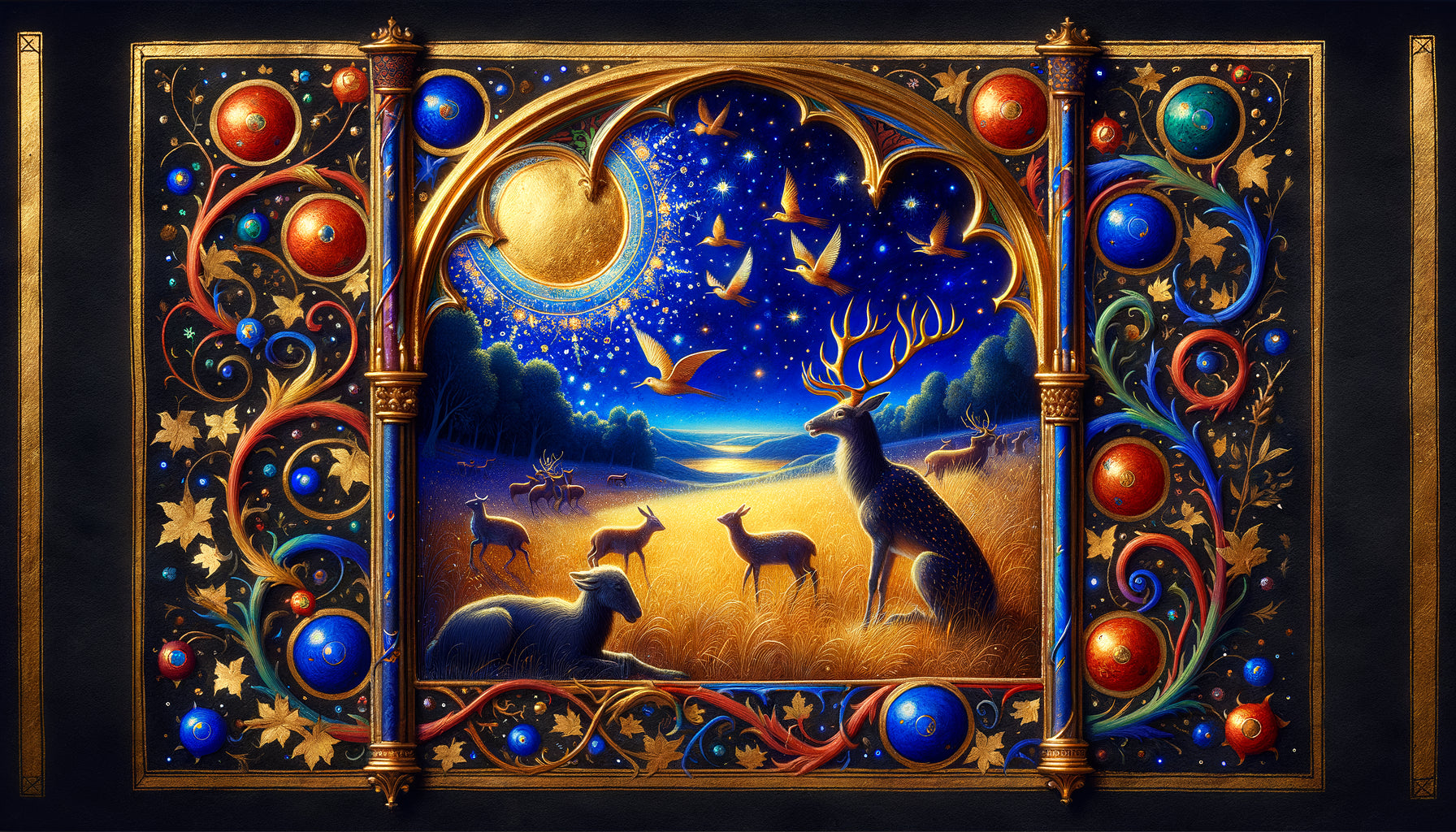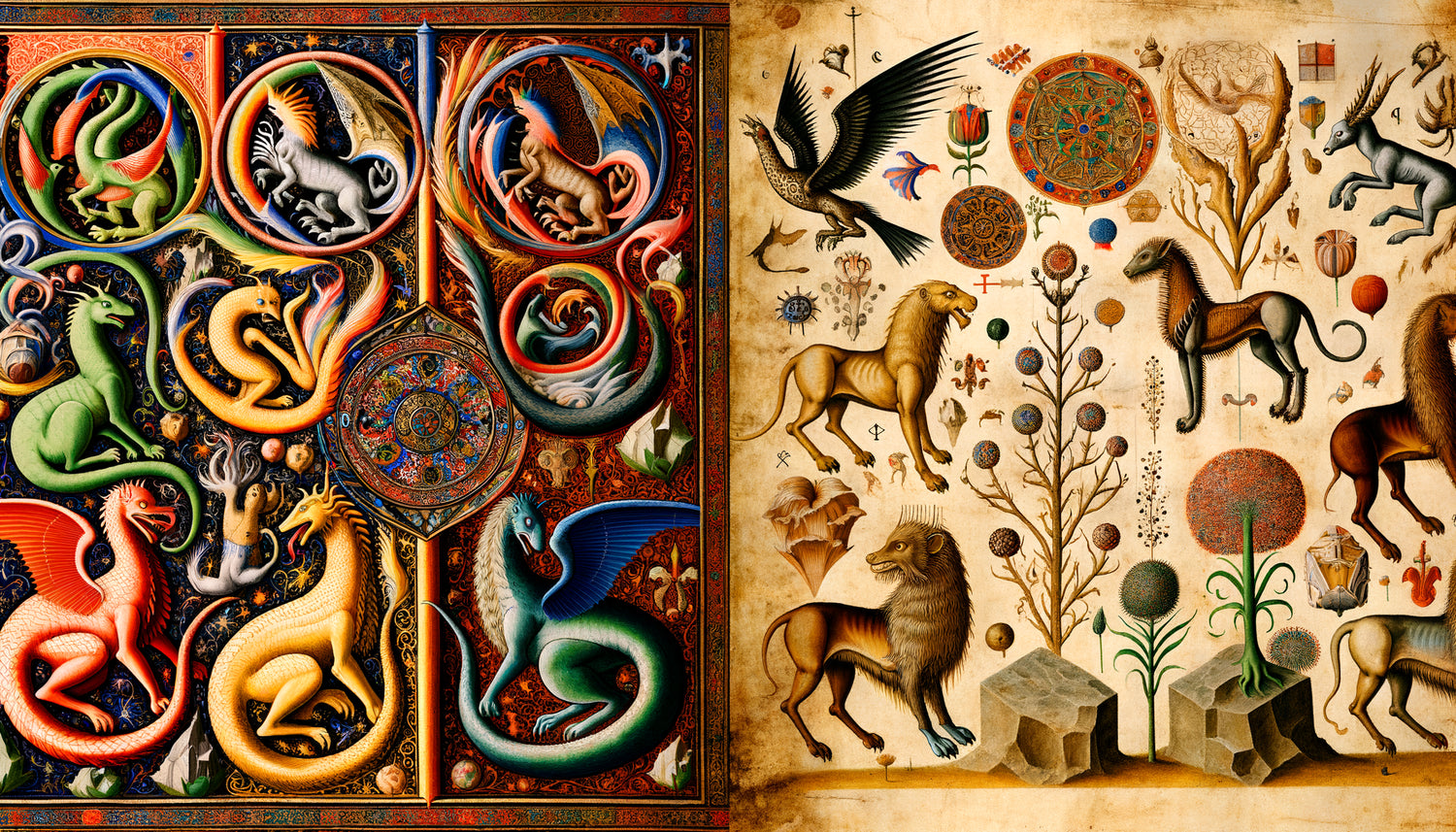
In the illuminated margins of medieval manuscripts, dragons and griffins mingle with unicorns and basilisks with a disconcerting confidence. These fantastic creatures populate cathedrals, adorn tapestries, inhabit every corner of the artistic imagination. Then comes the Renaissance, and gradually, silently, these wonderful beings disappear from canvases and frescoes. In their place: perfectly proportioned human bodies, realistic landscapes, nature faithfully observed. This disappearance is not accidental. It tells a story of a shift in thinking, a turning point for the world towards a new conception of beauty and truth.
Here's what this artistic transformation reveals: the transition from symbolic art to scientific art, the emergence of a rational vision of the world, and the birth of an aesthetic founded on direct observation of nature rather than the legacy of medieval bestiaries.
You may be looking at Renaissance paintings admiring their technical beauty, without realizing that they bear traces of a lost world. You might wonder why artists abandoned these creatures that had fascinated for centuries? The answer lies at the intersection of several revolutions: philosophical, scientific and artistic. Together we will explore this pivotal moment when medieval imagination gives way to rational observation, when religious symbolism fades before triumphant humanism. This story sheds light not only on the evolution of art, but also on the profound transformation of our relationship with the world and images.
The triumph of observation: when nature supplants imagination
The Renaissance marks a decisive turning point in the way artists perceive their subject. At the heart of this revolution lies a new principle: direct observation of nature. Leonardo da Vinci spends hours dissecting corpses, studying the anatomy of birds to understand flight, observing the movement of water. This empirical approach radically transforms artistic practice.
In this intellectual context, fantastic animals in medieval art pose a problem. How can one represent anatomically accurately a creature that does not exist? The medieval dragon was acceptable in an artistic system where symbolic value took precedence over plausibility. But for a Renaissance artist trained in meticulous observation, painting a griffin becomes an exercise contradictory with his new requirements of realism.
Leonardo's notebooks perfectly illustrate this tension. When he draws imaginary creatures, he builds them meticulously from real elements: a monster will have the head of a dog, the scales of a fish, the wings of a bat. Imagination itself is now subject to the laws of anatomy and natural plausibility. Fantastic animals do not disappear abruptly; they transform, losing their purely symbolic character to become rational assemblages.
The scientific perspective replaces the medieval bestiary
Medieval bestiaries mixed real animals and legendary creatures without distinction. The lion mingled with the unicorn, the horse with the griffin. This lack of differentiation reflected a conception of knowledge where the authority of ancient texts outweighed experience. The Renaissance, with its great explorations and geographical discoveries, overturned this hierarchy. Artists discover real exotic animals – rhinoceroses, parrots, American animals – which fuel their imagination much better than inherited chimeras.
Humanism and the centrality of man in creation
The humanist philosophy places man at the center of creation. This intellectual revolution is directly reflected in Renaissance art. Paintings are populated with idealized human figures, psychological portraits, mythological scenes where gods have perfectly proportioned human bodies. Humanism celebrates the dignity and beauty of humankind, which has become the measure of all things.
In this new aesthetic hierarchy, fantastic animals lose their relevance. They belonged to a medieval system where man was only one element among others in a creation dominated by supernatural forces. The dragon symbolized evil, the unicorn virgin purity, the phoenix resurrection. These creatures served a theological discourse where man was a spectator of cosmic battles.
The Renaissance affirms, on the contrary, man's ability to understand and master the world. Michelangelo sculpts heroic bodies that embody human creative power. Raphael paints faces of grace that celebrate humanity. In this context, representing a dragon is almost an admission of intellectual weakness, a return to outdated superstitions. Renaissance art prefers to explore the psychological complexity of a human gaze rather than the contours of a chimeric creature.
Greek-Roman mythology: a more acceptable bestiary
Paradoxically, some fantastic creatures survive through the rediscovery of ancient mythology. But notice the difference: centaurs, satyrs and tritons in the Renaissance are always represented with precise anatomical concern. They belong to a noble mythological system, validated by the authority of the Ancients, and not to medieval folklore now considered popular and superstitious.

When rational perspective chases symbolism
The invention of linear perspective by Brunelleschi in the early 15th century constitutes a technical and philosophical revolution. It imposes a rigorous mathematical organization of pictorial space. Every element of the painting must obey the laws of geometry, fit into a coherent system where proportions are calculated with precision.
Medieval fantastic animals functioned in a symbolic space where the size of figures reflected their spiritual importance, not their position in space. A saint could be larger than a mountain, a dragon fill the sky. This hierarchical and symbolic system becomes incompatible with Renaissance rational perspective.
How to harmoniously integrate a dragon into a Tuscan landscape painted according to the rules of atmospheric perspective? How to coexist a unicorn with characters whose proportions obey Alberti's anatomical canons? This technical incompatibility accelerates the disappearance of fantastic creatures. They no longer have a place in the rationalized, measurable, coherent space that Renaissance artists construct.
Art becomes a place of visual harmony based on scientific principles. Art treatises multiply, codifying the rules of composition, proportion, and color. Within this theorized and systematized framework, the arbitrariness of an invented creature appears as an anomaly, almost a matter of taste.
The role of printing in standardizing knowledge
The invention of printing by Gutenberg around 1450 transforms the circulation of knowledge. Illustrated books multiply, disseminating a standardized iconography. The first printed natural history treatises clearly distinguish between real animals and fabulous creatures, categorizing knowledge with new rigor.
This standardization of knowledge gradually marginalizes medieval bestiaries. A Renaissance artist who wishes to represent a lion now consults naturalist descriptions rather than allegorical manuscripts. The massive diffusion of realistic images creates a new visual consensus that naturally excludes fantastic representations.
The engravings of Albrecht Dürer perfectly illustrate this shift. His famous rhinoceros of 1515, although inaccurate in some details, testifies to a desire to represent a real exotic animal. This documentary approach, multiplied by printing, progressively builds a visual repertoire based on observation rather than symbolic tradition.
The circulation of artistic models
Prints also allow artists to study the works of their contemporaries. This circulation creates cross influences and accelerates the adoption of new aesthetic conventions. When Italian masters abandon fantastic creatures, their example quickly spreads throughout Europe thanks to engravings reproducing their compositions.

The Last Havens of Fantastic Imagination
Fantastic animals do not completely disappear. They find refuge in specific contexts that allow them to survive the rationalization of art. Jérôme Bosch, at the turn of the 16th century, populates his paintings with extraordinary hybrid creatures. But note that he is often considered an archaic artist, prolonging a medieval tradition on the verge of extinction.
The illuminated margins of luxury manuscripts continue to welcome grotesques and chimeras, precisely because they occupy a marginal, decorative space where representative rigor is less required. Heraldic coats of arms retain their griffins and dragons, but in a purely symbolic, codified register that removes them from realistic judgment.
Some late Renaissance artists, such as Arcimboldo with his composite portraits, reintroduce a fantastic dimension, but in a playful and intellectual register that has nothing to do with the serious theological concerns of medieval bestiaries. The fantastic becomes a game of wit, technical virtuosity, not an expression of cosmology.
Are you as fascinated by the animal imagination as I am?
Discover our exclusive collection of animal paintings that celebrates the fascinating beauty of the animal kingdom, between striking realism and timeless symbolism.
A Disappearance That Tells Our Modernity
The gradual disappearance of fantastic animals in Renaissance art is not anecdotal. It marks a profound civilizational shift: the transition from an enchanted world, populated by mysterious forces and symbolic creatures, to a rational, measurable universe dominated by scientific observation and human centrality.
This aesthetic transformation reflects major intellectual mutations: the emergence of the experimental method, the affirmation of humanism, the progressive secularization of thought. Dragons and unicorns could not survive in a world where Copernicus displaced the Earth from the center of the universe, where Vesalius dissected bodies to understand their functioning, where Machiavelli analyzed political power in rational terms rather than theological ones.
When contemplating today's Renaissance paintings where nature is depicted with striking realism, where human bodies display a studied anatomical perfection, we witness the beginnings of our own modernity. The Renaissance lays the foundations for an art that values observable truth over inherited imagination, personal experience over traditional authority, reason over symbol. This artistic revolution foreshadows the scientific and philosophical upheavals that will continue to transform our relationship with the world in the centuries that follow.
Yet, something may have also been lost in this great movement of rationalization. By chasing fantastic creatures, the Renaissance also distanced itself from a certain form of visual poetry, a relationship with the world where the invisible and the marvelous had their rightful place. This tension between realism and imagination, between observation and dream, continues to permeate contemporary art, reminding us that the question posed by the Renaissance remains strikingly relevant: what place should be given to the imagination in a world increasingly dominated by scientific rationality?
Frequently Asked Questions
Have fantastic animals completely disappeared from art after the Renaissance?
No, they have never completely disappeared, but their status and function have radically changed. After the Renaissance, fantastic creatures survive in specific contexts: 19th-century symbolist art reinvests them with a psychological and dreamlike dimension, 20th-century surrealism uses them to explore the unconscious, and contemporary art often invokes them from a critical or ironic perspective. The fundamental difference is that these creatures are no longer accepted as possibly real or as serious theological symbols, but become conscious metaphors, tools for exploring human imagination. In medieval art, a dragon could represent an authentic spiritual reality; in modern art, it becomes the expression of a subjectivity, a fear, a fantasy. This transformation reflects our more general relationship with the marvelous: we no longer believe in it, we use it as symbolic language.
Why did some Renaissance artists like Bosch continue to paint fantastic creatures?
Jérôme Bosch represents a fascinating case of transition. Active between the late 15th and early 16th centuries, he is chronologically located in the Renaissance but still largely belongs to medieval sensibilities, particularly in the Northern Netherlands where Italian humanism penetrates more slowly. His extraordinary hybrid creatures serve a typically medieval moral and religious purpose: to illustrate temptations, sins, and the torments of hell. But already, his contemporaries considered him singular, almost anachronistic. His success with collectors came precisely from this strange originality in an artistic context that was evolving towards realism. Other artists like Arcimboldo in the 16th century also create fantastic images, but in a playful and mannerist register which has nothing more of the medieval: it is intellectual virtuosity, not cosmology. These exceptions ultimately confirm the general rule of a progressive rationalization of artistic representation during the Renaissance.
Has this artistic evolution influenced our modern way of representing animals?
Absolutely, and profoundly. The Renaissance established a standard of realistic animal representation that still dominates today in most contexts, from wildlife photography to scientific illustration. We have inherited this requirement for anatomical accuracy and fidelity to observable nature. Even in modern animation and special effects, when we create fantastic creatures for the cinema, we build them according to principles of plausible anatomy, just as Leonardo da Vinci did in his notebooks. Contemporary film dragons have muscles, joints, movements that obey realistic biomechanical laws. This approach is a direct consequence of the intellectual revolution of the Renaissance. At the same time, our modern separation between realistic art and fantastic art, between wildlife documentary and science fiction, between zoology and mythology, also reflects this break initiated in the 16th century. The Renaissance bequeathed to us this conviction that authentic representation passes through scientific observation, that beauty lies in natural truth rather than symbolic invention.