Observe this tiny creature, both admired and despised depending on the continent where one casts their gaze. In a Beijing workshop, a brush delicately traces the whiskers of a rat, a symbol of prosperity and intelligence. A few thousand kilometers away, in a Gothic cathedral, the same animal embodies sin and corruption under the chisel of a medieval sculptor. How can a single creature carry such opposing meanings? This fascinating duality reveals much more than simple cultural differences: it unveils two radically distinct worldviews.
Here's what the symbolism of the rat in Chinese art versus medieval European art reveals to us: cultural perspectives on wisdom and abundance in Asia, a representation of moral decay in the West, and an extraordinary lesson on the relativity of symbols that will enrich your view of animal art. Three valuable lessons for anyone who wants to understand the visual language of civilizations.
You have probably noticed these animal representations in museums without ever really grasping their symbolic scope. This frustration of missing out on profound cultural messages is legitimate. Rest assured: understanding these ancestral codes requires no academic training, simply a curious gaze and a few reading keys. I propose a comparative journey through two artistic universes to discover how a simple rodent has become the revealer of antagonistic worldviews.
The celestial rat: symbol of fortune in the Chinese imagination
In Chinese cosmology, the rat occupies a prestigious position: it is the first animal of the zodiac, the one that opens the cycle of twelve astrological signs. This primacy is not insignificant. According to legend, during the great race organized by the Jade Emperor, the rat demonstrated remarkable intelligence by riding on the back of the ox to cross the river, then jumping at the last moment to cross the finish line first.
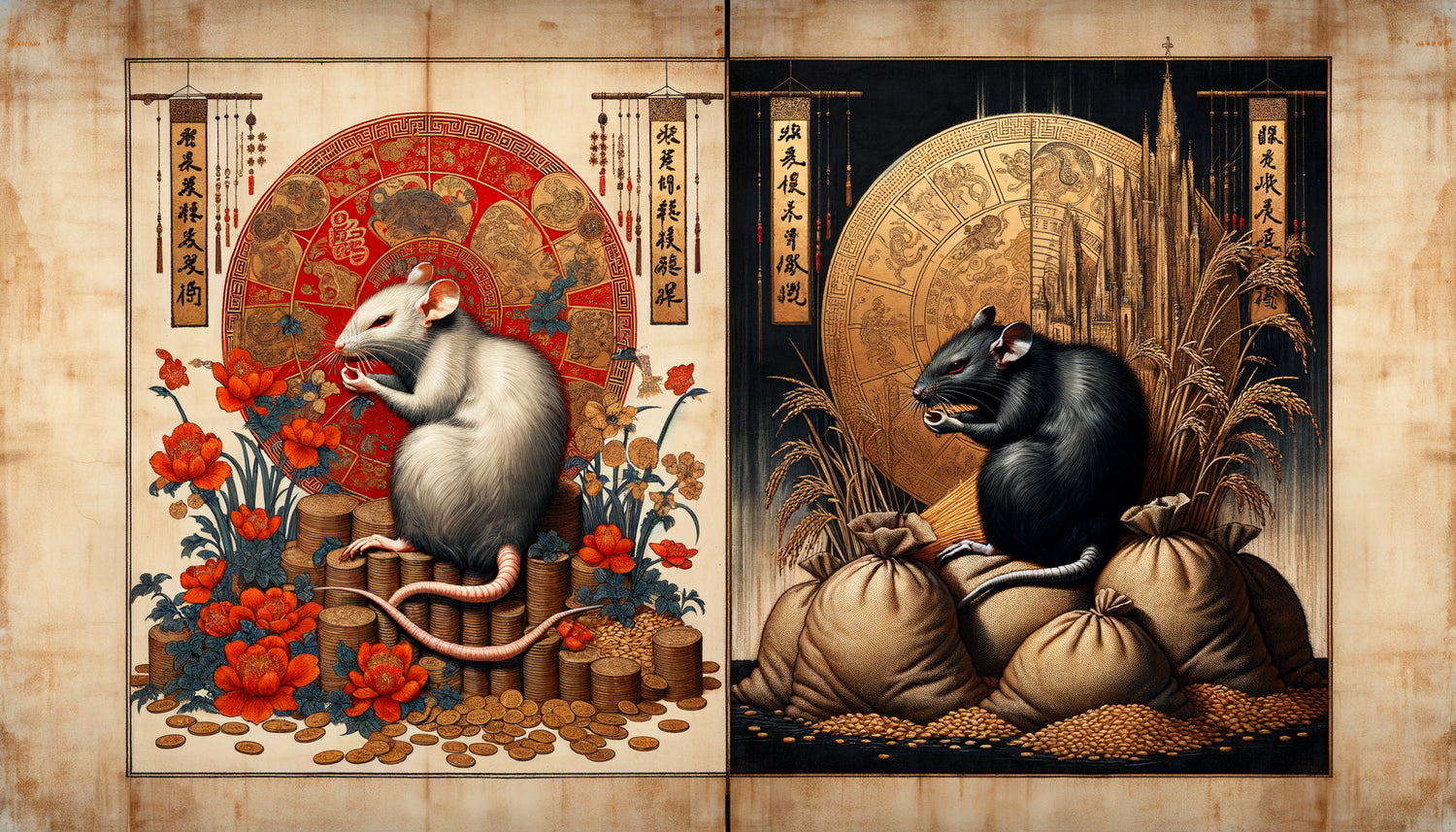
This clever trickery, far from being considered deception, is celebrated as proof of adaptability and quick wit. In traditional Chinese art, the rat appears frequently in auspicious paintings, particularly during Lunar New Year celebrations. Artists often depict it surrounded by sunflower seeds or coins, symbols of abundance and prosperity.
The symbolism of the rat in Chinese art is also enriched with practical considerations: an excellent reproducer, this animal embodies fertility and the multiplication of wealth. Chinese merchants were happy to hang representations of rats in their shops, convinced that they would attract fortune. On Ming and Qing porcelain, we find delicate scenes where the rat nibbles on ears of rice, a visual metaphor for well-stocked granaries and a generous harvest.
The aesthetics of positive representation
Painters of the Song dynasty developed a particularly refined approach to the rat. Their Chinese ink paintings depict creatures with delicate features, eyes sparkling with intelligence, captured in dynamic poses that evoke vital energy. This aestheticized representation contrasts sharply with European iconography of the same period. The Chinese rat is rendered with the same artistic attention as a phoenix or a dragon, proof of its elevated symbolic status.
The Shadow of Cathedrals: The Medieval Rat as Embodiment of Evil
Let us now cross borders to discover a completely different reality. In medieval European art, the symbolism of the rat takes on a dark, almost apocalyptic dimension. Far from representing prosperity, it becomes the emblem of spiritual corruption, sin and destruction.
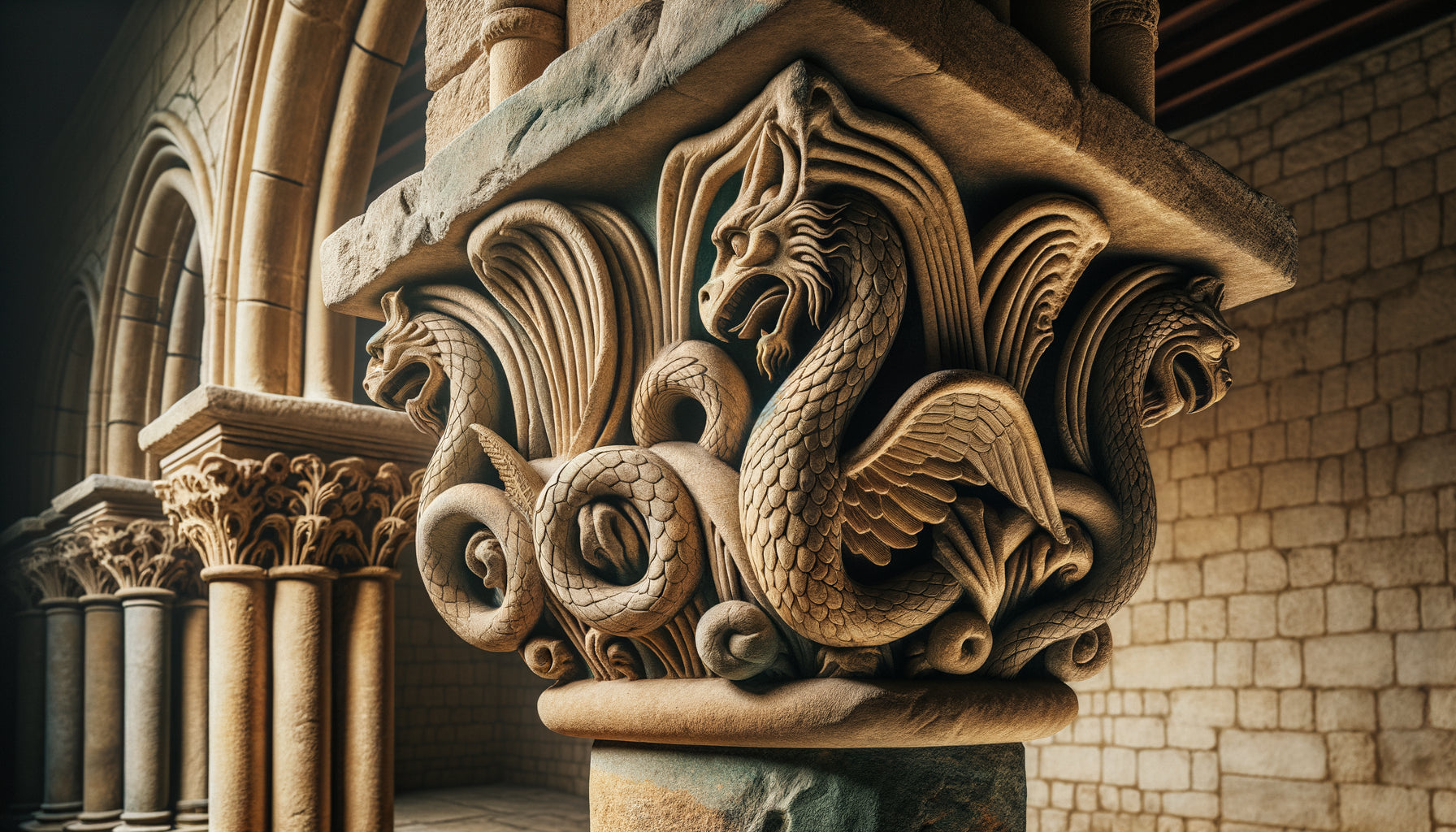
On Romanesque capitals and Gothic misericords, the rat frequently appears in moralizing scenes. Medieval sculptors depict it gnawing at the foundations of buildings, a visual metaphor for sin undermining the Christian soul. In illuminated manuscripts, the rat figures among creatures associated with demons and dark forces, participating in this characteristic moral zoology of the time.
This negative reputation is rooted in several historical realities. The rat is associated with epidemics, particularly the Black Death that ravaged Europe in the 14th century. Although the bacteriological link was not established until centuries later, the symbolic association between the rodent and death is deeply ingrained in the collective imagination. Artists of the Middle Ages translate this fear by depicting rats devouring crops, contaminating grain reserves, embodying the constant threat of famine.
The Moralized Bestiary and Its Visual Codes
In medieval bestiaries, these manuscripts that compiled zoological knowledge by associating it with moral lessons, the rat systematically figures among impure creatures. Its prolificity is interpreted negatively as a manifestation of animal lust. Its nocturnal and subterranean habitat reinforces its association with spiritual darkness. Illuminators paint it with repulsive features, prominent teeth, shaggy fur, creating an aesthetic of disgust that absolutely contrasts with the elegance of Chinese representations.

Two cosmologies, two perspectives: understanding the symbolic gap
This radical opposition in the symbolism of the rat between Chinese art and medieval European art is no coincidence. It reveals profoundly different philosophical structures. Chinese thought, nourished by Taoism and Confucianism, values harmony with nature and recognizes the value of each creature in the cosmic balance. The rat, through its ingenuity and adaptability, embodies admired virtues.
Conversely, medieval European thought, dominated by a rigorous Christian theology, establishes a strict hierarchy between creatures. Animals are judged according to their usefulness to humans and their conformity to a divine order. The rat, perceived as harmful and parasitic, is relegated to the bottom of this scale, associated with evil forces.
This symbolic duality also questions our own contemporary perceptions. When you admire an animal art work, you inevitably project your own cultural baggage. Understanding these historical differences greatly enriches your reading of symbols and your appreciation of artistic representations, whether they are ancient or modern.
When Art Reveals the Values of a Civilization
The symbolism of the rat in these two artistic traditions functions as a cultural mirror. In China, the valorization of cunning intelligence, material prosperity and fertility is reflected in the positive representation of the animal. Art becomes a vector of blessing, a support for attracting celestial favors.
In medieval Europe, the obsession with moral purity, fear of corruption and distrust of the undomesticated natural world are translated into a repulsive iconography. Art fulfills a didactic function: it teaches the faithful which creatures to avoid, what sins to fight.
These opposing approaches beautifully illuminate the social function of art. More than a simple reproduction of reality, the artwork transmits values, shapes collective perceptions and perpetuates worldviews. The rat thus becomes a condensed symbol of entire philosophies, a crystallization point of the fundamental beliefs of a society.
The Persistent Influence in Contemporary Art
This historical duality continues to influence contemporary artists. Banksy, for example, frequently uses the rat in his work, playing precisely on this symbolic ambiguity inherited from it. In Western street art, the rat can alternately embody creative marginality or social critique, resonating with its medieval status as a creature of the margins.
At the same time, contemporary Asian artists reinterpret traditional zodiac motifs, creating works where the rat retains its positive connotations while dialoguing with modern aesthetics. This persistence demonstrates the strength of ancestral symbols and their ability to cross centuries while being renewed.
Let this symbolic richness inspire your interior
Discover our exclusive collection of animal paintings that celebrate the diversity of cultural representations and bring symbolic depth to your decor.

Integrate this knowledge into your artistic appreciation
Understanding the symbolism of the rat in Chinese art versus medieval European art radically transforms your perspective on animal art. From now on, when faced with a representation of a rodent, you will no longer see just an animal, but a condensed set of cultural values, a window open onto a specific worldview.
This reading grid applies far beyond the rat alone. Each animal has its own symbolic variations depending on cultures. The terrifying Western dragon contrasts with the benevolent Asian dragon. The owl, Greek wisdom, becomes a creature of ill omen in some European traditions. Developing this symbolic awareness immensely enriches your museum experience and your ability to choose works of art that carry meaning for your interior.
When you select an animal representation for your living space, ask yourself about its symbolic charge. Do you want to invoke prosperity in the Chinese manner? Do you prefer a more complex reading, playing on the ambiguity of symbols? This reflection transforms simple decoration into a conscious cultural act, an affirmation of your sensitivity to dialogues between civilizations.
Imagine your living room transformed by a work that tells this millennial story, that invites your guests to discover these fascinating symbolic divergences. Each glance cast upon the work becomes an opportunity for cultural sharing, a starting point for enriching conversations about the relativity of symbols and the beauty of the diversity of human interpretations.
The symbolism of the rat in these two great artistic traditions teaches us an essential lesson: no symbol is universal, no representation is neutral. Each image bears the imprint of the culture that produced it. By cultivating this awareness, you develop not only your aesthetic sensitivity, but also your understanding of the world in its magnificent complexity. And perhaps that is the most beautiful gift art can offer us: the ability to see beyond our own cultural certainties.