In my gallery specializing in pre-Columbian art, a question constantly arises before our Toltec pieces: 'But how do you know if it's a coyote or a dog?' This seemingly simple interrogation hides a fascinating artistic sophistication. The Toltec sculptors, these masters of stone and ceramics who dominated central Mexico between 900 and 1150 AD, had developed a visual language of remarkable precision to differentiate these two canids in their works.
Here's what this distinction brings: a deep understanding of Mesoamerican animal symbolism, an authentic appreciation of Toltec art, and the ability to decipher the spiritual messages engraved in stone.
For novice collectors as well as enlightened enthusiasts, this confusion between coyote and dog in Toltec sculptures is frustrating. One hesitates to acquire a piece for fear of being wrong about its meaning. Treasures are missed due to a lack of knowledge of how to read the clues left by the artists.
Rest assured: Toltec sculptors used precise visual codes, passed down from generation to generation. Once these reading keys are mastered, each sculpture reveals its identity with clarity.
I will reveal to you the secrets I have learned by studying hundreds of authentic pieces, so that you can instantly identify a coyote from a Toltec dog.
The morphology of the muzzle: the first sculptural clue
Toltec artists paid particular attention to the muzzle of their canine sculptures. This differentiation was not trivial: it reflected two radically different symbolic universes.
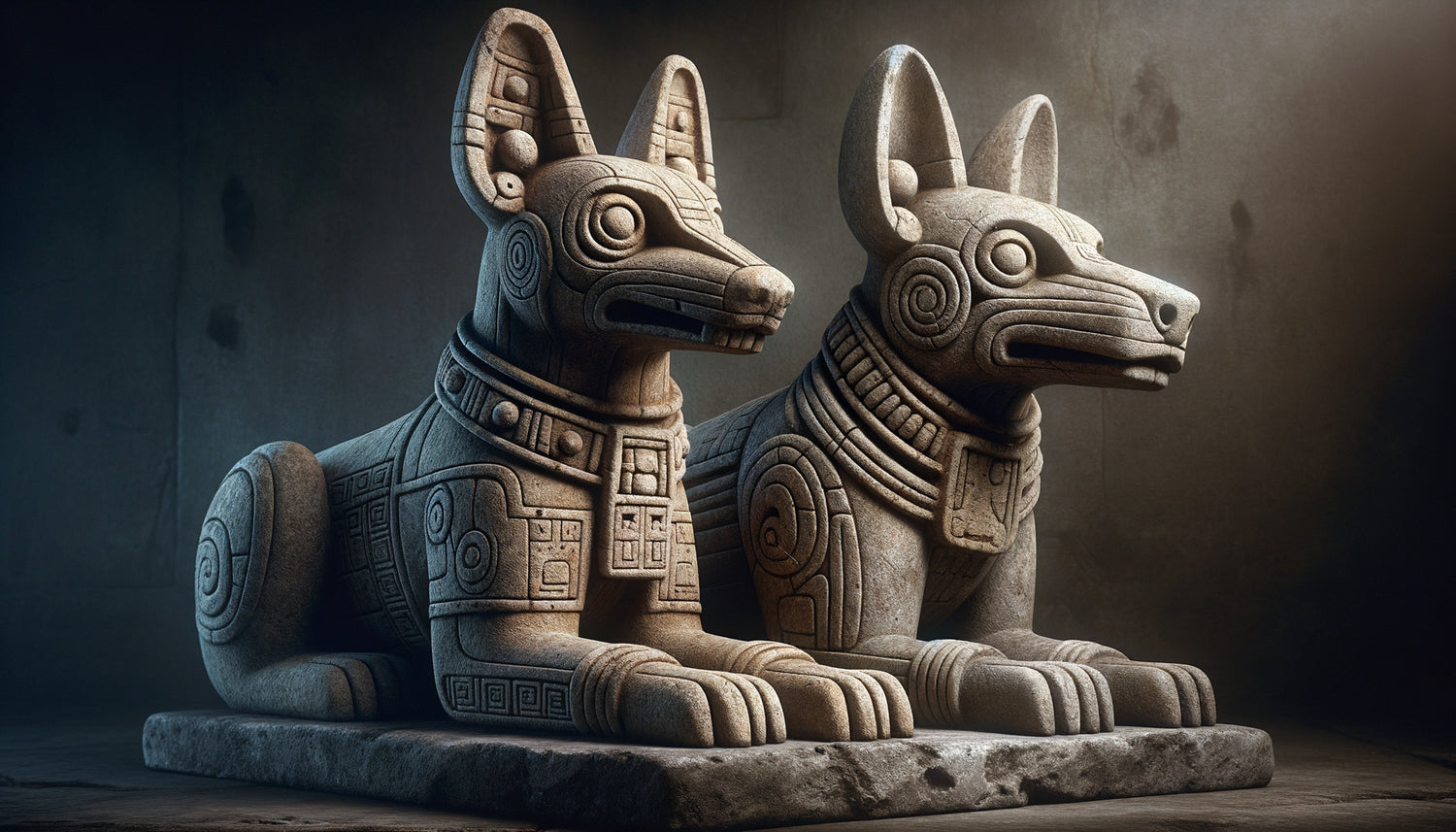
The Toltec coyote is immediately recognizable by its elongated, pointed muzzle. Sculptors deliberately exaggerated this characteristic to evoke the animal's cunning and sly intelligence. The profile of the coyote in sculptures presents a continuous line from the forehead to the tip of the nose, without a pronounced break. This linear elegance translated the wild and unpredictable nature of the animal.
Conversely, the domestic dog in Toltec art sports a shorter, more rounded muzzle. Artisans often created a slight depression between the forehead and the nose, giving the dog a softer, more domesticated appearance. This morphology reflected the role of the dog as a companion, spiritual guide to the underworld, and sometimes a source of sacred food.
I restored a magnificent Toltec ceramic where this distinction was striking: two canids side by side, one with a long, sharp muzzle (the hunting coyote), the other with a stocky muzzle (the guardian dog). The anatomical precision was astonishing.
Erect ears: symbols of differentiated vigilance
The orientation and shape of the ears in Toltec sculptures constitute a major identity marker between coyote and dog.
The coyote is distinguished by unusually large ears, standing vertically and slightly tilted forward. Toltec sculptors amplified this proportion to emphasize the coyote's supernatural vigilance, its connection to nocturnal forces, and its ability to hear the messages of the gods. These oversized ears create a characteristic triangular silhouette, recognizable even on fragments of sculpture.
The Toltec dog, on the other hand, has more modest ears, sometimes semi-erect or even drooping depending on the breed depicted. Artists knew that Mesoamerican dogs, including the techichi and the xoloitzcuintle, had varying ear shapes. This morphological diversity in canine representations is a testament to the sculptors' meticulous observation.
The sacred angle of the ears
A fascinating detail: the opening angle between the two ears typically measures 45 to 60 degrees for Toltec coyotes, compared to 60 to 90 degrees for dogs. This sacred geometry was never left to chance in Mesoamerican art.

The sculpted tail: body language frozen in stone
The representation of the tail is perhaps the most revealing clue to differentiate a coyote from a dog in Toltec art.
The coyote invariably has a drooping and bushy tail, often sculpted with a slight downward movement. Artists sometimes engraved fine lines to suggest the thickness of the fur. This low tail evokes the coyote's wary nature, always on its guard. In some exceptional pieces, the coyote's tail curls slightly at the end, an anatomical detail observed in real coyotes at rest.
The Toltec dog, conversely, frequently sports a raised or curled tail. This posture testifies to confidence, domestication, and the animal's protective role. Xoloitzcuintles dogs, particularly revered by the Toltecs, are often depicted with a thin, straight tail, reflecting their actual morphology.
During an acquisition for an American collector, I authenticated a basalt sculpture where the canine’s tail was broken. Fortunately, other morphological characteristics - elongated muzzle, oversized ears, tense posture - unequivocally confirmed that it was a coyote.
Body language: wild postures versus domestication
Beyond anatomical details, the general posture of the sculptures reveals the very essence of each animal.
The Tolttec coyotes are depicted in dynamic positions evoking movement: head turned to the side in a listening position, body slightly contracted as if ready to pounce, paws positioned asymmetrically suggesting walking or running. This bodily tension conveys the coyote's unpredictable nature, its role as a trickster in Mesoamerican mythology.
The sculpted dogs generally adopt more static and reassuring postures: sitting on their haunches, lying in a sphinx-like position, or standing in a calm and symmetrical attitude. This stability reflects their role as loyal companions, psychopomps guiding souls to Mictlan, the underworld.
The head raised towards the cosmos
A powerful symbolic detail: Toltec coyotes often lift their muzzles to the sky, evoking their nocturnal howling and their connection with celestial deities. Dogs tend to look more forward or down, at the earthly and subterranean world they inhabit.

The symbolic attributes: collars, ornaments and ritual context
The decorative elements added to the sculptures provide valuable contextual clues for identification.
Domesticated Toltec dogs frequently wear sculpted collars, pendants or body ornaments. These adornments signal their status as tamed animals, their ritual value and their belonging to the human sphere. Some sculptures show dogs with bells engraved around their necks, a detail documented by Spanish chroniclers concerning sacrificial dogs.
Coyotes, creatures of the wild par excellence, always appear nude in Toltec art, without any artificial ornamentation. This sculptural nudity emphasizes their untamed nature, their belonging to cosmic chaos rather than civilized order.
The archaeological context of discovery often reinforces this distinction: dog sculptures come mainly from funerary contexts (accompanying the deceased), while coyote representations emerge more from ritual areas linked to warrior cults and nocturnal deities.
The texture of the fur: revealing surface techniques
The surface treatment techniques employed by Toltec sculptors differed subtly between coyotes and dogs.
To represent the coyote’s thick fur, artisans used fine, multidirectional incisions, creating a rough texture suggesting the density of wild fur. On ceramics, this texture was sometimes achieved by impressing textiles or plant fibers before firing, giving a naturally shaggy appearance.
The dog's fur, particularly that of xoloitzcuintles often glabrous, was rendered with smooth and polished surfaces. Even for dogs with hair, the surface treatment remained more uniform, more controlled, reflecting domestic order against wild disorder.
This technical distinction, subtle but constant, testifies to the sophistication of naturalistic observation among the Toltecs, a people often wrongly reduced to their martial prowess.
Capture the mystical spirit of ancestral canids in your interior
Discover our exclusive collection of animal paintings that celebrates the symbolic power of wild and domestic creatures across civilizations.
When distinction becomes a collecting art
Today, understanding these sculptural differences between coyotes and Toltec dogs transforms your view of pre-Columbian art. Each piece you observe - in a museum, gallery or private collection - now reveals its true identity.
This knowledge goes beyond simple intellectual curiosity. It opens the door to a profound appreciation of the Mesoamerican worldview, where every morphological detail carried a cosmological message. The coyote embodied creative chaos, divine trickery, necessary transgression. The dog represented loyalty, the passage between worlds, the consented sacrifice.
By refining your eye to the nuances of the elongated muzzle against the short muzzle, oversized ears against modest ears, drooping tail against raised tail, you become a guardian of ancestral knowledge. You join the lineage of those who know how to read stone as others read books.
Start by carefully observing photographic reproductions of authentic Toltec sculptures. Train your eye to spot these distinctive markers. Then, on your next visit to a museum or specialized gallery, test your newly acquired knowledge. You will be surprised at how much these differences, now obvious, had escaped you before.
Frequently asked questions about coyote-dog differentiation in Toltec art
Did the Toltecs represent other canids than coyotes and dogs?
Excellent question for attentive collectors. The Toltecs focused primarily on these two canids due to their symbolic importance and cultural proximity. Coyotes and dogs occupied central places in their worldview: the former as a divine manifestation and agent of creative chaos, the latter as a funerary companion and spiritual guide. Occasionally, representations of wolves are found, but they remain exceptional and geographically limited to mountainous areas where these animals were observed. The distinction between wolf and coyote in Toltec art lies in size: wolves are sculpted with more massive proportions and more developed musculature. However, the vast majority of Toltec canine sculptures depict either wild coyotes or domestic dogs, reflecting the fundamental dichotomy between wilderness and domesticated culture that structured their thinking.
How to authenticate a Toltec sculpture depicting a canid?
Authentication represents the major challenge for any collector of pre-Columbian art, and I constantly remind this in my gallery. Beyond identifying the type of canid (coyote or dog), several criteria allow authenticating a genuine Toltec piece. First examine the material: the Toltecs mainly used basalt, obsidian, ceramics and sometimes jade for their animal sculptures. The patina should be consistent and deep, resulting from centuries of burial or exposure. Do the tool marks correspond to the techniques available between 900 and 1150 AD? Modern counterfeiters often leave anachronistic metallic tool marks. Always consult a certified expert and require a thermoluminescence analysis for ceramics or documented provenance. Beware of pieces that are too perfect: the wear of time leaves authentic traces that no reproduction can truly imitate. A serious dealer will provide you with a certificate of authenticity, property history and legal export permits.
What is the symbolic value of the coyote versus the dog in Toltec culture?
This question touches on the heart of Mesoamerican spirituality that I find fascinating from my beginnings in pre-Columbian art. The coyote embodied divine ambiguity: creator and destroyer, wise and mad, benefactor and thief. He was associated with dance, music, and transgression of social norms. Several Toltec deities presented coyote attributes, notably in their warrior and nocturnal aspects. The coyote represented absolute freedom, cosmic unpredictability, and the cunning necessary for survival. The dog, on the other hand, symbolized loyalty until death - literally, since dogs were sacrificed at funerals to accompany their master to the underworld. The dog guided souls through the nine levels of Mictlan, the underground world. It also represented sacred food during certain rituals, creating an intimate link between sacrifice, nutrition and spirituality. This coyote-dog duality reflected the Toltec balance between chaos and order, wild nature and civilization, divine transgression and sacred duty.