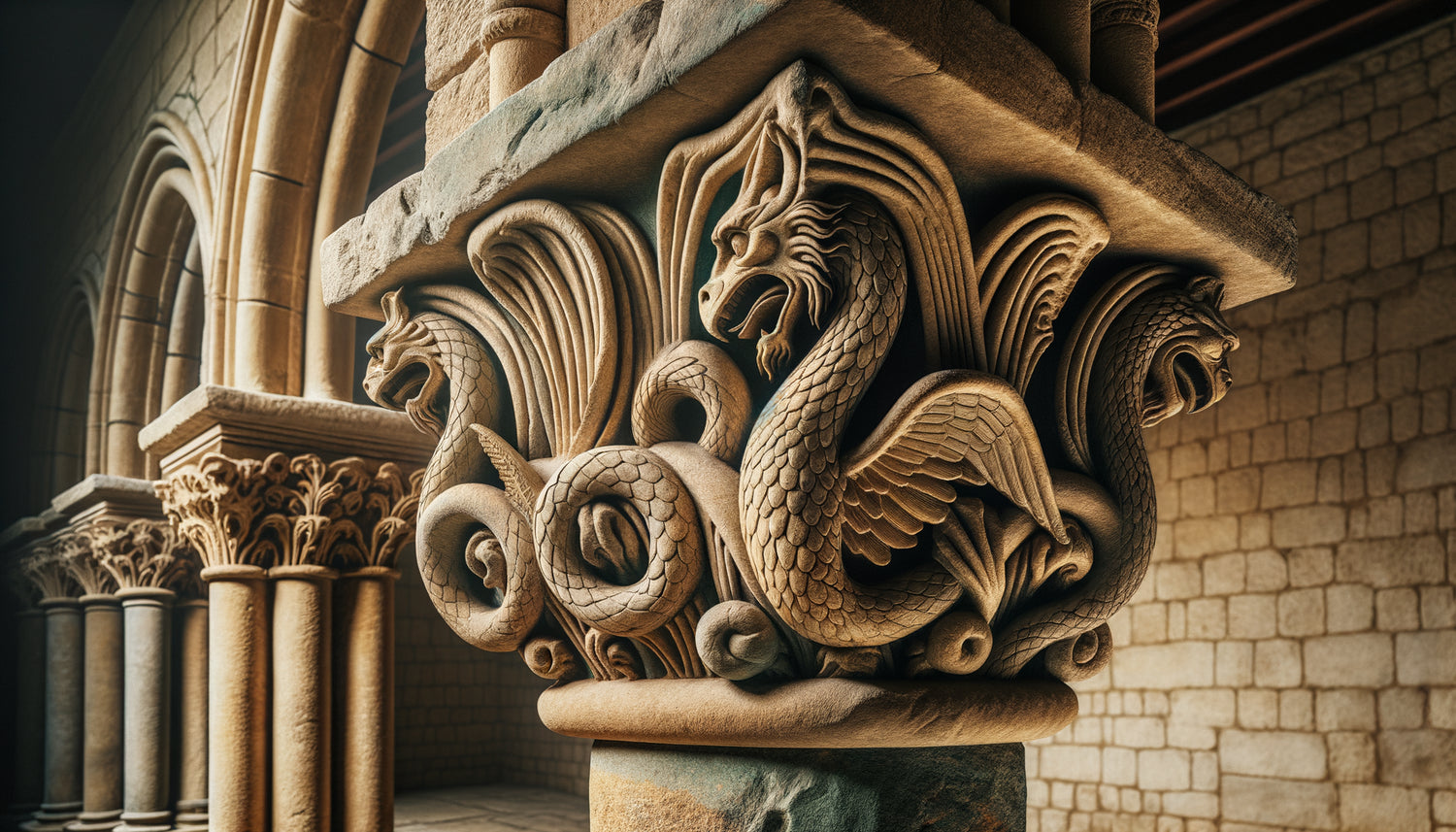
In the dimness of a Romanesque church, look up. There, perched on the capitals crowning the columns, you will discover an astonishing bestiary: winged dragons, double-tailed mermaids, menacing griffins, hybrid centaurs. These fantastic creatures sculpted in stone in the 11th and 12th centuries continue to fascinate as much as they question. Why did our medieval ancestors populate their places of worship with such strange monsters?
Here's what these fantastic animals from Romanesque capitals reveal: a universal sculptural language to transmit faith, a sublime decorative aesthetic that transcends the centuries, and a fascinating bridge between sacred and profane that still inspires our contemporary decoration.
You visit an abbey and remain perplexed by these enigmatic sculptures. Are they mere ornaments, or do they carry a profound spiritual message? This question has divided historians and enthusiasts for generations. The reality? It is much richer and more nuanced than this binary debate.
Rest assured: understanding these historicized capitals does not require a degree in art history. You just need to learn to decode their visual language, the very one that spoke to the illiterate faithful of the Middle Ages. And this understanding will enrich your view of art, but also your approach to symbolic decoration in your own interior.
I invite you on a journey to the heart of these stone sanctuaries, to unravel fact from fiction and discover how these millennial sculptures can still nourish our decorative imagination today.
When stone becomes pedagogy: the sculpted bible of the illiterate
In the 12th century, nearly 90% of the population could neither read nor write. Faced with this reality, the Church developed a system of visual transmission of remarkable effectiveness: Romanesque architecture became a giant picture book. The capitals, these architectural elements located at the top of the columns, become privileged educational supports.
Fantastic animals play a central role in this Biblia pauperum (Bible of the Poor). The dragon embodies the devil and earthly temptations. The mermaid symbolizes deceptive seduction that turns the soul away from the divine path. The griffin, half-eagle half-lion, represents either Christ in his double divine and terrestrial nature, or evil forces depending on its sculptural context.
At Vézelay Abbey, the Romanesque capitals masterfully illustrate this didactic function. One capital shows a man with donkey's ears: allegory of stupidity and intellectual pride. Another depicts chained monkeys: metaphor for sins that enslave the human soul. Each sculpture constitutes a silent but eloquent sermon.
The medieval moral bestiary
Romanesque sculptors draw on several sources to compile their bestiary: biblical texts of course, but also the *Physiologus*, a famous allegorical bestiary from the 2nd century, and local folklore traditions. This combination creates a complex symbolic language where each creature possesses a precise moral meaning.
The lion, king of animals, represents the resurrection of Christ (since it was believed that lion cubs were born dead and came back to life after three days). The pelican who tears its breast to feed its young with its blood symbolizes the christ sacrifice. These animal representations, real or fantastic, form a coherent system of theological transmission adapted to an illiterate public.
The argument of pure decoration: an aesthetics of wonder
However, reducing these sculptures to a solely pedagogical function would be an error. Many Romanesque capitals present scenes whose symbolic interpretation remains debated, or even impossible. Some animal motifs seem to relate more to decorative inventiveness than to moral lessons.
At the church of Saint-Pierre in Chauvigny, a capital shows hybrid creatures intertwined in a purely ornamental composition. No obvious religious message, just a celebration of sculptural virtuosity and aesthetic pleasure. This decorative dimension responds to a profound medieval aspiration: to embellish the house of God to magnify his glory.
Saint Bernard of Clairvaux himself, in the 12th century, strongly criticized these decorative excesses in his famous *Apology*: 'What are these ridiculous monsters, these deformed beauties or these beautiful deformities doing in the cloisters, before the eyes of brothers who read?' This diatribe paradoxically testifies to the extent of the phenomenon: fantastic animals were indeed invading Romanesque buildings, sometimes beyond any theological justification.
The creative freedom of Romanesque imagiers
Medieval sculptors, called imagiers, had a considerable margin of artistic freedom. Mostly anonymous, they let their imagination run wild in the less visible areas of the church. The capitals of crypts or ambulatories often present the most daring and fanciful compositions.
This playful dimension transpires in some details: one sculptor slips a grimacing self-portrait as a monkey, another hides a laughing face in a vegetal intertwining. These winks prove that the stakes were not always theological, but also aesthetic and personal. Romanesque art thus reconciles faith and creativity, message and beauty.

The complex truth: symbolism AND decoration intertwined
So, a bible for the illiterate or pure decoration? The honest answer: both, in varying proportions depending on the buildings, commissioners, sculptors and even the precise location of the capital within the church.
Choir capitals, the most sacred area, generally display strictly religious iconography: biblical scenes, figures of saints, Christological symbols. Fantastic animals appear there within a clearly defined narrative or symbolic framework. Conversely, capitals in the nave or side aisles allow more room for decorative inventiveness and more enigmatic creatures.
This spatial hierarchy reveals a sophisticated medieval thought that distinguishes several levels of sacredness. Fantastic bestiaries serve as a transition between the exterior profane world and the interior sanctuary, creating a liminal space where the marvelous coexists with the sacred without competing.
Local context shapes interpretation
Each region develops its own sculptural traditions. In Burgundy, historicized capitals prioritize complex narrative scenes with a strong pedagogical dimension. In Auvergne, the repertoire of fantastic animals is more restrained, more geometric. In southwestern France, Islamic influence via Spain introduces oriental motifs where the ornamental dimension prevails.
The status of the building also plays a role: an urban cathedral, under strict episcopal control, generally presents a more orthodox iconography than a small rural church where the local sculptor has more freedom. Understanding these creation contexts allows us to refine our reading of each capital.
From Roman capitals to your decoration: contemporary heritage
Today, these medieval fantastic animals continue to inspire designers, decorators and art lovers. Their symbolic power combined with their timeless aesthetics offers endless decorative resources for our contemporary interiors.
The Roman bestiary recalls an essential truth in decoration: a decorative element gains depth when it tells a story. Rather than purely aesthetic objects, prioritize pieces charged with symbolism, even personal. This approach transforms your interior into a narrative space, just as Romanesque churches transformed stone into storytelling.
Animal motifs, real or imaginary, also create powerful visual focal points. A artwork depicting a griffin or dragon in a modern living room generates the same fascination as a Roman tent: it captures the eye, sparks curiosity, invites contemplation. This decorative function paradoxically joins the medieval pedagogical dimension: the work becomes support for conversation and transmission.
Reinterpreting Roman codes in a contemporary interior
How to transpose this richness into your decoration? Several avenues are open to you. Opt for stylized animal representations that evoke the medieval aesthetic without slavishly copying it. Favor stone, ocher, deep blue hues that recall Roman pigments. Play on contrasts between clean and ornate, just as Roman churches alternate bare surfaces with richly sculpted capitals.
The symbolic approach can also guide your choices: select animals carrying values that speak to you. The lion for courage, the phoenix for rebirth, the deer for spiritual quest. This semantic dimension enriches your relationship with your decoration, transforming your interior into a reflection of your personal and symbolic universe.
Invite the magic of medieval bestiary into your home
Discover our exclusive collection of animal artworks that capture the symbolic and aesthetic power of fantastic creatures, to transform your walls into true contemporary chapels.

The gaze that transforms stone into narrative
At the end of this journey through the heights of Romanesque churches, a certainty emerges: opposing symbolism and decoration in the analysis of Roman capitals is a false debate. These sculptures rather embody a sophisticated medieval vision where beauty and meaning reinforce each other.
The fantastic animals that populate these capitals were indeed intended to instruct illiterate faithful, but they also satisfied a deep aesthetic need: to create sacred spaces worthy of the majesty of God. Pedagogy and splendor are not mutually exclusive; they dialogue in harmony which is the genius of Roman art.
For you, art and decoration enthusiasts, this medieval lesson remains strikingly relevant: the most beautiful interiors are those that tell a story while enchanting the eye. Visit a Romanesque church near you, look up at these millennial capitals, and be inspired by this masterful alliance of meaning and form.
Then, back home, look at your walls with new eyes: what creatures, what symbols, what stories would deserve to find their place there?
Frequently Asked Questions about Roman Fantastic Creatures
Why are frightening creatures found in churches?
The fantastic animals of Romanesque churches primarily served to materialize abstract concepts of good and evil for a largely illiterate population. Frightening creatures represented the vices, temptations, and demons that the faithful had to spiritually combat. Their presence in sacred space constantly recalled the struggle between divine and infernal forces. But beyond this educational function, these sculptures also testified to a rich medieval imagination where the marvelous and the monstrous naturally belonged to the worldview. The church thus became a microcosm representing the entire creation, from the most sublime to the most terrifying, under the protective gaze of God.
How can you recognize a capital with symbolic function from a purely decorative capital?
The distinction is not always obvious, even for specialists! A few clues can guide you: a symbolic capital generally presents identifiable narrative scenes (battle between good and evil, biblical episode, personified vice) or animals from the classic Christian bestiary (lion, lamb, dragon). A more decorative capital favors repetitive motifs, complex interlacing, hybrid creatures with no clear reference to a sacred text. Location also counts: the closer you get to the choir, the more symbolic the dimension becomes. But keep in mind that this border remains porous: a single Romanesque capital can combine formal beauty and spiritual message. It is precisely this ambiguity that makes up the richness of Roman art.
Can we be inspired by Roman capitals to decorate a modern interior?
Absolutely, and it’s even a particularly fertile source of inspiration! The approach isn't to literally reproduce medieval sculptures, but to capture their spirit: combine aesthetics and symbolism, create visually striking focal points full of meaning, dare stylized animal representations. Specifically, you can integrate paintings or engravings depicting fantastic creatures in a refined contemporary style, play with color palettes inspired by Romanesque pigments (ochres, deep blues, dark greens), or collect decorative objects that each tell a story. The legacy of Romanesque capitals teaches us that an interior gains depth when each decorative element becomes a carrier of narrative and emotion, transforming your living space into a place that is both beautiful and meaningful.