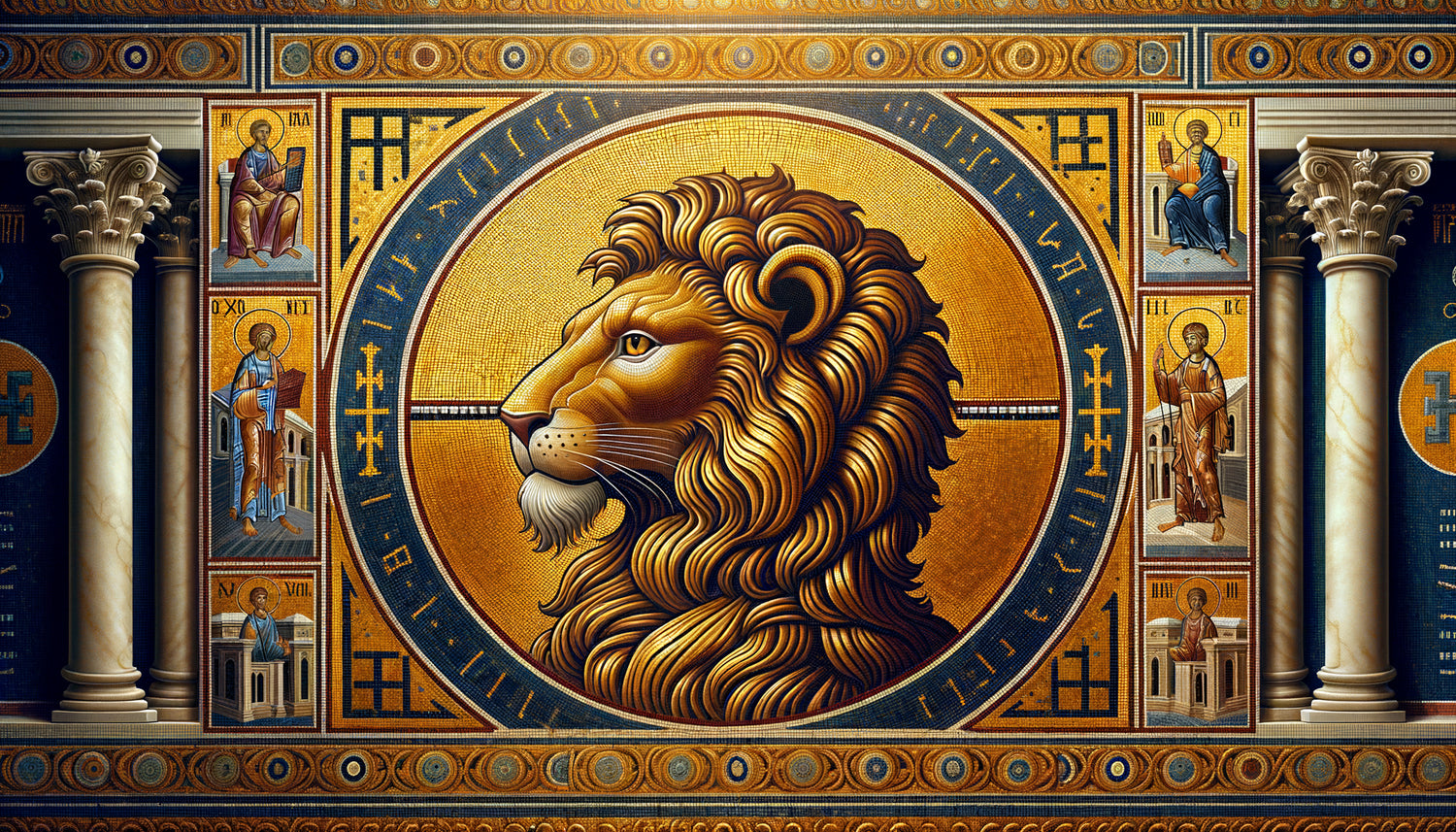
The first time I restored a Byzantine mosaic in a chapel in Ravenna, I spent hours recomposing, tessera by tessera, the gaze of a golden lion. Its emerald eyes fixed me with a disturbing intensity. It wasn't just a decorative feline: it was a guardian, a symbol, a theology crystallized in stone and glass.
Here is what the lion in Byzantine mosaics reveals: a protective power that links the earthly to the divine, a representation of the resurrected Christ, and a symbolic language that transforms sacred architecture into visual catechesis. These majestic creatures adorn basilicas from Constantinople to Venice, carrying messages that our ancestors deciphered instantly.
You may admire these mosaics in art books or during travels, but their profound meaning eludes you. Byzantine symbols speak a forgotten language, that of an era when every color, every animal, every position had a precise theological scope.
Yet, understanding these codes does not require years of study in iconography. Byzantine artisans created to be understood, even by illiterate faithful. Their lions tell universal stories of protection, resurrection and divine majesty that still resonate today.
Let me guide you into the fascinating universe of these golden felines who have been watching over our churches and imaginations for fifteen centuries.
The lion as an incarnation of divine power
In the Byzantine imagination, the lion first embodies the majesty of Christ. This association dates back to biblical texts, notably the Book of Revelation which names Jesus the 'Lion of the tribe of Judah'. Byzantine mosaicists translated this metaphor into gold and lapis lazuli, creating felines haloed with manes that shone like a sun.
In Hagia Sophia in Constantinople, before its transformation into a mosque, lions adorned the pendentives and arches, strategically positioned to signify the Christ's dominion over creation. Their gaze always directed towards the altar, guiding the eye of the faithful towards the focal point of the liturgy.
This symbolism is found in the mosaics of Saint Mark’s Basilica in Venice, where the winged lion of the evangelist Mark dialogues with other tetramorphic creatures. Here, the feline represents not only power, but also the announcement of the resurrection, because according to a medieval legend, the lion cubs were born dead and resurrected on the third day thanks to the breath of their father.
Guardians of thresholds and protectors of souls
During my restorations in Sicily, I discovered that Byzantine lions always occupied liminal positions: at entrances, passages between nave and choir, symbolic thresholds. This arrangement was never random.
The lions functioned as spiritual guardians, protecting the sacred space from evil forces. In the cathedral of Monreale, they frame the portals with perfect symmetry, their paws resting on twisted columns, embodying stability in the face of the chaos of the profane world.
This protective function was also expressed in the tesserae used: the gold backgrounds represented divine light, while the lions themselves were often composed of semi-precious stones with apotropaic virtues. Red jasper for strength, green malachite for hope, ochre for sanctified earth.
The technique of animated tesserae
Byzantine mosaicists mastered a subtle art: the variable inclination of the tesserae. When restoring these works, I understood that the lions seemed to move with the light. Their manes rippled as worshippers moved through the nave, creating an impression of miraculous life that reinforced their protective power.

The lions and the Byzantine light liturgy
The Byzantine liturgy is a symphony of light, and the lion mosaics play their part in it. In churches like Sant'Apollinare in Classe in Ravenna, I observed that the golden felines capture the light from the candelabras and reflect it towards the worshippers.
This interaction was not accidental. Architects precisely calculated the angle of the windows so that, at key liturgical moments – Epiphany, Easter, Transfiguration – sunbeams specifically illuminated the lions. The feline became ablaze, a visible manifestation of divine presence.
In some mosaics, the lions hold phylacteries with Greek inscriptions. These texts, often Psalms, create a dialogue between image and word, the two pillars of Byzantine theology. The lion does not roar: it proclaims the Good News.
Decoding the attributes: mane, posture and gaze
Every detail in a Byzantine mosaic carries meaning. The lion's mane, when forming seven distinct rays, evokes the seven gifts of the Holy Spirit. When it spreads like sunshine, it signifies Christ’s royalty.
Posture also reveals subtle theological nuances:
The lion lying down symbolizes peaceful vigilance, that of Christ who watches over his Church so that the forces of evil cannot surprise him. These representations often adorn areas near the altar.
The standing lion, front paws resting on a sphere or book, embodies Christ’s dominion over the cosmos and his word which governs the universe. These compositions are found in the apses, at the culminating point of the spatial hierarchy.
The Roaring Lion, with its open mouth, does not threaten: it announces resurrection, as explained by patristic texts. Its breath awakens the dead, foreshadowing the Last Judgment.
The gaze that pierces the centuries
The eyes of Byzantine lions are never realistic. Enlarged and frontal, they fix the viewer with an hypnotic intensity. This stylistic convention creates a direct relationship between the symbol and the faithful: you do not observe the lion, it is he who observes you, who judges you, who protects you.

The contemporary legacy of Byzantine lions
These millennial felines continue to inspire creators and collectors. In the restoration workshops where I worked, we regularly receive requests for reproductions of Byzantine motifs for contemporary interiors. The timeless power of these symbols transcends eras.
Interior designers are now integrating elements inspired by Byzantine mosaics: gilded wallpapers with stylized lions, luminaires whose shadows project feline silhouettes, textiles echoing the color palettes of Ravenna. This aesthetic brings a profound symbolic depth that contemporary design often seeks.
Even in urban art, this influence is found: in Thessaloniki, I photographed murals where golden lions dialogue with the modern city, creating a bridge between Byzantine heritage and contemporary expression.
The Byzantine lion still inspires our interiors and imaginations
Discover our exclusive collection of animal paintings that captures the timeless majesty of animal symbols and transforms your spaces into galleries of meaning.
Integrating the symbolism of the Byzantine lion at home
You don't need to transform your living room into a basilica to benefit from this symbolic richness. A few principles are enough to capture the spirit of these mosaics.
Favor warm and deep hues: ochre, vermilion, emerald green, lapis blue. These colors immediately create an atmosphere of majestic contemplation. A simple cushion adorned with a stylized lion motif can become the focal point of a space.
Play with directional lighting. The Byzantines were masters of dramatic lighting. Install light sources that create zones of shadow and clarity, making your decorative objects converse with the space, as mosaics conversed with liturgy.
Finally, look for reproductions or contemporary creations that respect the characteristic frontalism of Byzantine art. This direct face-to-face with the symbol creates a presence that transforms decoration into an experience.
When stone tells of eternity
Standing before these mosaics, in the oblique light of a Roman afternoon, I have often felt this truth: Byzantine artisans did not create for beauty alone, but for the eternity of meaning. Their lions cross the centuries without losing their power of evocation.
Each tessera placed was a prayer, each lion a concentrated theology, each golden gaze a promise of protection. Understanding these symbols is to access a universal language where the animal becomes a bridge between earth and sky, between you and infinity.
Let these golden lions enter your life, even through an image, an object, a color. Their millennial majesty has not finished inspiring us, protecting us, raising us towards the light they have captured and reflected for fifteen centuries.