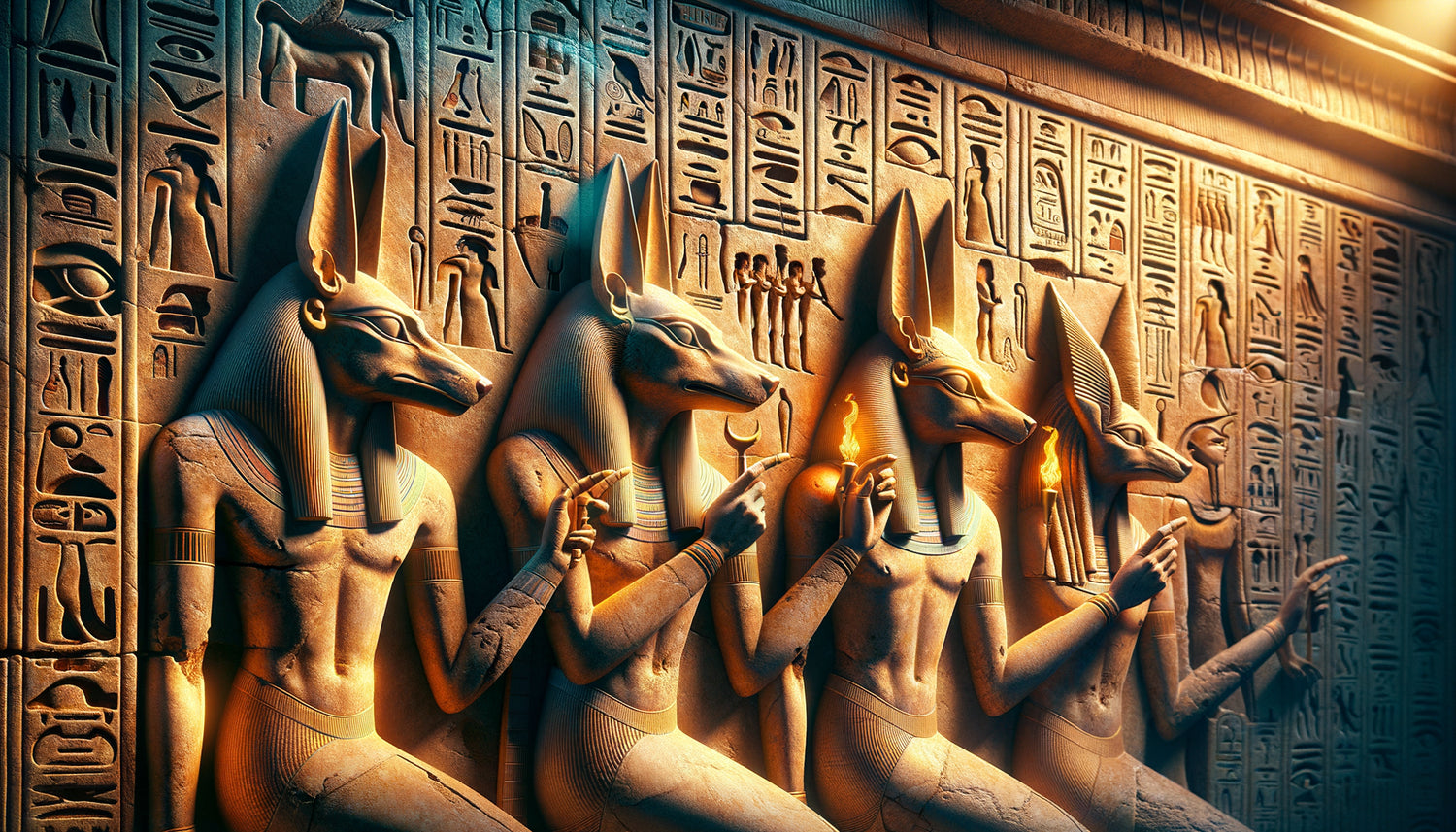
I spent three years in Cairo restoring Ptolemaic frescoes, and each morning, entering these millennial tombs, the same question seized me: why these impossible faces? A man with a jackal muzzle, a woman crowned with cow horns, a god with a falcon's head staring into eternity. These representations were not mere decorative ornaments, but a visual language of dizzying sophistication.
Here is what these hybrid deities reveal: a conception of the sacred where the animal embodies cosmic powers, a symbolic system that transforms each wall into theological text, and an aesthetic that still inspires our contemporary relationship to spiritual iconography.
Many think that these representations belong to primitive superstition, a people incapable of conceiving abstraction. This condescending reading completely misses the depth of Egyptian philosophy. For far from being naive, these animal-headed images constitute one of the most elaborate symbolic systems in antiquity.
Let me guide you behind the scenes of this sacred iconography, where each animal form tells a story of power, cosmos and invisible. You will discover that these walls covered with hybrid deities still speak to our modern imagination.
The Animal as Alphabet of the Divine
Egyptians did not represent gods disguised as animals. They visualized divine qualities through the natural attributes observed in the animal world. When you contemplate Anubis with his jackal head, you do not see a god who resembles a jackal, but a divinity whose function – guardian of the necropolis – is perfectly embodied in this animal that prowls cemeteries at dusk.
This symbolic logic creates a visual lexicon of remarkable effectiveness. The falcon for Horus evokes piercing vision, the ability to see from celestial heights. The lioness for Sekhmet manifests destructive and protective power simultaneously. The hippopotamus for Taouret symbolizes maternal ferocity that protects births.
In the temples I restored, each animal-headed deity functioned as a sacred ideogram – an image immediately readable that condensed complex theological concepts. For a people where hieroglyphic writing already mixed images and sounds, this approach was perfectly consistent.
When Form Reveals Cosmic Function
Thoth appears with an ibis head, this wading bird with a long curved beak. Why? Because the ibis probes the mud of the Nile to extract its food, just as Thoth, god of wisdom, probes mysteries to extract knowledge. The parallel is not arbitrary: it reveals a careful observation of animal behavior reinterpreted as divine metaphor.
Sobek bears a crocodile head not by chance, but because this predator of the Nile embodies the ambivalent power of waters – creators and destroyers. Egyptians had understood that the crocodile, like the river itself, could give life through its fertilizing floods or take it through devastating overflows.
This form-function correspondence created a system where the iconography itself carried theological meaning. No need for lengthy explanatory texts: the animal head was the explanation.
The human body, signature of divine intelligence
But why did these deities retain a human body? This hybridization was not an awkward compromise but a precise theological affirmation: the gods possessed the intelligence, capacity for action and consciousness inherent in humanity, enriched by the specific powers of the animal world.
The human body signaled that these entities could speak, act, judge – functions impossible for a simple animal. This combination created a unique ontological category: neither human nor animal, but divine.

Walls as a theater of the invisible
In Egyptian temples, walls were not decorative surfaces but interfaces between the visible and the invisible. Each representation of an animal-headed deity activated a presence, creating a point of contact between the earthly world and cosmic forces.
I restored frescoes in the temple of Kom Ombo where Sobek and Horus face each other in perfect symmetry. This arrangement was not aesthetic but functional: it materialized the balance of forces, the necessary coexistence of opposing powers. The walls became theological diagrams in color.
The colors themselves carried codified meanings. Anubis's black evoked fertile land and regeneration. Seth’s red manifested chaos and desert. Each fresco was a polysemic text where form, color and position created layers of meaning.
The divine procession as an architectural narrative
Walking through the corridors of Karnak, you literally traverse a theological narrative. The animal-headed deities succeed each other in a precise order, telling about cosmic cycles, founding myths and divine genealogies. Architecture becomes a book that is deciphered while walking.
A legacy that transcends the millennia
This iconography of animal-headed deities has profoundly marked the Mediterranean imagination. The Greeks adopted and adapted some of these representations – think of Anubis becoming Hermanubis in Ptolemaic Egypt. Early Egyptian Christians sometimes depicted Saint Christopher with a dog's head, prolonging this tradition of sacred hybridization.
Even today, this aesthetic fascinates. I see it in contemporary art collections where human-animal hybrid figures are experiencing a spectacular resurgence in popularity. Artists find in them the ability to condense meaning, to create images that speak simultaneously to intellect and intuition.
In the interiors I advise, integrating reproductions of these Egyptian deities creates focal points charged with mystery. A faience Horus on a shelf, an engraving of Isis with outstretched wings, a papyrus depicting Bastet – these elements bring a narrative depth that few decorative objects can match.

The narrative power of sacred animals
What makes these representations so powerful is their ability to tell stories without words. Bastet with her cat's head instantly embodies domestic protection, a femininity that is both gentle and fierce. Khépri, the scarab beetle who rolls the sun, visualizes the daily cycle of rebirth with remarkable metaphorical elegance.
The Egyptians understood something that we are rediscovering today: hybrid images short-circuit rational thought to directly touch the imagination. They create an effect of fascination, a pause in the gaze that invites contemplation.
This narrative effectiveness explains why these motifs work so well in contemporary spaces. They bring symbolic density without ever being explicit or didactic. They suggest, evoke, invite personal interpretation.
The animal as a mirror of our own mysteries
By representing their gods with animal heads, the Egyptians recognized that humanity alone is not enough to express the divine. They admitted that certain qualities – keen vision, implacable strength, protective instinct – are manifested more purely in the animal world.
This philosophical humility resonates particularly strongly today, at a time when we are reconsidering our relationship with non-human life. These hybrid deities remind us that we share this world with different but no less intelligent beings.
Let these ancestral powers inhabit your space
Discover our exclusive collection of animal paintings that capture this same symbolic force and transform your walls into spaces of contemplation full of meaning.
Invite mystery into your daily life
Imagine your gaze catching every morning a silhouette of Anubis in gold metal in your entrance. This moment of visual connection with iconography dating back 4000 years creates a daily ritual, a contemplative pause that anchors your day in a larger temporality.
Egyptian deities with animal heads teach us that the sacred can inhabit our spaces without heavy solemnity. They bring mystery without dogmatism, depth without austerity. They transform an ordinary wall into a symbolic portal.
Start simply: choose a deity whose symbolism resonates with your intention for a space. Thoth for an office where you write. Bastet for a child's room. Horus for a place where you make decisions. Let these ancestral figures accompany you, not as inert decorative objects, but as living symbolic presences.
Frequently Asked Questions
Did the Egyptians really believe that their gods had animal heads?
No, it was a sophisticated symbolic language, not a literal belief. The Egyptians knew perfectly well how to distinguish representation from reality. These images functioned as visual ideograms condensing complex theological concepts. Egyptian texts often speak of the gods in human form or even abstractly. The animal head was a visualization tool of divine attributes, a way to make the invisible visible. It is comparable to our modern allegorical representations – we do not literally believe that Justice is a woman with a blindfold, but this image instantly communicates a concept. The Egyptians used the animal as an alphabet of the sacred, each species embodying specific qualities: vision for the falcon, protective ferocity for the lioness, regeneration for the scarab.
Why did some deities have several different animal forms?
This multiplicity reflected the complexity of divine functions in Egyptian thought. A single deity could manifest in different forms depending on the context or the particular aspect of their power that was to be invoked. Hathor, for example, appears sometimes as a cow (nourishing and maternal aspect), sometimes as a lioness (warrior and protector aspect). This fluidity of form was not an inconsistency but a richness: it recognized that the divine cannot be confined to a single image. Egyptians understood that divine identity transcends form. These variations also allowed adapting the visual message to specific place and ritual. In a temple dedicated to fertility, Hathor-cow would predominate; in a context of protecting the pharaoh, Hathor-lioness would be preferred. This iconographic flexibility testifies to a nuanced theological thought.
How to integrate these Egyptian motifs into a contemporary interior without falling into kitsch?
The key lies in selectivity and quality. Avoid accumulation and prioritize one or two strong pieces rather than a profusion of objects. Choose reproductions with clean lines, favoring noble materials: bronze, reconstituted stone, prints on art paper. The frequent mistake is to mix too many thematic elements – it's better to have a sublime Horus in matte bronze on a white minimalist wall than an accumulation of Egyptian references. Play on stylistic contrast: a graphic and contemporary Anubis silhouette in a Scandinavian interior creates a fascinating visual tension. Also consider the scale: a large mural reproduction has more artistic effect than decorative. Finally, respect the symbolism: place these images with intention, in spaces where their meaning resonates – Thoth near your books, Bastet in a family space, Maât where you make decisions.