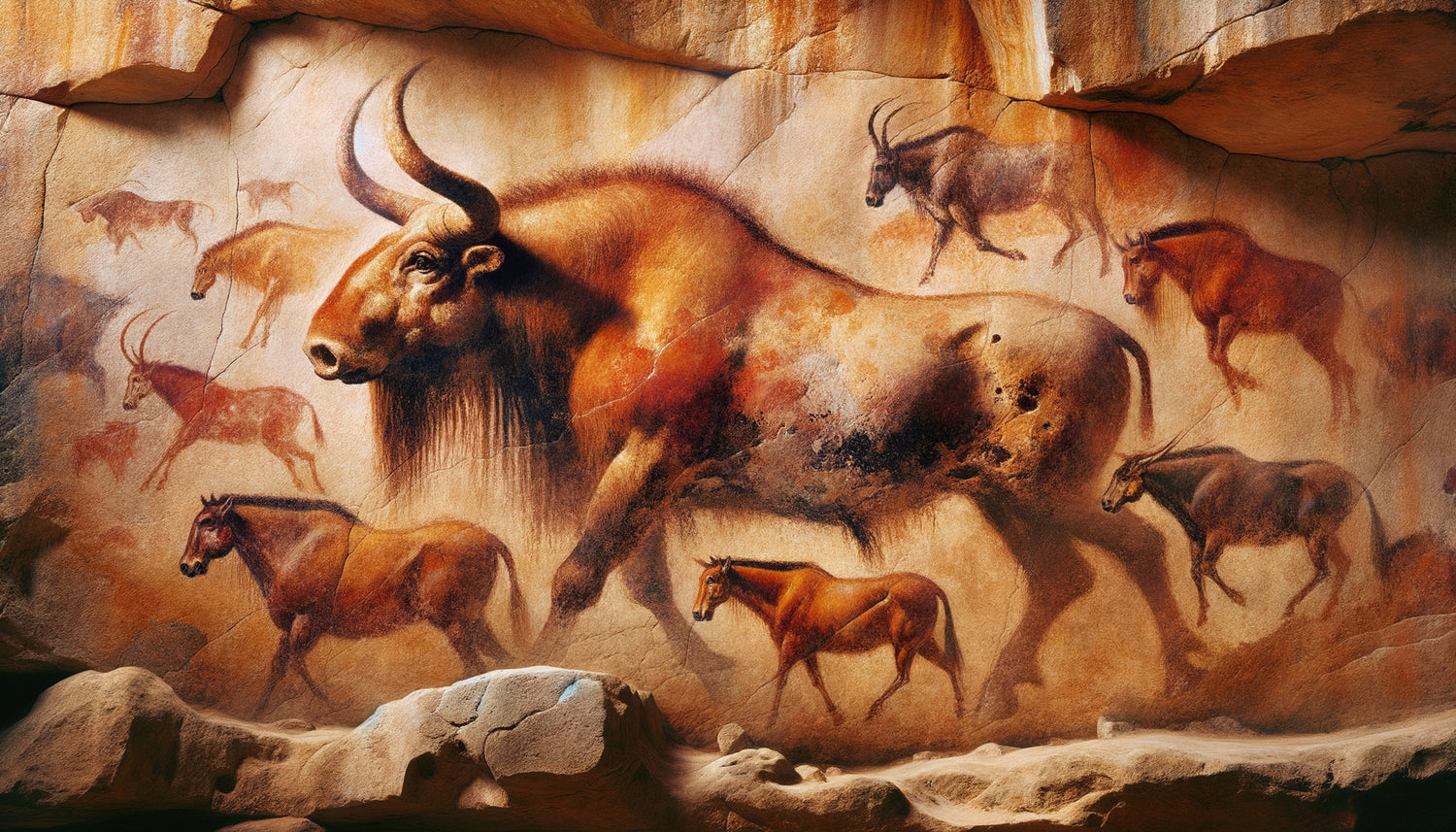
September 1940. Four teenagers and their dog explore a cavity in the Lascaux hill, in Dordogne. What they discover that day shakes all certainties about our ancestors: hundreds of animals gallop on the walls, with astonishing realism, dating back 17,000 years. How could "cave men" have created such splendor?
Here is what the Lascaux frescoes revealed to us: a radically new understanding of prehistoric artistic genius, proof of zoological observation of unparalleled precision, and demonstration that primitive animal art was not primitive at all.
For centuries, our Paleolithic ancestors were imagined as clumsy brutes, incapable of complex thought. The few artistic testimonies discovered before Lascaux were considered childish scribbles, crude attempts at representation. This condescending vision collapsed in an instant before the monumental aurochs of the Hall of Bulls.
Rest assured: you don't need to be an archaeologist to understand why these paintings changed everything. Their message crosses the millennia with a startling clarity. Let me tell you how a French cave rewrote the history of animal art and continues to inspire our relationship with animal representations today.
The Sistine Chapel of Prehistory: when technique defies time
When Abbé Henri Breuil, a leading expert in parietal art, enters Lascaux in 1940, he is speechless. The technical mastery of the Magdalenian artists surpasses everything that had been observed until then. These prehistoric painters used ground mineral pigments with remarkable sophistication: red and yellow ochres, manganese oxides for deep blacks, kaolin for whites.
But the real revolution lies in their understanding of animal anatomy. Each horse depicted shows an intimate knowledge of equine musculature. The deer leap with a dynamism that no Renaissance masters would have disavowed. Aurochs – these wild bovines now extinct – are rendered with such accuracy that zoologists have been able to reconstruct their precise morphology.
The artists of Lascaux employed perspective and movement techniques thought to be invented millennia later. They exploited the natural reliefs of the rock to give volume to their creations. A bovine painted on a protuberance literally seems to emerge from the wall. This use of support reveals an extraordinary spatial awareness.
Surprising tools at the service of art
Research has revealed that these primitive artists made brushes with animal hair, used moss or leather stamps, and even mastered the techniques of stencils and airbrushing by blowing pigments through bone tubes. This technical sophistication shattered the image of the ignorant prehistoric man.
An extraordinary bestiary: fauna as never represented
Lascaux shelters nearly 600 animal figures and 1,500 engravings. What immediately strikes you is the diversity of species represented and especially their hierarchy. Horses dominate with around 360 representations, followed by aurochs, deer, ibex. This selection is not random.
Contrary to what was thought, the animals painted do not necessarily correspond to those that Magdalenians hunted most often. Reindeer, a staple of their diet, are almost absent from Lascaux. This revelation transformed our understanding: prehistoric animal art was not documentary but symbolic. Each animal probably had a spiritual, mythological or cosmological meaning.
The famous Well Scene perfectly illustrates this narrative dimension. It shows a disemboweled bison facing a stylized man and a bird on a stick. This enigmatic composition suggests a story, perhaps a founding myth. The art of Lascaux is not simply a zoological gallery: it is a complex narrative where animals play symbolic roles.
Naturalistic observation at its peak
The anatomical details are so precise that paleontologists use these representations to understand the behavior of extinct species. The attitudes of flight, charge, rut are rendered with a remarkable ethological accuracy. These artists clearly spent hours observing herds, memorizing every movement, every characteristic posture.

The conceptual revolution: rethinking prehistoric intelligence
Before Lascaux, the scientific consensus placed the emergence of abstract thought and complex artistic expression at the time of the first agricultural civilizations, about 10,000 years ago. The frescoes in the Lascaux cave, dated to 17,000 years before our era, have pushed this boundary back by 7,000 years.
This discovery has forced anthropologists and prehistorians to recognize that Homo sapiens already possessed, in the Upper Paleolithic, all the cognitive abilities of modern humans. Symbolic thought, complex planning, cultural transmission, technical innovation: it was all there, beautifully expressed on these limestone walls.
The very organization of the sanctuary is a testament to a coherent artistic vision. The Hall of Bulls functions as a staged space where the gaze is guided from one composition to another. This deliberate staging reveals an aesthetic intention comparable to that of a contemporary museum curator.
The legacy of Lascaux in our modern relationship with animal art
Since its opening to the public in 1948, Lascaux has inspired generations of artists. The great names of modern art – Picasso, Miró, Dubuffet – made pilgrimages to this prehistoric cathedral. Picasso is even said to have declared upon leaving: "We have invented nothing."
This influence can be felt in our contemporary appreciation of animal art. The purity of the lines, the economy of means, the ability to capture the essence of an animal in a few strokes: these aesthetic principles cross the ages. Naturalist illustrators, wildlife photographers, contemporary designers draw on this millennial visual vocabulary.
The frescoes of Lascaux have also taught us to look differently at representations of animals in their cultural context. Whether it's medieval bestiaries, Japanese prints or 19th-century animal painting, we now understand that the representation of an animal is never neutral: it always carries a symbolic, spiritual or philosophical message.
A timeless aesthetic
The expressive minimalism of Lascaux particularly resonates with our time. These powerful silhouettes, these essential outlines, this ability to suggest movement with a few curves: here is a lesson in visual efficiency that contemporary graphic designers continue to study. Primitive animal art becomes a reference for modern design.

Why Lascaux still moves us today
Beyond its scientific importance, Lascaux touches something deeply human. These hands placed on the wall 17 millennia ago create a vertiginous emotional bridge. The Magdalenian artists shared with us the same imperative need to represent the living world, to capture the beauty and power of the animals that surrounded them.
This continuity overwhelms us because it reveals the universality of the aesthetic experience. The emotion we feel in front of a Lascaux horse is not different from that experienced by its creators. Animal art transcends eras precisely because it touches our primordial fascination with non-human life.
The closure of the original cave in 1963, made necessary by degradation due to visits, and the creation of Lascaux II and then Lascaux IV are testament to our desire to preserve and share this treasure. These extraordinarily faithful replicas allow millions of visitors to experience the cave while protecting the original. This respect demonstrates the sacred value we place on this heritage.
Extend the magic of Lascaux into your home
Discover our exclusive collection of animal paintings that captures the same timeless and powerful essence, to create in your home a space imbued with this millennial beauty.
An invitation to reconsider our creative history
The frescoes of Lascaux remind us that artistic sophistication is not new. Our Paleolithic ancestors possessed a refined aesthetic sense, a deep understanding of their natural environment, and the technical ability to translate their vision into works of striking beauty.
This revolution in our understanding invites humility. It also reminds us that our connection to animals, our desire to represent them and celebrate them, is inscribed in the depths of our cultural DNA. Each time we hang an animal image in our home, we perpetuate a gesture 17,000 years old.
Lascaux has not only revolutionized our vision of primitive art: this cave has redefined our place in the great history of human creativity. It has shown us that artistic genius is not a recent conquest of civilization, but a flame that already burned intensely in the hearts of our distant ancestors, illuminating the darkness of their underground sanctuaries.
Frequently Asked Questions
Why do the animals of Lascaux seem so modern in their execution?
The artists of Lascaux mastered surprisingly sophisticated pictorial techniques: use of natural reliefs to create volume, color gradients, suggestion of movement, and above all an anatomical observation of extraordinary precision. They spent their lives in contact with these animals, developing an intimate knowledge of their morphology and behavior. This meticulous observation, combined with a true artistic talent, explains why these works retain a visual power that still speaks to us today. “Primitivism” is a concept that Lascaux has definitively questioned.
Can the original Lascaux cave still be visited?
No, the original cave was closed to the public in 1963 after it was discovered that visitors' breathing and temperature variations were irreversibly damaging the paintings. Green algae and fungi began to develop on the walls. However, you can visit Lascaux IV, a complete replica inaugurated in 2016, which reproduces with astonishing fidelity the atmosphere and works of the original cave thanks to cutting-edge technologies. This immersive experience allows you to understand the emotion of discovery while preserving this invaluable heritage for future generations.
How to integrate the aesthetics of parietal art into contemporary decoration?
The art of Lascaux is characterized by its graphic power, its expressive minimalism and its natural ochre tones – qualities perfectly compatible with modern interiors. Opt for purified animal representations, prioritize marked silhouettes and outlines rather than abundant details. Earthy, ocher, black and white tones naturally recall the prehistoric palette. Parietal art particularly inspires ethnic-chic, industrial or Scandinavian style decorations. A large reproduction of an animal on a neutral background, with clean lines and a dynamic composition, will capture this millennial energy while harmoniously integrating into a contemporary space. It is this meeting between primitiveness and modernity that creates the most striking interiors.