Imagine yourself on top of the world, where the air becomes so rare that every breath counts. At over 4000 meters above sea level, on the vast Tibetan Himalayan plateau, lives an extraordinary creature: the yak. This sentinel of the peaks, with its dense coat like a royal mantle and imposing silhouette, far exceeds its role as a simple farm animal. For Tibetan artists, the yak represents much more than a companion for life. It embodies the strength of high altitudes, this unique ability to thrive where nature seems to forbid any existence.
More than 260 million yaks populate the Tibetan plateau (Source: Tibet Travel), a figure that even exceeds the human population of this region. For millennia, Tibetan art has drawn on this symbolic strength to tell the story of a people who have learned to dance with the most hostile elements on the planet.
Yaks in ancient Tibetan art: symbols of high altitudes
The first artistic representations of yaks appear in ancient Tibetan rock art, particularly in the cave paintings of Rutog caves in Ngari, where these animals coexist with the sun, the moon and the sacred mountains. These ancient engravings already reveal the sacred dimension given to yaks, creatures capable of surviving temperatures down to -40°C. In Tibetan genesis, myth tells that "the head, eyes, intestines, hair, hooves and heart of the yak turned into sun, moon, stars, rivers, lakes, forests and mountains". This cosmogony places the animal at the center of the creation of the high altitude world.
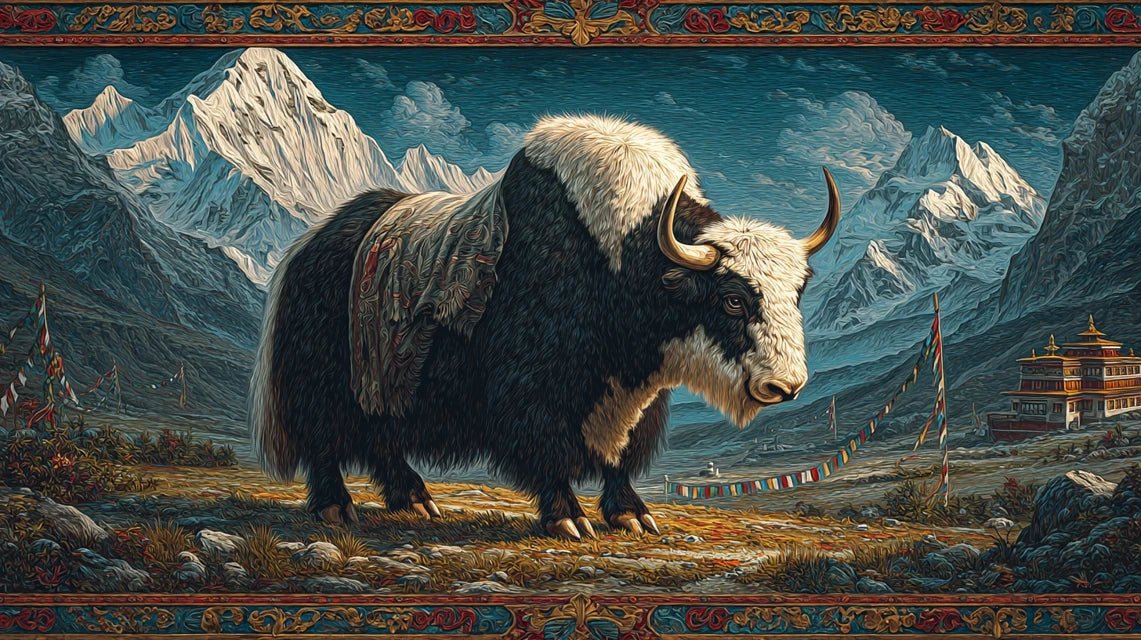
The sacred Tibetan iconography systematically associates yaks with the strength of high altitudes. Their representations in monastic frescoes and murals emphasize their unique ability to carry loads of 100 to 200 kg over distances of 15 km per day, while climbing dizzying heights up to 6000 meters. This physical prowess inspires Tibetan artists who develop specific visual codes: dense fur represented by thousands of meticulous strokes, a massive posture evoking unwavering stability in the face of altitude storms, and imposing horns symbolizing ancestral spiritual power.
The exceptional physiological characteristics of yaks fascinate Tibetan art creators. Possessing three times more red blood cells (Source: Tibetan Culture Research) than ordinary bovines, oversized lungs and a heart, these animals embody the perfect adaptation to high altitudes. This biological excellence is artistically translated by representations emphasizing the wide chest and dilated nostrils, signs of their superior respiratory capacity.
Tibetan artistic techniques to represent the strength of yaks
In the art of traditional Tibetan thangkas, painters develop specific techniques to capture the essence of high-altitude yaks. Natural pigments extracted from altitude minerals - browns ochres, deep blacks - faithfully reproduce the chromatic palette of these animals. The 15th century Menri school favors fine lines to detail their dense fur, while the 16th century Karma Gardri school uses bright colors to contrast the dark mass of the yaks with snowy landscapes.
The representation of high-altitude strength in Tibetan art follows precise canons. The proportions of the yaks respect sacred geometric measurements: a stocky body occupying two-thirds of the composition, short but powerful legs firmly anchored to the ground. Tibetan artists master the art of suggesting movement despite their bulk, using colorful draperies and ornaments to energize their works.
- The technique of hair gradient allows creating the illusion of volume and texture
- The use of 24 carat gold leaf to highlight certain sacred details
- Atmospheric perspective adapted to high-altitude landscapes
- Harmonious integration into complex mandala compositions
Thangka painters spend months perfecting these representations, each detail having a specific spiritual meaning. The yak's long, undulating tail, different from that of other bovines, becomes a recurring decorative element in ornamental borders.
Applications of yaks in contemporary Tibetan high-altitude art
Contemporary Tibetan art reinvents traditional representations of yaks while preserving their Buddhist symbolism of the high altitudes. Modern animal paintings now integrate these iconic creatures into innovative compositions, accessible notably on specialized platforms offering works inspired by this Himalayan aesthetic. Current artists explore new supports: large format canvases, multimedia installations, bronze sculptures, while retaining the spiritual essence of these summit guardians.
High-altitude strength finds a renewed expression in contemporary Tibetan art. Creators use mixed techniques combining traditional pigments and modern materials to evoke the exceptional resistance of yaks to extreme conditions. Compositions often integrate weather elements - violent winds, eternal snows, altitude skies - to contextualize the power of these animals.
The influence of yak Tibetan art extends beyond Tibet, inspiring a new generation of international artists. Museum exhibitions dedicate entire sections to these representations, testifying to the universality of the message conveyed: the possible harmony between living beings and their hostile environment.
Tibetan cultural festivals keep this artistic tradition alive. During the Shoton Festival, yaks adorned with colorful fabrics themselves become walking works of art, merging reality and artistic representation in a celebration of high altitudes.
Optimization of Yak Representations in Traditional Tibetan Art
Tibetan artistic excellence in depicting yaks relies on careful observation of their behavior at high altitudes. Tibetan master artisans develop specific working methods: detailed anatomical studies, observational sketches made in sub-zero temperatures, analysis of seasonal variations in fur. This scientific approach nourishes authentic artistic creativity.
The durability of artworks depicting yaks is a major issue in Tibetan climatic conditions. Artisans use frost-resistant binders, supports treated against humidity, and pigments stable to the intense UV rays of high altitudes. Thangkas benefit from specifically adapted conservation techniques: protective roller conditioning, controlled exposure, preventive restoration.
Modern optimization of artistic representations integrates new biological knowledge about yaks. Genetics reveals that these animals possess unique adaptations: slowed metabolism, perfected thermoregulation, resistance to solar radiation. These discoveries enrich contemporary iconography, allowing artists to refine their depictions with unprecedented scientific precision.
The transmission of Tibetan artistic know-how follows strict rules. Apprentice painters spend several years exclusively mastering the techniques of depicting yaks before addressing other subjects. This specialization guarantees excellence and perpetuates artistic traditions related to these symbols of high altitudes.
FAQ: Yaks in Tibetan Art
Why do yaks occupy such an important place in Tibetan art?
Yaks represent much more than utilitarian animals for the Tibetan people. Their exceptional ability to survive at high altitudes makes them living symbols of resilience and spiritual strength. In Tibetan mythology, they are considered sacred creatures whose different body parts have transformed into cosmic elements, making them natural subjects for artistic expression to convey the deep connection between humans and their hostile environment.
How do Tibetan artists represent the strength of yaks in their works?
Tibetan artists use specific visual codes: massive proportions occupying two-thirds of compositions, dense fur rendered by thousands of meticulous strokes, and stable postures evoking unwavering resistance to altitude storms. Artistic schools such as Menri and Karma Gardri have developed particular techniques using natural high-altitude pigments and gold leaf to capture the spiritual essence of these guardians of the summits.
Can we still admire works of art depicting Tibetan yaks today?
Absolutely! Contemporary Tibetan art continues to celebrate these iconic creatures through various forms: traditional thangkas in monasteries, modern paintings on large-format canvases, bronze sculptures, and even multimedia installations. Cultural festivals such as the Shoton Festival perpetuate this tradition by transforming living yaks into mobile works of art adorned with colorful fabrics, creating a unique bridge between art and reality.