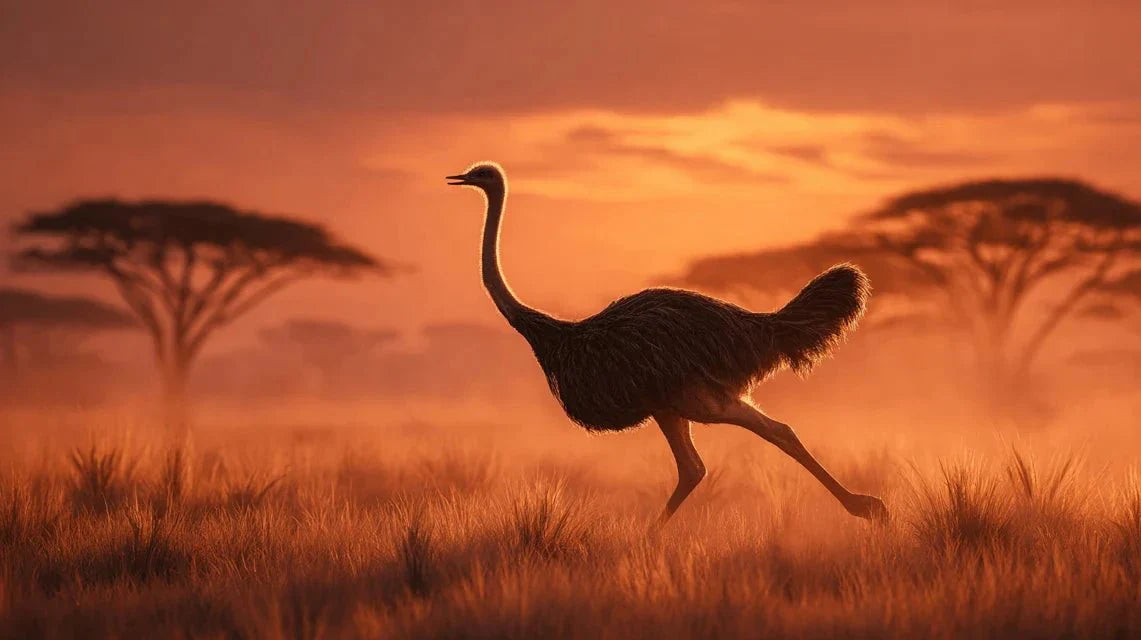
Africa immediately evokes a sense of wild adventure in our minds. Imagine yourself in the golden savanna at sunrise. Suddenly, a majestic silhouette appears on the horizon. The African ostrich stands proudly on its long legs, embodying all the magic of African wildlife.
These 2.5-meter tall winged giants tell a unique story. A story of extraordinary adaptation to the harshness of Africa. A story of a living symbol that has captivated the imagination for millennia of those who dream of authentic exoticism and African escape.
The ostrich, a living symbol of African exoticism
Why do ostriches fascinate so many safari enthusiasts? The answer lies in their spectacular appearance. With their 130 kilograms distributed over an elongated body, they defy our usual representations of birds.
Observe a male in courtship display: his intense black plumage contrasts dramatically with his bright white feathers. This natural palette harmonizes perfectly with the ochre tones of the African savannas. Females, more discreet in their brown hues, master the art of camouflage.
But it is their running speed of 70 km/h that impresses the most. Imagine this natural bullet crossing the plains in a cloud of golden dust. What more exotic animal spectacle could you hope for?
- World record: largest living bird on earth
- Athletic performance: running speed up to 70 km/h
- Unique aesthetics: striking black-and-white contrast in males
- Iconic habitat: vast wild territories of Africa
How ostriches embody the authenticity of wild Africa
The ostrich plays a crucial role in the African ecosystem. It acts as a natural sentinel for herds of zebras and antelopes. Thanks to its imposing size and sharp eyesight, it spots predators from afar.
When it suddenly stops grazing and starts running, it is the alarm signal for the entire savanna. This inter-species cooperation perfectly illustrates the harmony of African nature.
Their reproductive life fascinates with its exoticism. A dominant male gathers a harem of several females who lay eggs together in a communal nest. These giant eggs weighing more than one kilogram each testify to the African extravagance.
The African ostriches survive in the most arid conditions. They can go without water by extracting moisture from their food. This remarkable resilience embodies the strength of wild Africa.
Discover our selection of animal paintings to bring this wild emotion into your interior.
Ostriches as ambassadors of authentic African exoticism
Since antiquity, ostriches have symbolized the mysterious Africa. Libyan warriors adorned their helmets with ostrich feathers to embody courage and power. In ancient Egypt, these feathers represented Maât, goddess of divine justice.
This sacred dimension reinforces their status as exotic icons. Prehistoric cave paintings in the Sahara bear witness to this millennial fascination with these extraordinary birds. Berber traditions attributed a protective role to ostriches, their eggs being used as talismans against the evil eye.
Today, photographic safaris primarily promise a meeting with ostriches. In the parks of Kenya, Tanzania and Namibia, they guarantee this sought-after exotic authenticity for adventure travelers.
- Ancient heritage: symbol of bravery among warriors
- Spiritual dimension: attribute of Egyptian deities
- Artistic heritage: present in African rock art
- Modern attraction: essential stars of safaris
Why ostriches represent the essence of African exoticism
The extraordinary adaptability of ostriches to extreme African environments explains their status as ambassadors of the continent. From the scorching desert of the Kalahari to the humid savannas of the Serengeti, they thrive in diverse biotopes.
Their eclectic diet - plants, insects, small reptiles - reflects the African biological richness. They even ingest pebbles to facilitate their digestion, a fascinating behavior that illustrates their unique evolutionary adaptation.
The modern ostrich industry represents a multi-million dollar market (Source: Agricultural economic study 2021), particularly in South Africa. This economic valuation perpetuates the ancestral link between these birds and African identity.
Ostrich farms are also developing for their dietary meat and resistant leather. This modern economic diversification relies on millennia of harmonious coexistence between humans and these giants of the savanna.
Unfortunately, wild ostrich populations remain vulnerable in several African countries according to the IUCN. Preserving these living embodiments of African exoticism has become an ecological emergency to maintain the magic of this continent of a thousand wonders.
Frequently asked questions about the exoticism of African ostriches
Why are ostriches considered exotic?
Ostriches embody exoticism through their exceptional size (the largest bird in the world), their habitat in African savannas, and their unique behavior. Their 70 km/h run and polygamous reproduction fascinate with their extraordinary and typically African character.
Where can you observe ostriches in Africa?
The best observation spots are found in Kenya (Masai Mara), Tanzania (Serengeti), Namibia (Etosha) and South Africa (Kruger). These parks offer safaris guaranteeing encounters with these winged giants in their natural environment.
What is the cultural symbolism of ostriches in Africa?
Since antiquity, ostriches have symbolized power and bravery. Libyan warriors wore their feathers as emblems, while in ancient Egypt, they represented the goddess Maât. This sacred dimension reinforces their status as icons of authentic African exoticism.