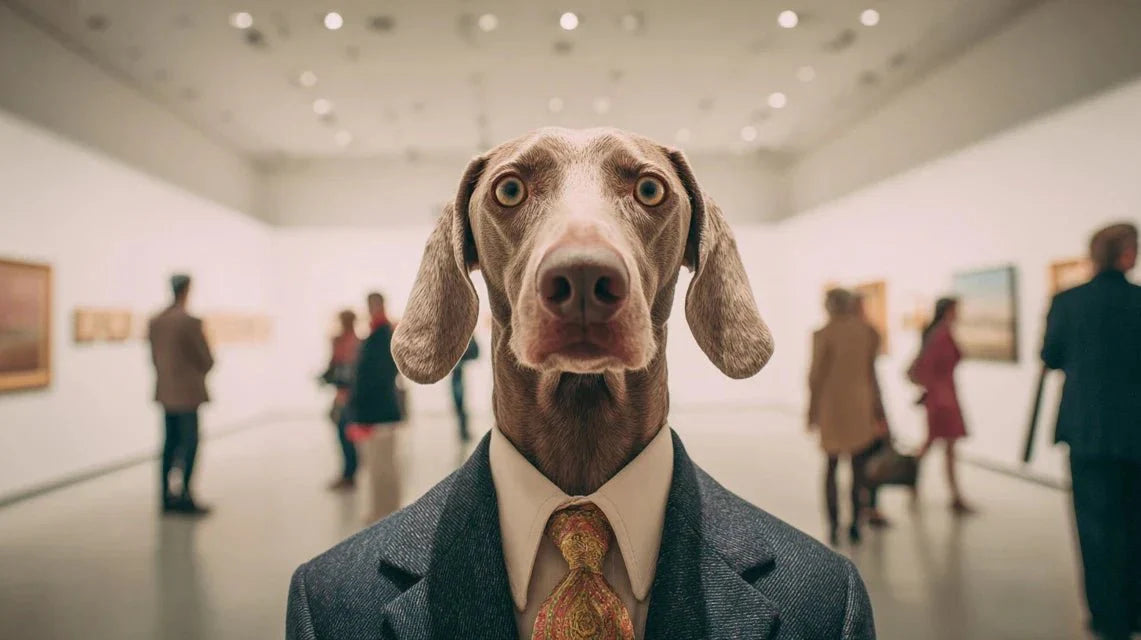
Imagine yourself facing a portrait. But instead of a human, it’s a dog posing in a suit and tie. This scene, which could elicit a smile, actually reveals a major artistic revolution. Contemporary art is now exploring new frontiers in its representation of animals, far exceeding simple animal representation to fundamentally question our relationships with animality. This contemporary artistic approach questions animal anthropomorphism through works that disrupt established categories between humanity and animality, thus revealing the porosity of our respective identities.
Contemporary art and animal anthropomorphism - Defining the issues
Contemporary art redefines animal anthropomorphism as a major critical tool, moving away from previous artistic traditions. This aesthetic revolution transforms traditional animal representation. Unlike traditional representations where animals served only as human metaphors, contemporary artists explore animal anthropomorphism to question our own humanity. This revolutionary approach transforms the animal into a critical mirror of our societal behaviors, creating an unprecedented dialogue between species.
Let's take the concrete example of William Wegman. This American artist turns his dogs into photographic models. His Weimaraner pose with disarming seriousness in typically human settings. This substitution generates creative tension that reveals the arbitrariness of our categorizations. Why couldn’t a dog be an artistic model? This seemingly simple question shakes our deepest convictions.
At the same time, this contemporary artistic approach is part of a broader reflection on animal ethics and our relationship with living beings. Contemporary art thus becomes a laboratory of experimentation where animal anthropomorphism serves to deconstruct our anthropocentric certainties.
This conceptual revolution finds its roots in the 1960s-70s, a pivotal period when artists began to question human domination over the animal kingdom. Contemporary animal anthropomorphism no longer seeks to entertain or moralize, but to deeply disturb our established perceptions.
Techniques of animal anthropomorphism in contemporary art
Anthropomorphism techniques in contemporary art are diversifying and becoming more complex. Contemporary plastic artists employ various strategies to question animal anthropomorphism. These revolutionary artistic practices include:
- Direct substitution: replacing human models with animals in typically human situations
- Corporeal hybridization: creating artistic chimeras mixing human and animal traits
- Behavioral staging: attributing codified human behaviors to animals
- Photographic detournement: using the photographic image to humanize the animal
This technical approach allows contemporary artists to create an immediate visual questioning, disrupting our perceptual automatisms. Animal anthropomorphism then becomes a sophisticated plastic language, capable of generating profound questions about our human and animal condition.
Contemporary animal paintings perfectly illustrate this technical evolution, where the anthropomorphized animal transcends its decorative function to become a vector of critical reflection.
Anthropomorphic Questioning - Concrete Artistic Applications
Contemporary art develops concrete applications of animal anthropomorphic questioning. Pierre Huyghe, an emblematic figure of this approach, creates living artistic ecosystems where the boundaries between humanity and animality blur. His work "Zoodram 4" (2011) places a hermit crab in a molding of Brancusi's "The Sleeping Muse," directly questioning our aesthetic relationship to animality.
Oleg Kulik pushes the questioning anthropomorphism to the extreme by embodying the animal himself. His performances, where he moves on all fours, held on a leash, radically invert traditional roles and question the devaluing dimension of animality in the eyes of humans. This revolutionary performance art transforms the artist into a "living ready-made," directly questioning our interspecies hierarchies.
Other artists explore different avenues. Damien Hirst, with his animals preserved in formaldehyde, raises the question of death and conservation. His works question our relationship to animal mortality and, by extension, human mortality. This conceptual approach to animal anthropomorphism generates passionate debates about the ethical limits of art.
Interactive installations constitute another crucial dimension. Artists create environments where the public can physically experience the animal condition, generating unprecedented bodily empathy. These immersive devices transform the viewer into an actor in the anthropomorphic work.
Contemporary animal anthropomorphism also generates major ethical debates. According to a recent study, 73% of contemporary artworks using animals raise ethical questions about the use of living beings in art (Source: Vincent Lecomte, Contemporary Art Under the Test of Animals, 2021). This statistic reveals the extent of the questioning generated by these artistic practices.
Optimization of Contemporary Art Questioning Anthropomorphism Animal
Optimizing the questioning in contemporary art anthropomorphic animal involves radicalizing approaches. Contemporary artists no longer simply question; they actively destabilize our mental categories.
This optimization is manifested by:
- Intensification of identity disturbance: creation of works where the distinction between human and animal becomes impossible
- Multiplication of supports: video, installation, performance, living sculpture
- Interdisciplinary collaboration : working with biologists, ethologists, philosophers
- Ethical commitment : taking a clear position on animal rights
Contemporary art thus optimized transforms animal anthropomorphism into a tool for social transformation. Contemporary artists no longer only question our representations, they act to change our fundamental relationship with non-human living beings.
This social transformation occurs through several mechanisms. First, ethical awareness : contemporary anthropomorphic works raise public awareness of animal suffering. Then, cultural deconstruction : they dismantle our prejudices about the hierarchy of species. Finally, proposal of alternatives : they imagine new relationships more egalitarian between humans and animals.
Contemporary art galleries become spaces for civic reflection where animal anthropomorphism generates essential public debates. This social function of contemporary art goes far beyond the traditional aesthetic framework.
This optimized approach generates maximum critical effectiveness. Animal anthropomorphism then becomes a vector of societal change, going far beyond the aesthetic framework to invest in the political and ethical field. The conceptual mutations it induces gradually transform our vision of the living world, opening the way to a renewed interspecies coexistence.
Frequently asked questions about animal anthropomorphism in contemporary art
Why is contemporary art so interested in animal anthropomorphism?
Contemporary art uses animal anthropomorphism as a critical mirror of our society. This approach makes it possible to question our certainties about humanity by exploring the blurred boundaries between species. Contemporary artists seek to deconstruct the dominant anthropocentrism and generate an ethical reflection on our relationship with living beings.
What is the difference between traditional and contemporary anthropomorphism?
Traditional anthropomorphism used the animal as a simple human metaphor, often for moralizing or decorative purposes. Contemporary anthropomorphism reverses this logic: it questions the very legitimacy of attributing human traits to animals and explores the ethical implications of our interspecies relationship.
Is contemporary anthropomorphic art ethically acceptable?
This question divides the artistic community. According to Vincent Lecomte (2021), 73% of works using animals raise ethical questions. Acceptability largely depends on the artistic intention, the treatment reserved for the animal and the critical scope of the work. Contemporary art tends towards a more respectful and reflective approach to animality.