In the immensity of the Australian desert, a fascinating encounter unites two millennia-old forms of architecture: that of termites and that of Aboriginal art. These insects, veritable architects of the earth, occupy a central place in Aboriginal spirituality and now inspire artistic creations that testify to a deep connection with nature and biomimetic architecture.
Termites in Aboriginal Art: Architectural Symbols of Dreamtime
Termites are a fundamental element of Aboriginal mythology, particularly among the Warlpiris whose ancestral lands extend north of Alice Springs. In their cosmology, these architects insects are not simple creatures: they embody mythological ancestors of Dreamtime, that creative period when the earth was shaped by Australian ancestral spirituality.
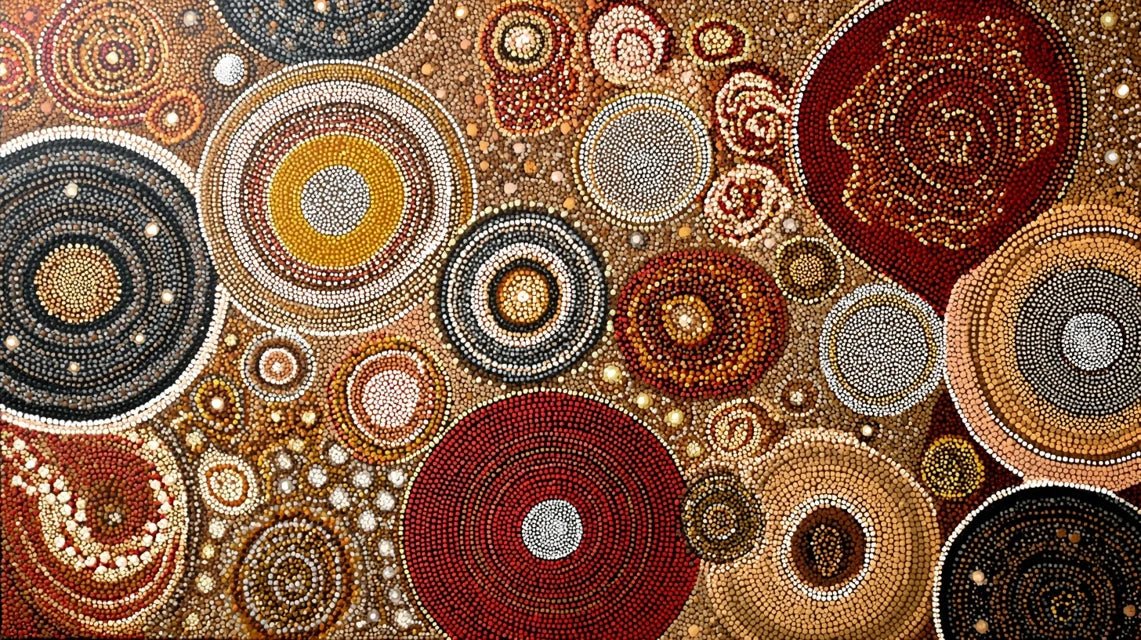
Theresa Ross Napurrurla, a renowned Aboriginal artist, represents the Pamapardu Jukurrpa (Dream of the Flying Ant) in her works. Her pointillist paintings reveal the complexity of the termite symbolism: concentric circles symbolize nests seen from above, while radiating patterns evoke the underground galleries dug by these natural architects.
Traditional Warlpiri Aboriginal pointillist iconography uses specific visual codes to represent these architect termite. The mingkirri (termitaria) appear as sacred structures in art, testifying to the Aboriginal recognition of these exceptional builders. This artistic representation goes beyond simple observation: it integrates a deep understanding of the natural architectural systems developed by termites.
Termite Architects: Construction of Nests and Aboriginal Symbolism
Termite architecture fascinates with its technical complexity. These architects of the earth build structures that can reach 9 meters high, using a mixture of clay soil cemented by their salivary secretions. Each termitier represents an achievement of traditional ecological construction: maintaining a constant temperature of 30°C despite extreme external variations (from 0°C to 40°C).
Aboriginal communities, particularly in Yirrkala and Maningrida, have developed a unique artistic approach by creating funerary sculptures from eucalyptus trunks hollowed out by termites. These works, called Larrakitj or Lorrkon, perfectly illustrate the alliance between termite architecture and Aboriginal artistic expression, contributing to the Aboriginal cultural heritage.
The complex structure of termite mounds directly inspires the motifs of contemporary Aboriginal art. Mushroom chambers, ventilation galleries and the protective envelope (idiothèque) become recurring graphic elements. This artistic transposition reveals the Aboriginal ability to transform observation of natural architecture into visual language.
Discover also beautiful animal art
Termite Aboriginal Art: Representation Techniques of Earth Architects
The techniques of representing termites in Aboriginal art reveal a refined artistic mastery. Aboriginal pointillism, developed in Papunya in the 1970s, finds its roots in the need to protect sacred symbols related to architect termite.
Artists use several processes to evoke termite architecture:
- The concentric points reproduce the spiral structure of the underground galleries
- The ochre colors (white, black, red, yellow) reflect the materials used by the termites: clay, earth, plant debris
- The radiant motifs evoke the ventilation systems developed by these natural architects
- The interconnected circles represent the colonies and their extensions
This termite iconography is enriched with regional variations. In the Northern Territory, representations often integrate the seasonal cycles: the winged termites (Pamapardu) who fly during the rainy season to establish new architectural colonies.
Termite Architecture in Contemporary Aboriginal Creations
The influence of termite architecture extends beyond traditional artistic boundaries to inspire revolutionary contemporary creations. Architect termites become models for biomimicry, particularly visible in projects such as the Eastgate Building in Zimbabwe, directly inspired by termite natural ventilation systems.
Contemporary Aboriginal artists integrate this architectural dimension into their works on canvas, glass and bronze. They explore the structural properties of termite mounds: resistance, thermal insulation, air circulation. These artistic research echo scientific discoveries about the natural composite materials used by the termites.
According to recent studies (Source: London Institute of Biomimicry), the termite architecture exhibits exceptional mechanical properties: compressive strength of 2.3 MPa, passive thermal regulation, optimized natural ventilation. These characteristics directly inspire contemporary Aboriginal artistic creations that integrate innovative materials while preserving traditional codes.
Preservation of traditions: termites architects in modern Aboriginal art
The transmission of knowledge related to termite architects is a major issue for Aboriginal communities. Art centers like Warlukurlangu Artists in Yuendumu develop specific programs to preserve this ancestral architectural knowledge.
The new generation of artists, like Theresa Napurrurla Ross, perpetuate the termite traditions while adapting them to contemporary supports. This artistic evolution is a testament to the vitality of Aboriginal cultural heritage in the face of modern challenges.
Termite Aboriginal art now finds its place in international collections. The Berndt Museum in Western Australia, with its 12,000 works (Source: University of Western Australia), documents this artistic richness related to the architects of the earth. This global recognition contributes to the valorization of Aboriginal knowledge on natural architecture.
Frequently asked questions
Why are termites important in Aboriginal art?
Termites represent creator ancestors in Aboriginal mythology. Their exceptional architectural capabilities make them symbols of constructive wisdom, particularly revered by the Warlpiri communities who incorporate their symbolism into their traditional artistic creations.
How do Aboriginal artists depict termite architecture?
Artists use concentric circles for nests seen from above, dots and lines for underground galleries, and radiating patterns for ventilation systems. These visual codes, passed down from generation to generation, translate the architectural complexity of termitaria into artistic language.
What influence do termites have on contemporary Aboriginal art?
The architecture of termites inspires new supports and materials in modern Aboriginal art. Artists explore the structural properties of termite mounds (strength, insulation, ventilation) to create innovative works that combine tradition and modernity while preserving ancestral cultural codes.