The symbolism of the kite in Asian art tells a millennial story that begins in the workshops of early Chinese artisans. Imagine these creators, more than 2,000 years ago, transforming simple silk sheets into celestial messengers carrying dreams and sacred symbols, thus constituting a true cultural heritage of Asian iconography.
The symbols of the kite in traditional Asian art
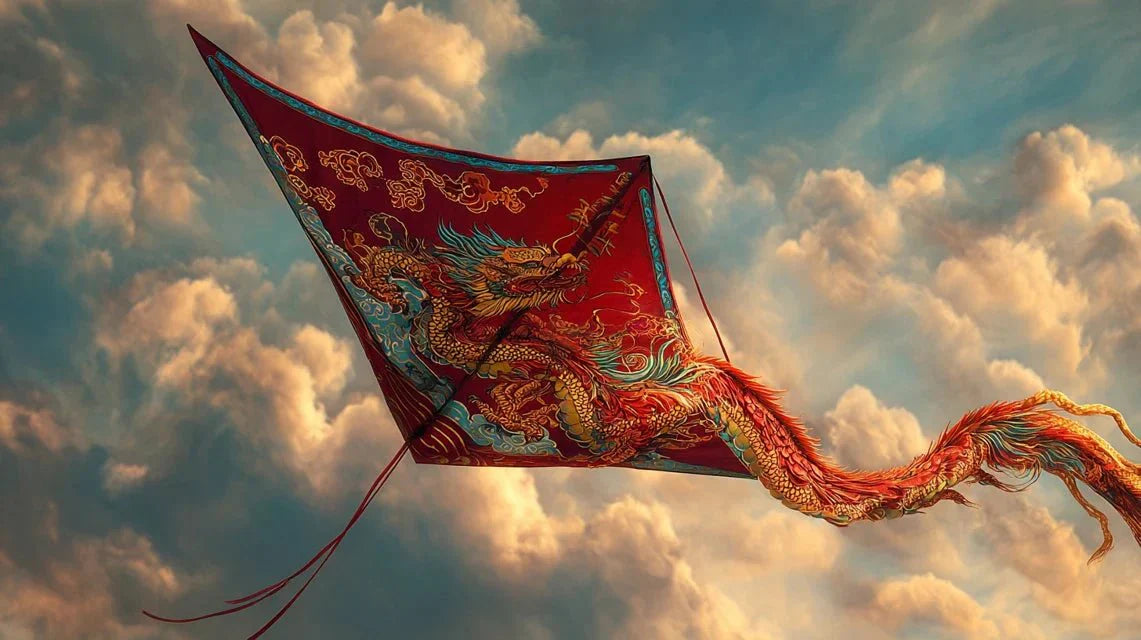
In the workshop of a Chinese master, each brushstroke tells a legend rooted in Chinese cosmology. The dragon stretching across the silk represents much more than a mythical creature. It embodies the emperor, the yang force that governs the universe according to Eastern spirituality. Facing him, the phoenix spreads its colorful wings, symbolizing the empress and feminine yin energy. Together, they create a cosmic dance on a flying canvas, true visual metaphors of universal balance.
In Japan, the artistic heritage changes color. Edo artisans paint warriors in sparkling armor, geishas in sumptuous kimonos. Each character carries their own story in this refined Asian iconography. The koi carp swimming upstream symbolizes perseverance in the face of challenges. The crane, with its thousand years of life, promises eternity.
The colors tell their own stories :
- Vermilion red burns like the passion of happiness
- Imperial yellow sparkles like the gold of palaces
- Jade green murmurs the secrets of nature
- Cobalt blue reflects the wisdom of infinite skies
Artistic techniques for symbolizing the kite in Asia
Observe a calligrapher at work: his hand dances to the rhythm of black ink, perpetuating a millennial artistic heritage. Each character he traces - 福 for happiness, 寿 for longevity - transforms the kite into a flying poem. These ideograms are not mere decorations; they are prayers launched towards the sky, pure expressions of Eastern spirituality.
Natural silk becomes canvas under skillful brushes. Mineral pigments blend in subtle nuances. The artisan applies layer after layer, creating depths that seem to bring the painted creatures to life. To understand this ancestral beauty, it is enough to admire animal paintings that perpetuate this living artistic tradition.
Geometric shapes tell the story of the universe according to Chinese cosmology. The diamond evokes the four horizons of the earth. The perfect circle symbolizes celestial eternity. These simple forms become complex when they assemble, creating compositions that defy the laws of Western art, true visual metaphors of universal harmony.
Symbolic applications of the kite in contemporary Asian art
Today, this cultural heritage is reborn in new forms. Modern festivals attract more than 2 million visitors (Source: Weifang International Festival) each year. These events transform the sky into a giant art gallery, celebrating traditional Asian iconography.
Contemporary artists innovate while respecting tradition. They integrate LEDs that make nocturnal dragons sparkle, use high-tech materials for more resistant kites. Yet, each modern creation still bears ancestral symbols, proving that some truths of Eastern spirituality transcend eras.
The art market has seized upon this renaissance. Collectors compete for authentic pieces, generating several million euros (Source: Association of Asian Kite Artisans) annually. These figures prove that traditional beauty still finds its place in our modern world.
Artistic refinement of the symbolism of the kite
Becoming a master in the art of kites requires Eastern patience. The apprentice spends years observing, repeating ancestral gestures. He learns that each symbol has its history, its place in the universal harmony of Chinese cosmology.
Museums like the one in Weifang become guardians of this memory. They develop conservation techniques that preserve these fragile works for future generations. Each kite preserved tells a story that could otherwise disappear, thus protecting this invaluable artistic heritage.
Art evolves with its time. Modern creators integrate ecological messages into their works, adapt ancestral symbols to contemporary concerns. This ability to adapt ensures that the art of kites will continue to fly towards the future, carrying new stories while preserving the wisdom of the past, perpetuating the visual metaphors of Eastern spirituality.
Frequently asked questions about the symbolism of the kite in Asian art
Q: What is the difference between Chinese and Japanese kite symbols?
R: Chinese kites favor mythical creatures (dragon, phoenix) representing cosmic forces, while Japanese art integrates more human characters (warriors, geishas) and terrestrial animals carrying messages of courage and longevity.
Q: How to recognize an authentic Asian artistic kite?
R: Criteria for authenticity include the use of traditional materials (silk, bamboo, mineral pigments), the presence of handwritten calligraphic characters, and compliance with ancestral color codes and symbolism specific to each region.
Q: Why does the symbolism of the kite remain important in modern Asian art?
R: This symbolism endures because it conveys universal values (harmony, balance, spirituality) that transcend eras, while offering contemporary artists a rich visual language to express modern concerns.