Imagine an animal that looks like a surprising mix of pig, miniature elephant and horse. That's exactly what the tapir is, this fascinating creature that has inhabited the forests of South America for millions of years. But here’s the most surprising thing: this animal with such a particular physique has become, over the centuries, one of the most important artistic figures on the South American continent, bearing witness to a remarkable artistic expressiveness.
For more than a thousand years, tapirs have inspired artists through a rich and diverse cultural heritage. Their small prehensile trunk and massive body have captivated the imagination of creators, from pre-Columbian potters to contemporary artists. This fascination goes far beyond simple curiosity: it reveals a deep relationship between man and this mysterious animal, anchoring its representation in ancestral traditions passed down from generation to generation.
Tapirs in South American pre-Columbian art
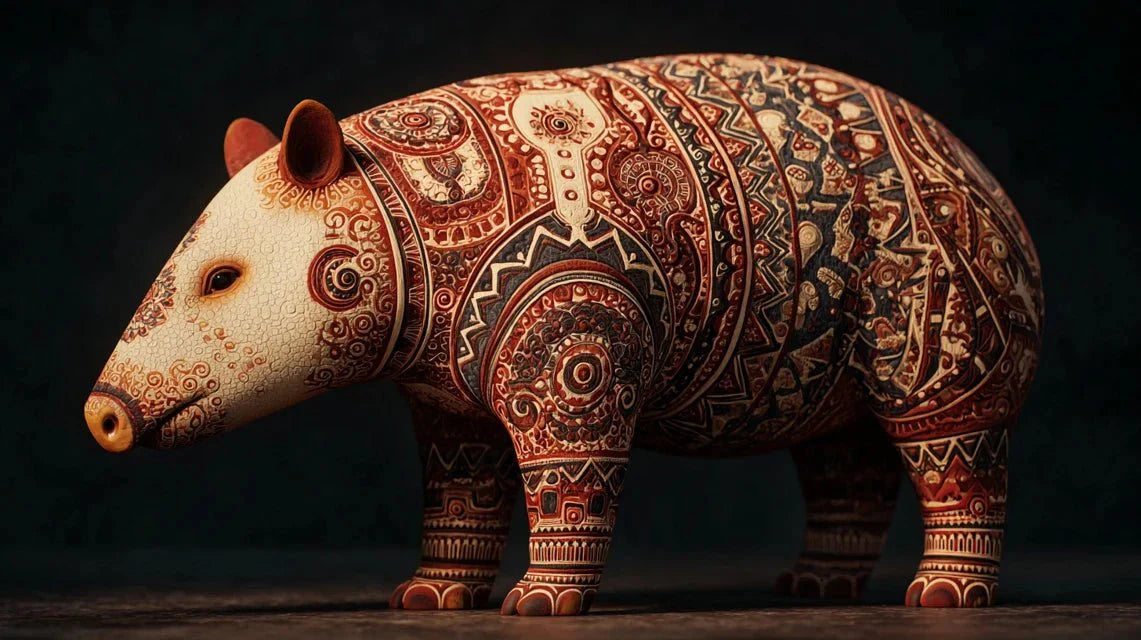
Let's go back in time to the pre-Columbian civilizations. In the pottery workshops of ancient Peru, Mochica artisans skillfully shaped extraordinary ceramics with their hands. Between 100 BC and 700 AD, they created thousands of pieces depicting tapirs in a complex and codified iconography.
The Larco Museum in Lima houses more than 45,000 objects testifying to this artistic passion. These works are not just figurines: they tell stories, carry spiritual messages and reveal the central place of the tapir in these ancient societies, constituting a true treasure of cultural heritage.
How did these master potters proceed? They began by modeling the clay by hand, capturing every detail of the tapir's anatomy. Its characteristic trunk, its small mobile ears, its stocky body - everything was reproduced with striking precision. Then came firing in earth-dug kilns covered with mesquite branches. The result? These magnificent reddish-brown hues on a cream background that characterize Mochica art.
A revealing anecdote: in 2016, a Chupicuaro culture ceramic depicting a tapir sold for two million euros! This "Great Callipyge Venus" perfectly illustrates the artistic value now recognized for these ancestral works.
Ritual representations of tapirs in Amazonian cultures
The story doesn't end there. In the depths of the Amazon rainforest, indigenous peoples have perpetuated this artistic tradition for centuries, preserving ancestral traditions of exceptional richness. Among the Inga people of Colombia, the tapir is not just an animal: it is the "guardian of the mountains", a spiritual protector venerated and respected.
Take the example of the Warime ritual of the Piaroa in Venezuela. Every three years, this fertility ceremony brings together the community. Men then don extraordinary masks carved by hand, some of which depict mythological tapirs. These creations, adorned with moriche feathers and painted with annatto, literally transform dancers into tapir spirits.
To discover how contemporary art celebrates the exceptional biodiversity of this region, explore this collection of animal paintings that pays homage to South American fauna.
In the Serranía de la Lindosa in Colombia, on the rocky walls, tens of thousands of paintings tell the story of tapirs. These millennial rock artworks show tapirs half-animal, half-spirit, testifying to a worldview where the boundaries between reality and spirituality blur, creating a unique iconography in the world.
Artistic techniques for representing tapirs
Each culture has developed its own technical secrets to represent tapirs in an artistic expressiveness that is their own. The methods vary, but the passion remains the same.
Traditional artisans master several approaches:
- The freehand modeling allows to capture the very essence of the animal
- The serial molding of the Mochicas ensured consistent production
- Controlled firing in buried kilns created these particular colors
- Application of engobes brought creations to life with subtle color games
Amazonian rock art tells another technical story. Imagine these prehistoric artists grinding iron oxides and colored earths to create their pigments. The result: works that defy time, resisting for millennia the tropical rains and humidity of the jungle.
Today, contemporary creators mix these ancestral techniques with modern technologies. They sculpt in volcanic stone, work precious metals and create digital installations where tapirs come to life spectacularly, thus respecting the cultural heritage while innovating.
Evolution of the representation of tapirs in South American contemporary art
Today's art tells a different story, more urgent. Contemporary artists transform the tapir into a symbol of environmental struggle and conservation efforts. Why? Because 85% of tapir populations have disappeared since 1980 (Source: Instituto de Pesquisas Ecológicas). This alarming reality fuels a new militant creativity.
In the streets of São Paulo, giant murals depict majestic tapirs alongside skyscrapers. In Bogotá, interactive installations raise public awareness about the protection of these threatened mammals and the preservation of biodiversity. Art thus becomes a colorful and moving cry of alarm.
Contemporary art galleries now regularly program exhibitions dedicated to tapirs. These events skillfully blend cultural heritage and ecological awareness, creating a fascinating dialogue between past and present, while valuing ancestral traditions.
Symbolism of Tapirs in South American Ceramic Art
But why so much artistic obsession with this animal? The answer lies in the extraordinary symbolic richness of the tapir. In South American ceramic art, it embodies more than just an animal, fitting into a complex and multidimensional iconography.
The deep meanings are expressed in several themes:
- Fertility and abundance : the tapir lives in the most luxuriant environments
- Passage between worlds : according to beliefs, it is capable of traveling between spiritual dimensions
- Quiet strength : its physical robustness inspires respect and admiration
- Natural harmony : a symbol of the balance between earth and water
On Mochica ceramics, tapirs often appear accompanied by snakes and jaguars. This sacred trinity represents the three levels of the cosmos: the underworld, terrestrial and celestial worlds. Each potter had to master these complex codes, veritable visual languages transmitted from generation to generation within the cultural heritage.
Contemporary art perpetuates this symbolic tradition while adapting it to current concerns about conservation. Today's creators draw on this millennial reservoir of meanings to create works that speak of both cultural continuity and ecological urgency.
Thus, from the clay shaped by the skilled hands of Mochica potters to today's digital installations, the tapir continues to inspire South American artists. This artistic permanence is a testament to the exceptional symbolic strength of this enigmatic animal, a true bridge between the natural world and the human creative universe, perpetuating ancestral traditions in a changing world.
FAQ - Frequently Asked Questions
Q1: Why do tapirs have such an important place in South American art?
A: Tapirs occupy a unique symbolic position in South American cultures. Their distinctive appearance and habitat in lush environments have made them symbols of fertility, passage between spiritual worlds, and quiet strength. This symbolic richness, combined with their ecological role as "gardeners of the forest," explains their constant presence in art for over a thousand years.
Q2 : How have the techniques of tapir representation evolved?
A : The techniques have evolved from pre-Columbian methods (freehand modeling, firing in underground kilns, natural pigments) to hybrid contemporary approaches. Modern artists now combine ancestral know-how with current technologies: digital sculpture, multimedia installations and street art, while preserving traditional iconography.
Q3 : What is the impact of the threat of extinction on contemporary art?
A : The 85% decrease in tapir populations since 1980 has transformed their artistic representation. Contemporary creators now use the tapir as a symbol of environmental struggle, creating militant works that raise awareness for conservation. Art thus becomes a tool for cultural and ecological preservation.