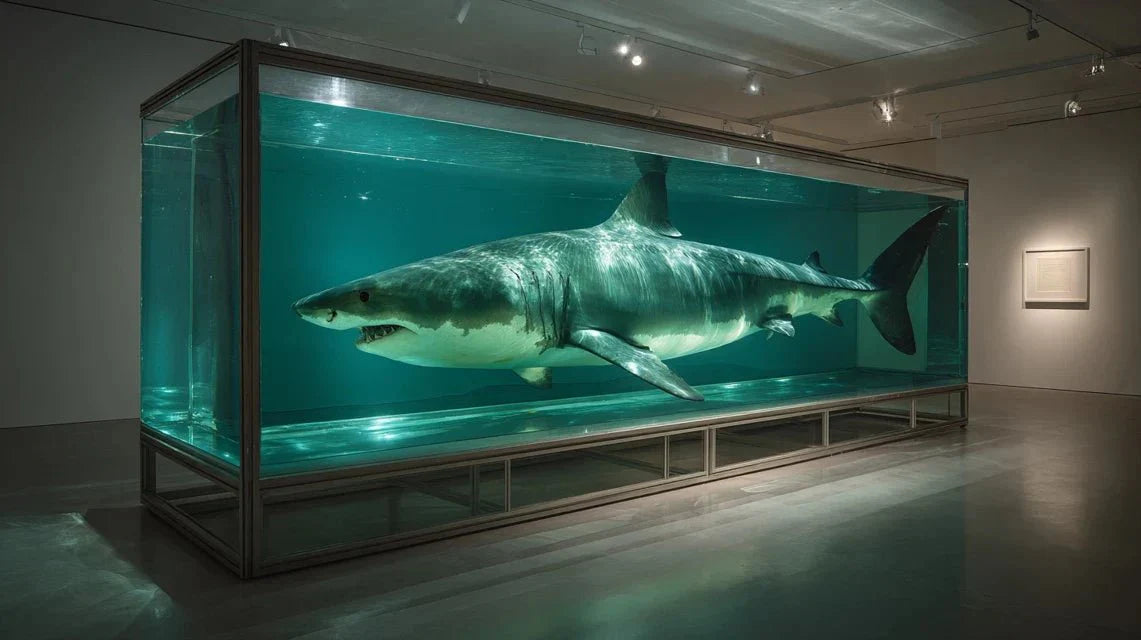
Imagine a 5-meter shark frozen for eternity in an immense aquarium. This vision, which could come from a science fiction film, has become a reality thanks to Damien Hirst. In 1991, the British artist revolutionized contemporary art with a radically new approach: the fossilization of real animals in formaldehyde. This innovative technique permanently suspends organic decomposition, transforming animal carcasses into immortal works of art. It creates an unprecedented bridge between science and aesthetics, questioning our perceptions of mortality.
Damien Hirst's fossilization techniques in contemporary art
It all begins with a process that evokes the most cutting-edge scientific laboratories. The fossilization technique developed by Damien Hirst relies on the use of formaldehyde, a chemical compound with exceptional preservative properties. This revolutionary approach consists of injecting formaldehyde directly into the animal's body, then immersing it in a 7% formalin solution for several weeks. This method, perfected with the help of Oliver Crimmen, conservator at the Natural History Museum in London, guarantees optimal preservation of specimens.
The fossilization process literally transforms organic tissues: formaldehyde hardens the flesh, making it resemble rubber. The fossilized animals lose their putrid appearance while retaining their original form. This technique allows to maintain the structural integrity of specimens for decades, creating an illusion of life suspended in time.
The preparation requires surgical precision. Each animal must be treated individually according to its size and constitution. 4.25-meter sharks require 850 liters of formaldehyde, while lambs are content with smaller volumes in tanks adapted to their dimensions.
The Natural History series: how Damien Hirst transforms animals into eternal art
Damien Hirst's Natural History series, launched in 1991, now comprises more than twenty iconic works. This collection presents a remarkable diversity of fossilized animals: tiger sharks, cows, calves, sheep, pigs, and even a bear and a zebra. Each specimen is presented in monumental glass and steel display cases, creating a modern cabinet of curiosities effect.
The flagship work "The Physical Impossibility of Death in the Mind of Someone Living" features a 5-meter shark in a 22-ton aquarium. This piece, sold for $8 million in 2004 (Source: The Art Newspaper), perfectly illustrates Hirst's ability to transform animals into objects of exceptional value. Wildlife paintings find their extension in three dimensions here, as can be discovered in the wildlife painting collections which explore this theme in other artistic forms.
The technique of fossilization allows Hirst to create serial works. "Mother and Child (Divided)" presents a cow and her calf cut longitudinally, exposing their internal organs. This approach transforms traditional animal art into a direct confrontation with mortality. Fossilized animals become contemporary memento mori, questioning our relationship to life and death.
The titles of the works reveal the artistic intention: "Away from the Flock" (1994), "The Ascension" (2003), "Heaven" or "The Incomplete Truth" imbue animals with a spiritual and philosophical dimension transcending their simple biological materiality.
Formaldehyde as an artistic medium: Damien Hirst's revolution
Formaldehyde is Damien Hirst’s revolutionary medium, transforming a chemical preservative into a creative tool. This substance, composed of hydrogen, oxygen and carbon, has preserving and antibacterial properties that stop decay. Hirst diverts this scientific use to create a unique fossilization art.
The innovation lies in the artistic application of a museum technique. Natural history museums already used this wet preparation method in the 19th century, but Hirst transfers it to the contemporary art space. Formaldehyde thus becomes a chemical brush sculpting organic matter.
This approach presents considerable technical challenges. Formaldehyde is an inflammable and carcinogenic gas requiring drastic precautions. The installation of the exhibition at the Gagosian Gallery in New York took a whole month of preparation to ensure visitor safety. Studies have revealed formaldehyde emissions exceeding recommended levels during some exhibitions.
The medium also imposes a particular temporality. Unlike traditional artistic materials, formaldehyde only ensures temporary conservation. Fossilized animals gradually degrade, requiring periodic replacements. Hirst’s Science Ltd company now offers to replace any animal over ten years old.
The impact of Damien Hirst's fossilized animals on contemporary art
Damien Hirst’s fossilized animals have generated a considerable impact on the contemporary art market. In 2008, Sotheby's sold 223 of the artist's works for a record total amount, propelling Hirst to the rank of Britain's most expensive artist after David Hockney and Lucian Freud. This economic valuation is evidence of the lasting influence of his fossilization technique.
Hirst’s approach has influenced an entire generation of contemporary artists exploring the relationships between art and science. His fossilization method has opened up new aesthetic perspectives, legitimizing the use of organic materials in contemporary art. The Young British Artists of the 1990s were widely inspired by this transgressive approach.
The impact extends beyond the purely artistic realm. Hirst’s fossilized animals question our contemporary relationship with nature and death. In an urban society disconnected from biological reality, these works brutally confront the viewer with the materiality of organic life. This sociological dimension explains in part their success with the general public.
International museum institutions have massively integrated these works into their permanent collections: Tate Modern in London, Museum of Modern Art in New York, Astrup Fearnley Museet in Oslo. This institutional recognition definitively establishes fossilization as a legitimate artistic technique.
Attendance statistics are eloquent: the 2012 exhibition at Tate Modern attracted 463,000 visitors (Source: Egora), setting a record for a monographic contemporary art exhibition. These figures demonstrate the persistent attraction of the public for Hirst’s fossilized animals.
Conservation and preservation: the technical challenges of Damien Hirst's works
The conservation of Damien Hirst’s fossilized animals poses unprecedented technical challenges in the history of art. Unlike traditional artworks, these pieces require constant maintenance and permanent chemical monitoring. Formaldehyde gradually evaporates, requiring regular renewals of the preservative solution.
The aging of fossilized animals follows a predictable process: the solution progressively becomes cloudy, colors fade, and tissues deteriorate. "The Physical Impossibility of Death" thus required complete replacement of the original shark in 2006, raising fundamental questions about artistic authenticity.
This preservation issue questions the notion of originality in conceptual art. Hirst considers that artistic intention is more important than the materiality of the object: replacing the animal does not constitute an alteration of the work but its perpetuation. This philosophy revolutionizes the traditional approach to artistic conservation.
Conservation techniques are constantly evolving. Conservators develop new monitoring methods, observing pH levels and formaldehyde concentration. These technological innovations optimize the longevity of fossilized animals while preserving their visual impact.
Preservation also involves environmental considerations. The storage and handling of formaldehyde require specialized facilities compliant with the strictest safety standards. This technical dimension transforms art exhibition into a complex logistical operation, redefining contemporary curatorial practices.
- Works require permanent chemical monitoring
- Replacement of specimens every ten years becomes standard
- Technological innovations constantly improve conservation techniques
- The environmental impact of formaldehyde imposes new constraints
- Conservation philosophy evolves towards the acceptance of replacement
Frequently Asked Questions about Damien Hirst’s Animal Fossilization
How does Damien Hirst actually fossilize animals?
Damien Hirst uses a formaldehyde preservation technique: he injects the chemical into the animal's body, then immerses it in a 7% formalin solution for several weeks. This method hardens tissues and permanently stops decay.
Why must Hirst’s fossilized animals be replaced?
Formaldehyde does not preserve specimens eternally. The solution becomes cloudy over time, colors fade, and tissues degrade. Hirst considers replacing the animal to preserve the original artistic intention of the work.
What types of animals has Damien Hirst fossilized in his works?
The Natural History series includes more than twenty species: tiger sharks, cows, calves, sheep, pigs, lambs, bears, zebras and even birds. Each animal is chosen for its symbolism and visual impact in the final work.