Imagine a golden lion erasing its tracks in a 12th-century manuscript. Then picture a shark suspended in the formaldehyde of a London gallery. Between these two images lies the entire history of Western animal representation, revealing a thousand years of artistic and cultural transformation through animal iconography.
When Animals Spoke of God: Medieval Art and Its Symbolic Creatures
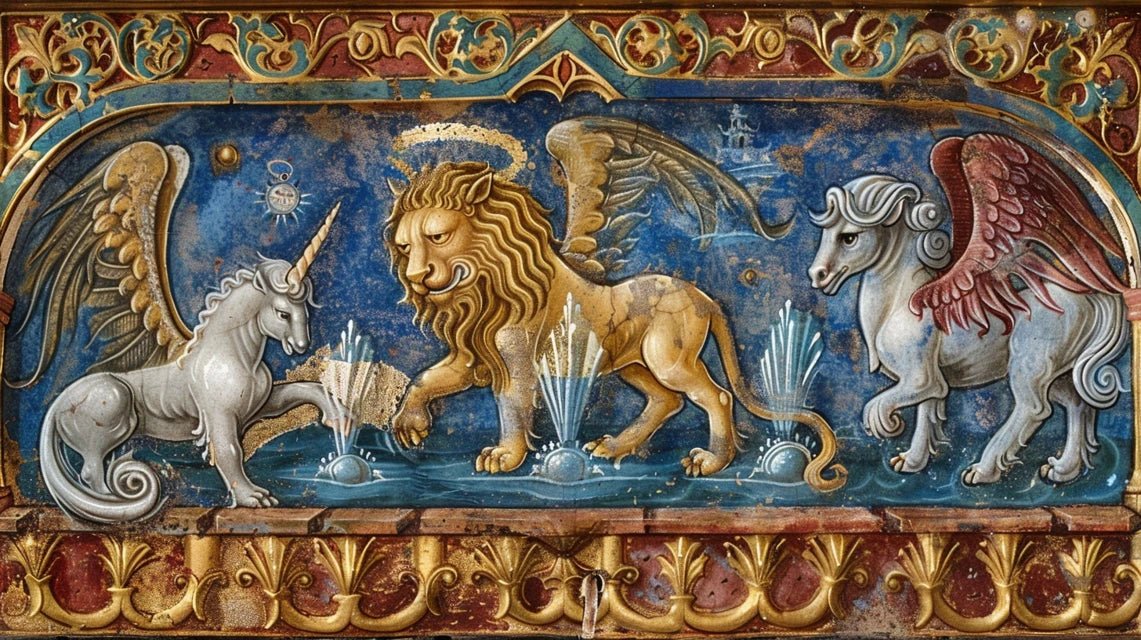
In the Middle Ages, painting an animal never simply means "making it look like." Each creature carries a divine message in this millennial iconographic tradition. In medieval bestiaries, these wonderful books inherited from the ancient world, the lion becomes Christ risen, the unicorn embodies divine purity.
Take the example of the pelican in Medieval religious art. These medieval representations are greatly influenced by Christianity: they are decorative but above all symbolic. The bird pierces its flank to feed its young with its blood - a perfect metaphor for Christ's sacrifice. This approach transforms each illumination into a visual catechism.
Illuminators develop a true color code in this sacred animal painting. Gold signals the presence of the divine, red evokes sacrifice, blue expresses celestial purity. In the margins of manuscripts, dragons and griffins stand guard, protecting the sacred word from evil forces.
This era invents extraordinary creatures: mermaids with fish tails, centaurs half-man half-horse, basilisks with a deadly gaze. To discover animal paintings inspired by this rich tradition, contemporary art still draws on these millennial references.
The Revolution of the Gaze: Towards Renaissance Naturalism
Everything gradually shifts between the 14th and 16th centuries in this major artistic evolution. During the Middle Ages, animal representation will evolve from a codified imagery derived from multiple influences to a naturalist representation. Artists begin to truly observe animals, not just symbolize them.
Dürer revolutionizes animal art with his "Hare" of 1502. Each hair seems to palpitate with life. This technical feat marks a break: the animal becomes a subject of scientific study as much as artistic. Princes create menageries where painters come to sketch from nature.
The major transformations of this period:
- Observation replaces symbolic interpretation
- Techniques are refined: oil on canvas, perfected perspective
- Animal art becomes a recognized specialty
- Anatomical discoveries revolutionize precision
This technical revolution is accompanied by a profound change in mentality. The animal escapes the symbolic straitjacket to become a creature worthy of interest in itself. Rubens captures the primitive violence of hunts, Flemish masters immortalize game and poultry with striking realism.
Contemporary Art Reinvents the Animal
The 20th century explodes all established codes in this revolutionary artistic modernity. It is from the 17th century that the representation of animals becomes a particular genre of Western painting, but the avant-gardes completely revolutionize this tradition.
Picasso deconstructs the bull into geometric shapes. Franz Marc paints blue horses that exist nowhere else than in his creative imagination. The animal becomes a pretext to explore color, form, pure emotion in this contemporary animal art.
Contemporary art goes even further. Since the 1970s, the use of live animals, sometimes questionable, is part of the relentless desire to reduce the gap between art and life. Joseph Beuys cohabits with a wild coyote, questioning our civilization-nature relationships. Damien Hirst suspends sharks in formaldehyde, questioning death and preservation.
This new approach explores the unprecedented: Kader Attia transforms stuffed bats into a reflection on exile. Chinese artists like Cai Guo-Qiang use gunpowder to "paint" wolves. The animal becomes a universal metaphor.
From illumination to digital: a permanent technical revolution
Each era invents its own tools of animal representation. Copyist monks use parchment, gold and precious pigments. Their miniaturized creations obey strict constraints: reduced formats, codified colors, centered compositions.
The Renaissance liberates animal art. Oil painting allows for monumental formats. The camera obscura revolutionizes anatomical accuracy. Data speaks for itself: at the Paris Salon, animal artworks go from 3% in 1850 to 15% in 1900 (Source: French National Archives).
Today, the creative arsenal explodes: digital photography, high-definition video, virtual reality, bio-art. Some artists even manipulate animal DNA. This technical evolution reflects our societal mutations: from the medieval vision centered on God to our contemporary ecological questions, animal representation remains our civilizational mirror.
History continues. In our current galleries, animals question our time: mass extinction, global warming, animal ethics. A thousand years after the golden lions of manuscripts, contemporary creators constantly reinvent our gaze on living beings.
FAQ - Animal representation in Western art
1. What is the main difference between medieval and contemporary animal art? Medieval art uses the animal as a religious symbol (the lion = Christ), while contemporary art explores the animal as a social, ecological or existential metaphor. Techniques have also evolved: from illumination on parchment to multimedia installations.
2. Why did medieval bestiaries represent fantastic animals? Bestiaries mix observation and legends inherited from antiquity. Fantastic creatures (unicorn, dragon, griffin) served to teach spiritual truths. For the medieval people, these animals were as "real" as the exotic animals they did not know directly.
3. How does contemporary wildlife art address ecological issues?
Contemporary artists use animal representation to raise awareness about species extinction (Damien Hirst), question our relationship with nature (Joseph Beuys), or denounce habitat destruction. The animal becomes a symbol of our environmental responsibility.