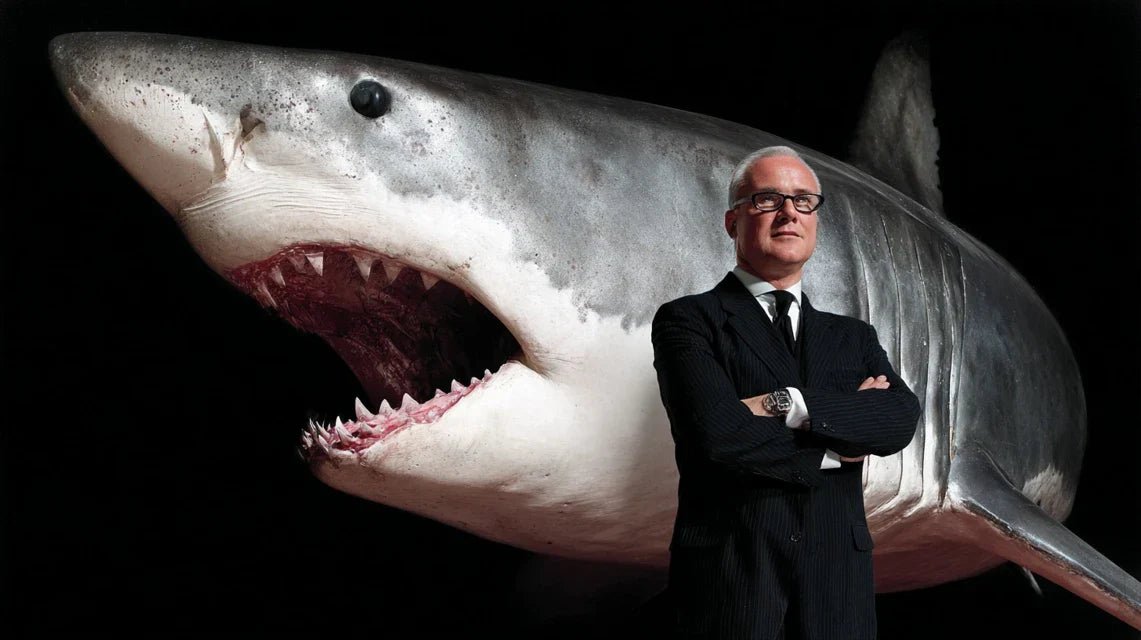
🎨 Imagine a 23-year-old man suspending a 4-meter tiger shark in a formaldehyde tank, provoking worldwide outrage. This striking image perfectly encapsulates the revolutionary audacity of Damien Hirst, the enfant terrible who transformed contemporary art into a global spectacle.
The neon glow of London galleries in the 1990s suddenly illuminates a generation of rebellious artists. Among them, a young man with blond hair and a provocative smile defies all artistic conventions. Damien Hirst doesn’t just paint: he embalms, dissects, and transforms death into million-dollar art.
But how does a student from Leeds become the richest artist in the UK? How do his scandalous works reach record prices of £111 million in a single sale? This biography reveals the secrets of a marketing genius who revolutionized the contemporary art market.
Discover the fascinating story of Damien Hirst, from his rebellious beginnings with the Young British Artists to his artistic empire - a masterful lesson on how to transform controversy into success.
Damien Hirst: the provocative businessman who revolutionized contemporary art
Understanding Damien Hirst requires looking beyond the controversies to grasp the scale of his artistic revolution. This man is not just a provocateur: he embodies the radical transformation of contemporary art, moving from the status of an aesthetic object to that of a cultural and commercial phenomenon.
| Biographical highlights | Artistic legacy |
|---|---|
| Full name: Damien Steven Hirst Date of birth: June 7, 1965 in Bristol, UK Nationality: British Education: Goldsmiths College, London |
Movement: Young British Artists (YBA) Style: Conceptual art, installations Flagship work: The Physical Impossibility of Death Innovation: Direct sales through auctions |
The numbers speak for themselves: with a fortune estimated at $384 million in 2024, Hirst demonstrates that a contemporary artist can become an economic empire. But this financial success should not overshadow his major aesthetic influence on an entire generation of artists.
Damien Hirst’s rebellious origins: from a working-class neighborhood in Leeds to artistic genius
Born Damien Steven Brennan in a working-class neighborhood of Bristol, the future master of contemporary art grew up in Leeds with his Irish mother Mary Brennan. This courageous woman, employed at the Citizens Advice Bureau, raises her son alone after his father leaves when Damien is 12 years old.
The foundational episode of anatomy: At 16 years old, Damien Hirst discovered his true passion in the cold hallways of the Leeds Medical School. Fascinated by death and anatomy, he regularly drew bodies there, creating his work "With Dead Head" in 1991. This early confrontation with mortality shapes his unique artistic universe.
The creative spark of Francis Davison: In 1983, an exhibition of abstract collages by Francis Davison at the Hayward Gallery overwhelms the young Hirst. These works of torn and colored paper "astonish" him and influence his creations during two crucial years.
Damien Hirst and 1980s England: Art in the Thatcher Era
The emergence of Damien Hirst coincides with the era of Margaret Thatcher (1979-1990), a period of radical social transformation in the United Kingdom. This time of aggressive economic liberalism and forced individualism profoundly influences the generation of Young British Artists.
The art scene of the 1980s stagnates, eclipsed by the New York scene dominated by Jeff Koons and Cindy Sherman. London's artistic institutions seem disconnected from global cultural transformations, creating fertile ground for an aesthetic revolution.
At the Goldsmiths College, Michael Craig-Martin revolutionizes art education by abolishing traditional separations between painting, sculpture and performance. This conceptual approach prepares a generation of artists to radically rethink the boundaries of contemporary art, with Sarah Lucas, Michael Landy and of course Hirst.
The Thatcherite philosophy of "self-help" and personal initiative deeply permeates these young creators. They develop a revolutionary entrepreneurial spirit, organizing their own exhibitions rather than waiting for institutional recognition.
The "Cool Britannia" spirit in gestation: Hirst and his contemporaries anticipate the British cultural pride of the 1990s. Their audacity prepares for the creative explosion that will touch fashion, music and visual arts, placing London at the center of the international art world.
This unique historical context explains the simultaneous emergence of personalities as significant as Tracey Emin, the Chapman brothers and Rachel Whiteread. They will all share with Hirst the same determination to shock the British art establishment.
Damien Hirst's early struggles: from penniless student to organizational genius
Arriving in London in 1984, young Hirst barely survives by working in the construction sector. These hard jobs finance his art studies while instilling a strong work ethic that will later characterize his management of an artistic empire.
His first artistic attempts go unnoticed in the conventional London art scene. Established galleries ignore his experiments with non-artistic materials. This frustration fuels his determination to create his own exhibition opportunities.
The meeting with Michael Craig-Martin at Goldsmiths College transforms his trajectory. This visionary professor encourages the personal initiative of his students and introduces Hirst to influential figures such as Nicholas Serota, future director of the Tate Modern.
Despite his financial difficulties, Hirst develops a keen sense of self-promotion. He intuitively understands that in contemporary art, media visibility is as important as aesthetic quality, a lesson that will guide his entire future career.
These years of hardship forge his character as an artistic entrepreneur. The experience of precariousness teaches him the importance of controlling his career rather than depending on traditional institutions, a philosophy he will masterfully apply later.
Damien Hirst and the "Freeze" scandal: when art becomes revolution
In 1988, at only 23 years old, Hirst organizes the legendary exhibition "Freeze" in a disused warehouse in the London Docklands. This bold initiative challenges the traditional British gallery system and launches the movement of the Young British Artists.
The exhibition brings together 16 Goldsmiths students in an industrial space transformed into a pristine gallery. Hirst already imposes his vision: contemporary art must leave stuffy salons to conquer public and media spaces.
The success of "Freeze" provokes incomprehension from the British art establishment. Traditional critics struggle to categorize these works that mix popular references, industrial materials and complex philosophical concepts.
The phrase that defines his philosophy: "Art is about life and there really isn't anything else. There isn't anything else." This statement by Hirst summarizes his revolutionary vision: art should no longer be separated from daily existence but become its brutal and fascinating mirror.
This period marks his definitive break with traditional British art. Hirst no longer seeks approval from institutions: he creates his own system of artistic and commercial validation, anticipating the transformations of the contemporary art market.
Damien Hirst's Conceptual Art: Between Death, Science, and Media Spectacle
1991 marks Hirst's creative explosion with the creation of his most iconic work. This period reveals a mature artist who transforms personal obsessions into universal visual languages, redefining the codes of contemporary art.
Financed by collector Charles Saatchi, Hirst designs his revolutionary masterpiece that will shake up the world of art. This strategic collaboration between artist and modern patron inaugurates a new era in relations between creation and market.
The Physical Impossibility of Death in the Mind of Someone Living: The work that revolutionized art
This 4-meter tiger shark suspended in a formaldehyde display transcends simple artistic exercise. The work forces the viewer to confront their own mortality in a striking face-to-face with sublimated death. The shark, neither alive nor truly dead, perfectly embodies the existential ambiguity that Hirst explores.
Sold for 8 million dollars in 2004, this installation proves that conceptual art can reach the prices of classic masterpieces. Hirst demonstrates that contemporary artistic value no longer depends on pictorial technique but on conceptual power and media impact.
Hirst's revolutionary techniques: between science and aesthetics
Hirst develops a unique artistic vocabulary combining formaldehyde, medical displays and stuffed animals. These industrial and scientific materials transform his installations into aesthetic laboratories where art and science dialogue in an unprecedented way.
Damien Hirst facing his contemporaries: art as business
Unlike Tracey Emin focused on autobiography or the Chapman brothers exploring violence, Hirst systematizes his artistic production. He develops reproducible series (Spot Paintings, Medicine Cabinets) that function as "art products" marketable on a large scale.
This entrepreneurial approach shocks his peers but revolutionizes the art market. Hirst proves that a contemporary artist can fully control their production, distribution and communication, anticipating modern creative economy.
OUR RECOMMENDED PRODUCTS
This artistic revolution by Hirst permanently influences global contemporary art. His demonstration that art can be simultaneously conceptual, commercial and media inspires a whole generation of entrepreneurial artists.
The complex personality of Damien Hirst: between creative genius and ruthless businessman
Behind the public image of the provocateur lies a fascinating personality blending artistic vulnerability and keen business acumen. Hirst reconciles authentic creative passion and commercial calculation with an ability that confuses his detractors as much as his admirers.
Father of three children with Maia Norman, then companion of Katie Keight, Hirst leads a stable family life contrasting with his scandalous image. This personal stability allows him to take considerable creative risks while maintaining a regular and ambitious artistic production.
Hs personal art collection reveals his profound influences: Francis Bacon, Andy Warhol and Jeff Koons coexist with old masters in his Devon home. This eclecticism testifies to a vast artistic culture that constantly nourishes his creative inspiration.
Hirst carefully cultivates his image as an "art bad boy" while methodically managing a creative empire employing dozens of collaborators. This dichotomy between public persona and entrepreneurial reality is one of the keys to his lasting success.
The commercial apotheosis of Damien Hirst: when art becomes a financial empire
The official recognition arrives with the Turner Prize in 1995, crowning Hirst as a major figure in British contemporary art. This institutional distinction definitively validates his revolutionary approach and encourages a generation of conceptual artists.
The exhibition "Sensation" at the Royal Academy in 1997 propels the Young British Artists onto the international stage. The 300,000 visitors confirm the public's appetite for accessible and spectacular contemporary art, validating Hirst's strategy.
The record prices of Damien Hirst: revolution of the art market
In September 2008, Hirst revolutionizes the art market with his sale "Beautiful Inside My Head Forever" at Sotheby's. This operation completely bypasses the traditional gallery system, the artist selling his works directly at auction.
| Period | Average Value | Record Sale |
|---|---|---|
| 1990-2000 | £50,000 - £500,000 | $8 million (Shark, 2004) |
| 2001-2010 | £500,000 - £2 million | £10.3 million (Golden Calf, 2008) |
| 2011-2024 | £1-£5 million | £15 million (The Currency, 2023) |
The sale of 2008 generates £111 million, an absolute record for a living artist. This financial performance demonstrates that conceptual contemporary art can rival old masters on the international market, definitively transforming the economic perception of current art.
Damien Hirst today: The conceptual artist turned living legend
At 59 years old, Hirst continues to surprise with ambitious projects such as "Treasures from the Wreck of the Unbelievable" in Venice in 2017. This monumental exhibition in the Palazzo Grassi and the Punta della Dogana confirms his ability to constantly reinvent his artistic language.
His recent series "Cherry Blossoms" (2019-2020) reveals a more serene Hirst, exploring pure painting with an unexpected sensitivity. These impressionistic canvases may mark the evolution of a mature artist towards a more contemplative form of art, without losing his conceptual signature.
Damien Hirst's influence on contemporary art: disciples and heirs
Takashi Murakami openly acknowledges Hirst’s influence on his entrepreneurial approach to art. The Japanese applies the industrial production methods and marketing developed by Hirst, demonstrating the international scope of his artistic legacy.
Ai Weiwei and Jeff Koons also adopt this philosophy of the workshop-factory, employing numerous teams to realize monumental works. Hirst’s influence goes beyond aesthetics to transform contemporary artistic production methods.
Recognizing Hirst's legacy in current art: Observe the spectacular installations, the use of non-artistic materials, and above all the sophisticated media strategy of emerging artists. These elements often reveal a direct or indirect influence from the revolution initiated by Hirst.
Where to discover Damien Hirst: museums, galleries and global collections
The Tate Modern in London holds several masterpieces, while the MoMA and the Guggenheim in New York regularly exhibit his installations. In France, the Centre Pompidou and the Fondation Cartier periodically present his works in their contemporary collections.
His own museum, the Newport Street Gallery in London, offers a complete overview of his artistic evolution. This private institution testifies to Hirst’s maturity, now capable of fully controlling his historical and critical representation.
🎁 Special offer for readers
Because you took the time to inform yourself, enjoy 10% discount on your first order :
⏰ Valid 72h after reading • Applicable to all our products
Frequently asked questions about Damien Hirst: everything you need to know about the controversial artist
Born Damien Steven Brennan on June 7, 1965 in Bristol, he grew up in Leeds with his Irish mother Mary Brennan after his father left when he was 12. A poor student, he didn't find his way until discovering art and medical anatomy as a teenager, developing an early fascination with death that would characterize all of his work.
Trained at Goldsmiths College (1986-1989), Hirst is deeply influenced by Michael Craig-Martin who abolishes traditional separations between artistic disciplines. The exhibition of Francis Davison in 1983 and his regular visits to the Leeds School of Medicine shape his unique conceptual approach blending art, science and philosophy.
Hirst revolutionizes contemporary art by using formaldehyde and medical display cases to preserve dead animals, creating powerful conceptual installations. His method transforms death into an aesthetic spectacle, forcing a direct confrontation with human mortality. He also develops reproducible series (Spot Paintings) which industrialize artistic production.
Recognition begins with the exhibition "Freeze" in 1988, followed by the decisive support of Charles Saatchi in 1991. The Turner Prize in 1995 officially confirms his talent, while the exhibition "Sensation" in 1997 propels him onto the world stage. His direct auction sales strategy in 2008 definitively confirms his status as a revolutionary artist-entrepreneur.