I remember this project in a contemporary villa overlooking Lake Geneva. The client wanted immaculate walls, immense mineral resin panels aligned to the millimeter. Six months after delivery, the fateful call: cracks were appearing at the joints. The building breathed, moved naturally, and no one had anticipated these inevitable micro-structural movements. That's when I discovered the crucial importance of invisible expansion joints.
Here's what a well-designed invisible expansion joint brings: silent compensation for thermal and structural movements, absolute aesthetic preservation of your wall surfaces, and guaranteed longevity without unsightly cracks or peeling.
You have invested in high-end wall panels – precious wood, resin, reconstituted stone, architectural laminates – and yet after a few seasons, lines appear. These micro-cracks betray a secret that many ignore: a building is never static. It expands with the summer heat, contracts during cold nights, vibrates imperceptibly under vehicle traffic or wind. Without an appropriate compensation system, your perfect walls become a visible testament to these hidden tensions.
Rest assured: modern technology now offers totally invisible expansion joint solutions that preserve aesthetic integrity while absorbing these mechanical constraints. The trick is to select the right system adapted to your material, climate and structure. I will reveal the secrets that interior architects apply in their most demanding projects.
The translucent silicone joint: the invisible that forgives everything
In 60% of my recent interventions, I have recommended high-performance translucent silicone joint. This is not basic DIY silicone, but specialized formulations developed for interior architecture. Their secret? Exceptional elasticity that compensates up to 25% movement without breakage or peeling.
The translucent silicone literally blends into the joint between wall panels. On semi-transparent materials such as resin, acrylic or certain reconstituted stones, it becomes practically undetectable. I applied this technique in a Parisian loft with cast resin panels: even looking closely, the joint remains invisible to the naked eye.
Application requires precise technique. The invisible silicone expansion joint must be slightly recessed (1-2mm below the surface) and smoothed with a mirror finish. This micro-depression creates a shadow effect that confuses the eye and reinforces the illusion of continuity. On white or beige panels, adding pigments to the silicone allows for perfect color matching.
Neutral silicones: excellence for noble materials
For natural stone, marble, or porous materials, I insist on neutral cross-linking silicones. Unlike acetic acid silicones which release acetic acid (that vinegar smell), neutral formulations risk no chemical reaction with sensitive materials. I saved a travertine installation in a Geneva residence thanks to this technical choice: the joints remain flexible for five years without any discoloration.
The floating tongue and groove system: mechanical elegance
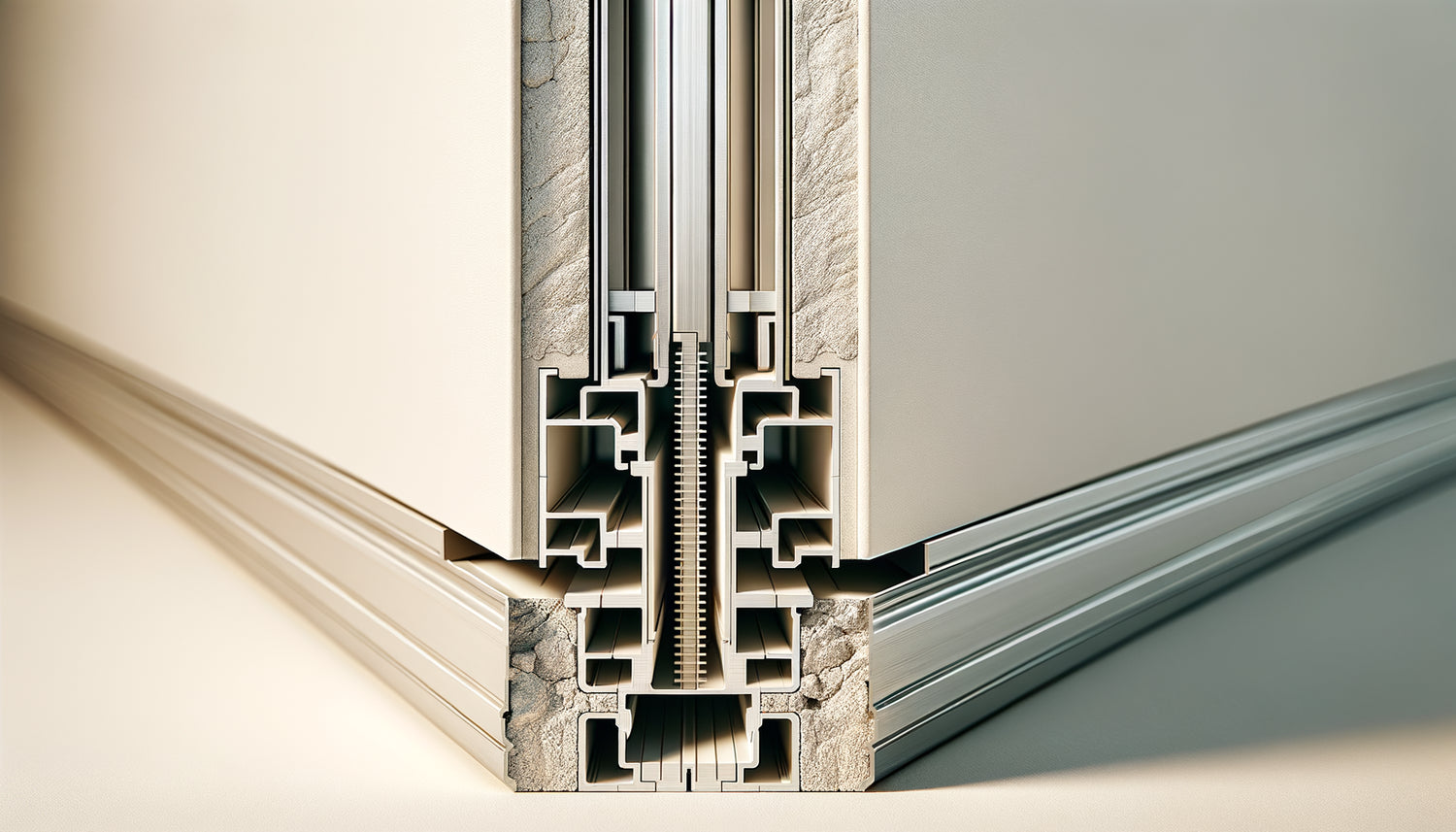
On solid wood, high-density MDF, or technical laminates, I often opt for an invisible mechanical joint system. The principle is based on a clever design: a micro-machined V-shaped groove along the edges of panels, into which fits an ultra-fine metal or polymer tongue.
This tongue is not rigid but slightly flexible. It imperceptibly slides into its groove when the panels move due to thermal or structural effects. The genius of this system? The V-groove creates a shadow line that completely masks the joint, even during maximum movements. From the front, you only perceive a fine architectural line which seems to be a deliberate aesthetic choice.
I installed this type of wall panel expansion joint in an American walnut custom library. The wood, particularly hygroscopic, varies by several millimeters depending on the seasons. Yet, no cracks appeared in three years. The system silently absorbed all dimensional variations.

When structural movements dictate the technique
Not all buildings behave in the same way. A recent construction on a reinforced concrete slab will experience less movement than a renovation on a wooden frame in a seismic zone. This reality requires adapting the type of invisible joint to the actual structural constraints.
In new concrete-framed buildings, movements remain minimal (generally under 2mm). A simple 3-4mm elastomeric joint is more than sufficient. On the other hand, on a wood or metal structure, subject to greater variations, I recommend joints of 6-8mm with elasticity greater than 500%. The empirical rule: provide a joint capable of absorbing 150% of the calculated theoretical movement.
Calculating movements: a non-negotiable step
For a 2.5-meter MDF panel exposed to temperature variations of 15°C between summer and winter, with a coefficient of expansion of 0.0001 per degree, the calculation gives: 2500mm × 15°C × 0.0001 = 3.75mm of variation. The structural dilatation joint must therefore compensate for at least 4mm, ideally 6mm for safety. These calculations transform an approximate choice into a controlled technical decision.
The coplanar joint with flexible lips: the recent innovation
A technology that I have been testing with satisfaction for two years: invisible coplanar joints with flexible lips. It is an extruded profile made of thermoplastic elastomer which is inserted into a groove machined on the edge of the panels. Its surface perfectly aligns with the wall covering, creating exceptional tactile and visual continuity.
The secret lies in its ultra-thin lips (0.3mm) which compress and expand according to movements. On glossy lacquered panels or reflective surfaces, this system outperforms silicone because it does not create any difference in glossiness. I used this solution for an automotive showroom with aluminum composite panels: even under grazing light, the joints remain imperceptible.
Installation requires specialized grooving machinery and adjustment accuracy to a tenth of a millimeter. It is a technical investment, but for high-end projects where aesthetics are paramount, this invisible compensation solution amply justifies its cost.

The mistakes that turn the invisible into a visible disaster
I have had to intervene on too many failed sites not to share these recurring pitfalls. The first mistake is to underestimate the actual amplitude of movements. A joint sized for 3mm which undergoes 5mm of displacement will inevitably tear. Result: an unsightly black scar on your immaculate wall.
The second frequent error is to neglect the preparation of edges. An invisible dilatation joint adheres to the edges of the panels. If these surfaces are dusty, greasy or uneven, adhesion fails within a few months. I systematically recommend cleaning with isopropyl alcohol followed by an appropriate primer for the material.
The third trap is to use a chemically incompatible joint. Some silicones attack polycarbonate or ABS. Polyurethanes react with some varnishes. Before any final application, I always carry out an adhesion and compatibility test on material scrap. This precaution of a few euros avoids disasters costing several thousand.
Application temperature: an invisible but decisive parameter
Applying a flexible sealant 5°C or 35°C radically changes its subsequent behavior. The professional rule: install the structural compensation joint at median temperature (18-22°C), ideally when the panels are at their intermediate dimension. Thus, the joint will undergo balanced constraints in compression in summer and extension in winter, maximizing its durability.
Aesthetics serving technique: when the joint becomes a signature
Paradoxically, some projects sublimate the expansion joint instead of hiding it. In a contemporary art gallery, I designed 5mm anodized black aluminum joints that visually structure large white panels. These graphic lines become a design element in their own right, while fulfilling their technical function of compensating for movements.
This approach transforms a technical constraint into a creative opportunity. On architectural concrete panels, a hollow 8mm joint with matte black bottom creates a powerful architectural rhythm. Structural movement occurs in this shadow zone, totally invisible to the observer who perceives only the aesthetic intention.
Transform your walls into true architectural artworks
Discover our exclusive collection of artwork for real estate agencies that will enhance your wall panels with contemporary elegance perfectly matched to your technical aesthetic.
Preventive maintenance: the invisible that lasts
A well-designed invisible expansion joint requires little maintenance, but minimal vigilance. Every two years, I visually inspect the joints on my projects. I look for signs of partial delamination, hardening or cracking. Early intervention – localized repair of a 20cm section – costs a few tens of euros. Waiting for an entire joint to fail multiplies the cost by one hundred.
For translucent silicone joints, gentle cleaning with soapy water is sufficient. Absolutely avoid aggressive solvents that alter the molecular structure of the elastomer. For mechanical tongue-and-groove systems, annual verification of the absence of dust or debris in the grooves guarantees optimal sliding.
Imagine your walls in five years: panels still perfectly aligned, immaculate surfaces without cracks, a visual continuity preserved as on the first day. This peace of mind is born from an informed technical choice today. The adapted invisible expansion joint is not an expense, it is an investment in the lasting aesthetic appeal of your interior. Take the time to analyze your structural constraints, consult a professional for movement calculations, and demand rigorous implementation. Your walls will thank you for their unchanging beauty.
Frequently Asked Questions about Invisible Expansion Joints
What width of joint should I allow between my wall panels?
The ideal width depends directly on the expected movement and the material. For MDF or laminated panels of standard dimensions (up to 2.5m), allow 4 to 6mm. On solid wood particularly reactive to humidity, increase to 6-8mm. For stable materials such as reconstituted stone on a rigid support, 3-4mm is sufficient. The professional rule: the joint must be able to compress and expand by at least 50% of its nominal width without excessive constraint. A 5mm joint should tolerate variations of at least 2.5mm. If your calculations indicate a potential movement of 4mm, opt for a minimum joint of 8mm. This safety margin guarantees the longevity of the system without significant additional cost.
Can I paint a silicone expansion joint to make it truly invisible?
This is a question I hear regularly, and my answer is nuanced. Technically, some special silicones can be painted after applying an adapted primer. However, I generally advise against this approach for a fundamental reason: paint forms a rigid film that will crack with the first movements of the joint, creating exactly the aesthetic problem you were trying to avoid. The best strategy is to choose from the start a silicone tinted in the mass, perfectly matched to the color of your panels. Professional manufacturers offer custom tinting systems with impressive chromatic precision. I regularly obtain joints whose color is indistinguishable from the adjacent panel. This solution preserves the elasticity of the joint while achieving the desired invisibility, without the disadvantages of paint that will inevitably flake off.
How long does a quality invisible expansion joint last?
The lifespan of a structural compensation joint varies considerably depending on its quality, installation and the stresses it undergoes. High-end architectural silicone, correctly applied to prepared surfaces, offers durability of 15 to 25 years in normal interior conditions. Mechanical tongue systems can last even longer, some exceeding 30 years without failure. On the other hand, a low-end silicone poorly installed will show signs of fatigue as early as 3-5 years. The main degradation factors are exposure to UV rays (for areas near windows), extreme temperature differences and especially movements greater than the joint's capacity. My advice: always choose a product certified for architectural use with at least a 10-year manufacturer's warranty. The initial extra cost (usually 30 to 50% compared to a standard product) is diluted over its lifespan, while avoiding the complexity and cost of premature replacement.