The first time I stepped into a restored Nubian temple in Abu Simbel, I was literally struck by the power of the creatures adorning the walls. These mythological animals, frozen in stone for over three millennia, seemed to still vibrate with a mystical energy. They were not mere decorations: they told the story of a people who saw in each fantastic creature a bridge between the earthly world and the divine.
Here's what the mythological animals of ancient Nubian temples reveal: a unique cosmogony that blends Egyptian influences and local traditions, a symbolic bestiary of incredible richness that protected the living and accompanied the dead, and an inexhaustible source of inspiration to create interiors full of mystery and spirituality.
You have probably admired contemporary African motifs without ever really understanding their deep roots. Perhaps you've sought to create an authentic atmosphere in your interior, but references were lacking. Nubian frescoes remain little known, eclipsed by the hegemony of classical Egyptian iconography.
Yet, these mythological animal representations constitute a treasure trove of inspiration for those who know how to decipher them. By exploring this sacred bestiary, you will discover how our ancestors transformed imagination into living wall art, and how these aesthetic codes can nourish your creativity today.
The Nubian Sphinx: Guardian with African Features
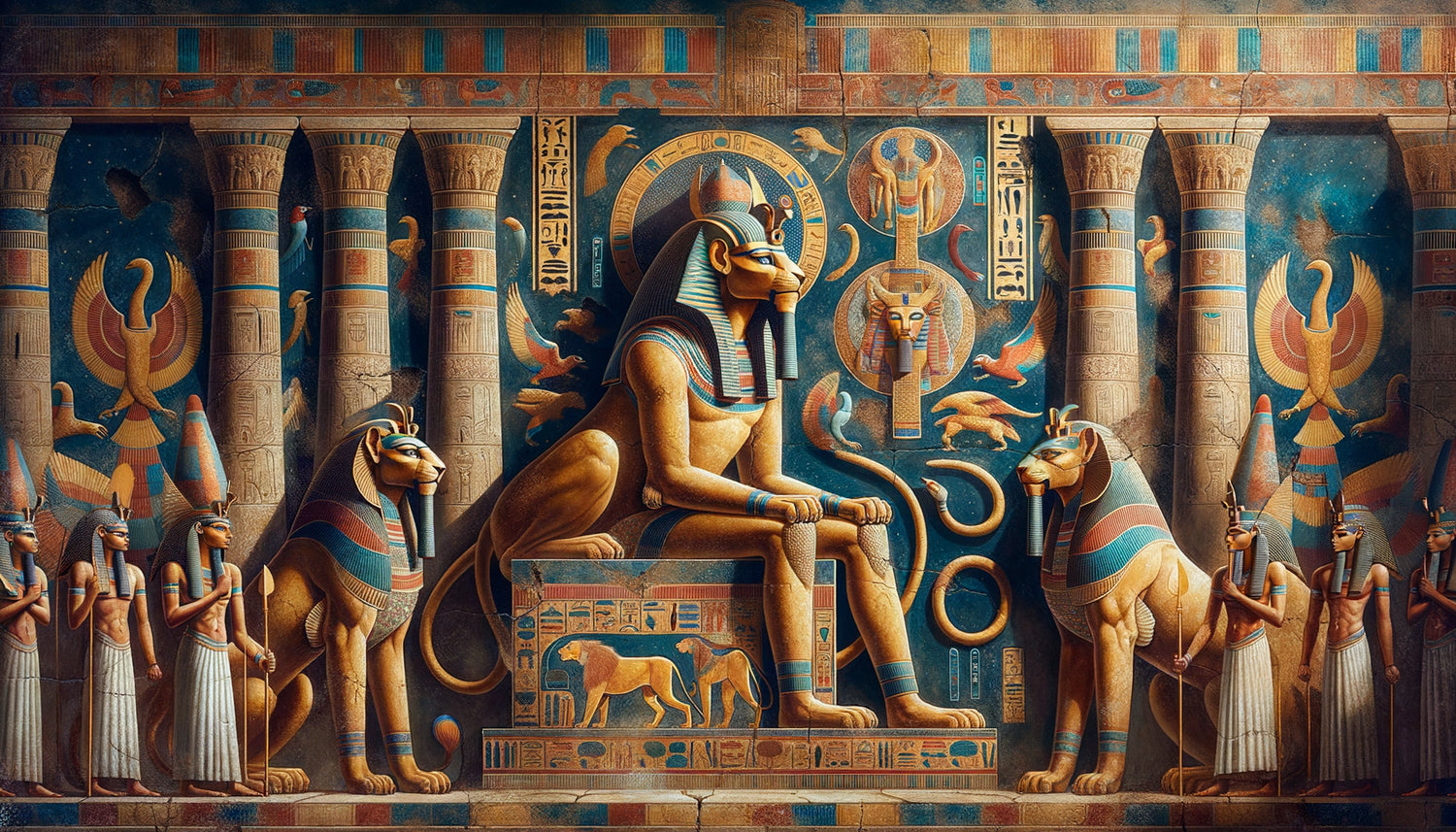
In the temples of Meroe and Naqa, the Nubian sphinx is strikingly different from its Egyptian cousin. Unlike the Sphinx of Giza with its hieratic face, the sphinx in Nubian frescoes has pronounced African features: high cheekbones, a wide nose, full lips. This hybrid creature, with the body of a lion and a human head, embodied the fusion between animal power and royal wisdom.
What particularly fascinates me is the way Nubian artists reinterpreted this pan-African symbol. The Nubian sphinx often sports an elaborate hairstyle typical of Kushite rulers, adorned with ostrich feathers or solar disks. In the walls of the Apedemak temple in Naqa, I photographed winged sphinxes that seem ready to take flight, their wings spread in a movement of astonishing grace.
These mythological guardians protected the entrances to sanctuaries and lined the processional avenues. Their presence in the frescoes served to delineate sacred space, creating a visual transition between the profane world and the realm of the gods. For contemporary decoration, this symbolism of protection and passage remains surprisingly relevant.
Apedemak: The Three-Headed Lion God
Here is a creature purely Nubian, with no equivalent in the Egyptian pantheon: Apedemak, the lion warrior god. In the temple dedicated to him in Naqa, frescoes depict him with a muscular human body and a leonine head, sometimes multiplied into three faces symbolizing his ability to see in all directions.
This mythological deity embodies military strength and fertility, a unique combination that reflects the Nubian vision of power. On interior walls, Apedemak often appears accompanied by serpents winding around his arms, adding a chthonic dimension to this fierce protector. Nubian artists painted him with ochre, red, and black pigments, creating a striking contrast with the light limestone background.
What makes these representations so powerful for decorative inspiration is their dynamism. Unlike Egyptian gods frozen in rigid poses, Apedemak literally leaps from the walls, muscles tense, mane flowing in an imaginary wind. This vital energy transcends centuries and continues to appeal to our modern sensibility.

Cosmic serpents: Mehen and the solar protectors
In Nubian cosmology, the serpent Mehen occupied a central place in funerary frescoes. This mythological reptile coiled in protective spirals around Ra's solar boat, defending the god against the forces of chaos during his nightly journey into the afterlife.
The frescoes in the royal tombs of Nuri show these cosmic serpents in all their symbolic splendor. Their scales were meticulously painted with alternating geometric patterns of malachite green and lapis lazuli blue, creating a hypnotic effect. These representations were not merely decorative: they functioned as visual talismans, intended to protect the deceased on his journey to eternity.
In other temples, one finds serpents with ram or falcon heads, bold hybridizations that testify to the creativity of Nubian theologians. These composite creatures often appear in the lower registers of the frescoes, as if to anchor the sacred in the depths of the earth. Their sinuous aesthetics inspire surprisingly modern decorative motifs today.
The hippopotamus Thouéris: protector of motherhood
Less known than her Egyptian counterparts, the hippopotamus goddess Thouéris in Nubian frescoes presents fascinating particularities. In temples dedicated to Nubian queens, particularly in Meroë, she appears with her massive hippopotamus body, lion paws, crocodile back, and drooping breasts symbolizing fertility.
What distinguishes the Nubian version is its frequent association with lush floral motifs. Artists surrounded it with lotuses, papyrus, and vines laden with fruit, creating compositions where animal power harmoniously blends with plant abundance. These frescoes adorned spaces reserved for birth rituals and infant protection.
The aesthetics of these representations blend tenderness and ferocity in a unique way. Thouéris protects with the necessary violence against malevolent forces, while also embodying maternal sweetness. This visual duality offers profound insights into how the Nubians conceptualized divine protection in their wall art.

Composite creatures: when imagination is unleashed
Nubian temples hold mythological creatures found nowhere else in the Nile Valley. In the side chapels of the temple of Soleb, I documented fantastic beings combining a crocodile head, a leopard body, and vulture wings. These bold hybrids testify to remarkable creative freedom.
Particularly intriguing is a creature that I call the "threshold guardian": it possesses four animal heads (lion, ram, falcon, and serpent) arranged in the four cardinal directions, symbolizing total surveillance of the sacred space. Its anthropomorphic body, richly adorned, stands at the entrance to the naos, where only purified priests could enter.
These composite creatures were not the result of arbitrary fantasy. Each animal element added a specific quality: the strength of the lion, the generative power of the ram, the piercing vision of the falcon, the cyclical rebirth of the serpent. The frescoes functioned as theological rebus, where the addition of animal attributes created complex abstract concepts.
In procession scenes, these mythological creatures accompanied the main deities, forming a celestial court of extraordinary visual richness. The pigments used – ochres, terracotta, carbon blacks, calcite whites – have remarkably resisted time, allowing us to appreciate these compositions today in their original polychromy.
The divine falcon: Horus reinterpreted
Although the falcon-god Horus is of Egyptian origin, the Nubians adopted and transformed him in their frescoes. In the temples of Kawa and Djebel Barkal, Horus appears with distinctive attributes: elaborate crowns blending ostrich feathers and ram horns, massive chokers of colored pearls, sometimes even a leopard skin draped over his shoulders.
The scenes depicting Horus protecting the Nubian pharaoh are particularly striking. The falcon spreads its immense wings above the sovereign in a gesture of cosmic protection, creating an arched composition that visually structures the entire panel. This iconography of the protective bird still resonates within our collective imagination today.
What makes these frescoes exceptional is the treatment of the plumage. Nubian artists detailed each feather with almost scientific precision, alternating smooth and textured areas, creating a volume and movement effect. These pictorial techniques, combined with a deep understanding of avian anatomy, produced mythological representations of astonishing realism.
Let the power of these millennial symbols transform your space
Discover our exclusive collection of African artworks that captures the mystical essence of Nubian mythological animals to create an atmosphere rich in history and spirituality in your interior.
Integrate this heritage into your world
After spending years studying these extraordinary frescoes, I am convinced that their evocative power transcends eras. The mythological animals of the Nubian temples still speak to us because they embody universal archetypes: protection, transformation, connection between visible and invisible.
To transpose this aesthetics into a contemporary interior, favor stylized representations rather than literal copies. A sphinx with African features can become a sophisticated cushion motif. The spirals of the serpent Mehen inspire hypnotic wall compositions. The powerful profile of Apedemak translates beautifully into a graphic silhouette.
The essential thing is to understand the symbolic grammar that underlies these representations. Each mythological creature in the Nubian frescoes carried a specific intention, created a particular atmosphere. By appropriating these codes with respect and creativity, you invite into your space a cultural depth that enriches everyday life.
Imagine yourself surrounded by these millennial symbols, redrawn for our time. Every glance at these motifs becomes a silent meditation, a reminder of civilizations that knew how to transform their beliefs into lasting beauty. It is this permanence of art in the face of time that makes these mythological animals so precious for our modern interiors.
Start modestly: choose a creature that resonates with you, study its symbolism, then find a way to integrate it that respects both its original essence and your personal aesthetics. The Nubian heritage awaits only your gaze to revive.